You walk into the bedroom and notice a wet spot on the comforter.
Or perhaps your cat urinates beside the litter box.
Maybe it suddenly starts using the bathtub.
Or you find urine on a wall near the front door.
For cat owners, few problems are more frustrating than discovering urine outside the litter box.
But your cat is almost certainly not doing this out of spite.
Current Feline Veterinary Medical Association guidance explains that house-soiling can develop when a cat’s physical, social, environmental or medical needs are not being met. It specifically advises against interpreting the behavior as anger or revenge.
More importantly, urinating outside the litter box can be an early sign of a medical problem.
Cornell lists inappropriate urination among the common signs of feline lower urinary tract disease. Other warning signs include painful or difficult urination, frequent attempts to urinate, blood in the urine and excessive licking around the genital area.
That is why the first question should not be:
“How do I stop my cat from peeing here?”
It should be:
“Why has my cat stopped using the litter box normally?”
Quick answer: Cats may pee outside the litter box because of urinary disease, pain, increased urine production, arthritis, stress, conflict with other cats, litter-box aversion, an undesirable box location or urine marking. Any cat that suddenly develops house-soiling should be evaluated by a veterinarian. Repeated straining with little or no urine—especially in a male cat—is an emergency.
First: Is Your Cat Peeing or Spraying?
Before solving the problem, determine what kind of behavior you are seeing.
There are two major possibilities:
toileting outside the litter box
and
urine marking, commonly called spraying.
They can look similar to owners but often have different causes.
Normal urination outside the box
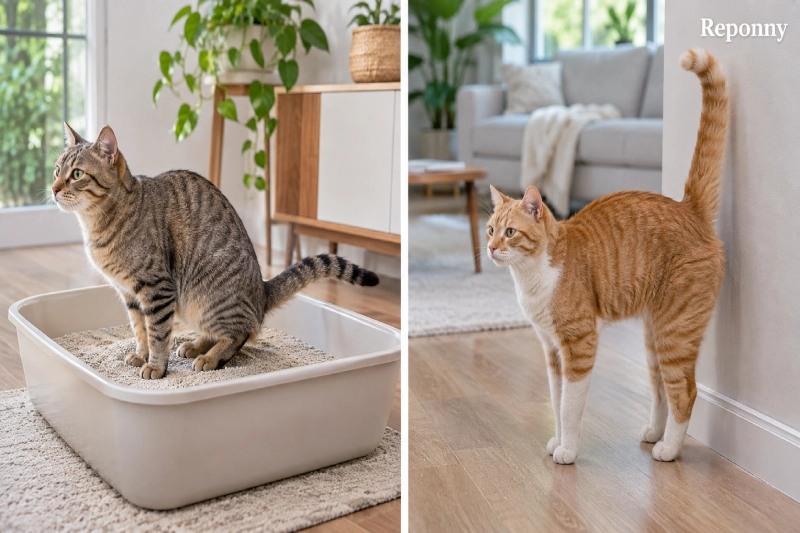
A cat usually:
- squats,
- releases a relatively normal amount of urine,
- and urinates on a horizontal surface.
Common locations include:
beds, carpets, clothing, rugs, floors and bathtubs.
This pattern is more consistent with the cat emptying its bladder somewhere other than the litter box.
Urine spraying
A spraying cat commonly:
- remains standing,
- backs toward a vertical surface,
- raises the tail,
- may quiver the tail,
- and releases a relatively small amount of urine backward.
Walls, doors, curtains and furniture sides are common targets.
VCA identifies this standing, tail-up posture with urine directed toward a vertical surface as the classic urine-marking pattern.
However, marking does not always follow the textbook pattern.
Some cats may mark horizontal surfaces too.
If you are unsure which behavior is occurring, recording a short video of the cat’s posture around the affected area can be useful for your veterinarian.
1. A Medical Problem May Be Causing the Accidents
This should always be considered first.
FelineVMA’s current house-soiling guidance recommends that every cat newly developing house-soiling receive a veterinary examination and urinalysis. Possible contributors include:
- cystitis,
- urinary infection,
- kidney disease,
- diabetes,
- arthritis,
- and other medical conditions.
Cornell similarly explains that urinary tract inflammation can cause:
pain, urgency and increased frequency of urination.
A cat may suddenly need to urinate before it reaches the box.
Or it may associate the litter box with discomfort and begin choosing a different location.
This can create a frustrating cycle:
pain in litter box → cat chooses another location → medical problem improves → cat keeps using the new location.
VCA notes that learned location preferences can continue even after the original medical cause has been treated.
That is why treating the medical problem and repairing the litter-box setup may both be necessary.
Feline Idiopathic Cystitis Can Cause House-Soiling
One important cause is feline idiopathic cystitis, commonly abbreviated FIC.
FelineVMA describes FIC as a frequent medical cause of house-soiling.
Affected cats may show:
- frequent urination,
- difficulty urinating,
- painful urination,
- and blood in the urine.
Cornell describes FIC as the most common diagnosis among cats presenting with lower urinary tract signs when another specific cause cannot be identified.
Stress appears to play an important role.
Changes in routine, household composition, feeding schedules and the cat’s environment may contribute to episodes in susceptible cats.
This is an important reminder that:
medical and behavioral factors are not always separate.
Stress can influence physical urinary disease.
A cat with FIC is not simply “misbehaving.”
Urinary Stones Can Also Cause Painful Urination
Urinary stones can irritate the bladder or urethra.
Cornell identifies struvite and calcium oxalate among the most common urinary stone types seen in cats.
A cat with stones may:
- urinate frequently,
- strain,
- produce blood in the urine,
- lick the genital region,
- or urinate outside the litter box.
Diagnosis may require:
urinalysis, imaging such as X-rays or ultrasound, and sometimes additional testing.
Do not assume that seeing urine outside the box tells you what the underlying urinary disease is.
Several conditions can create almost identical symptoms.
A Blocked Male Cat Is an Emergency
This is the most important safety point in the article.
Male cats have a relatively long, narrow urethra.
They are therefore at greater risk of urethral obstruction.
Cornell describes urinary obstruction as an absolute veterinary emergency. An obstructed cat may repeatedly attempt to urinate but produce very little or no urine. As the blockage continues, the cat becomes increasingly distressed and potentially life-threatening electrolyte and toxin abnormalities can develop.
Warning signs may include:
- repeated trips to the litter box,
- straining,
- crying,
- producing only drops of urine,
- no urine at all,
- excessive genital licking,
- restlessness,
- vomiting,
- weakness,
- or increasing distress.
Owners sometimes mistake urinary straining for constipation.
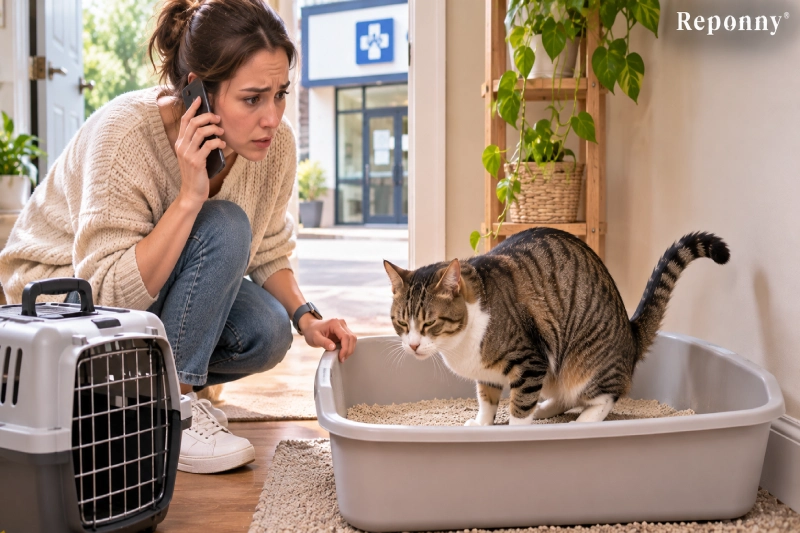
If a male cat repeatedly enters the litter box and strains without producing a normal amount of urine:
do not wait to see whether it improves.
Seek emergency veterinary care immediately.
2. Kidney Disease, Diabetes or Hyperthyroidism Can Increase Urination
Not every urinary accident begins with bladder pain.
Some diseases cause cats to produce larger amounts of urine.
Cornell identifies kidney disease, diabetes mellitus and thyroid disease among conditions that can contribute to litter-box problems because affected cats may drink and urinate more frequently.
Imagine a cat that previously urinated twice or three times during a normal day.
Now it produces much larger urine clumps and needs to urinate more often.
If the litter box is far away, difficult to access or dirty, accidents may become more likely.
So pay attention not only to where your cat urinates.
Also observe:
- urine-clump size,
- drinking,
- appetite,
- body weight,
- and frequency of litter-box visits.
A significant increase in thirst or urination deserves veterinary evaluation.
3. Arthritis or Mobility Problems Can Make the Box Difficult to Use
Sometimes the bladder is functioning normally.
The problem is getting into the litter box.
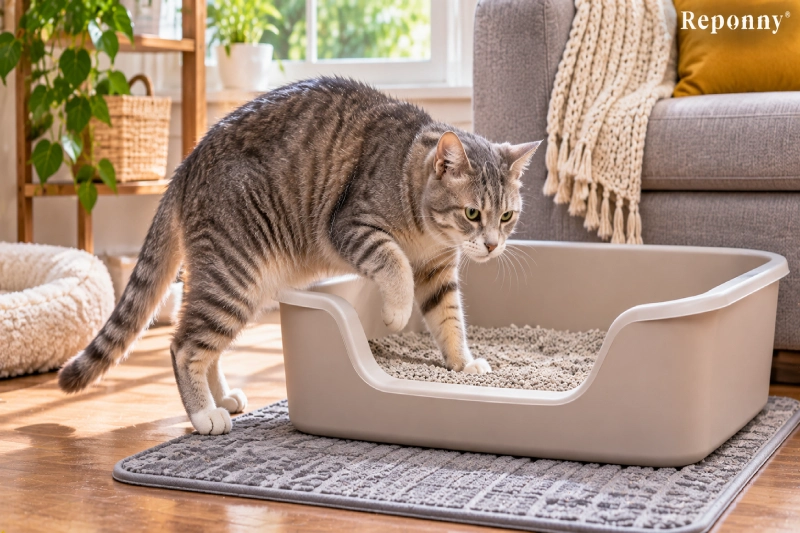
VCA explains that cats with arthritis, declining sensory function or age-related cognitive changes may need larger boxes with lower sides and easier access.
FelineVMA makes the same recommendation for older cats, advising low-entry boxes and placing litter boxes on the level of the house where the cat spends most of its time.
Imagine an older cat whose only litter box is:
upstairs, inside a high-sided plastic container.
That cat may need to climb stairs and then step over a tall wall every time it urinates.
If arthritis makes those movements painful, the bath mat downstairs may become easier.
Signs mobility may be contributing
Watch for:
- hesitation before jumping,
- difficulty climbing stairs,
- stiffness after resting,
- reduced activity,
- avoiding high furniture,
- or standing beside the box without entering.
Make the box easier to reach before blaming the cat.
4. The Litter Box May Be Too Small
Humans often choose litter boxes based on:
price, appearance and how easily they fit in the bathroom.
Cats evaluate them differently.
Current FelineVMA guidance states that bigger is generally better and recommends a box approximately 1.5 times the length of the cat from the nose to the base of the tail. It also notes that many commercial litter boxes are too small.
A large cat inside a small covered box may struggle to:
turn around, dig, position comfortably or avoid stepping on previous waste.
Large plastic storage containers or appropriately modified utility trays can sometimes work better than conventional litter boxes.
If your cat’s body nearly fills the box:
the box is probably too small.
5. Your Cat May Dislike the Litter
Litter preference matters.
Current FelineVMA guidance states that many cats dislike:
- strongly scented litter,
- dusty litter,
- litter deodorizer,
- and plastic liners.
It notes that most cats tend to prefer a soft, unscented clumping litter.
Cornell also reports a general preference for fine-textured, unscented litter.
But individual preferences vary.
If your cat consistently urinates on:
carpet, towels or bedding,
it may prefer softer substrates.
If the problem began immediately after changing litter brands:
that is an important clue.
Change litter gradually
Do not suddenly replace the entire litter setup if your cat is currently using it successfully.
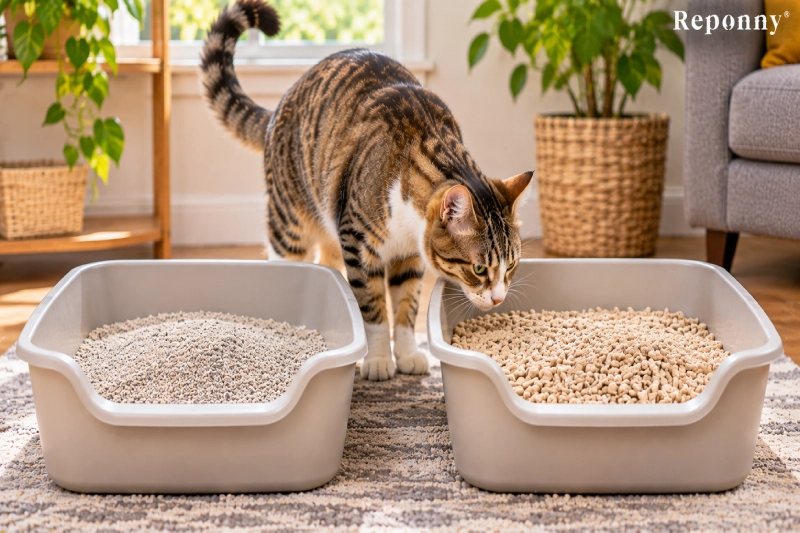
When introducing a new litter, provide a separate test box when possible.
Let the cat show you which option it prefers.
6. The Litter Box May Be Too Dirty
Cats are generally clean animals.
A box that seems acceptable to you may already smell unpleasant to your cat.
FelineVMA recommends removing waste at least once daily and washing the litter box every one to four weeks, depending on the system and use, with soap and hot water. Strong chemicals and ammonia-based cleaners should be avoided.
Cornell similarly recommends frequent scooping and keeping litter dry and clean.
In multi-cat homes, cleanliness becomes even more important.
Several cats can fill a box very quickly.
A cat that dislikes stepping near another cat’s waste may simply look elsewhere.
Do not cover odor with perfume
Strong fragrances are designed for humans.
They do not necessarily improve the litter-box experience for cats.
A better solution is:
remove the waste.
7. The Location May Feel Unsafe
A litter box can be perfectly clean and still be unacceptable because of where it is placed.
FelineVMA recommends locations that are:
- quiet,
- private,
- easy to access,
- and difficult for another cat to block.
Avoid placing the only litter box:
beside a washing machine, beside a loud furnace, behind a door, in a crowded hallway or in a tiny room with only one escape route.
Imagine using a bathroom where someone could trap you every time you entered.
That is how a nervous cat may experience a litter box positioned in a dead-end closet while another cat waits outside.
Current FelineVMA guidance specifically warns that social blocking around litter boxes can cause a less confident cat to eliminate elsewhere.
8. You May Not Have Enough Litter Boxes
A widely used guideline is:
number of cats + one extra litter box.
So:
one cat → ideally two boxes.
two cats → ideally three boxes.
three cats → ideally four boxes.
FelineVMA recommends one box per cat plus one additional box, placed in multiple locations.
The location detail is critical.
Three boxes lined up beside each other do not necessarily function as three independent resources.
FelineVMA specifically notes that cats may perceive boxes positioned very close together as one large toileting area.
Spread them throughout the home.
In a multi-level house, provide access on different floors—especially for older cats.
9. Conflict With Another Cat May Be the Real Problem
Multi-cat conflict can be subtle.
There may be no dramatic fight.
One cat may simply:
- stare,
- follow,
- block,
- chase,
- or wait outside the litter-box area.
The less confident cat learns:
the litter box is dangerous.
Cornell recommends considering whether another pet is frightening the cat while it enters or exits the box and suggests providing boxes with better visibility and multiple escape options when social conflict is involved.
FelineVMA similarly warns that a more confident cat near the litter box can cause another cat to seek a different place to eliminate.
Watch the household, not just the litter box.
If one cat constantly waits outside the bathroom where the only litter box is located, moving or adding boxes may be essential.
10. A Bad Experience Can Create Litter-Box Aversion
Cats learn associations quickly.
Imagine your cat develops painful cystitis.
It enters the box.
Urination hurts.
It repeats this experience several times.
Eventually:
box = pain.
Even after the bladder improves, the cat may continue avoiding that location.
FelineVMA also warns that negative experiences unrelated to illness can create aversion.
Examples include:
- being startled by a loud appliance,
- being trapped by another animal,
- receiving medication while inside the box,
- being disturbed by children,
- or repeatedly encountering a dirty box.
Never use the litter box as a place to trap your cat for something unpleasant.
The toileting area should feel safe.
11. Your Cat May Have Developed a Surface Preference
Sometimes the cat simply discovers a surface it likes better.
Cornell notes that cats may develop preferences for surfaces such as:
- carpet,
- clothing,
- bedding,
- tile,
- or other materials.
For example:
your cat has a painful urinary episode and urinates on a soft bath mat.
The bath mat feels comfortable.
The cat returns.
Eventually, the medical problem is gone but the location preference remains.
This is one reason house-soiling should be addressed early.
The longer a cat repeatedly uses a new location, the more established the habit may become.
12. Stress Can Trigger Urinary Problems and House-Soiling
Stress deserves special attention because it can influence both behavior and physical health.
Cornell identifies environmental stress as an important factor in feline idiopathic cystitis.
Possible triggers include:
- moving house,
- schedule changes,
- changes in feeding,
- and changes in the number of animals in the household.
FelineVMA’s 2026 positive-reinforcement guidance similarly identifies social and environmental distress among contributors to urine or fecal soiling and marking.
So if house-soiling begins shortly after:
a new cat arrives, construction starts, a baby comes home or the family moves,
do not assume the problem is “behavioral” in the sense that nothing physical is happening.
Stress and urinary health can interact.
Why Is My Cat Peeing on My Bed?
Beds are common targets.
That does not necessarily mean your cat is angry with you.
A bed provides:
- a large surface,
- soft absorbent material,
- easy digging-like texture,
- familiar human scent,
- and often a quiet location.
Cornell notes that cats with litter-box aversion or surface preferences may choose soft materials such as clothing, carpeting and bedding.
If urination on the bed begins suddenly:
rule out medical causes first.
Then evaluate:
the litter, box size, cleanliness, location, household stress and whether the cat has developed a soft-surface preference.
Punishment will not solve the underlying problem.
Why Is My Cat Peeing in the Bathtub or Sink?
Smooth, cool surfaces such as bathtubs and sinks are also commonly chosen by cats with urinary discomfort or litter-box problems.
Cornell has noted that cats with lower urinary tract disease may sometimes prefer smooth, cool surfaces such as bathtubs or sinks.
Do not assume this means the cat prefers plumbing.
It may be telling you:
something about urination or the litter box is uncomfortable.
Why Is My Cat Peeing Beside the Litter Box?
This is an especially useful clue.
If the cat travels all the way to the litter box but urinates directly beside it, the location may be acceptable while something about the box itself is not.
Possibilities include:
- box too small,
- entry too high,
- dirty litter,
- wrong litter texture,
- strong fragrance,
- covered design,
- painful posture,
- or a frightening experience inside the box.
VCA notes that litter-box aversion can be partial and that deposits may appear close to the box.
Study the setup before moving the box elsewhere.
Spraying Has Different Triggers
Urine marking is a normal feline communication behavior, although it is extremely undesirable inside a home.
FelineVMA notes that marking can increase in response to changes within the cat’s core territory.
Cats may target:
new backpacks, shoes and other objects carrying unfamiliar smells.
Marking beside windows and doors may suggest a trigger outside the home, such as another cat.
Marking in hallways, doorways or central rooms may reflect stress associated with people, pets or changes inside the household.
VCA also notes that intact cats are more likely to urine mark and that neutering reduces spraying in many cats, although some neutered males and spayed females continue the behavior.
If your cat sprays, investigate the trigger.
Do not simply add more litter.
How to Build a Better Litter-Box Setup
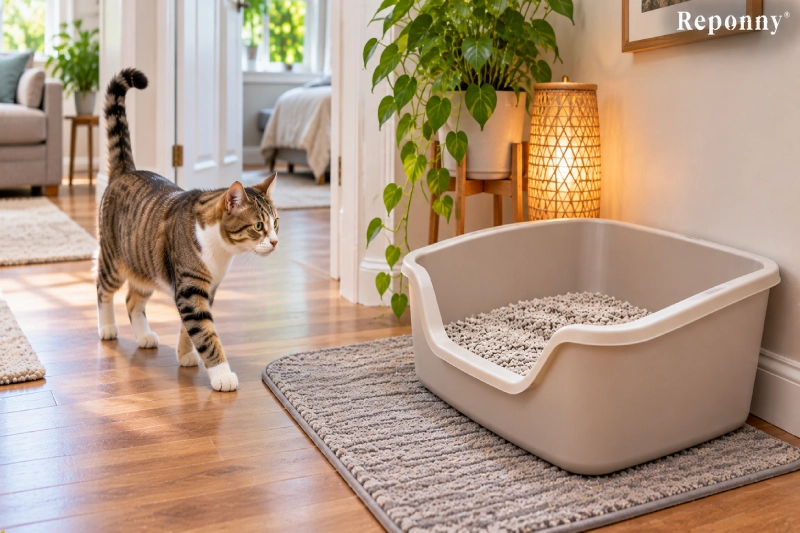
A strong litter-box setup removes as many barriers as possible.
Number
Use approximately:
one box per cat + one extra.
Size
Aim for roughly:
1.5 times your cat’s nose-to-tail-base length.
Litter
A good starting point for many cats is:
soft, unscented clumping litter.
Location
Choose:
quiet, accessible locations with clear escape routes.
Keep litter boxes separate from food and water.
Accessibility
For kittens, senior cats or cats with arthritis:
use low entry points.
Cleanliness
Scoop at least daily.
Wash regularly with mild soap and hot water.
Avoid ammonia-based cleaners.
Multi-cat homes
Spread boxes across separate areas.
Do not place all boxes together.
Try a Litter Preference Test
If medical problems have been addressed but the cat still avoids the box, let the cat help choose the setup.
FelineVMA recommends offering multiple boxes with different litter types or depths to determine the cat’s preference.
For example:
Box A → fine unscented clumping litter.
Box B → another unscented texture.
Keep the boxes otherwise similar.
Observe which one the cat uses consistently.
Then make more boxes match the preferred setup.
This is much more useful than repeatedly buying products based on what humans think looks comfortable.
Put a Box Where the Cat Is Already Peeing
This may feel like surrender.
It is not.
It is behavior management.
FelineVMA recommends temporarily or permanently adding a litter box at a location the cat has chosen for toileting.
VCA similarly describes placing a box in the preferred location and then gradually moving it once reliable box use is established.
The priority is first to rebuild:
urination → litter box.
Once that habit is stable, location can sometimes be adjusted gradually.
How to Clean Cat Urine Properly
Cleaning matters because residual odor may encourage repeated marking.
FelineVMA recommends using an appropriate urine odor and stain remover and cleaning an area large enough to remove the full odor footprint.
It specifically advises avoiding ammonia-based cleaners, because ammonia can smell urine-like to cats.
Do not simply spray perfume over the area.
The goal is to remove the odor rather than cover it.
Wash bedding according to fabric instructions and thoroughly treat carpet padding or other absorbent material when necessary.
If urine has penetrated deeply into porous surfaces, repeated cleaning may be required.
Never Punish a Cat for Peeing Outside the Litter Box
Do not:
- yell,
- hit,
- rub the cat’s nose in urine,
- spray the cat with water,
- or drag it to the litter box.
FelineVMA specifically warns that punishment can increase fear-related aggression, damage the human-cat bond and encourage cats to mark in less obvious locations.
Merck similarly advises against punishment because it may worsen the underlying behavioral problem.
Your cat is not learning:
“I should use the litter box.”
It may instead learn:
“Urination near humans is dangerous.”
That can make the problem harder to identify and solve.
Can Pheromone Products Help?
They may help some cats when anxiety or urine marking is involved.
FelineVMA includes synthetic feline pheromones among possible supportive strategies after the toileting environment has been individualized for the cat.
However, pheromones should not replace:
- veterinary evaluation,
- appropriate litter boxes,
- environmental management,
- or treatment of social conflict.
Think of them as a possible supporting tool, not a cure for every litter-box problem.
What About Outdoor Cats Near the Windows?
Outdoor cats can trigger urine marking.
FelineVMA notes that marking around windows and doors often indicates that the perceived social threat is outside the home.
If a neighborhood cat repeatedly sits outside your window, your indoor cat may feel that its core territory is threatened.
Possible strategies include:
- reducing visual access to the visiting cat,
- blocking uncontrolled cat-door access,
- and using humane outdoor deterrents.
The goal is to remove or reduce the trigger.
A Practical Step-by-Step Plan
When your cat begins peeing outside the litter box:
Step 1: Call your veterinarian
Rule out medical problems.
Step 2: Watch how the cat urinates
Determine whether this looks like full bladder emptying or urine marking.
Step 3: Check the box
Ask:
Is it large enough?
Easy to enter?
Clean?
Unscented?
Quietly located?
Step 4: Count your boxes
Use approximately one per cat plus one.
Step 5: Separate the boxes
Do not line them all up together.
Step 6: Look for conflict
Watch whether another pet blocks access.
Step 7: Consider recent changes
New animal?
New person?
Move?
Renovation?
Outdoor cat?
Step 8: Clean accident sites thoroughly
Remove urine odor and avoid ammonia cleaners.
Step 9: Add a box to the preferred location
Re-establish successful litter-box use.
Step 10: Do not punish
Solve the underlying problem instead.
A Quick Guide to Peeing Outside the Litter Box
| What You Notice | What It May Suggest |
|---|---|
| Squatting and producing normal puddle | Toileting outside box |
| Standing + tail quivering + vertical urine | Urine marking |
| Frequent small urinations | Urinary disease possible |
| Straining + little/no urine | Emergency obstruction possible |
| Blood in urine | Urinary tract disease |
| Large urine volumes + drinking more | Kidney disease, diabetes or other medical cause |
| Peeing beside box | Box/litter/access problem possible |
| Peeing on soft bedding | Surface preference or medical issue |
| Senior cat avoids high-sided box | Mobility problem possible |
| One cat guards litter box | Inter-cat conflict |
| Spraying near windows | Outdoor-cat trigger possible |
| Problem starts after household change | Stress may contribute |
| Cat suddenly stops using box | Veterinary exam recommended |
Frequently Asked Questions
Why Is My Cat Peeing Outside the Litter Box?
Possible causes include urinary disease, pain, increased urine production, litter-box aversion, stress, mobility problems, conflict with another cat and urine marking.
Veterinary evaluation should be the first step when the behavior is new.
Is My Cat Peeing Outside the Box Because It Is Angry?
Probably not.
Current FelineVMA guidance specifically states that cats do not house-soil because of spite or anger toward their caregivers.
When Is Cat Urination an Emergency?
Repeated straining with little or no urine is an emergency, especially in a male cat.
Urethral obstruction can rapidly become life-threatening and requires immediate veterinary treatment.
Why Is My Cat Peeing Next to the Litter Box?
Your cat may like the location but dislike the box itself.
The box may be dirty, too small, difficult to enter, uncomfortable or filled with a litter the cat dislikes.
Why Is My Cat Peeing on My Bed?
Beds are soft, absorbent and contain familiar scent.
Cats with litter-box aversion or a soft-surface preference may choose bedding, but medical causes should always be ruled out first.
How Many Litter Boxes Should I Have?
A common guideline is:
one litter box per cat plus one extra.
The boxes should be distributed in different locations rather than grouped together.
What Type of Litter Do Cats Prefer?
Many cats prefer soft, fine-textured, unscented clumping litter.
Strong fragrances, deodorizing products and some liners can discourage litter-box use.
Should Litter Boxes Be Covered or Uncovered?
Individual preference varies, but many cats prefer large uncovered boxes because they allow more space, airflow and environmental visibility.
If house-soiling occurs, trying an uncovered box is reasonable.
Why Is My Cat Spraying After Being Neutered?
Neutering greatly reduces sexually motivated spraying, but it does not eliminate all urine marking.
Stress, other cats and environmental changes can still trigger marking in neutered cats.
Can Stress Cause a Cat to Pee Outside the Box?
Yes.
Stress can contribute directly to urine marking and may also influence conditions such as feline idiopathic cystitis.
Should I Punish My Cat for Peeing Outside the Litter Box?
No.
Punishment can increase fear, damage your relationship with the cat and potentially worsen urine marking.
Final Thoughts
When a cat pees outside the litter box, it is easy to become frustrated.
Urine smells.
Furniture can be damaged.
Beds need washing.
And repeated accidents can feel personal.
But this is one feline behavior that should never begin with punishment.
Begin with investigation.
FelineVMA currently recommends that every cat that starts house-soiling receive a thorough veterinary examination and urinalysis.
That recommendation matters because urinary disease can look behavioral.
A cat with bladder inflammation may suddenly urinate on the carpet.
A cat with arthritis may avoid a high-sided box.
A cat with kidney disease or diabetes may simply be producing more urine than before.
And a male cat repeatedly straining while producing almost no urine may have a life-threatening urethral obstruction.
Once medical problems have been addressed, look at the world from your cat’s perspective.
Is the box large enough?
FelineVMA recommends roughly 1.5 times the cat’s length from nose to tail base.
Is the litter comfortable?
Many cats prefer soft, unscented clumping litter.
Is the box clean?
Remove waste at least daily.
Is it easy to reach?
Older cats may need low entry points and boxes on the floor where they spend most of their time.
Is it safe?
Another cat should not be able to trap or intimidate the cat while it uses the box.
And do you have enough boxes?
A practical guideline remains:
number of cats + one extra box, distributed around the home.
Also distinguish toileting from urine marking.
A large puddle on a horizontal surface usually tells a different story from a small amount of urine sprayed onto a vertical doorway.
Marking may reflect sexual behavior, social tension or environmental stress.
Clean accidents carefully.
Remove the odor.
Avoid ammonia-based products.
And do not yell, spray water or rub your cat’s nose in the urine.
FelineVMA warns that punishment can increase fear and encourage marking in less obvious places.
The solution usually comes from asking a better question.
Not:
“How do I make my cat stop?”
But:
“What is preventing my cat from comfortably using the litter box?”
Find that answer, and you have a much better chance of solving the problem permanently.