You walk through the front door and your cat immediately approaches.
The tail rises.
The cat presses its forehead against your leg, slides its cheek along your ankle, curves its body around you and then repeats the entire sequence from the other side.
Sometimes there is purring.
Sometimes a little chirp.
And sometimes your cat seems determined to rub against every part of you it can reach.
So, why does your cat rub against you?
In most cases, rubbing is completely normal feline social and scent-marking behavior.
Cats have scent-producing glands in several areas around the face and body. When they rub their forehead, cheeks, chin or body against people and objects, they deposit chemical signals that humans generally cannot detect.
Current Feline Veterinary Medical Association guidance explains that cats use facial and body rubbing to deposit natural pheromones and establish familiar boundaries within which they feel safe and secure.
Rubbing can also function as a friendly greeting.
Cats Protection notes that cats commonly rub their head or body against familiar people when saying hello, while cats belonging to the same social group may rub against one another as well.
That means your cat may be doing several things at once:
greeting you + seeking interaction + depositing familiar scent + strengthening a social routine.
But rubbing is not always something to interpret emotionally.
If your cat suddenly begins rubbing its face or body far more intensely than usual—especially with scratching, hair loss, head shaking, skin changes or obvious discomfort—itchiness, parasites, allergies, ear disease or another medical problem should be considered.
Quick answer: Cats rub against people as part of normal social and scent communication. Head bunting and cheek rubbing deposit scent from glands around the face, helping create a familiar environment and often occurring during friendly greetings. Cats may also rub because they want attention. Sudden excessive rubbing, especially with itching, hair loss, ear problems or other behavioral changes, deserves veterinary attention.
What Is Head Bunting in Cats?
Head bunting is the behavior people commonly describe as a cat “headbutting” them.
Instead of striking aggressively, the cat deliberately presses or pushes:
- the forehead,
- side of the head,
- cheek,
- or chin
against a person, another familiar cat or an object.
The cat may then slide its face along the surface.
VCA explains that cats have pheromone-producing glands around the cheeks, forehead and chin, and rubbing these areas deposits scent onto the object or individual being rubbed.
The FelineVMA also identifies scent-producing regions on the lips, chin, top of the head, paws and other parts of the body.
This means a head bunt is not simply physical contact.
It is also chemical communication.
The scent is usually impossible for you to notice.
For another cat, however, scent is a major source of information about the environment.
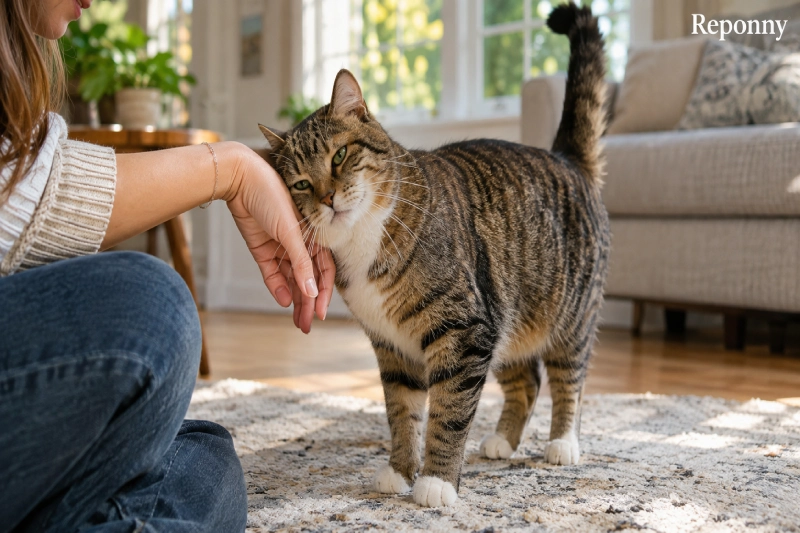
1. Your Cat Is Saying Hello
One of the simplest explanations is that rubbing is a greeting.
You may notice it most clearly when:
- you return home,
- your cat wakes from a nap,
- you enter a room,
- or you have been separated for several hours.
Cats Protection describes head and body rubbing as a common friendly greeting and notes that socially affiliated cats may greet one another in similar ways.
The rubbing may be accompanied by:
- tail held upright,
- gently curved tail tip,
- purring,
- chirping,
- soft eyes,
- or walking closely around your legs.
A 2013 feline environmental-needs guideline also identifies head bunting toward humans as a signal associated with seeking social attention.
So when your cat runs toward you after you arrive home and immediately presses its forehead into your shin, the interaction is very likely positive.
How should you respond?
Allow the cat to initiate.
Offer your hand at a comfortable distance.
If the cat moves forward and rubs against it, gentle cheek or head petting may be welcome.
If the cat walks away, let the greeting end.
The goal is not to turn every head bunt into a long petting session.
It is to respond while respecting the cat’s control over the interaction.
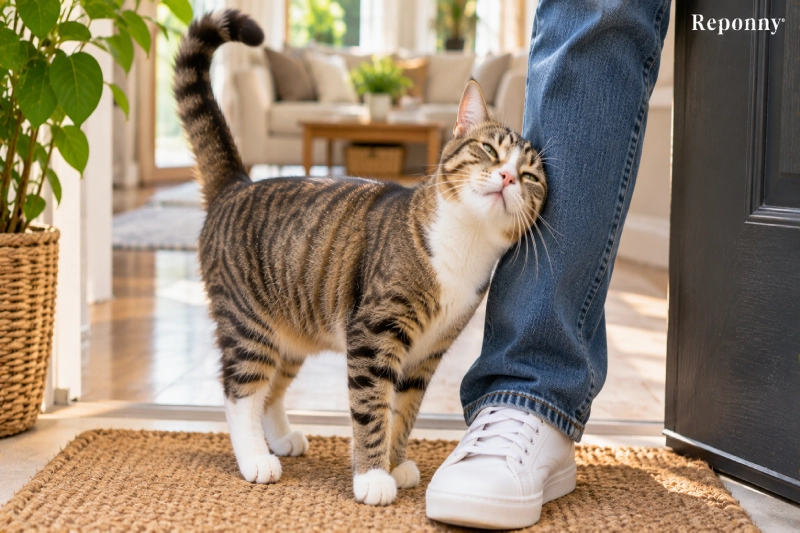
2. Your Cat Is Depositing Familiar Scent
This is one of the most important functions of rubbing.
Humans depend heavily on vision.
Cats rely much more strongly on smell.
The FelineVMA explains that cats evaluate their surroundings using scent and deposit natural pheromones through facial and body rubbing, helping establish familiar boundaries where they feel safe.
Cats Protection similarly explains that facial pheromones are deposited when a cat rubs its face against objects or people and that these familiar chemical signals can help the cat identify an area as safe.
This is why cats commonly rub against:
- furniture corners,
- doorframes,
- beds,
- scratching posts,
- table legs,
- people,
- and other familiar cats.
The behavior helps create what we might think of as a familiar scent landscape.
Is your cat claiming ownership of you?
That explanation is oversimplified.
You will often hear:
“Your cat is marking you as its property.”
Cats do deposit scent on people, but feline scent communication is more complicated than a simple ownership label.
Facial rubbing appears strongly connected with familiarity, social communication and environmental security rather than being only a territorial warning. In a study of a social group of farm cats, cheek and perioral rubbing on objects was not associated with dominance rank, suggesting the behavior has social functions beyond straightforward territorial defense.
A better interpretation is:
your cat is adding familiar scent to an important part of its social environment.
That includes you.
3. Your Cat May Be Marking You as Familiar and Safe
Cats Protection describes facial rubbing as a way for cats to deposit scent associated with familiarity and security.
Think about what happens when you return home after spending the day somewhere else.
To your cat, you may carry unfamiliar smells:
- another building,
- food,
- outdoor air,
- another person,
- a dog,
- cleaning products,
- or public transportation.
Your cat may immediately rub its face against you.
This does not necessarily mean it is trying to erase every unfamiliar odor.
But depositing its own familiar chemical signals may help restore a recognizable scent environment.
The FelineVMA specifically advises owners to respect this sensory system and avoid unnecessarily removing facial scent marks from areas cats repeatedly rub.
From the cat’s perspective, familiar smell can be part of what makes a place feel predictable.
4. Rubbing Can Be Part of Social Bonding
Cats are not always solitary.
Domestic cats can form stable social relationships with other cats and with humans.
Among cats that belong to the same social group, behaviors can include:
- sleeping together,
- grooming one another,
- tail wrapping,
- nose touching,
- and rubbing against one another.
The feline environmental-needs guidelines specifically identify body rubbing and tail wrapping as behaviors associated with cats belonging to the same social group.
A review of free-ranging cat social behavior likewise documents allorubbing—one cat rubbing against another—as a common affiliative social interaction.
This helps explain why your cat may rub against:
another household cat first, then you, then a piece of furniture.
Scent and social contact overlap.
Is there really a “group scent”?
Cats living in familiar social groups can exchange scent through rubbing and close contact.
Behavior specialists often describe this as contributing to a shared or communal scent profile.
However, it is better not to imagine a perfectly uniform chemical “family badge.”
Feline chemical communication is more complex than that.
The important point is that rubbing between familiar cats is generally affiliative, and exchanging familiar odor information likely plays a role in social recognition and environmental security.
5. Your Cat Wants Attention
Sometimes rubbing is very practical.
Your cat wants you to notice it.
Head bunting can efficiently produce:
- eye contact,
- talking,
- petting,
- play,
- or food.
The feline environmental-needs guidelines specifically describe head bunting toward humans as a signal that the cat may want attention and recommend gentle head rubbing or stroking if the cat permits it.
Cats Protection also identifies attention-seeking as one reason cats rub against people.
Imagine the sequence:
Your cat rubs your ankle.
You bend down.
You pet it.
The cat rubs again.
You continue.
Over time, both of you learn the routine.
The cat learns:
rubbing reliably begins interaction.
That does not make the behavior fake.
Social behavior and learned consequences can coexist.
Your cat can enjoy rubbing against you and know that doing so usually earns a cheek scratch.
Why Does My Cat Rub Against My Legs?
Your legs are easy targets.
They are:
- at cat height,
- large enough to rub against,
- associated with movement,
- and often the first part of you the cat reaches.
A typical greeting may look like:
head against shin → cheek slides along leg → body curves around calf → tail passes against leg.
Cats Protection identifies this kind of head-and-body rubbing as common greeting behavior.
If the cat repeatedly weaves between your feet while you are walking, however, be careful.
Cats do not always appreciate the tripping hazard they create.
Pause rather than accidentally stepping on the cat.
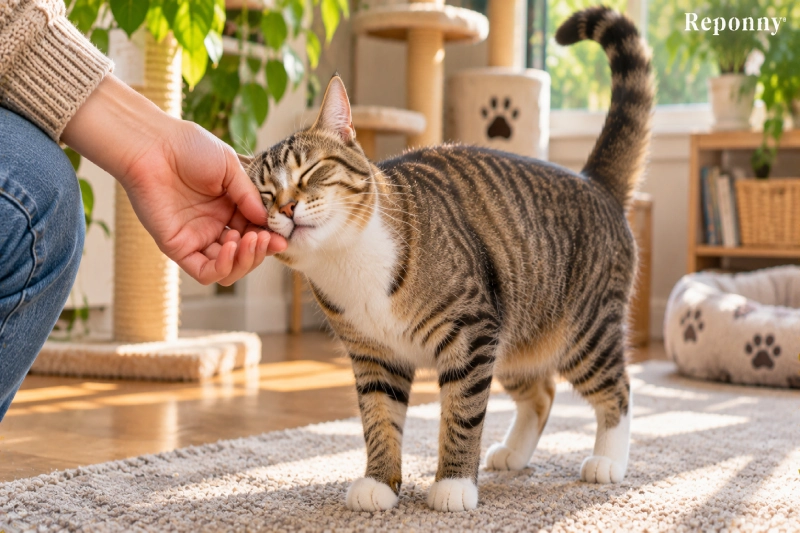
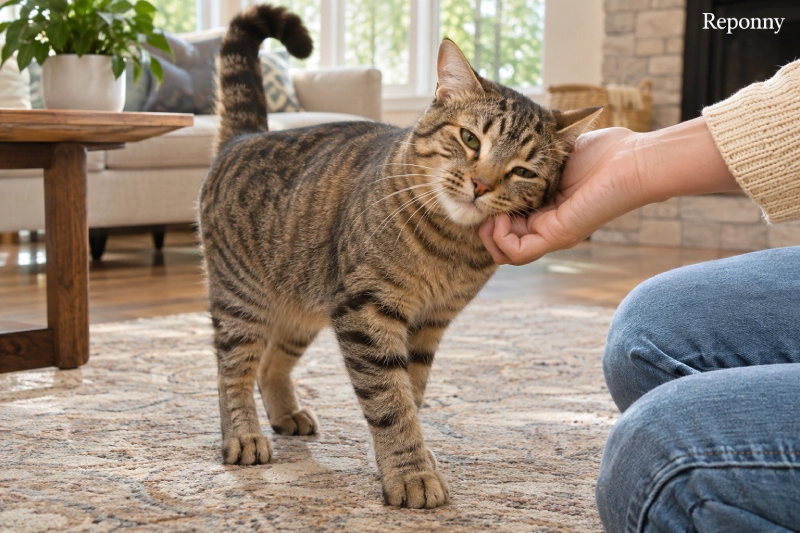
Why Does My Cat Rub Its Face on My Hand?
This is often a very useful form of cat-initiated interaction.
Instead of reaching directly over the cat’s head, offer a relaxed hand slightly in front of or beside the cat.
The cat can then choose whether to:
- sniff,
- move away,
- or push its cheek or forehead against you.
If the cat rubs into your hand, that can be a good indication that some gentle contact is welcome.
Current cat-friendly veterinary handling guidelines note that the areas around facial scent glands are often preferred locations for touch.
So cheek rubs and head scratches may be better tolerated by many cats than:
- belly rubbing,
- grabbing paws,
- or prolonged stroking down sensitive areas.

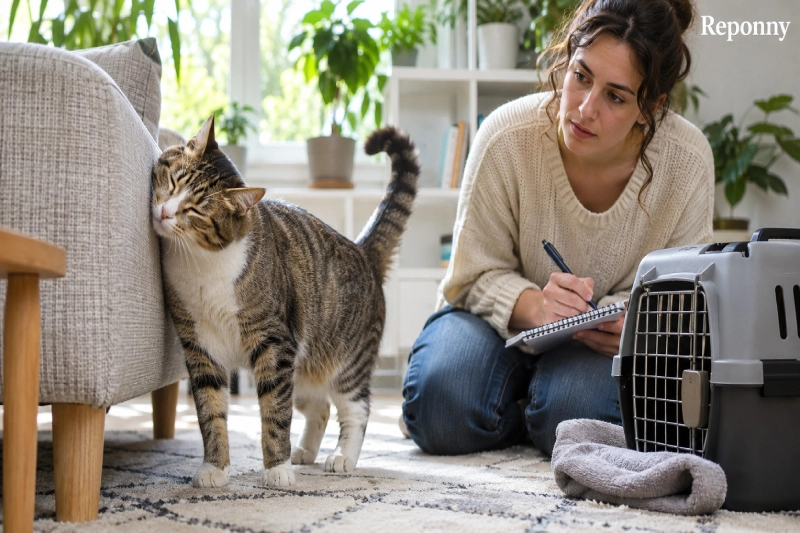
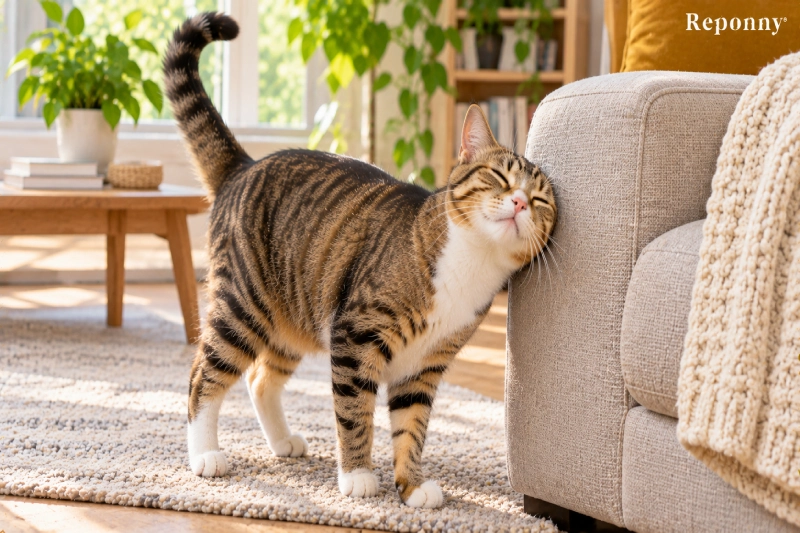
Why Does My Cat Rub Against Furniture?
Because people are not the only things cats scent mark.
Facial rubbing on objects is normal.
VCA describes cheek rubbing on furniture as a form of bunting, during which scent is deposited onto the surface.
Common targets include:
- sofa corners,
- table legs,
- doorframes,
- bed frames,
- walls,
- and objects along frequently used pathways.
Cats Protection explains that cheek rubbing tends to occur in the core territory, where cats feel relatively safe and relaxed. This differs from urine spraying, which may become more prominent around areas associated with uncertainty or threat.
That distinction is fascinating.
A cat rubbing its cheek against its favorite doorway may essentially be maintaining a familiar scent environment.
A cat suddenly spraying urine beside a window after seeing an unfamiliar outdoor cat is communicating in a very different context.
Should You Clean Areas Where Your Cat Rubs Its Face?
Normal household cleaning is obviously necessary.
But repeatedly stripping scent from every favorite facial-rubbing location may be unnecessary.
FelineVMA guidance specifically recommends respecting feline scent marks and avoiding excessive cleaning of heavily facially marked areas when possible because those familiar chemical signals can contribute to environmental security.
You do not need to leave your house dirty.
The idea is simply to avoid:
strongly scented cleaner + complete removal of every familiar scent mark + frequent repetition
in locations that are otherwise safe and clean.
Cats experience a smell world that humans barely notice.
A product that smells pleasantly “fresh” to us may dramatically alter the sensory environment for the cat.
Rubbing Is Different From Urine Spraying
Both are forms of scent communication.
But they do not necessarily mean the same thing.
Cats Protection explains that cheek rubbing is commonly associated with safe areas within the cat’s core territory, whereas urine spraying may increase in areas where the cat feels threatened or uncertain.
VCA similarly notes that urine marking can occur when a cat experiences environmental or social distress.
So:
Facial rubbing
Often occurs in familiar locations and social situations.
Urine spraying
Can be associated with sexual communication, territorial information or environmental stress.
Do not interpret all scent marking as interchangeable.
Why Does My Cat Rub Against Me and Then Walk Away?
Because rubbing does not necessarily mean:
“Pet me for the next twenty minutes.”
The interaction itself may have been enough.
Your cat may:
rub against you, deposit scent, exchange a brief social greeting and continue with its day.
That is perfectly normal.
Humans sometimes make the mistake of turning a two-second feline greeting into prolonged handling.
If the cat walks away:
let it go.
A successful social interaction does not have to be long.
Why Does My Cat Rub Against Me and Purr?
This commonly occurs during positive social interaction.
Cats Protection notes that friendly rubbing may be accompanied by purring and sometimes even drooling when a cat is particularly enthusiastic.
If the cat also shows:
- upright tail,
- relaxed ears,
- soft eyes,
- loose muscles,
- and voluntary proximity,
the overall picture strongly supports comfort.
But purring alone should never be used as proof that a cat is happy.
As discussed in Reponny’s article on purring, cats may also purr during stress or illness.
Always interpret the entire cat.
Why Does My Cat Rub Against Me and Then Bite?
This can be confusing.
The cat appears friendly.
It rubs against you.
Then:
bite.
Cats Protection notes that rubbing followed by biting may occur when a cat becomes overexcited, and predatory or play behavior may also be redirected toward a person.
Another possibility is petting overstimulation.
The cat may have wanted:
brief cheek contact
but received:
extended full-body petting.
Watch for warning signals such as:
- tail flicking,
- ears rotating sideways or backward,
- skin twitching,
- body tension,
- looking toward your hand.
If those signs appear, stop touching.
Rubbing is an invitation to interact—not unlimited permission for continuous contact.
Why Does My Cat Rub Its Tail Against Me?
Cats may include the body and tail in a rubbing sequence.
A greeting can begin with the head, continue along the side of the body and finish with the tail passing around your leg.
The FelineVMA identifies scent-producing areas in multiple parts of the body, including near the tail base.
Tail wrapping also occurs between socially affiliated cats.
So a relaxed cat passing its body and tail around your legs can be part of a normal friendly interaction.
The important word is:
relaxed.
A rapidly thrashing tail means something different.
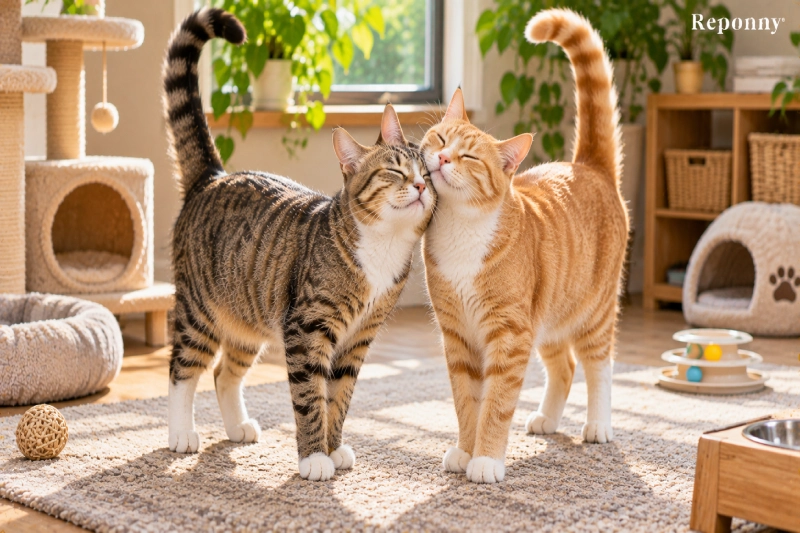
Why Do Cats Rub Against Each Other?
This behavior is commonly called allorubbing.
It occurs between cats that have social relationships.
A review of free-ranging domestic cats documents head rubbing and allorubbing during friendly interactions, often alongside tail-up signals and other affiliative behavior.
Allorubbing may combine:
- social greeting,
- tactile contact,
- and scent exchange.
Research on domestic-cat social behavior also suggests that cheek rubbing has communicative functions beyond dominance or territorial defense.
If your household cats regularly:
rub against each other, sleep touching, groom one another and approach with relaxed tails,
they likely have a much more affiliative relationship than two cats that merely tolerate occupying the same house.
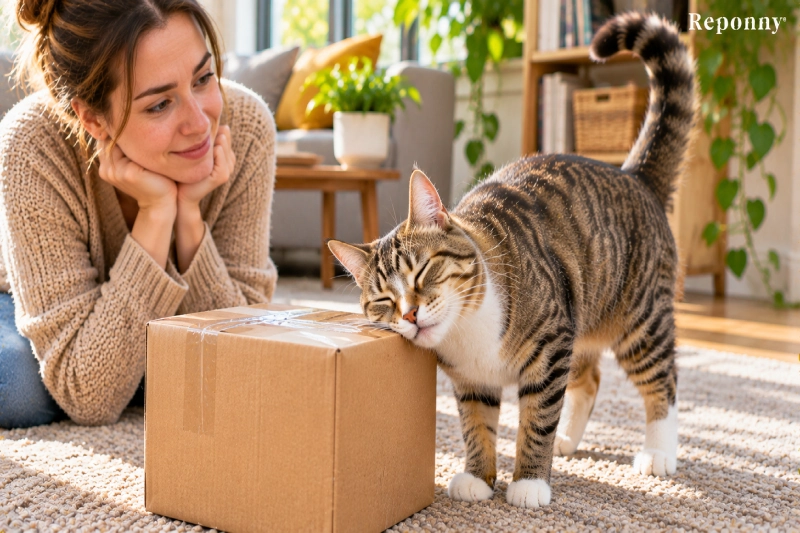
Why Does My Cat Rub Against New Objects?
Cats often investigate changes in their environment.
Suppose you bring home:
a package, suitcase, chair or shopping bag.
Your cat approaches.
Sniffs.
Then rubs its face along the object.
This may help integrate the unfamiliar item into the cat’s familiar scent environment.
A 2025 study examining cats’ responses to human odors observed face rubbing against objects after olfactory investigation and proposed a possible connection between smell exploration and subsequent odor-marking behavior, although the researchers emphasized that the relationship needs further study.
So:
sniff → inspect → rub
is a perfectly reasonable feline sequence when something new appears.
Why Does My Cat Rub Against Catnip or Silver Vine?
This is a somewhat different rubbing behavior.
Cats exposed to certain plants such as:
catnip and silver vine
may rub their face and head against the plant and roll intensely.
A 2021 study published in Science Advances found that the silver-vine compound nepetalactol triggered this characteristic rubbing response and that rubbing transferred the compound onto the cats’ fur. Remarkably, the transferred compound helped repel Aedes albopictus mosquitoes.
This does not mean ordinary head bunting against you serves the same mosquito-defense function.
It illustrates an important principle:
not every rubbing behavior has exactly the same biological purpose.
Context matters.
Is Head Bunting Really a Sign of Affection?
It can certainly occur during positive social interactions.
But “affection” is a broad human term.
Scientifically, it is more precise to say that head bunting is often an affiliative behavior associated with familiarity, social interaction and scent communication.
A 2026 study involving 443 pet caregivers examined several forms of human-pet touch and found that pet-initiated bunting/rubbing in cats was associated with owner-reported measures of feline wellbeing, although the study was observational and cannot reduce the behavior to a single emotional state.
So if your relaxed cat runs toward you, tail upright, rubs its forehead against you and settles nearby:
yes, that is a positive interaction.
You do not need to translate it into an exact sentence.
When Excessive Rubbing May Be a Medical Problem
Normal rubbing is common.
A sudden major increase is different.
Cats Protection advises veterinary evaluation when rubbing becomes new, unusually frequent or aggressive because possible medical causes include:
- allergies,
- fleas,
- ear infection,
- feline hyperesthesia,
- or neurological disorders.
VCA similarly identifies excessive:
- rubbing,
- scratching,
- licking,
- biting,
- chewing,
- and grooming
as possible signs of itchy skin.
Watch for additional symptoms
Pay particular attention if rubbing occurs with:
- head shaking,
- repeated ear scratching,
- redness,
- hair loss,
- scabs,
- excessive grooming,
- skin twitching,
- bad odor from the ears,
- discharge,
- sensitivity when touched,
- or changes in behavior.
If your cat suddenly spends much of the day forcefully rubbing one side of its face against furniture, do not simply assume it has become more affectionate.
Something may be irritating or painful.
Rubbing vs. Head Pressing: An Important Difference
This distinction can be critical.
Normal head bunting is:
- voluntary,
- social,
- brief,
- and involves rubbing or sliding the forehead and cheeks against something.
A cat generally appears alert and behaves normally before and afterward.
Head pressing is different.
Head pressing describes persistent, abnormal pressing of the head against:
- a wall,
- floor,
- furniture,
- or another solid surface
without the normal rubbing movement or social context.
That behavior can be associated with serious neurological disease and warrants veterinary evaluation.
So:
forehead bump + cheek rub + tail up = normal bunting is likely
while
persistent head held firmly against a wall + abnormal behavior = veterinary concern.
Do not confuse the two.
Should You Rub Your Face Against Your Cat?
You do not need to imitate your cat literally.
Human faces are large and approaching directly can be uncomfortable for some cats.
Instead, let your cat initiate contact.
Offer:
- your hand,
- finger,
- or side of your arm
at an appropriate distance.
If the cat chooses to bunt, allow the interaction.
You can respond with gentle cheek, forehead or chin petting if the cat appears to enjoy it.
Current cat-friendly handling guidance identifies facial gland regions as commonly preferred touch areas.
Avoid forcing your face close to an unfamiliar cat.
How to Respond When Your Cat Rubs Against You
The best response depends on the cat.
Try a simple approach:
Offer your hand.
Let the cat rub.
Give one or two gentle strokes around the cheeks or head.
Pause.
Then watch.
If the cat leans in again:
continue briefly.
If it walks away:
let the interaction end.
This respects one of the most important principles of feline social interaction:
choice.
Not every cat wants the same amount of touching.
And the same cat may want different levels of interaction at different times.
Cat Rubbing Behavior at a Glance
What You See What It May Mean Head bunt when you arrive home Friendly greeting / social interaction Cheek rubbing on your hand Scent deposition + social contact Body rubbing around legs Greeting, familiarity or attention Facial rubbing on furniture Normal scent marking Rubbing between household cats Affiliative social behavior Rubbing then walking away Greeting may simply be finished Rubbing + purring + relaxed body Positive social interaction likely Rubbing + tail flicking + bite Overstimulation or rising arousal Sniffing new object then rubbing Scent investigation/marking may be involved Sudden excessive face rubbing Itch, ear problem or other medical cause should be considered Persistent head pressed against wall Not normal bunting; veterinary evaluation needed Frequently Asked Questions
Why Does My Cat Rub Against Me?
Cats rub against people as part of normal social and scent communication.
Facial rubbing deposits chemical signals from glands around the cheeks, forehead and chin and commonly occurs during friendly greetings.
What Does It Mean When a Cat Headbutts You?
The behavior is more accurately called head bunting.
It commonly combines social interaction with scent deposition and is usually positive when the cat has relaxed body language.
Is My Cat Marking Me as Its Property?
That is an oversimplification.
Cats do deposit scent on people, but facial rubbing is associated with familiarity, social communication and environmental security—not simply ownership or dominance.
Why Does My Cat Rub Its Face on Me?
Cats have scent-producing glands around the face.
Rubbing these areas on you deposits familiar chemical signals and can also occur during greeting and social interaction.
Why Does My Cat Rub Against My Legs?
Your legs are easy surfaces for head and body rubbing.
This commonly occurs during greeting or when a cat wants attention.
Why Does My Cat Rub Against Me and Purr?
Rubbing and purring often occur together during comfortable social interactions.
Look for supporting signs such as relaxed ears, soft eyes, loose muscles and an upright tail.
Why Does My Cat Rub Against Me and Then Bite?
The cat may have become overexcited or overstimulated.
Cats Protection also notes that hunting or play behavior can sometimes become redirected toward the person after rubbing.
Why Does My Cat Rub Against Furniture?
Facial rubbing deposits familiar scent onto objects within the cat’s environment and is a normal form of feline scent communication.
Why Do Cats Rub Against Each Other?
Socially affiliated cats may perform allorubbing during friendly interactions.
Research and feline environmental guidelines identify body rubbing as one of the behaviors associated with social-group relationships.
Why Is My Cat Suddenly Rubbing Its Face on Everything?
A temporary increase may occur after environmental changes or exposure to new smells.
However, persistent excessive rubbing—particularly with scratching, hair loss, head shaking or skin changes—can indicate itchiness, fleas, allergies, ear disease or another medical problem.
Is Head Bunting the Same as Head Pressing?
No.
Head bunting is a normal social rubbing behavior.
Persistent head pressing against a wall or other surface without normal rubbing behavior can indicate a neurological problem and should be evaluated by a veterinarian.
Final Thoughts
When your cat rubs its forehead against you, slides its cheek across your hand or weaves around your legs, there is usually more happening than simple physical affection.
Cats live in a world shaped heavily by smell.
The Feline Veterinary Medical Association explains that facial and body rubbing deposits natural chemical signals and helps establish familiar boundaries in which cats feel secure.
That makes rubbing part of the cat’s scent communication system.
But it is also social.
Cats Protection identifies rubbing as a common friendly greeting, and feline behavioral research documents similar allorubbing between socially affiliated cats.
So your cat may rub against you because:
you are familiar.
you are part of its social environment.
it is saying hello.
it wants attention.
and your presence is associated with safety and predictability.
Several of those explanations can be true at the same time.
What you should avoid is reducing the behavior to:
“My cat owns me.”
Facial rubbing is much more nuanced than a simple territorial ownership signal. Research has found that cheek rubbing on environmental objects does not neatly track dominance rank, supporting the idea that it serves broader social and communicative functions.
The best response is usually simple.
Let your cat approach.
Offer your hand.
Allow the head bunt.
Give a gentle cheek scratch if the cat asks for one.
Then let the cat decide whether the interaction continues.
And—as with almost every feline behavior—pay attention to changes.
A cat that has rubbed affectionately against your legs every morning for years is behaving very differently from a cat that suddenly spends hours forcefully rubbing one side of its face against furniture.
Excessive rubbing can sometimes accompany skin disease, fleas, allergies, ear problems or other medical conditions.
Know your cat’s normal pattern.
Read the ears, eyes, whiskers, tail and posture.
And remember:
when a relaxed cat walks up, raises its tail and gently pushes its forehead into you, you are witnessing one of the most characteristic combinations of touch, scent and social communication in the feline world.