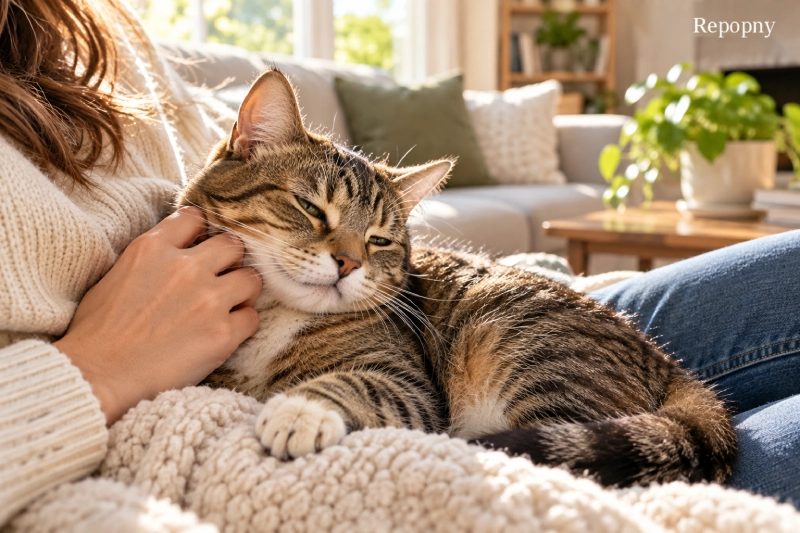
Few sounds are as closely associated with cats as purring.
Your cat curls beside you on the couch, closes its eyes, and begins to vibrate softly. It is easy to assume the message is simple:
“I’m happy.”
Often, that interpretation is probably correct.
But cats also purr when they are hungry, interacting with their kittens, asking humans for something, frightened, stressed, in pain, or unwell.
Scientific reviews of feline vocal communication therefore describe purring as a context-dependent vocalization rather than a universal sign of happiness. Purrs commonly occur during friendly, close-range interactions, but researchers have documented them in solicitation and stressful contexts as well.
That means the sound alone cannot tell you exactly how your cat feels.
You need to look at:
body posture, eyes, ears, whiskers, appetite, activity, surroundings, and what happened immediately before the purring began.
Quick answer: Cats commonly purr because they are relaxed, communicating socially, asking for food or attention, interacting with their mother or kittens, coping with stress, or experiencing pain or illness. Purring is usually positive—but not always.
What Is a Cat’s Purr?
A purr is a low-frequency, rhythmic vocalization typically produced with the mouth closed.
Unlike a meow, which is usually separated into individual sounds, a purr can continue almost uninterrupted for seconds or minutes.
A scientific review of feline vocalizations describes purring as a continuous rhythmic sound produced during both inhalation and exhalation. It commonly occurs during friendly communication and solicitation.
For decades, researchers believed cats needed rapid, actively controlled contractions of muscles around the larynx to create each purring cycle.
Recent research has complicated that explanation.
A 2023 study examined eight excised domestic-cat larynges and found that all could generate self-sustaining oscillations in the normal purring range without active muscle contraction or neural input. Researchers also identified connective-tissue structures within the vocal folds that may help cats generate unusually low frequencies. The study did not prove that neural control plays no role in living cats, but it showed that feline laryngeal anatomy itself can generate purr-like vibration.
The fundamental purring frequency measured in that research was approximately 25–30 Hz.
So even something that sounds as familiar as a purr remains scientifically fascinating.
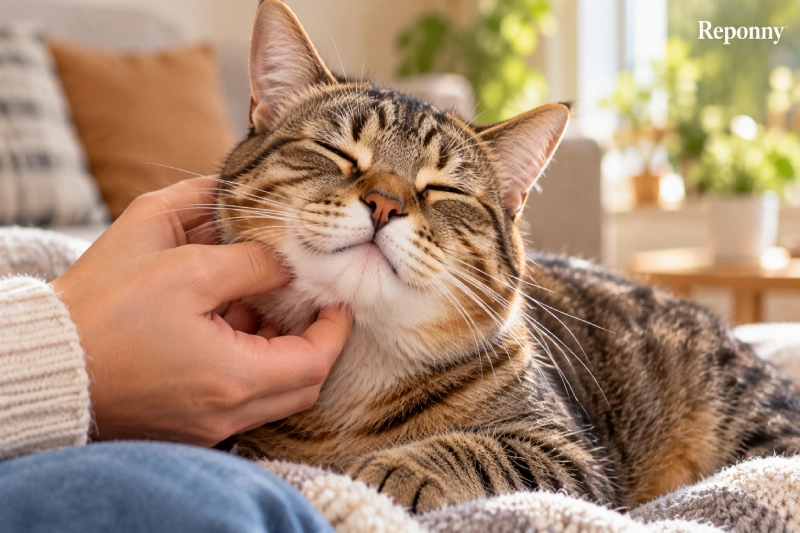
1. Your Cat Is Relaxed and Content
This is the reason most owners recognize.
A comfortable cat may purr while:
- sleeping beside you,
- resting on your lap,
- kneading a blanket,
- being gently stroked,
- lying in sunlight,
- or settling into a favorite bed.
Scientific reviews describe purring as strongly associated with affiliative and contented situations. A 2025 acoustic study similarly characterized purrs as relatively stereotyped low-frequency vocalizations produced particularly in affiliative contexts.
When purring reflects contentment, the rest of the body usually supports that interpretation.
You may see:
soft eyes, slow blinking, neutral or forward ears, relaxed whiskers, loose muscles, comfortable paws, and an unhurried tail.
A relaxed cat may also knead with its front paws while purring.
In this context, there is little reason to search for a hidden meaning.
Your cat probably is comfortable.
But purring alone is not proof of happiness
A cat sitting rigidly in a veterinary carrier while purring is presenting a completely different picture from a cat sleeping loosely across your legs.
Always read the entire cat, not merely the sound.
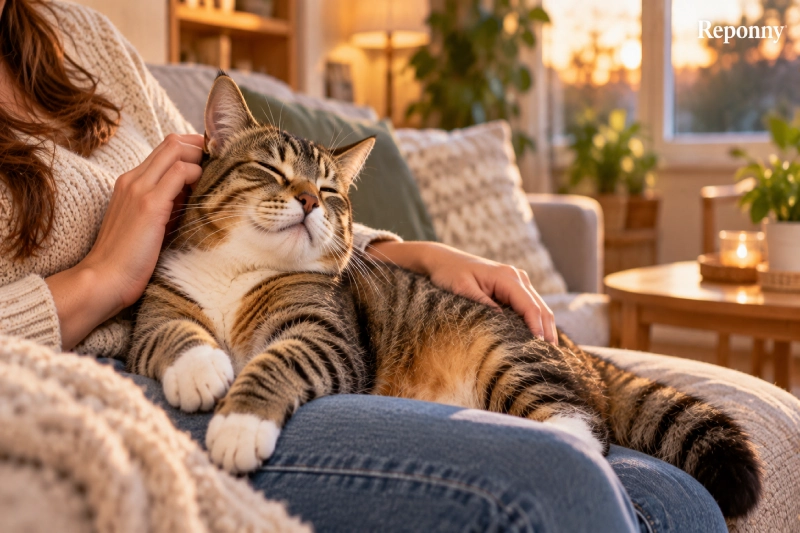
2. Your Cat Is Communicating With You or Another Cat
Purring is also a social signal.
It is particularly useful at close range because the sound is relatively quiet.
A review of feline vocal communication describes purring as a friendly signal associated with physical contact and suggests it can communicate something broadly similar to:
“I am not a threat.”
That interpretation helps explain why cats may purr when:
- greeting familiar people,
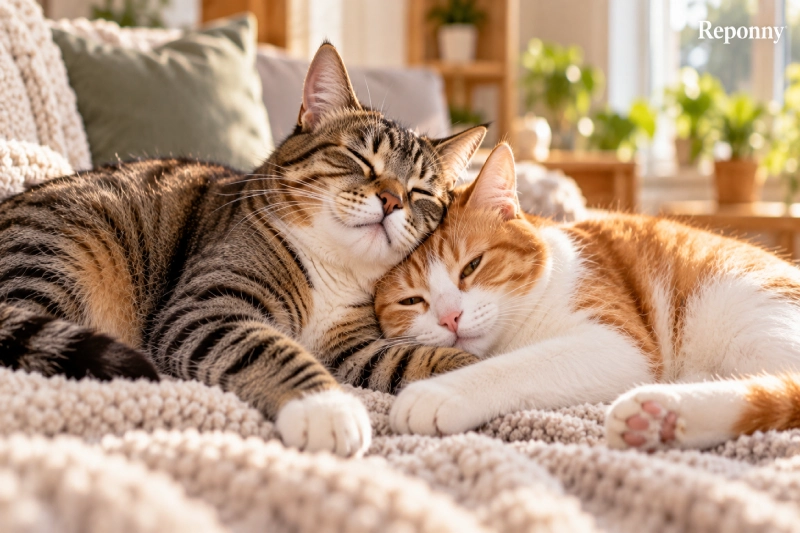
- lying beside another bonded cat,
- rubbing against someone,
- receiving grooming,
- or seeking close physical contact.
Cats are far more socially flexible than the stereotype of the completely solitary feline suggests. Research shows that domestic cats can form attachment bonds with human caregivers and adapt their communication to life with people.
Purring is one part of that communication system.
Interestingly, newer research suggests that individual cats may even have identifiable acoustic signatures in their purrs.
A 2025 study analyzed 557 purrs from 21 cats and found that purrs contained substantial information about individual identity. In the study, purrs actually allowed more accurate individual classification than meows.
So the purr is not necessarily a generic sound produced identically by every cat.
Your cat’s purr may contain an individual acoustic signature
3. Your Cat Wants Food or Attention
Sometimes a purr is not simply saying:
“I feel good.”
It may be saying:
“I want something from you.”
Researchers have identified a special form commonly called a solicitation purr.
A 2009 study found that cats can embed a higher-frequency, cry-like component within purring when soliciting food from their owners. Human listeners judged these solicitation purrs as more urgent and less pleasant than ordinary purrs.
The researchers suggested that the higher-frequency element may make the signal particularly difficult for humans to ignore.
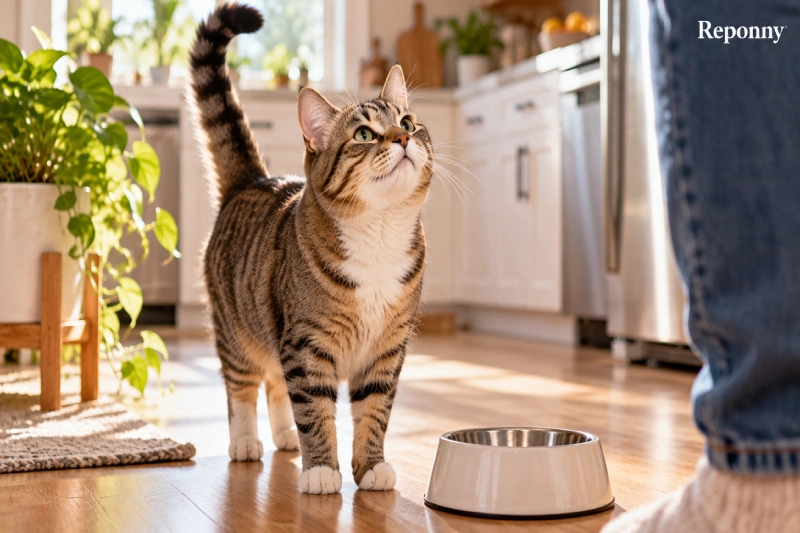
You may notice this type of behavior when your cat:
- wakes you before breakfast,
- stands near the food bowl,
- follows you into the kitchen,
- rubs against your legs,
- purrs while staring at you,
- or purrs and meows together.
The context makes the message much easier to interpret.
Morning purring does not necessarily mean pure affection
Your cat may genuinely enjoy seeing you.
It may also know that you control the breakfast supply.
Those two motivations are perfectly capable of occurring at the same time.
4. Purring Helps Mothers and Kittens Communicate
Purring begins very early in a cat’s life.
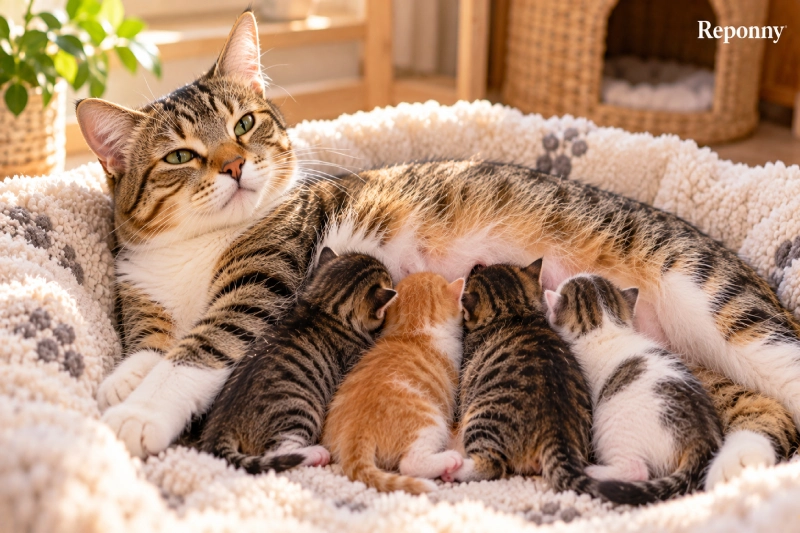
Scientific reviews report that kittens begin using vocal communication almost immediately after birth and that purring develops early. Purring between mothers and kittens occurs around nursing and close-contact interactions.
Because newborn kittens are vulnerable and remain close to the nest, a quiet signal has obvious advantages over a loud vocalization.
The feline-vocalization literature has described kitten purring during nursing as a possible “all is well” signal associated with close physical contact. Mother cats also purr around their litters.
This may help maintain communication without creating a loud sound that travels over long distances.
Kittens also knead while nursing.
That may help explain why adult cats sometimes recreate an entire collection of kitten-like behaviors when extremely relaxed:
kneading + purring + settling against a soft surface.
It does not mean the adult cat literally thinks its blanket is its mother.
It shows that behaviors established very early in life can remain part of the adult cat’s comfort repertoire.
5. Your Cat May Purr When Stressed or Frightened
This is the reason that surprises many owners.
Cats do not purr exclusively when they are happy.
A major review of feline vocal behavior notes that purring has also been observed during stress, pain, and severe distress.
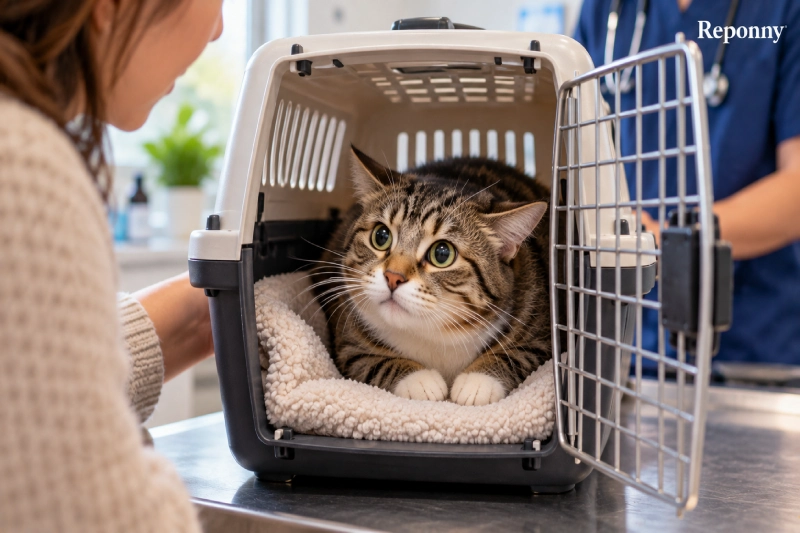
A frightened cat may purr:
- inside a carrier,
- at a veterinary clinic,
- during an unfamiliar situation,
- after being frightened,
- or while being handled when it would rather escape.
Why?
Scientists do not yet have a definitive answer.
One possibility is that purring functions partly as a self-regulatory or appeasement behavior. Another is that it communicates non-aggressive intent during vulnerable situations.
These explanations remain more tentative than the clear association between purring and friendly interaction.
So instead of assuming:
“My cat is purring, therefore it loves the veterinarian,”
look at the cat.
Signs suggesting stress rather than relaxation can include:
- dilated pupils,
- flattened or sideways ears,
- crouching,
- tense muscles,
- tail tucked around the body,
- freezing,
- hiding,
- or attempting to escape.
Purring plus a rigid body is very different from purring plus a loose sleeping posture.
6. Your Cat May Purr When in Pain or Unwell
This is the most important reason not to use purring as a health test.
A sick or injured cat can still purr.
The feline-vocalization literature specifically reports purring in contexts involving pain, stress, and serious illness, not only pleasurable situations.
That does not mean every purring cat is secretly sick.
Most of the time, a comfortable purring cat with normal behavior is probably simply comfortable.
But purring should never cause you to ignore other warning signs.
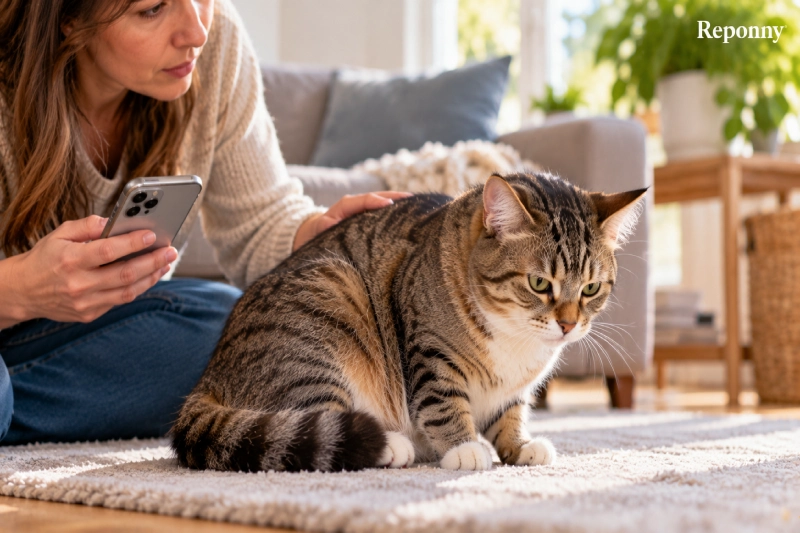
Pay attention if a cat is purring while also:
- hiding more than usual,
- refusing food,
- losing weight,
- breathing differently,
- moving reluctantly,
- limping,
- sitting hunched,
- avoiding jumping,
- vomiting repeatedly,
- acting unusually quiet,
- reacting painfully to touch,
- or suddenly changing normal behavior.
The important clue is not the purr alone.
It is the change from your cat’s normal pattern.
A normally energetic cat that suddenly spends the entire day crouched beneath the bed while purring deserves more attention than a cat purring during its usual evening cuddle.
Does Purring Help Cats Calm Themselves?
Possibly—but this should be described carefully.
Because cats purr in both comfortable and stressful situations, researchers and veterinary behavior specialists have proposed that purring may have a self-soothing or conflict-reducing function.
That hypothesis fits observations of cats purring while frightened, injured, or vulnerable.
However, scientists have not demonstrated a simple mechanism showing that a cat consciously switches on its purr specifically to regulate stress.
It is therefore more accurate to say:
Purring may be involved in self-regulation during stressful situations.
Not:
“Cats definitely purr to release stress.”
Feline communication research repeatedly emphasizes that the same vocalization can occur in more than one context.
Can a Cat’s Purr Heal Bones?
You may have seen claims such as:
“Cats purr at healing frequencies.”
“A cat’s purr repairs broken bones.”
“Purring heals tissue and reduces pain.”
There is an interesting scientific observation behind these claims—but the conclusion is often exaggerated.
Older acoustic work found that felid purrs contain low frequencies, and a frequently cited 2001 conference abstract reported strong components across roughly 25–150 Hz. The author proposed that the overlap between purr frequencies and frequencies studied in vibration therapies might indicate a healing function. However, that work was a hypothesis based primarily on acoustic frequency overlap—not a controlled demonstration that natural purring repairs injuries.
More rigorous 2023 research confirmed that domestic-cat larynges can produce fundamental purring frequencies around 25–30 Hz, but that study investigated how purrs are produced, not whether they heal tissue.
So the scientifically responsible conclusion is:
Cats genuinely produce low-frequency vibrations, but there is currently insufficient direct evidence to say that normal purring heals broken bones or other injuries in cats or humans.
It is an interesting hypothesis—not an established treatment.
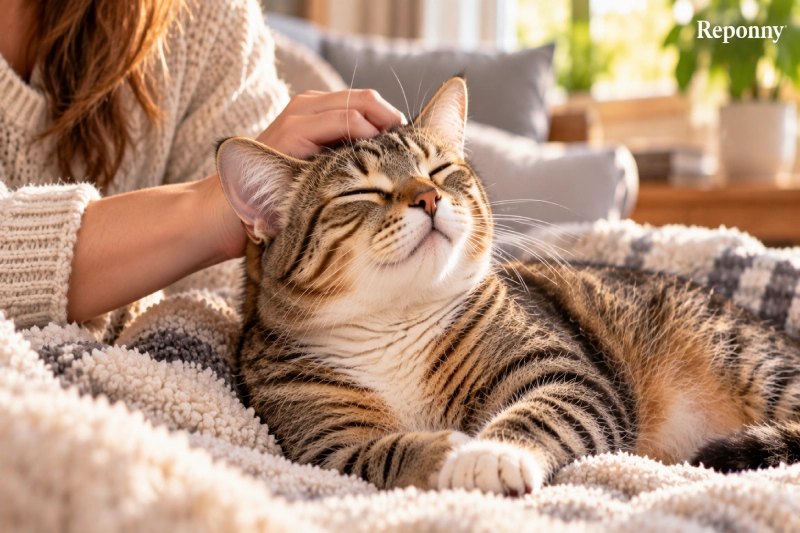
Why Does My Cat Purr When I Pet It?
Most likely because the interaction is comfortable.
If your cat:
- approaches voluntarily,
- remains close,
- purrs,
- has soft eyes,
- keeps its ears neutral,
- kneads,
- rubs against you,
- or slowly blinks,
the overall pattern suggests a positive social interaction.
But continue watching the tail and body.
A cat can begin the interaction happily and later become overstimulated.
If the tail starts thrashing, ears turn backward, skin twitches, or the cat repeatedly looks at your hand, stop petting and allow it to choose whether the interaction continues.
Purring does not override other body-language signals.
Why Does My Cat Purr and Knead at the Same Time?
Purring and kneading both have strong associations with early kittenhood.
Kittens knead around the mammary glands while nursing, and close-range purring occurs in mother-kitten interactions.
Many cats retain kneading into adulthood.
An adult cat that climbs onto a soft blanket, kneads rhythmically, purrs, and settles down is generally displaying a collection of behaviors associated with comfort and security.
Some cats drool slightly during especially intense kneading sessions as well.
As long as the behavior is normal for your cat and no other symptoms are present, it is usually not a concern.
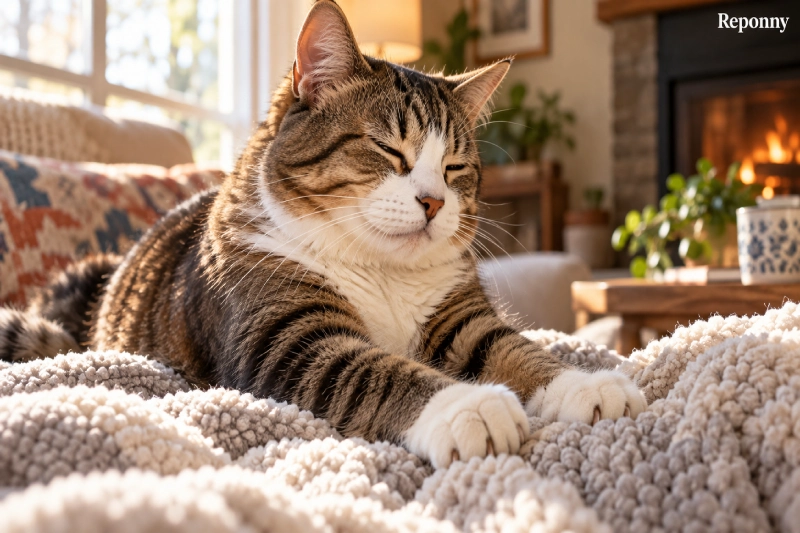
Why Does My Cat Purr When It Sees Me?
There can be several overlapping explanations.
Your cat may:
- enjoy your presence,
- anticipate physical contact,
- expect food,
- associate you with safety,
- or be initiating friendly interaction.
Domestic cats can form attachment relationships with their caregivers, and research shows that social interactions between cats and humans are far more complex than the old stereotype of cats as emotionally detached animals suggests.
Look at what happens next.
Cat purrs, tail up, rubs against you
Likely friendly greeting.
Cat purrs, runs toward the kitchen, stares at bowl
Food solicitation may also be involved.
Cat purrs, climbs onto lap and sleeps
Comfort and social contact are likely.
Several motivations can exist simultaneously.
Your cat does not have to choose between liking you and liking breakfast.
Why Does My Cat Purr So Loudly?
Individual cats differ.
Some purr so quietly that you can barely hear them unless you place a hand gently against the chest or neck.
Others sound like small engines.
Scientific research confirms meaningful individual variation in purring characteristics, and a 2025 study found that purrs contain enough individual information to help distinguish one cat from another acoustically.
A naturally loud purr is usually not concerning.
What matters more is change.
If your normally quiet cat suddenly begins producing unusual respiratory sounds that you are interpreting as purring—especially with open-mouth breathing, coughing, wheezing, or visible effort—do not assume it is simply a louder purr.
Breathing difficulty requires veterinary attention.
Do All Cats Purr?
Most domestic cats purr, but frequency and loudness differ greatly between individuals.
Some cats purr frequently.
Others purr so quietly that their owners rarely notice it.
A cat that does not often purr can still be perfectly happy and securely bonded.
Look for other positive signals such as:
- relaxed posture,
- tail-up greetings,
- rubbing,
- slow blinking,
- choosing to sleep nearby,
- playing,
- normal appetite,
- and voluntarily seeking interaction.
Do not judge your relationship entirely by the volume of your cat’s purr.
Can Cats Recognize Each Other by Purring?
This is an emerging research area.
A 2025 study found substantial individual identity information in purrs. Researchers analyzed hundreds of vocalizations and achieved 84.6% classification accuracy for individual cats from purrs, higher than the accuracy obtained from meows in that dataset.
That does not yet prove exactly how cats use those identity cues in everyday social life.
But it suggests that a purr may convey more information about who is producing it than the repetitive sound initially appears to contain.
This is another reminder that feline vocal communication is more sophisticated than “purr equals happy.”
How to Tell Why Your Cat Is Purring
Use context.
| Situation | Likely Explanation |
|---|---|
| Relaxing on your lap with soft eyes | Contentment |
| Rubbing against you with tail up | Friendly social communication |
| Waiting beside food bowl | Solicitation / hunger |
| Mother nursing kittens | Mother-kitten communication |
| In unfamiliar carrier with tense body | Stress or self-regulation may be involved |
| Hiding, hunched or moving painfully | Illness or pain should be considered |
| Kneading a blanket and settling down | Comfort / relaxation |
| Purring while following you to kitchen | Social greeting and/or food request |
The strongest interpretation usually comes from several signals pointing in the same direction.
When Should Purring Concern You?
Purring by itself usually requires no veterinary care.
Instead, pay attention to the behaviors surrounding it.
Contact your veterinarian if purring occurs alongside:
- sudden appetite loss,
- repeated vomiting or diarrhea,
- difficulty breathing,
- weakness,
- hiding,
- significant weight loss,
- lameness,
- inability to jump normally,
- persistent hunched posture,
- unusual aggression when touched,
- urinary difficulty,
- or another substantial change from normal behavior.
Cats can hide pain surprisingly well.
A purr does not rule it out.
Frequently Asked Questions
Why Do Cats Purr?
Cats purr for several reasons, including contentment, social communication, solicitation, mother-kitten interaction, stress, and pain or illness. Scientific reviews emphasize that purring occurs in multiple contexts rather than serving as a single “happy” signal.
Does Purring Always Mean a Cat Is Happy?
No.
Happiness and relaxation are common reasons, but cats may also purr during fear, stress, pain, hunger, or illness.
Why Does My Cat Purr When I Pet It?
If its body is relaxed and it voluntarily remains with you, purring likely reflects comfort and friendly social interaction.
Watch for other signals to make sure the cat does not become overstimulated.
Why Does My Cat Purr When It Is Hungry?
Cats can produce a solicitation purr containing a higher-frequency element that humans perceive as especially urgent. Research suggests cats may use this form when requesting food from people.
Why Does My Cat Purr at the Vet?
Stress does not prevent purring.
Cats can purr in uncomfortable or frightening situations, potentially as part of communication or self-regulatory behavior.
Why Does My Sick Cat Still Purr?
Purring does not prove that a cat feels well.
Cats have been observed purring during pain, stress, and serious illness. Evaluate appetite, posture, movement, breathing, activity, and other symptoms rather than relying on purring alone.
At What Frequency Do Cats Purr?
Modern experimental research found that excised domestic-cat larynges could produce purr-range fundamental frequencies of approximately 25–30 Hz.
Higher harmonics can also occur.
Do Cats Purr When They Breathe In and Out?
Yes.
A feline-vocalization review describes purring as being produced continuously through both the inspiratory and expiratory phases of breathing.
Does a Cat’s Purr Heal People?
Claims that a cat’s purr directly heals fractures or tissue are not established by clinical evidence.
There is genuine research on feline purr frequencies, but frequency overlap with experimental vibration therapies does not demonstrate that natural purring provides a therapeutic treatment.
Why Does My Cat Purr and Bite Me?
A cat may initially enjoy an interaction and then become overstimulated.
Purring can continue while other signals—such as tail thrashing, backward ears or body tension—indicate that the cat wants contact to stop.
Read the whole body rather than the purr alone.
Final Thoughts
A cat’s purr is one of the most familiar sounds in the animal world, but its meaning is much richer than:
“I’m happy.”
Yes, cats frequently purr when they are deeply relaxed.
They may purr while sleeping beside you, kneading a blanket, being stroked, or resting with another familiar cat. Research consistently associates purring with friendly and affiliative interactions.
But cats can also use purring to communicate a need.
The solicitation purr demonstrates that cats can modify purring in ways humans perceive as more urgent, particularly when asking for food.
Purring also begins early in life and plays a role in mother-kitten communication.
And most importantly, cats may purr when frightened, stressed, in pain, or unwell.
So when your cat purrs, listen—but also look.
Ask:
Are the eyes soft?
Are the ears relaxed?
Is the body loose or tense?
Is the cat eating normally?
Is it seeking attention, standing beside the food bowl, hiding, or moving differently?
Context gives the purr its meaning.
Science is even changing our understanding of how the sound itself is produced. Research published in 2023 showed that specialized feline vocal-fold anatomy can generate approximately 25–30 Hz purr-like oscillations without the active muscular mechanism long assumed to be essential.
And research published in 2025 found that purrs carry surprisingly strong information about individual cat identity.
The purr may sound simple.
Biologically and socially, it is anything but.