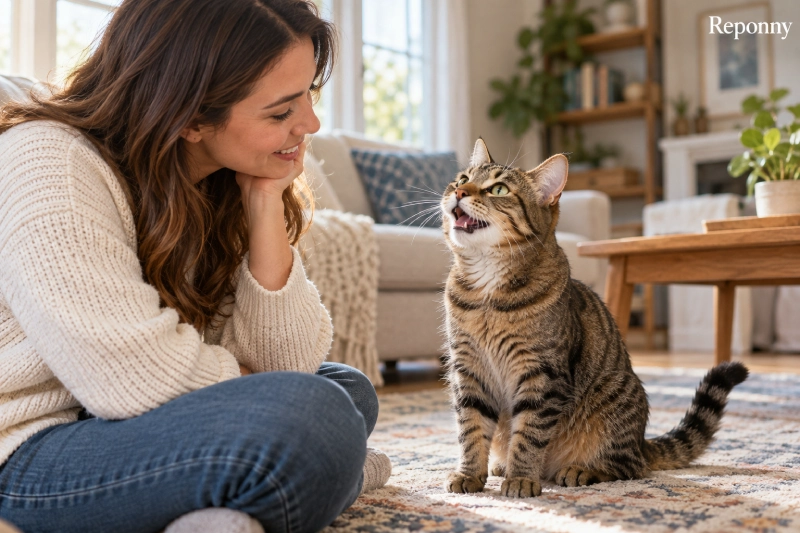
Some cats barely make a sound. Others seem determined to hold a conversation from the moment you wake up until you go to bed.
Your cat may meow when you enter the room, while following you into the kitchen, beside a closed door, before dinner, or at three o’clock in the morning for no obvious reason.
In many cases, this is completely normal.
Adult domestic cats use meowing particularly often in communication with humans. Cats Protection notes that adult cats do not usually communicate with other adult cats by meowing in the same way they communicate with us, while VCA describes meowing as an especially important form of human-directed communication. Kittens, mothers, unneutered cats seeking mates, and cats in certain social situations are exceptions.
Cats can learn surprisingly quickly which sounds make people respond.
If a particular meow causes you to open the food cupboard, your cat may repeat it tomorrow. If another sound makes you open a door, provide attention, or begin playing, that vocalization can become part of your cat’s personal communication system.
But there is an important distinction between a naturally talkative cat and a cat that suddenly starts meowing much more than usual.
Pain, urinary problems, hyperthyroidism, cognitive decline, anxiety, sensory changes, and other health conditions can increase vocalization. A new pattern should therefore never automatically be dismissed as your cat becoming “more demanding.”
Quick answer: Cats may meow because they are greeting you, hungry, seeking attention, bored, asking for access, stressed, in heat, responding to changes in their environment, or experiencing a medical problem. If your cat suddenly begins meowing much more than normal—especially with weight loss, appetite or thirst changes, litter-box problems, pain, confusion, or nighttime yowling—contact your veterinarian.
Why Do Cats Meow at Humans?
One of the most interesting features of the domestic cat’s meow is how strongly it is associated with communication with people.
VCA explains that kittens meow to communicate with their mothers, but mature domestic cats continue using meows particularly effectively with humans. Cats appear to learn that people respond to vocal signals more readily than we respond to many subtle feline signals such as scent marking or body posture.
That means your cat may develop an individual “vocabulary.”
One sound may mean:
“Good morning.”
Another may mean:
“Open this door.”
A longer, more persistent version may mean:
“Dinner is late.”
Cats Protection notes that owners often learn to recognize their own cat’s different vocal patterns because cats can learn which sounds lead to particular responses from their caregivers.
There is no universal translation dictionary, however. The same pitch or length of meow can mean different things in different cats.
The most useful clues are context and changes from your cat’s normal behavior.
1. Your Cat Is Greeting You
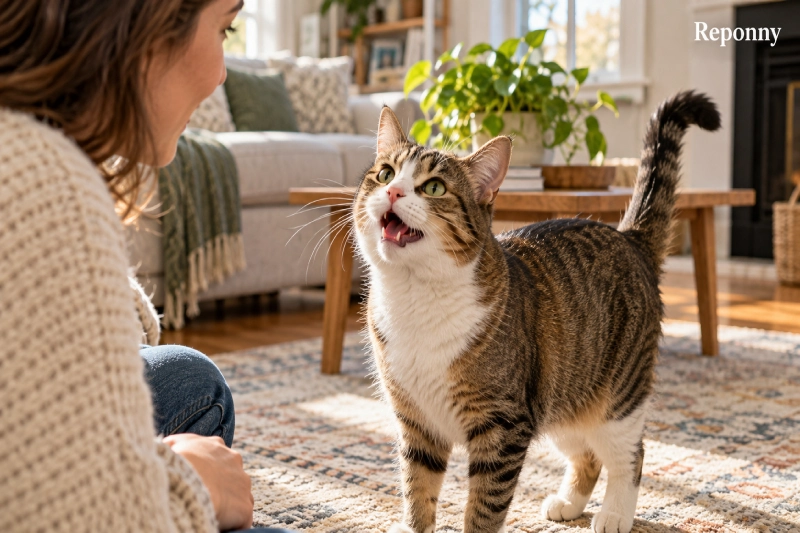
Some cats simply like to announce themselves.
You may hear a short meow when you:
come home from work, enter a room, wake up in the morning, or make eye contact after your cat has been resting.
VCA describes greeting as one of the common reasons cats meow at people.
Look at the rest of the cat.
A friendly greeting may include an upright tail, soft eyes, relaxed ears, rubbing against your legs, and voluntarily approaching you.
In this context, vocalization is probably not a problem that needs to be stopped.
It is simply part of your cat’s social personality.
Some cats greet quietly.
Others appear to have a detailed report prepared every time you return home.
2. Your Cat Is Hungry—or Has Learned That Meowing Produces Food
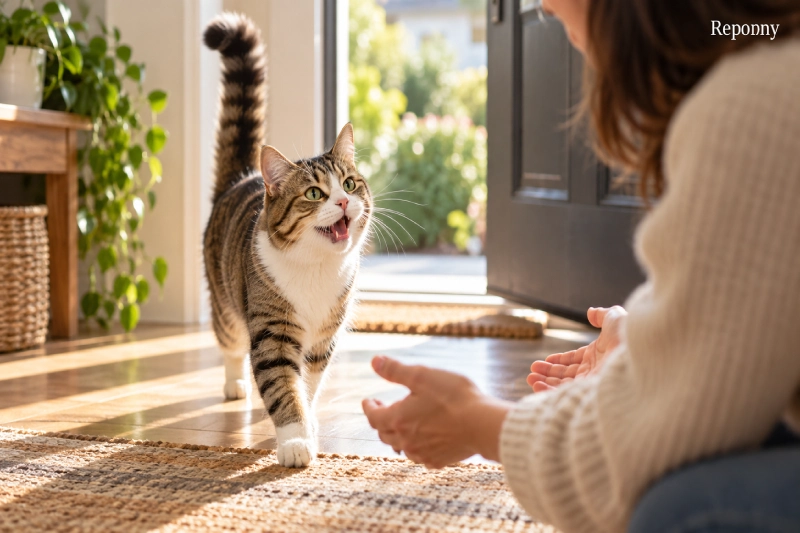
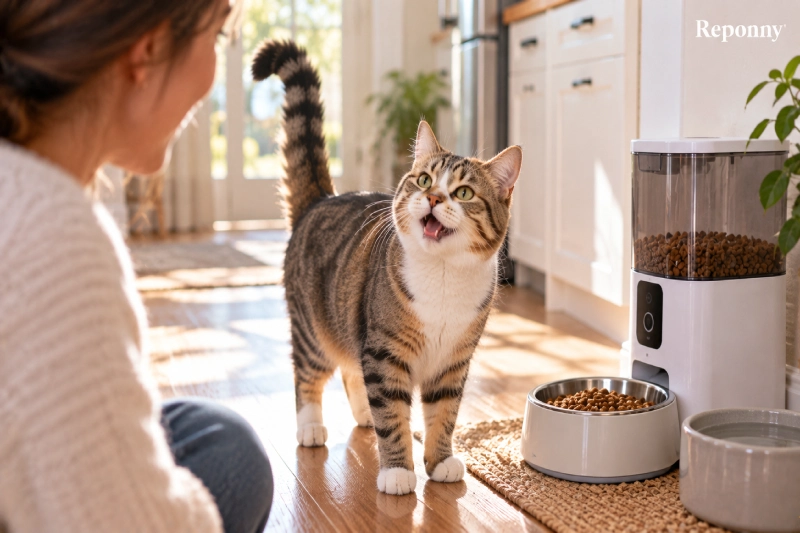
Mealtime is one of the strongest triggers for vocalization.
Your cat may begin meowing when it hears:
a food container opening, the refrigerator door, your alarm clock, or even your footsteps heading toward the kitchen.
VCA identifies food solicitation as one of the most common reasons for meowing and recommends maintaining predictable feeding routines rather than repeatedly providing food in direct response to demanding vocalization.
This is where learning becomes important.
Imagine this sequence:
Your cat meows.
You feed it.
The next morning, it meows again.
You feed it again.
From the cat’s perspective, the strategy works perfectly.
Over time, the meowing may start earlier, last longer, or become louder.
That does not mean you should ignore genuine hunger. Make sure your cat is receiving the appropriate daily calorie intake.
But once nutritional needs are being met, try to make the feeding schedule, rather than the meow itself, predict when food appears.
An automatic feeder can sometimes help because breakfast begins to come from a machine rather than directly from a sleepy human at 4:30 a.m.
3. Your Cat Wants Attention
A cat may meow because it wants something more valuable than food:
you.
Some cats vocalize when they want:
petting, play, grooming, conversation, or simply company.
If your cat meows and you immediately look at it, talk to it, pick it up, or begin playing, the cat may learn that vocalization is an excellent attention button.
That is not necessarily bad.
Communication between cats and people is part of the relationship.
The problem occurs when the behavior becomes so persistent that both the cat and household become frustrated.
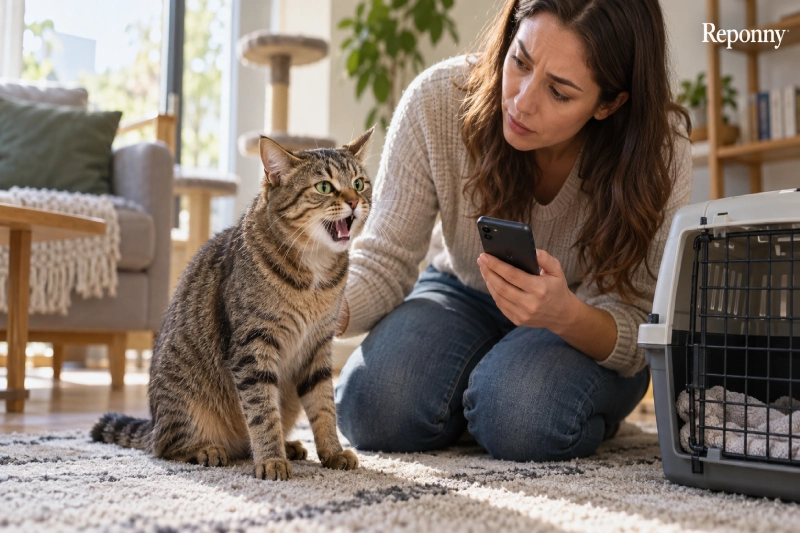
VCA recommends responding strategically. Instead of rewarding persistent demanding meowing at its peak, wait for a brief quiet moment and then provide attention, affection, or play. This can help reinforce calmer behavior rather than increasingly intense vocalization.
Do not punish the cat for trying to communicate.
Instead, provide plenty of positive interaction before the cat becomes desperate for stimulation.
4. Your Cat May Be Bored
Indoor cats need more than food and a litter box.
They also need opportunities to:
climb, stalk, chase, scratch, explore, hide, observe, and interact.
A cat that spends much of the day with little stimulation may discover that meowing produces activity.
VCA’s veterinary behavior guidance recommends providing regular social play, exploratory opportunities, toys, climbing, perching, and food-based enrichment for cats with problematic vocalization.
Try thinking like a cat.
If nothing interesting has happened for six hours and loudly meowing causes a human to appear, meowing suddenly becomes one of the most entertaining activities available.
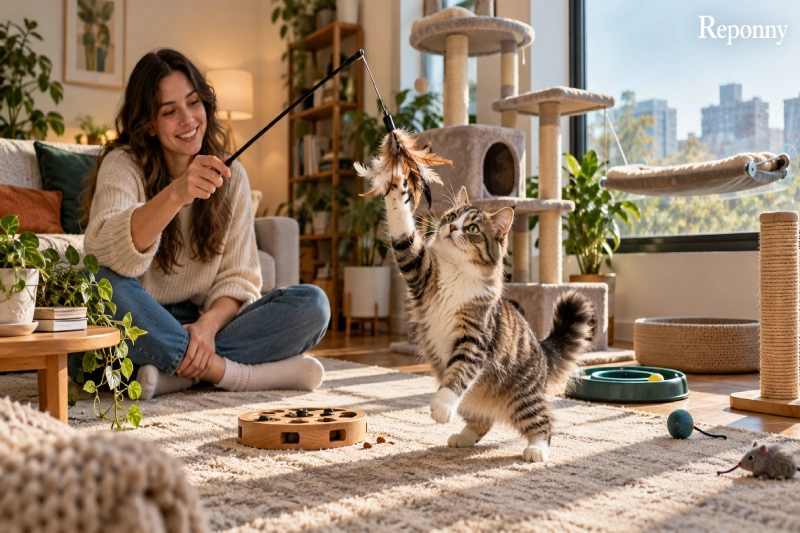
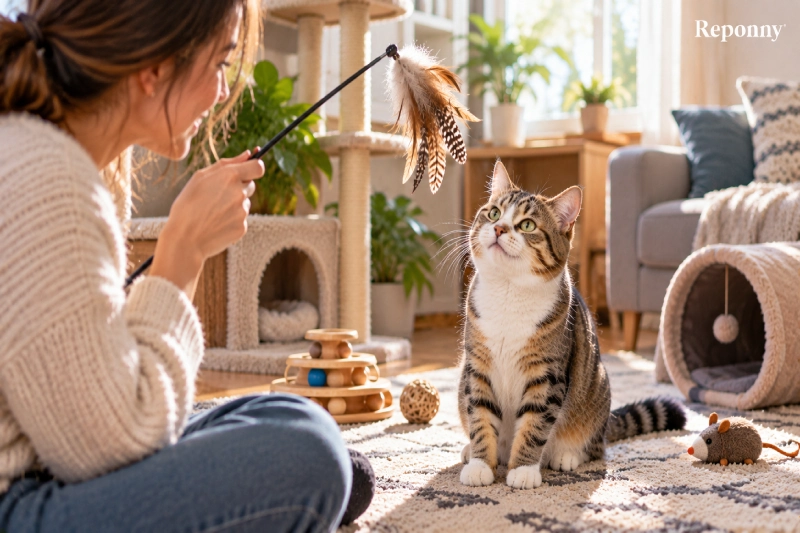
Scheduled interactive play can help.
A useful routine is a short hunting-style play session using a wand toy, followed by part of the cat’s normal meal.
Puzzle feeders, window perches, cat trees, cardboard boxes, rotating toys, and opportunities to explore vertically can also add variety.
The goal is not simply to make the cat tired.
It is to create a life in which vocalizing is not the only reliable way to make something happen.
5. Your Cat Wants a Door Open—or Access to Something
Cats quickly learn that humans control important resources.
We open:
bedroom doors, closets, windows, food cabinets, balconies, and sometimes access to outdoor spaces.
VCA specifically identifies requests for access as a common reason cats meow.
Your cat may stand beside a closed door and vocalize until you open it.
Again, consistency matters.
If a room is permanently off-limits, opening the door occasionally after 20 minutes of meowing can accidentally teach the cat one powerful lesson:
Twenty minutes of meowing works.
If access is safe and appropriate, consider a predictable routine.
If access is not allowed, provide an alternative attractive area rather than repeatedly changing the rule.
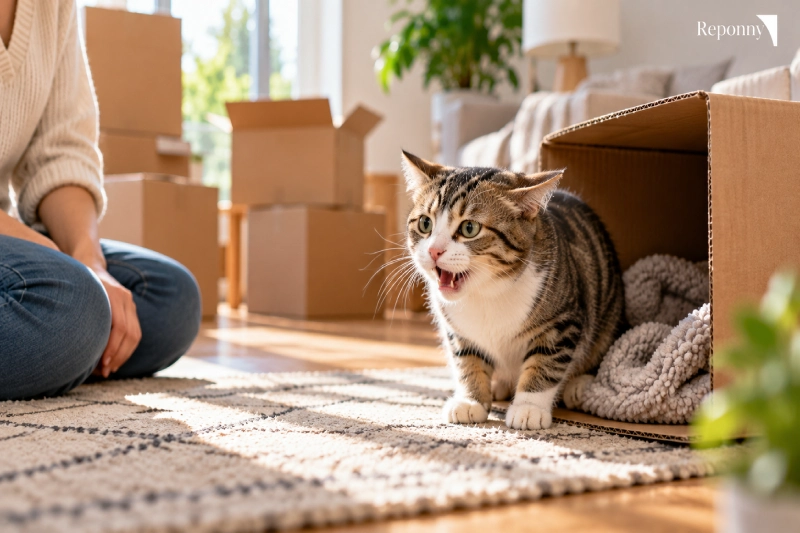
6. Stress or Environmental Change Can Increase Meowing
Cats often prefer predictability.
Changes that seem minor to humans may be significant to them.
A move, renovation, new baby, visitor, new pet, change in work schedule, outdoor cat appearing at a window, conflict with another household cat, or relocation of important resources can all change behavior.
Cats Protection advises paying attention to body language when vocalization increases. Ears turning sideways or backward and wide pupils can accompany anxiety, and a change in the frequency or type of vocalization warrants attention.
Stress-related meowing may occur with other signs such as hiding, reduced play, urine marking, overgrooming, appetite changes, increased vigilance, or social withdrawal.
Do not simply try to silence the noise.
Ask:
“What changed?”
Sometimes restoring predictability, increasing hiding opportunities, separating resources in a multi-cat household, or preventing visual conflict with outdoor cats can address the underlying issue.
If anxiety is persistent or severe, veterinary or qualified behavior support may be appropriate.
7. Unneutered Cats May Yowl When Seeking a Mate
Hormonal behavior can dramatically increase vocalization.
An unspayed female cat in heat may become extremely vocal, producing prolonged calls or yowls that are very different from ordinary conversational meows.
Unneutered males may also vocalize in response to females and mating-related signals.
VCA identifies sexual behavior as one of the common causes of persistent feline vocalization.
You may also notice restlessness, increased affection, attempts to escape outdoors, rolling, unusual postures, or urine marking.
If you are not planning responsible breeding, discuss spaying or neutering with your veterinarian.
Do not punish reproductive vocalization.
The cat is responding to biology, not deliberately trying to disturb the household.
8. Your Cat May Be Meowing Because Something Hurts
A cat that suddenly becomes much more vocal should be evaluated differently from a naturally talkative cat.
VCA includes meowing more than normal among possible behavioral signs of pain. Other changes may include restlessness, reluctance to jump, hiding, reduced activity, aggression when touched, or purring at unusual times.
Pain can come from many sources.
Arthritis may make climbing stairs or entering a litter box uncomfortable. Dental disease may make eating painful. Abdominal disease, injury, constipation, urinary problems, or other conditions can also produce vocalization.
Because cats often hide illness, behavioral changes may appear before dramatic physical symptoms.
If your normally quiet cat suddenly starts crying repeatedly, the question should not first be:
“How do I make the cat stop?”
It should be:
“Why has this changed?”
Meowing in the Litter Box Can Be an Emergency
This situation deserves special attention.
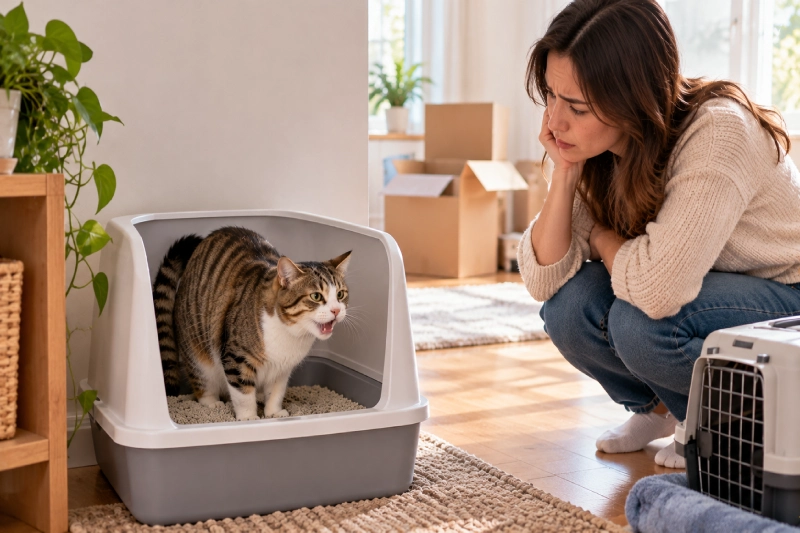
Cornell lists crying while urinating, frequent attempts to urinate, painful urination, blood in the urine, and passing little or no urine among signs of feline lower urinary tract disease. A complete urethral obstruction is an absolute emergency.
Male cats are particularly vulnerable because their urethra is relatively narrow.
If your cat repeatedly enters the litter box, strains, cries, and produces little or no urine, seek veterinary care immediately.
Do not assume the cat is constipated.
Do not wait overnight to see whether the problem improves.
Cornell warns that complete urinary obstruction can rapidly cause dangerous electrolyte abnormalities and become life-threatening.
VCA likewise identifies repeated unproductive urination and vocalizing in the litter box as warning signs requiring urgent attention.
Why Is My Older Cat Meowing So Much?
In senior cats, increased vocalization deserves particular attention.
Cornell notes that older cats may develop excessive meowing, wandering, disorientation, altered sleep patterns, sensory changes, pain, and other behavioral changes. Importantly, these signs should not automatically be dismissed as “just old age.”
Several medical conditions can contribute.
One is hyperthyroidism, a common disease of middle-aged and older cats. Cornell’s 2026 guidance lists weight loss, increased appetite, increased thirst and urination, vomiting or diarrhea, hyperactivity, and behavioral changes among common signs. Cornell’s internal medicine guidance also specifically includes vocalizing among possible symptoms.
So an older cat that suddenly becomes:
very hungry, thinner, restless, thirsty, and unusually vocal
should not simply be labeled demanding.
A veterinary examination and blood testing may reveal a treatable medical cause.
Why Does My Senior Cat Yowl at Night?
Nighttime vocalization is particularly common in conversations about aging cats.
Cornell describes loud, apparently unprompted vocalization—often during the night as one possible sign of feline cognitive dysfunction. Other signs can include disorientation, altered sleep-wake cycles, staring at walls, reduced interest in play, inappropriate elimination, and changes in interaction.
However, cognitive dysfunction should not be assumed until other causes are considered.
Cornell points out that nighttime vocalization in older cats can also be associated with conditions such as:
hyperthyroidism, hypertension, pain, sensory decline, and other age-related diseases.
A cat losing vision or hearing may also become disoriented, particularly in darkness.
If your senior cat suddenly begins walking through the house crying at night, schedule a veterinary evaluation rather than immediately assuming dementia.
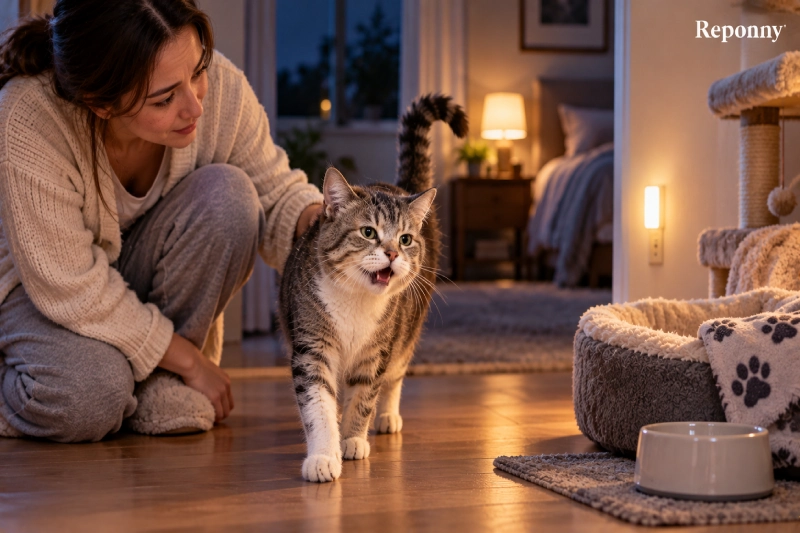
Some Cats Are Naturally More Vocal Than Others
Not every highly vocal cat has a behavioral or medical problem.
Individual personality matters.
VCA’s veterinary behavior guidance notes that certain breeds, including Siamese cats, are known for being particularly vocal.
Even within the same breed, however, there can be enormous variation.
One cat may greet you with one quiet chirp.
Another may provide commentary while you cook, shower, work, and walk between rooms.
The key concept is baseline.
If your cat has always been talkative, remains healthy, eats normally, maintains weight, uses the litter box normally, sleeps normally, and shows relaxed body language, frequent meowing may simply be part of its personality.
If a normally quiet cat suddenly becomes extremely vocal, that change is far more significant.
Does the Sound of the Meow Matter?
Yes—but not enough to create a universal translation chart.
Cats can vary:
pitch, duration, intensity, repetition, and timing.
VCA notes that cats use different tones and intensities when communicating with people, and owners often become skilled at recognizing their own cat’s vocal patterns.
A short conversational meow may accompany greeting.
A long, persistent meow may accompany a request.
A loud yowl or caterwaul is more intense and may occur during mating behavior, territorial arousal, stress, pain, or illness.
But avoid internet charts claiming that every specific sound has a fixed English translation.
Your own cat’s normal pattern is much more useful.
A change in voice quality can also matter.
VCA recommends veterinary attention when a cat’s meow suddenly becomes different or raspy, while Merck notes that laryngeal disorders can alter the voice and may be associated with respiratory disease, irritation, trauma, or other problems.
Why Does My Cat Meow When I Talk to It?
Some cats appear to participate in genuine back-and-forth conversations.
You say the cat’s name.
It meows.
You answer.
It meows again.
This does not mean the cat understands human language in the same way another person does.
But it may understand that vocal interaction produces social attention.
Over time, the cat-human pair can develop a predictable pattern.
Your tone, facial expression, routine, gestures, and previous responses all contribute.
So when your cat “answers” you, it may not be translating your sentence.
It is participating in a learned social exchange.
There is nothing wrong with enjoying the conversation.
Why Does My Cat Follow Me and Meow?
Following plus vocalizing often suggests a request for interaction.
The cat may want:
food, attention, play, access to another room, or simply company.
Watch what happens next.
A cat that walks toward the kitchen while looking back at you may have a different goal from a cat that leads you toward a toy.
If the behavior suddenly becomes unusually persistent, consider whether the cat is stressed or uncomfortable rather than assuming it merely wants attention.
Context turns the sound into useful information.
Why Does My Cat Meow Before Using the Litter Box?
An occasional sound does not necessarily indicate disease.
But repeated vocalization associated with urination or defecation should not be ignored.
Painful urination, bladder inflammation, urinary stones, constipation, arthritis, and other problems can make litter-box use uncomfortable.
Cornell specifically lists crying while urinating among signs of feline lower urinary tract disease.
If your cat strains repeatedly while producing little or no urine, treat that as an emergency—particularly in a male cat.
What Should You Do About Excessive Meowing?
Start by identifying why the cat is vocalizing rather than trying to suppress the sound.
A practical approach looks like this:
| Situation | Best First Response |
|---|---|
| Normal greeting meow | Respond normally if you enjoy the interaction |
| Meowing before scheduled meals | Keep feeding times predictable |
| Demanding attention | Provide regular enrichment; reward calm moments |
| Bored indoor cat | Increase play, climbing, exploration and food enrichment |
| Meowing at a closed door | Establish a consistent access rule |
| New meowing after household change | Look for stressors and improve predictability |
| Unspayed/unneutered mating calls | Discuss spaying/neutering with your veterinarian |
| Sudden unexplained vocalization | Veterinary evaluation |
| Senior cat yowling at night | Check for medical, sensory and cognitive causes |
| Crying and straining in litter box | Urgent veterinary care, especially if little/no urine is produced |
The general rule is simple:
meet genuine needs, investigate medical causes, enrich the environment, and avoid accidentally rewarding escalating demand behavior.
Do not shout at your cat or physically punish it.
The animal is either communicating a need, repeating a learned behavior, reacting emotionally, or experiencing a problem. Punishment does not identify which one.
How to Reduce Attention-Seeking Meowing Without Ignoring Your Cat
There is an important difference between:
ignoring a cat
and
not rewarding the loudest possible version of a request.
Your cat still needs social interaction.
Provide it proactively.
Schedule several short periods of play and attention throughout the day.
When possible, begin interaction while the cat is calm rather than waiting until it has been vocalizing continuously.
VCA recommends reinforcing brief quiet periods rather than immediately rewarding persistent attention-demanding meowing.
For example, if the cat is meowing repeatedly for play, wait for a brief pause.
Then initiate the game.
Over time, the cat may learn:
being calm also makes good things happen.
When Should You See a Veterinarian?
A sudden or persistent change in vocalization deserves attention, particularly when accompanied by another change in health or behavior.
VCA advises veterinary evaluation for new vocalization patterns, including increased meowing, nighttime roaming and meowing, litter-box vocalization, or changes in the sound of the voice.
Be especially concerned when increased meowing occurs with changes in appetite or thirst, weight loss, vomiting or diarrhea, difficulty moving, hiding, aggression when touched, breathing changes, confusion, poor grooming, or altered urination.
And remember the urinary emergency:
repeated straining + crying + little or no urine = immediate veterinary attention.
Frequently Asked Questions
Why Is My Cat Meowing So Much All of a Sudden?
A sudden increase can result from stress, pain, illness, urinary problems, hormonal behavior, hunger, or another change.
Because cats rarely change established behavior for no reason, a new vocalization pattern should be investigated—especially when other physical or behavioral changes are present.
Why Does My Cat Meow at Me Constantly?
Your cat may have learned that meowing produces food, attention, play, access, or conversation.
Make sure basic needs and medical problems are addressed first. If the behavior is learned attention-seeking, provide predictable enrichment and reward calm periods rather than repeatedly responding only after persistent vocalization.
Why Does My Cat Meow So Much at Night?
Young healthy cats may be active at night because of their natural activity patterns, boredom, or learned attention-seeking.
In older cats, however, nighttime vocalization can also be associated with pain, hyperthyroidism, hypertension, sensory decline, or cognitive dysfunction.
Why Is My Older Cat Meowing More?
Senior cats may vocalize more because of medical disease, pain, hearing or vision changes, anxiety, hyperthyroidism, hypertension, or cognitive decline.
Cornell recommends not assuming behavioral changes are simply an inevitable part of aging.
Why Does My Cat Meow for Food Even After Eating?
Possibilities include learned food-seeking behavior, boredom, a diet that does not match energy needs, or increased appetite caused by disease.
Hyperthyroidism can cause increased appetite together with weight loss and other behavioral changes in middle-aged and older cats.
If appetite has suddenly increased while your cat loses weight, contact your veterinarian.
Why Is My Cat Meowing in the Litter Box?
Painful urination, bladder inflammation, urinary stones, obstruction, constipation, or other medical problems may cause vocalization.
A cat repeatedly straining with little or no urine needs immediate veterinary care because urethral obstruction can be life-threatening.
Why Does My Cat Meow When I Come Home?
This is commonly a greeting.
If your cat approaches with relaxed posture, soft eyes and perhaps an upright tail, the meow is likely part of friendly social interaction.
Why Does My Cat Meow When I Stop Petting It?
The cat may be requesting more attention.
If its body remains relaxed and it voluntarily stays close, you can continue if you want. But watch for overstimulation signs such as tail lashing, tense muscles or backward ears.
Why Has My Cat’s Meow Become Raspy?
A temporary voice change may occur after heavy vocalization, but persistent changes can also occur with laryngeal inflammation, respiratory disease, irritation, trauma or other conditions.
A new or persistent raspy voice should be discussed with your veterinarian.
Are Some Cat Breeds More Vocal?
Yes.
VCA notes that breeds such as Siamese cats tend to be more vocal than many others. Individual personality still varies enormously within every breed.
Final Thoughts
Meowing is one of the ways domestic cats have become extraordinarily effective at communicating with people.
Your cat may meow to say:
hello, feed me, play with me, open the door, pay attention, or something does not feel right.
The challenge is that the same sound does not always carry the same message.
Context matters.
A cat meowing beside the food bowl five minutes before breakfast is very different from an older cat wandering through the house yowling at 2 a.m.
A short greeting from a relaxed cat is very different from crying while straining in the litter box.
And a naturally talkative Siamese is very different from a normally silent cat that suddenly begins vocalizing continuously.
The most useful thing you can learn is your own cat’s baseline.
Know how often your cat normally meows.
Know what its normal voice sounds like.
Know when it usually becomes vocal.
Then notice changes.
If the behavior is normal attention-seeking or food solicitation, predictable routines, enrichment, play, and reinforcing calmer behavior can help.
If the increase is sudden, unexplained, or associated with pain, weight loss, appetite or thirst changes, altered mobility, confusion, litter-box problems, or another health change, contact your veterinarian.
Older cats deserve particular attention. Cornell identifies nighttime vocalization as one possible sign of cognitive dysfunction but emphasizes that medical causes such as pain, hyperthyroidism, hypertension, and sensory changes may produce similar behavior.
And if your cat cries while repeatedly trying to urinate but produces little or nothing, do not wait.
A urinary obstruction can be a life-threatening emergency.
The goal is not to stop every meow.
A meowing cat is communicating.
The goal is to understand what changed, what the cat needs, and when that voice is telling you something medically important.