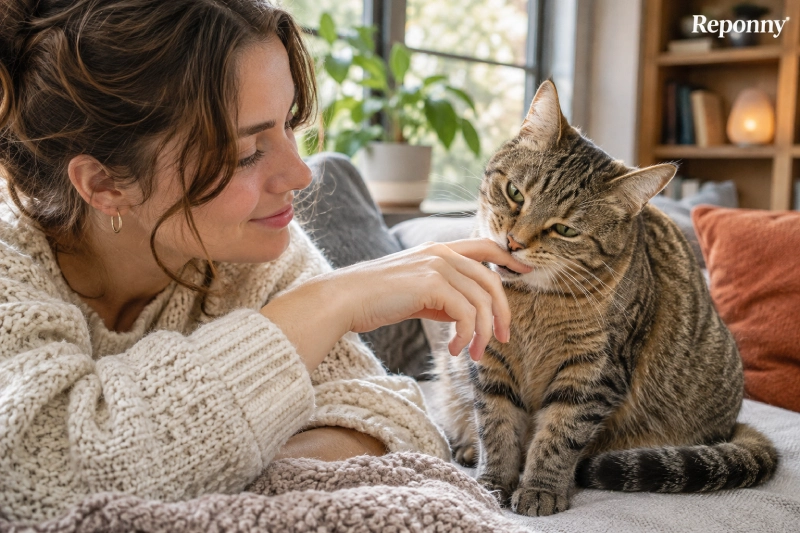
Your cat is curled beside you.
It is purring.
Its eyes are soft.
You stroke its cheeks, scratch gently behind the ears, and everything seems perfectly peaceful.
Then suddenly:
bite.
Not a full-force attack.
Not necessarily enough to break the skin.
Just a quick little nip on your hand before your cat either continues sitting beside you or walks away.
Cat owners commonly call these “love bites.”
But does your cat really bite because it loves you?
Sometimes a gentle bite occurs during an otherwise friendly interaction. But “love bite” is an informal human term rather than a specific scientific category of feline behavior.
A light nip can mean several different things.
Your cat may be:
- playing,
- becoming overstimulated,
- asking you to stop petting,
- responding to an uncomfortable touch,
- redirecting hunting behavior,
- or communicating in a way that happens to look affectionate.
VCA describes petting-induced aggression as a situation in which a cat may initially enjoy being stroked but eventually reach a point where continued physical contact is no longer pleasant. Instead of simply walking away, some cats turn and bite. The bite may be very light or may be strong enough to puncture the skin.
Cornell similarly notes that petting-induced aggression may be preceded by signs such as dilated pupils, tail lashing and ears moving backward.
Quick answer: A gentle “love bite” may occur during friendly interaction, but it does not necessarily mean affection. Cats may nip because they are playing, overstimulated, finished with petting, uncomfortable, frightened or in pain. Watch the entire body—especially the ears, tail, pupils and muscle tension. Stop petting before the bite if your cat begins showing discomfort.
What Is a Cat Love Bite?
“Love bite” is a popular phrase used to describe a relatively gentle cat bite that occurs during an otherwise calm or affectionate interaction.
Typically, the cat does not:
- charge at the person,
- growl continuously,
- attack repeatedly,
- or attempt to cause serious injury.
Instead, the sequence may look like:
approach → rubbing → purring → petting → gentle bite → interaction changes or ends.
The problem with the phrase “love bite” is that it can encourage people to interpret every gentle bite as affection.
That is not necessarily accurate.
VCA explains that some cats bite during petting because the physical sensation has become unpleasant, even though the cat may have genuinely enjoyed the first part of the interaction.
So a gentle bite may sometimes mean something closer to:
“That was enough.”
rather than:
“I love you.”
The strength of the bite matters—but so does everything that happened immediately beforehand.
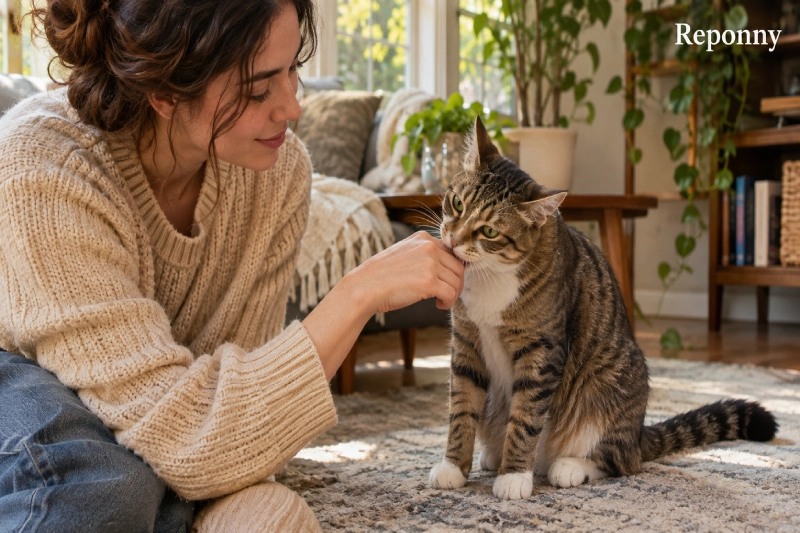
1. Your Cat May Be Overstimulated by Petting
This is one of the most common explanations.
A cat may genuinely enjoy petting for a while.
Then the same touch gradually becomes irritating.
VCA describes this as petting-induced aggression or sometimes “don’t pet me” aggression. The exact mechanism is not fully understood, but the cat’s tolerance for repeated touch appears to have a limit.
Imagine a cat that enjoys ten strokes.
The first five feel good.
The next three are tolerated.
By stroke number ten, the cat has had enough.
Humans often miss the transition because the cat was purring only seconds earlier.
But feline emotional states can change quickly.
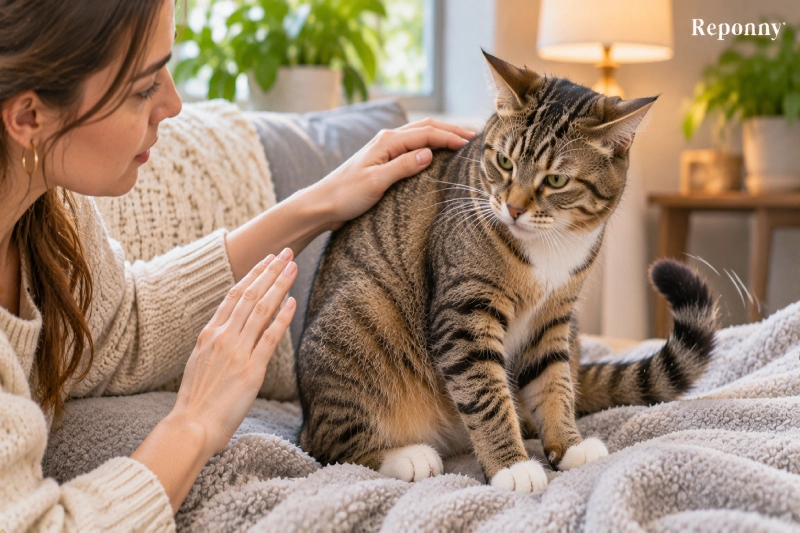
Warning signs may appear before the bite
Cornell and VCA identify several possible signs that a cat is becoming uncomfortable during petting:
- tail flicking,
- stronger tail lashing,
- ears rotating backward,
- body tension,
- dilated pupils,
- freezing,
- moving away,
- or turning the head toward the person’s hand.
The bite is often not the first signal.
It is simply the signal humans notice most clearly.
Stop before your cat has to bite
If the tail begins moving rapidly or the ears rotate back:
stop touching the cat.
Give it space.
Do not wait until it hisses or bites.
FelineVMA’s current positive-reinforcement guidance recommends keeping interactions relatively short, petting slowly, and pausing periodically to see whether the cat chooses to continue.
That is one of the best ways to prevent “love bites.”
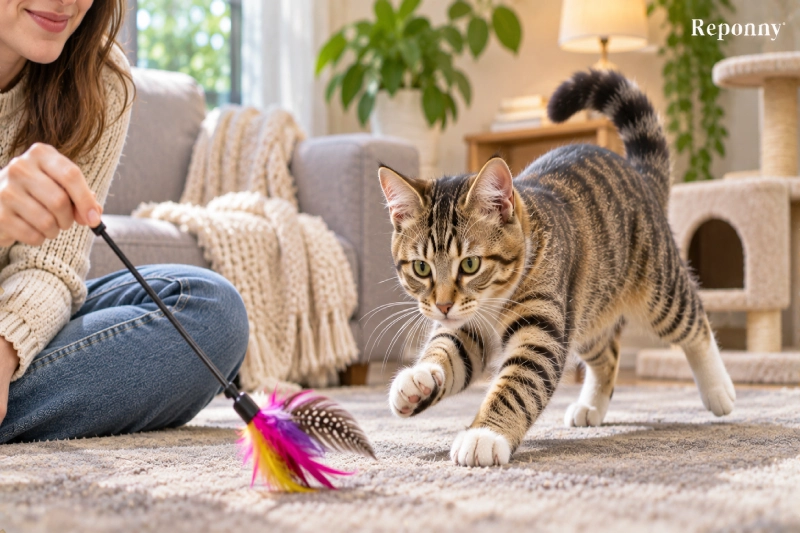
2. Your Cat May Simply Be Playing
Cats use their mouths during play.
Kittens especially practice:
- stalking,
- chasing,
- grabbing,
- wrestling,
- kicking,
- and biting.
These behaviors are connected to the predatory skills cats naturally use when hunting.
Cornell notes that young cats and kittens commonly display play aggression, particularly when they lack enough appropriate opportunities for play or did not have sufficient experience learning bite inhibition from littermates.
VCA similarly explains that under-stimulation and excess unused energy can lead to play-related biting, including stalking, pouncing and biting people.
How play biting may look
Your cat may:
- crouch,
- stare at your moving fingers,
- wiggle its hindquarters,
- pounce,
- grab your hand,
- bite,
- bunny-kick,
- and then run away.
This is very different from a calm cat lying on your lap that suddenly bites after fifteen minutes of petting.
Never make your hands the prey
It may seem funny to wrestle with a tiny kitten using your fingers.
But the kitten grows.
If the cat learns:
hands = toys,
the same behavior can become painful later.
VCA recommends directing predatory play toward appropriate moving toys rather than human hands and feet.
FelineVMA similarly recommends routine object play with prey-like toys, including short hunting-style play sessions.
Use:
- wand toys,
- toy mice,
- kicker toys,
- rolling toys,
- and other safe objects.
Let toys receive the bites.
Not your fingers.
3. Your Cat May Be Telling You “Stop”
A gentle bite can be communication.
Cats do not have words.
They communicate through:
- posture,
- ears,
- eyes,
- whiskers,
- tail movement,
- vocalization,
- movement away,
- swatting,
- and sometimes biting.
If earlier signals are missed, the cat may escalate.
Imagine this sequence:
Your cat turns its ears backward.
You continue petting.
Its tail begins flicking.
You continue petting.
The cat turns its head toward your hand.
You continue petting.
Finally:
bite.
From the cat’s perspective, the message may have been sent several times.
The bite was simply the first message that worked.
VCA specifically emphasizes watching for subtle changes such as ear position, body tension and tail flicking and stopping the interaction immediately when they appear.
A bite that stops when you stop
If your cat gives one controlled bite and immediately relaxes once the petting ends, that pattern strongly suggests the goal was to stop the interaction.
Punishment is unnecessary and counterproductive.
Your cat communicated.
The better response is to learn the earlier signals next time.
4. Your Cat May Like Some Types of Petting More Than Others
Not every part of a cat’s body is equally enjoyable to touch.
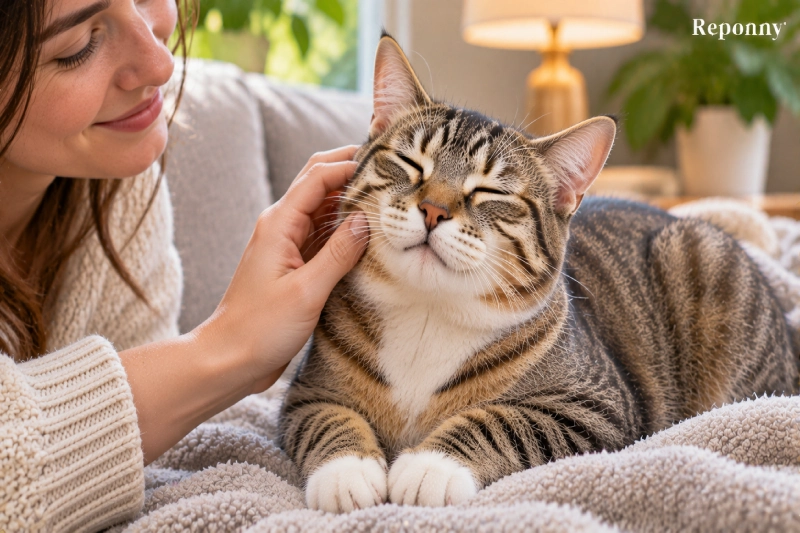
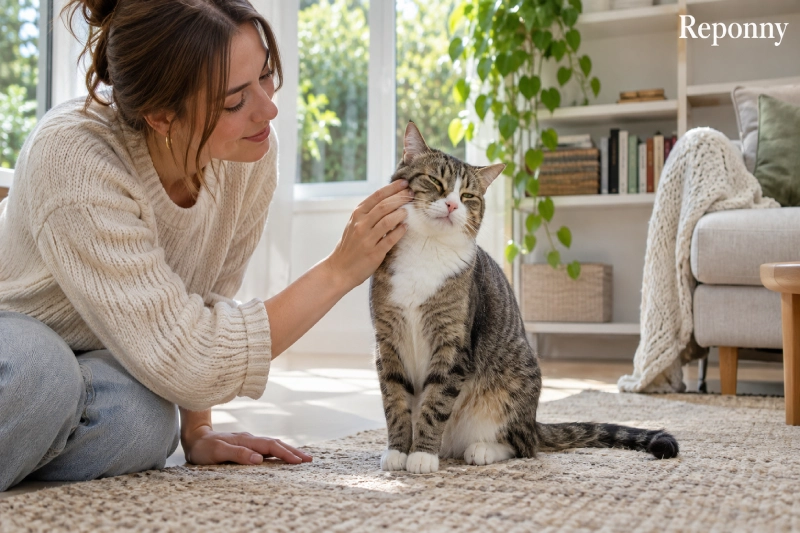
FelineVMA’s current guidance recommends initially focusing petting around the facial scent-gland areas, particularly around the temporal region between the eyes and ears, for cats that tend to bite during petting.
Many cats also enjoy:
- cheeks,
- chin,
- forehead,
- and around the base of the ears.
Other regions may be more sensitive.
For many cats, touching the:
- belly,
- feet,
- legs,
- tail,
- or lower back
may quickly reduce tolerance.
FelineVMA specifically cautions that belly exposure does not necessarily mean a cat wants the belly touched and that belly petting can lead to biting.
Let your cat vote
Try two or three gentle strokes.
Pause.
What happens?
If the cat:
- leans toward you,
- rubs into your hand,
- remains relaxed,
- or actively requests more contact,
continue briefly.
If the cat:
- turns away,
- moves its head,
- stiffens,
- flicks its tail,
- lowers its ears,
- or leaves,
stop.
This simple consent test can dramatically reduce petting-related bites.
5. A Bite Can Be Triggered by Pain
This is especially important when biting suddenly appears in a cat that previously enjoyed being touched.
Cornell notes that pain can produce defensive aggression.
Cats with conditions such as osteoarthritis may bite when painful joints are touched or when movement causes discomfort. Dental disease and other painful conditions can also alter behavior.
VCA similarly recommends veterinary examination when unexpected biting develops because discomfort in:
- joints,
- limbs,
- neck,
- back,
- ears,
- teeth,
- gums,
- or skin
can reduce a cat’s tolerance for touch.
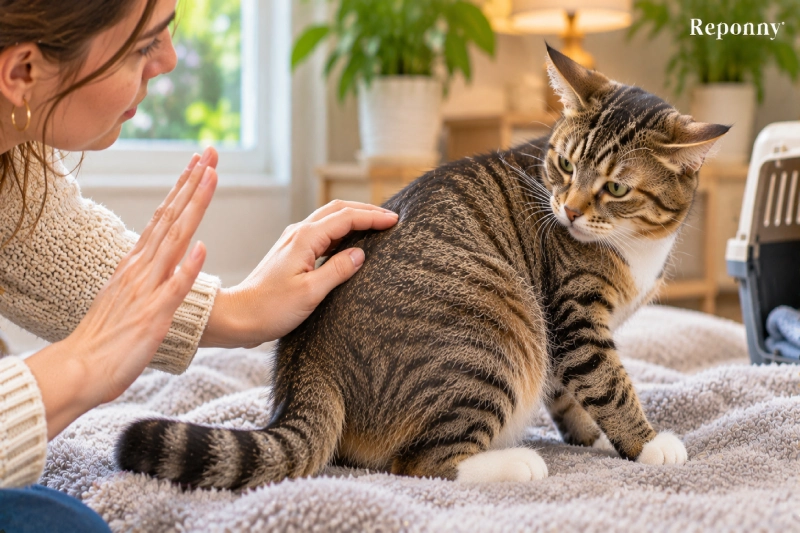
Watch for location-specific biting
Suppose your cat happily accepts cheek scratches.
But every time you touch the lower back, it immediately turns and bites.
That pattern deserves attention.
The problem may not be the cat’s personality.
It may be telling you:
“That hurts.”
Other possible signs of pain include:
- difficulty jumping,
- reduced activity,
- hiding,
- altered posture,
- poor grooming,
- aggression when handled,
- reduced appetite,
- or changes in litter-box behavior.
Do not repeatedly test the painful area.
Schedule a veterinary examination.
6. Skin Sensitivity Can Make Touch Uncomfortable
Pain does not always come from bones or joints.
Skin disease can also make petting unpleasant.
VCA notes that dermatitis or inflammation of the skin may increase sensitivity to touch and cause a cat to react aggressively during petting.
Possible causes of itchy or painful skin can include:
- fleas,
- allergies,
- wounds,
- infection,
- or other dermatologic problems.
Watch for:
- excessive scratching,
- overgrooming,
- hair loss,
- redness,
- scabs,
- skin twitching,
- or sudden sensitivity over one area.
A cat that once enjoyed being stroked along its back but suddenly cannot tolerate it may need veterinary examination.
What About Feline Hyperesthesia?
Some cats have an unusual syndrome involving extreme sensitivity, most often over the back and near the base of the tail.
Cornell describes feline hyperesthesia syndrome as a condition in which touching the affected area may trigger:
- skin rippling,
- dilated pupils,
- sudden scratching,
- tail chasing,
- vocalization,
- drooling,
- and sometimes sudden attempts to bite.
Hyperesthesia is not the explanation for every cat that dislikes lower-back petting.
It is relatively specific and requires veterinary evaluation.
But if your cat has dramatic episodes of skin rippling or appears unusually distressed when its back is touched, do not dismiss the behavior as a quirky “love bite.”
7. Fear or Startle Can Cause a Sudden Bite
A cat that feels trapped may bite even if it normally likes you.
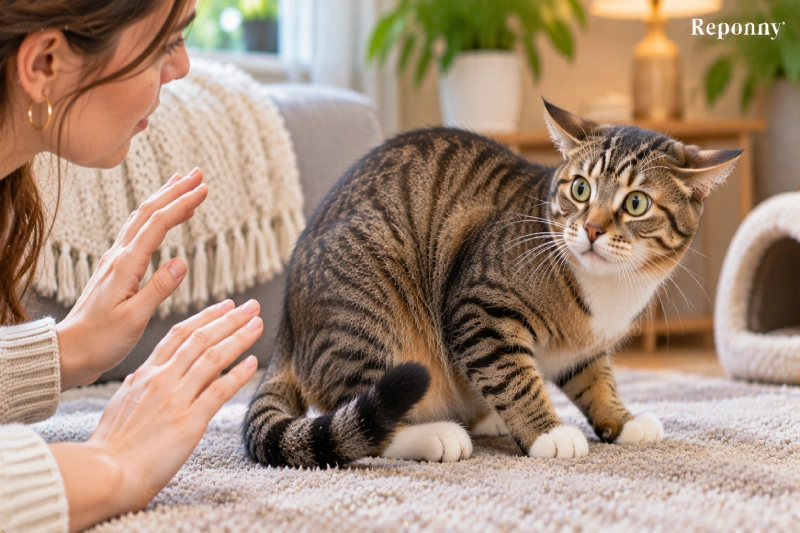
Cornell explains that fear aggression can occur after unfamiliar or unpleasant stimuli and may include:
- crouching,
- flattened ears,
- hissing,
- dilated pupils,
- tucked tail,
- and defensive biting.
VCA also notes that a frightened cat may startle easily when a person suddenly reaches toward it, particularly after a stressful event.
Imagine your cat has just heard a loud crash outside.
Its pupils are enormous.
The body is tense.
You reach down to comfort it.
The cat bites.
That bite does not mean the cat suddenly dislikes you.
Its nervous system was already highly aroused.
Give frightened cats space instead of immediately picking them up or restraining them.
8. Your Cat May Be Redirecting Arousal
Sometimes the person being bitten is not the original trigger.
A classic example:
Your indoor cat sees an unfamiliar cat outside the window.
It becomes intensely aroused.
The tail lashes.
The pupils dilate.
The body becomes rigid.
You walk over and try to pick it up.
The cat bites you.
Cornell describes this as redirected aggression—the cat is highly aroused by one stimulus but directs the response toward another nearby target.
FelineVMA’s 2026 behavior guidance likewise warns against approaching or picking up a highly aroused cat after conflict or frustration and recommends using barriers rather than hands if intervention is necessary.
This is not a love bite.
It can be dangerous.
Allow the cat time and space to calm down before attempting physical interaction.
Love Bite vs. Play Bite vs. Overstimulation Bite
These behaviors can look similar, but the context usually gives clues.
| Situation | Likely Explanation |
|---|---|
| Gentle nip during relaxed social interaction | Communication; may occur during affiliative interaction |
| Bite after several minutes of petting | Petting overstimulation likely |
| Stalking fingers or ankles before biting | Play / predatory behavior |
| Bite after tail lashing and ears turning back | Cat wants interaction to stop |
| Bite only when one body area is touched | Pain or sensitivity should be considered |
| Bite after sudden frightening event | Fear/startle |
| Bite after seeing another cat outside | Redirected arousal possible |
| Hard repeated bite with growling/hissing | Not a typical “love bite”; aggression/fear should be evaluated |
A useful rule is:
Do not name the bite first. Look at what happened before it.
Why Does My Cat Bite Me While Purring?
Because purring and biting are not opposites.
A cat can begin an interaction in a relaxed state, purr, enjoy petting, and then become overstimulated.
The purring may continue for part of that transition.
So:
purring does not guarantee unlimited permission to pet.
This is the same principle that applies to other feline behaviors.
A cat’s emotional state is dynamic.
Watch what the tail, ears and muscles are doing right now, rather than relying on what the cat was doing thirty seconds ago.
If purring is accompanied by:
- loose posture,
- soft eyes,
- neutral ears,
- and no tail tension,
the cat probably remains comfortable.
If the tail starts whipping and the ears move back, stop.
Why Does My Cat Lick Me and Then Bite Me?
This behavior often confuses owners.
Your cat licks your hand several times.
Then suddenly it nips.
There is no single explanation.
Possibilities include:
- social grooming turning into play,
- increasing arousal,
- overstimulation,
- or simply a communication signal that the interaction has gone on long enough.
The context matters more than the lick-bite sequence itself.
If the cat remains relaxed and the bite is extremely gentle, it may simply be part of a social interaction.
If tension increases before the bite, it is more likely a request to stop.
Why Does My Cat Rub Against Me and Then Bite?
Rubbing usually occurs during normal feline social or scent behavior.
Cats Protection notes that a cat that rubs and then bites may have become overexcited, and hunting/play behavior may also become redirected toward the person.
Watch the transition.
Does your cat:
rub → remain relaxed → give tiny nip?
or:
rub → become increasingly excited → tail moves rapidly → pounce and bite?
Those are different interactions.
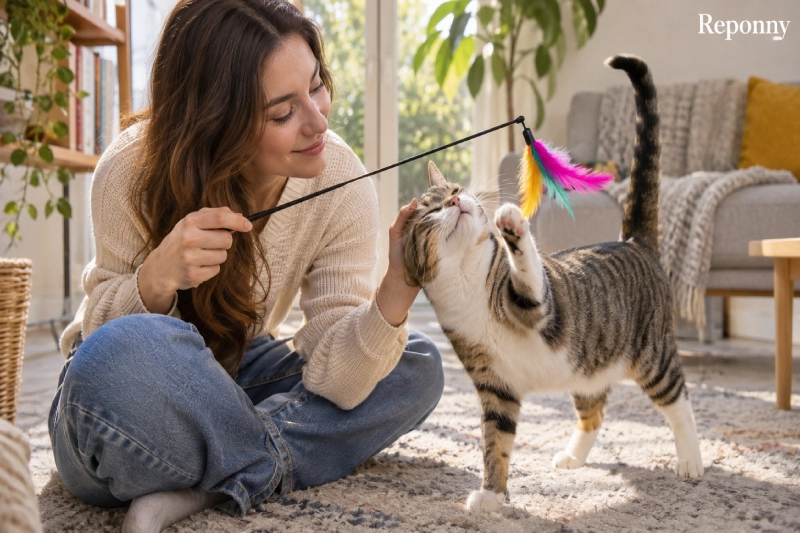
A wand toy can be useful when rubbing seems to transition into predatory play.
Why Does My Cat Bite Me and Then Stay Beside Me?
This can happen with petting-induced biting.
The goal may have been:
stop touching me
rather than:
go away forever.
Once you stop petting, the cat may remain comfortably beside you.
That can feel contradictory from a human perspective.
But it makes sense if the cat likes your company while disliking continued physical contact.
Cats can want proximity without constant touching.
That distinction is extremely useful for understanding feline relationships.
A cat sleeping beside your leg may enjoy being close to you without wanting twenty minutes of continuous petting.
Respecting that preference can actually improve the relationship.
Why Does My Cat Bite My Feet or Ankles?
This is usually more consistent with predatory play than with a love bite.
Moving feet are irresistible targets for some cats.
Cornell describes play aggression as frequently involving stalking, hiding, pouncing and biting moving targets.
VCA adds that under-stimulation and excess energy can increase play-related aggression.
Increase appropriate play.
Use prey-like toys.
Avoid deliberately moving your hands or feet beneath blankets for the cat to attack.
That game can be entertaining when the cat is tiny but much less enjoyable when the cat is an adult.
How Can You Prevent Petting Bites?
The most effective strategy is not punishment.
It is learning your cat’s threshold.
Keep Petting Sessions Short
If your cat commonly bites after approximately one minute, stop after thirty seconds.
Over time, you may be able to gradually extend the interaction while the cat remains comfortable.
VCA specifically recommends keeping sessions below the cat’s tolerance threshold.
Pet Preferred Areas
Start with:
- cheeks,
- forehead,
- around the ears.
FelineVMA recommends facial areas for cats with petting-related biting and advises petting from the side rather than looming directly over the cat.
Pause Frequently
Give two or three strokes.
Stop.
If your cat actively requests more interaction, continue.
If it does not, let the interaction end.
Watch the Tail
Tail-tip flicking may be the first warning you notice.
Full tail lashing is an even clearer sign.
Watch the Ears
Ears rotating backward or outward can signal rising discomfort.
Do Not Restrain the Cat
If the cat wants to leave, allow it to leave.
Use Toys for Rough Play
Hands should not become prey.
What Should You Never Do After Your Cat Bites?
Do not:
- hit the cat,
- shout,
- spray it with water,
- flick its nose,
- hold it down,
- chase it,
- or force more contact.
Cornell warns that physical punishment can increase fear and anxiety and worsen aggression.
Punishment may also make the cat associate your hands with unpredictable threats.
Instead:
stop interaction, give the cat space, and think about what triggered the bite.
Prevention works better than punishment.
Should You Let a Cat Bite Gently During Play?
It is better not to intentionally teach cats that human skin is an acceptable play target.
Even a cat that usually bites gently may become more aroused during play and bite harder.
Use toys.
This is particularly important for kittens because early play habits can continue into adulthood.
CDC also advises against rough play with cats and kittens because it can contribute to biting and scratching behaviors toward people.
What Should You Do If a Cat Bite Breaks the Skin?
A true puncture bite should not be dismissed simply because the cat is your pet.
Cat teeth are sharp and can create narrow puncture wounds.
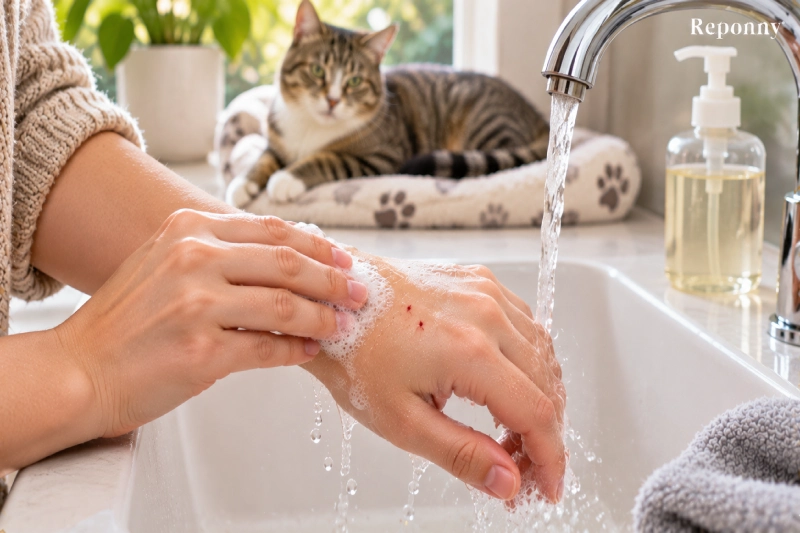
CDC advises immediately washing cat bites and scratches with warm soapy water and seeking medical attention when the wound is serious or becomes red, painful, warm or swollen, when the animal may pose a rabies concern, or when tetanus protection may not be current.
Mayo Clinic similarly advises prompt medical care for deep puncture wounds or signs of infection.
Seek medical advice more readily for:
- deep punctures,
- bites on the hand or near a joint,
- significant swelling,
- increasing redness,
- drainage,
- fever,
- severe pain,
- or bites involving an unfamiliar or unvaccinated animal.
The behavior may have been minor from the cat’s perspective.
The wound can still become medically important.
When Should You Talk to Your Veterinarian About Biting?
Arrange a veterinary evaluation when biting:
- begins suddenly,
- becomes much more frequent,
- becomes dramatically harder,
- occurs when one particular body area is touched,
- is accompanied by reduced mobility,
- occurs with skin twitching or extreme sensitivity,
- is associated with hiding or appetite changes,
- or represents a significant personality change.
Cornell recommends ruling out medical causes before treating aggression as purely behavioral. Conditions including osteoarthritis, dental disease, hyperthyroidism and neurological problems can contribute to aggressive behavior.
If medical causes are ruled out and serious biting continues, ask about referral to a qualified veterinary behaviorist.
A Quick Guide to Cat “Love Bites”
| What Happens Before the Bite | Most Likely Possibility |
|---|---|
| Relaxed interaction, one very light nip | Mild social communication possible |
| Long petting session | Overstimulation |
| Tail flicking + ears moving back | Warning to stop |
| Stalking hands or feet | Play/predatory behavior |
| Bite when belly is touched | Touch preference / overstimulation |
| Bite when one painful area is touched | Medical discomfort |
| Sudden bite after loud noise | Fear/startle |
| Bite after seeing outdoor cat | Redirected aggression |
| Skin ripples + extreme back sensitivity | Hyperesthesia or other medical issue should be considered |
| Bite causes puncture wound | Clean wound and consider medical care |
Frequently Asked Questions
Why Does My Cat Give Me Love Bites?
A gentle bite can occur during a friendly interaction, but “love bite” is an informal term.
The bite may reflect social interaction, play, overstimulation or a request for petting to stop.
Watch the cat’s body language and what happened immediately beforehand.
Are Cat Love Bites a Sign of Affection?
They can occur during affectionate interactions, but the bite itself should not automatically be translated as affection.
Some gentle bites are actually the cat’s way of ending physical contact.
Why Does My Cat Bite Me While I Pet It?
Petting-induced aggression can occur when a cat initially enjoys petting but eventually becomes overstimulated or uncomfortable.
VCA recommends watching for tail flicking, backward ears, body tension or attempts to move away and stopping before the bite occurs.
Why Does My Cat Bite Me While Purring?
Purring does not mean a cat wants unlimited contact.
A cat may begin the interaction relaxed and become overstimulated while still purring.
Read the current tail, ears, eyes and muscle tension.
Why Does My Cat Lick Me Then Bite Me?
It may be part of social grooming, playful arousal or overstimulation.
The most useful clue is whether the cat remains physically relaxed or becomes increasingly tense before biting.
Why Does My Cat Rub Against Me and Then Bite?
The cat may become overexcited or transition from social interaction into play.
Cats Protection notes that rubbing followed by biting may be linked to overexcitement or redirected hunting behavior.
Why Does My Cat Bite My Hand Gently and Not Let Go?
If the cat is playing, your hand may have become a prey or wrestling target.
Stop moving the hand and redirect the cat toward an appropriate toy rather than pulling or continuing rough play.
Why Does My Cat Bite Me When I Stop Petting It?
Some cats may attempt to continue interaction through play or grab at a moving hand.
Watch the surrounding body language.
Do not assume that every bite after petting has the same motivation.
Why Does My Cat Bite When I Pet Its Belly?
Many cats do not enjoy belly petting.
FelineVMA specifically cautions that exposing the abdomen can be a relaxed social posture without being an invitation to touch it.
Why Has My Cat Suddenly Started Biting Me?
Sudden behavior change deserves attention.
Pain, dental disease, joint discomfort, skin disease, neurological problems, fear or environmental stress can change a cat’s tolerance for handling. Cornell recommends ruling out medical causes when aggressive behavior develops.
Should I Punish My Cat for Love Bites?
No.
Punishment can increase fear and worsen aggression.
Instead, stop interaction, identify the trigger and learn to recognize earlier warning signals.
Final Thoughts
The phrase “love bite” makes cat biting sound simple.
It is not.
A gentle nip may happen during a warm, relaxed interaction.
Your cat may be sitting on your lap, purring and appearing perfectly comfortable.
But the bite itself does not necessarily mean:
“I love you.”
Sometimes it means:
“I am playing.”
Sometimes:
“That is enough petting.”
Sometimes:
“Do not touch me there.”
And occasionally:
“Something hurts.”
VCA and Cornell both describe petting-induced aggression as a real feline behavior in which a cat may initially tolerate or enjoy touch but eventually become uncomfortable enough to bite.
The key is learning what happens before the bite.
Watch the ears.
Watch the tail.
Watch the pupils.
Watch whether the muscles become tense.
Notice whether the cat turns toward your hand or tries to move away.
And give your cat a choice.
A useful interaction might be:
two or three gentle strokes → pause → see what the cat does.
If the cat leans toward you, continue briefly.
If it turns away, let the interaction end.
Current FelineVMA guidance supports short, frequent interactions and periodic pauses that allow the cat to choose whether contact continues.
Also remember that biting can sometimes signal a medical problem.
If a cat suddenly becomes sensitive to touch—particularly over one area—or aggressive behavior develops alongside mobility, appetite, skin or other health changes, schedule a veterinary examination.
And if the bite breaks your skin, treat the wound seriously. Wash it immediately with soap and water and seek medical care for deep punctures or signs of infection.
Understanding the difference between affection, play, overstimulation and pain allows you to respond before a gentle warning becomes a painful bite.
The goal is not to teach your cat never to communicate.
It is to become better at listening before teeth are needed.