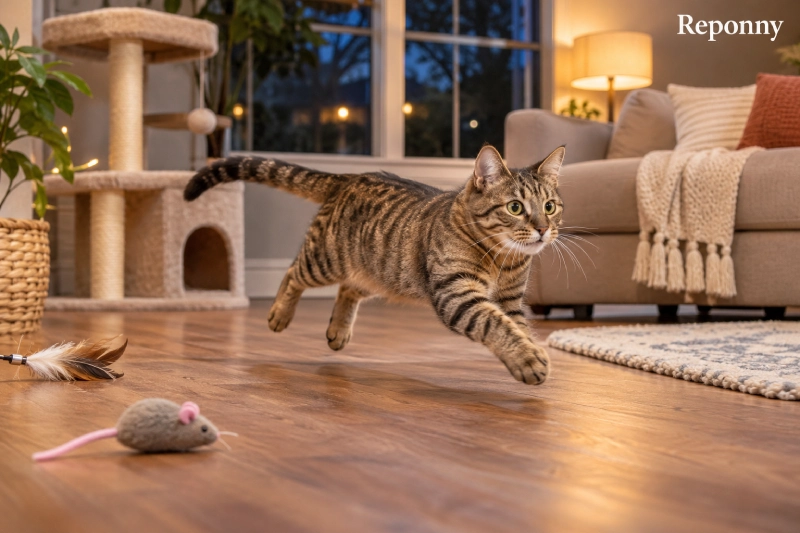
It is 2:00 a.m.
The house is quiet.
You are finally asleep.
Then suddenly:
thump.
Your cat launches off the sofa, races down the hallway, jumps onto the bed, disappears around the corner and returns at full speed as if being chased by something invisible.
Thirty seconds later, everything is quiet again.
Welcome to the cat zoomies.
These sudden bursts of running, jumping and pouncing can look chaotic, but in most healthy cats they are completely normal.
VCA describes cat zoomies as brief periods of hyperactivity that can include frantic running, pouncing and sometimes vocalizing. They occur especially often in kittens and younger cats and may be associated with pent-up energy, play, insufficient stimulation or activation of normal predatory behavior.
The fact that zoomies often happen at night is not surprising either.
Cats are naturally most active around dawn and dusk, a pattern known as crepuscular activity. Veterinary behavior guidance notes that hunting, exploration and social activity often increase during these periods. A cat that sleeps much of the day may therefore become ready for action just as its human family wants to go to bed.
Most nighttime zoomies do not indicate illness.
But a sudden major increase in frantic activity—especially in an older cat or when accompanied by weight loss, excessive hunger, increased thirst, unusual vocalization, skin rippling, confusion or other behavioral changes—deserves closer attention.
Quick answer: Cats often get nighttime zoomies because their natural activity rhythm peaks around dawn and dusk, they have stored energy after resting, or their hunting and play instincts are active. Regular interactive play, environmental enrichment and predictable feeding routines can help shift activity earlier in the evening. Sudden or extreme hyperactivity, particularly in a senior cat, should be discussed with your veterinarian.
What Are Cat Zoomies?
The word zoomies is an informal term for a sudden burst of intense activity.
A cat may:
- sprint from room to room,
- jump onto furniture,
- skid across floors,
- climb a cat tree,
- pounce on toys,
- chase its own tail,
- vocalize,
- or abruptly change direction several times.
Then, often just as suddenly as it started, the activity stops.
The cat may sit down.
Groom itself.
Walk to the water bowl.
Or curl up as though absolutely nothing happened.
VCA describes these episodes as periods of frenzied running and pouncing and notes that they can occur throughout a cat’s life, although they are especially common in kittens and young cats.
In many healthy cats, zoomies are simply an energetic form of play.
Are zoomies the same as aggression?
No.
A cat sprinting through the house is not necessarily frightened or aggressive.
During normal playful zoomies, you may see:
- energetic running,
- playful pouncing,
- rapid direction changes,
- bright alert eyes,
- and brief pauses before another sprint.
True fear or defensive aggression usually comes with additional body-language signals such as:
- flattened ears,
- defensive hissing,
- a tightly tucked or puffed tail,
- persistent hiding,
- or clear attempts to escape a perceived threat.
Always interpret the entire situation.
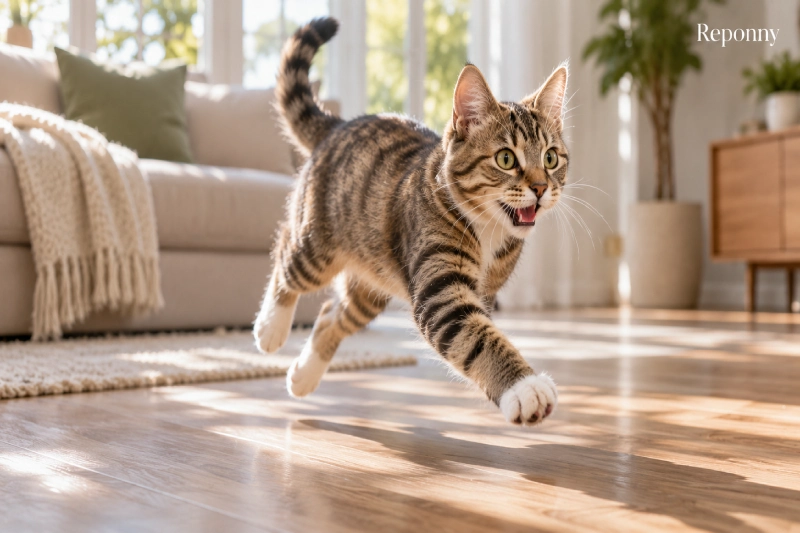
Why Do Cats Get the Zoomies at Night?
There is rarely just one reason.
Nighttime zoomies can result from a combination of:
natural activity rhythms + stored energy + hunting motivation + household routine.
Understanding those factors makes the behavior much easier to manage.
1. Cats Are Naturally Active Around Dawn and Dusk
Cats are often casually described as nocturnal.
That is not entirely accurate.
Domestic cats are commonly described as crepuscular, meaning activity naturally increases around dawn and dusk.
VCA’s veterinary behavior guidance explains that cats often show more hunting and exploratory activity during these periods.
Feline veterinary guidance similarly notes that cats naturally become active during dusk and early morning and may wake their caregivers during these times looking for food or interaction.
This creates a scheduling problem.
You may want:
11:00 p.m. → lights off → sleep.
Your cat’s biology may suggest:
11:00 p.m. → excellent time to run through the hallway at maximum speed.
Indoor living can shift these patterns somewhat, but it does not completely erase them.
Why does my cat wake me at 4 or 5 a.m.?
Early morning is another naturally active period.
Your cat may wake because:
- its internal activity rhythm is increasing,
- it expects breakfast,
- it has learned that humans respond at that time,
- or several of these factors are occurring together.
That does not mean your cat has decided to ruin your sleep.
It is following a schedule that makes sense from a feline perspective.
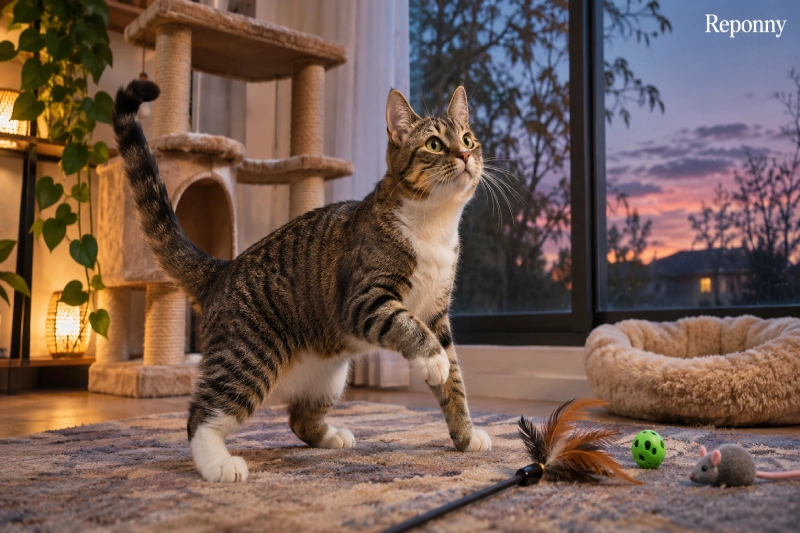
2. Your Cat Slept Most of the Day
Imagine the schedule of a typical indoor cat.
You leave home in the morning.
The house becomes quiet.
There is no human interaction.
No prey to stalk.
Very little changes.
Your cat naps.
Then naps again.
Then finds another place and takes another nap.
Several hours later, you come home.
Suddenly:
- lights turn on,
- food appears,
- doors open,
- people move around,
- voices return,
- toys become available.
Your cat’s day may effectively begin when yours is ending.
VCA specifically notes that cats left relatively inactive during the day may rest for much of that time and then become highly active when the owner comes home to provide food, social interaction and play.
So nighttime zoomies may simply represent:
stored energy finally finding an outlet.
This is especially common in:
- kittens,
- young adult cats,
- indoor-only cats,
- and cats living in relatively quiet environments.
The solution is not to prevent your cat from sleeping all day.
Cats naturally need substantial sleep.
Instead, give the cat more opportunities for meaningful activity while it is awake.
3. Your Cat Needs More Play and Mental Stimulation
Zoomies can be more frequent when a cat does not have enough appropriate outlets for activity.
VCA identifies insufficient mental stimulation and pent-up energy as possible contributors to zoomies.
Current 2026 Feline Veterinary Medical Association guidance emphasizes that cats need opportunities to perform natural behaviors, including:
- hunting,
- playing,
- climbing,
- hiding,
- exploring,
- scratching,
- and interacting socially.
The FelineVMA specifically recommends interactive toys that mimic prey and food-based enrichment such as puzzle feeders as part of a healthy indoor environment.
Think about the difference between two indoor environments.
Environment A
One food bowl.
One bed.
One old toy lying on the floor.
No climbing opportunities.
Little interactive play.
Environment B
Cat tree.
Window perch.
Scratching areas.
Cardboard boxes.
Rotating toys.
Puzzle feeding.
Several short human-led play sessions.
The second environment gives the cat far more opportunities to use its brain and body before midnight.
Zoomies may still happen.
But boredom is less likely to be the only exciting part of the cat’s day.
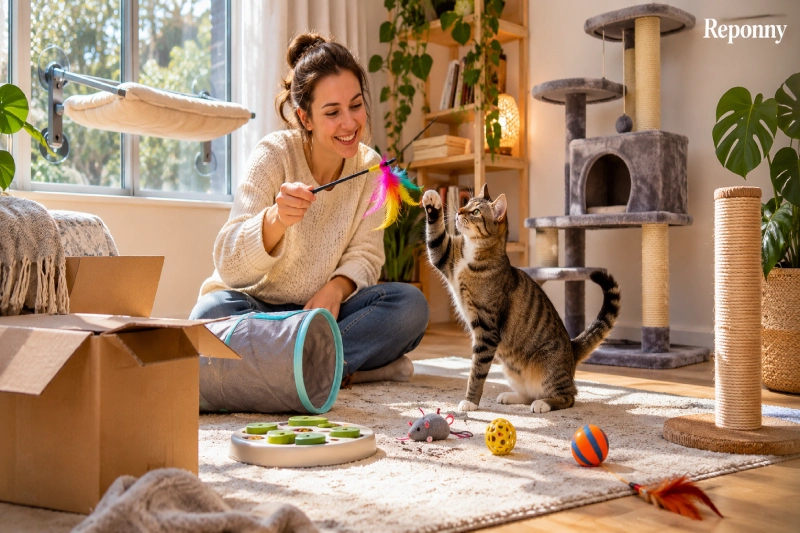
4. Your Cat’s Hunting Instinct Has Switched On
Zoomies often resemble hunting because many of the same movements are involved.
Cats are predators.
A natural hunting sequence can include:
search → stalk → chase → pounce → capture.
The FelineVMA’s environmental guidance stresses that cats need opportunities to express predatory behavior and recommends toys that imitate prey such as mice or feathers. It also advises allowing the cat to successfully capture the toy periodically so play does not become frustrating.
During nighttime zoomies, your cat may suddenly:
race behind furniture, crouch, leap onto a chair and attack a toy.
There may be no real prey.
The behavioral system itself is enough.
This is why young cats sometimes appear to be chasing invisible enemies.
They are not necessarily hallucinating.
They may simply be engaged in intense play.
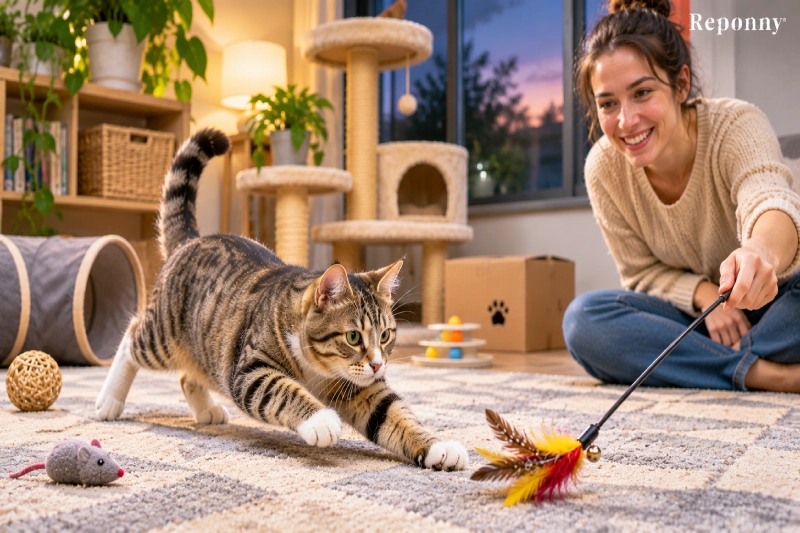
Give the hunt an appropriate target
Use:
- wand toys,
- toy mice,
- rolling toys,
- kicker toys,
- and other safe prey-like objects.
Avoid encouraging the cat to chase:
- hands,
- toes,
- ankles,
- or feet moving under blankets.
Those habits can become painful once a kitten grows into an adult cat.
5. Kittens Have Even More Energy
Zoomies are especially common in kittens and young cats.
VCA specifically notes that kittens experience zoomies frequently, although adult cats can continue having them throughout life.
This makes biological sense.
Kittens are constantly developing:
- coordination,
- hunting skills,
- balance,
- speed,
- social play,
- and environmental awareness.
Running, pouncing and chasing are practice.
What appears to us as chaotic movement can help a kitten learn how its body works.
Do not punish kitten zoomies
A kitten racing through the house is usually not misbehaving.
Instead:
make the environment safe.
Secure fragile objects.
Avoid slippery hazards where possible.
Keep dangerous cords out of reach.
Provide appropriate climbing areas.
And direct the kitten toward toys rather than hands and feet.
A young cat needs legal ways to be energetic.
6. Your Routine May Accidentally Encourage Nighttime Activity
Cats learn patterns very quickly.
Suppose your cat runs across your bed at 3 a.m.
You wake up.
The cat meows.
You go to the kitchen and give it food so it will be quiet.
From your perspective:
“I fed the cat so I could go back to sleep.”
From the cat’s perspective:
“Running across the human at 3 a.m. produces breakfast.”
That is powerful reinforcement.
VCA warns that caregivers may accidentally encourage nighttime activity by responding with food, affection or attention.
Feline veterinary guidance similarly advises against feeding a cat immediately when the owner wakes if the cat has been actively waking the person, because this can reinforce early-morning wake-up behavior.
Consistency matters
If you ignore the behavior for five nights but feed the cat at 4 a.m. on the sixth night, the cat may simply learn:
persistence eventually works.
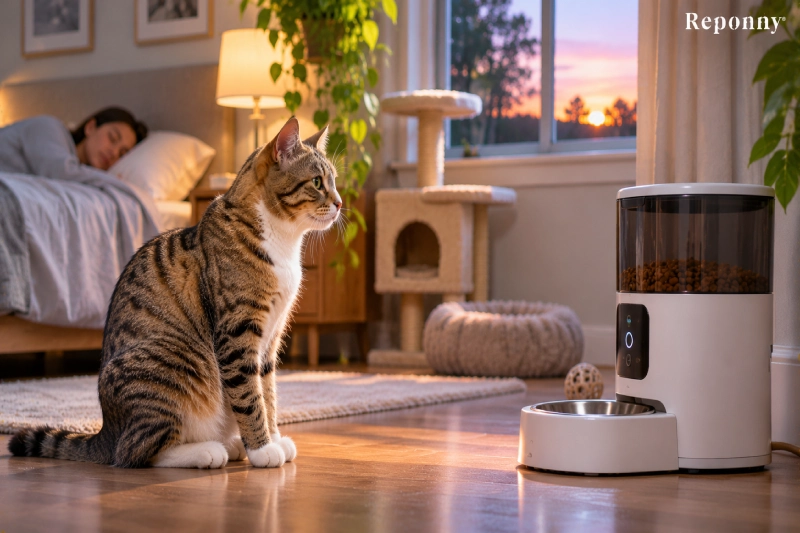
For early-morning hunger, an automatic timed feeder can sometimes help separate food delivery from the human waking up.
VCA specifically suggests timed feeding for cats that repeatedly wake very early for breakfast.
7. Some Cats Get Zoomies After Using the Litter Box
Yes, this happens.
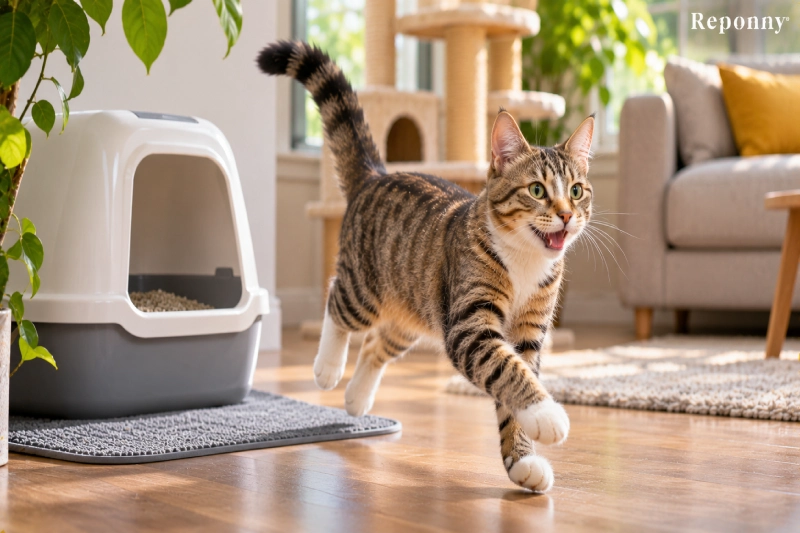
A cat may use the litter box and then suddenly sprint away at full speed.
VCA includes short bursts of zoomies after litter-box use among patterns that can occur in otherwise normal cats.
You may see:
dig → eliminate → cover → jump out → sprint down hallway.
Why?
The exact reason has not been firmly established.
You may see online explanations claiming that bowel movements stimulate the vagus nerve and create a feeling of euphoria.
That specific explanation should not be treated as established feline science.
For many cats, post-litter-box running may simply be another brief burst of arousal or activity.
When post-litter-box running is not funny
Pay attention if the cat also:
- cries,
- strains,
- repeatedly enters the litter box,
- has diarrhea,
- passes hard stool,
- produces little or no urine,
- or appears painful.
VCA notes that constipation, colitis and other medical problems can make elimination uncomfortable.
Repeated attempts to urinate while producing little or no urine can be an emergency, particularly in male cats.
Do not dismiss painful elimination as “poop zoomies.”
Are Nighttime Zoomies Bad for Cats?
Usually, no.
For a healthy cat, occasional zoomies can simply be:
play + exercise + normal feline behavior.
The goal is not necessarily to eliminate them.
The concern is whether the behavior:
- is dangerous,
- prevents the household from sleeping,
- represents a dramatic change,
- or occurs with signs of illness.
A kitten sprinting around the living room every evening is very different from a previously quiet 15-year-old cat suddenly running frantically through the house at night while losing weight and vocalizing.
Baseline matters.
How to Reduce Cat Zoomies at Night
You probably cannot change your cat’s biology completely.
But you can influence when energy is expressed.
The most effective strategy is usually:
more appropriate activity before bedtime + predictable routine + avoiding accidental nighttime rewards.
Use Interactive Play in the Evening
This is one of the most useful changes you can make.
VCA recommends increasing play and social interaction during the afternoon and evening to help shift a cat’s activity schedule closer to the household’s schedule.
Instead of a single very long session, try several shorter sessions.
For example:
early evening → five to ten minutes of play
later evening → another short session
before bedtime → final hunting-style session
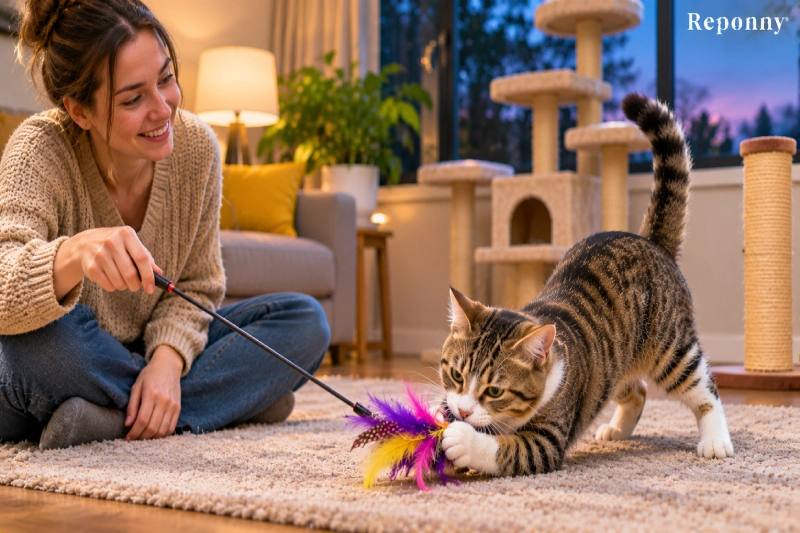
Use a wand toy.
Move it like prey.
Do not simply shake it continuously in front of your cat.
Let it:
hide behind furniture, pause, move again, run away, and occasionally be captured.
Current FelineVMA guidance emphasizes that cats should sometimes successfully catch their simulated prey.
The goal is not to exhaust your cat until it cannot move.
It is to provide an appropriate outlet for normal predatory activity.
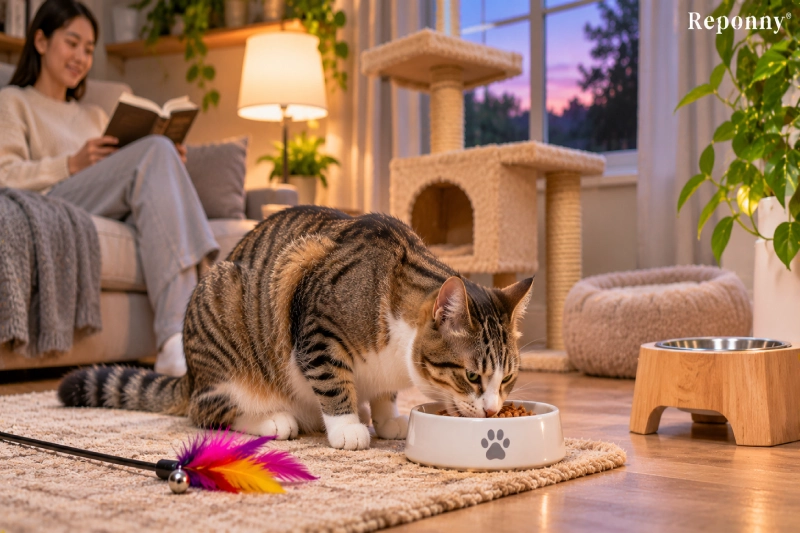
Try a Play-Then-Meal Routine
A practical evening routine can be:
play → capture → meal → quiet time.
This loosely mirrors a natural sequence in which hunting activity is followed by eating and rest.
VCA recommends coordinating feeding, play and social interaction to help shift the cat’s schedule away from disruptive nighttime activity.
This does not require feeding extra calories.
Use part of the cat’s normal daily food allowance.
For example:
instead of giving the entire dinner at 6 p.m., you might reserve part of the planned daily calories for the meal following the final evening play session.
If your cat has a medical condition or uses a prescription diet, keep feeding changes consistent with your veterinarian’s recommendations.
Increase Daytime Enrichment
You do not need to keep a cat awake all day.
Cats naturally sleep many hours.
But you can make awake periods more meaningful.
Current FelineVMA guidance recommends an environment containing:
- safe places,
- separated resources,
- predatory-play opportunities,
- predictable social interaction,
- and sensory conditions appropriate for cats.
Useful enrichment can include:
window perches, cat trees, scratching posts, cardboard boxes, tunnels, puzzle feeders, toy rotation and short training sessions.
For cats that spend long days alone, rotating available toys can make the environment less predictable without overwhelming the cat.
VCA also recommends foraging toys, small frequent meals and novel objects for exploration as ways to enrich daytime activity.
Rotate rather than overwhelm
You do not need fifty toys on the floor.
Keep several available.
Put others away.
Rotate them periodically.
An old toy can become interesting again after it has disappeared for a while.
Give Your Cat Vertical Space
Nighttime running often includes furniture.
Your cat jumps onto the sofa.
Then a table.
Then a shelf.
Then the back of your chair.
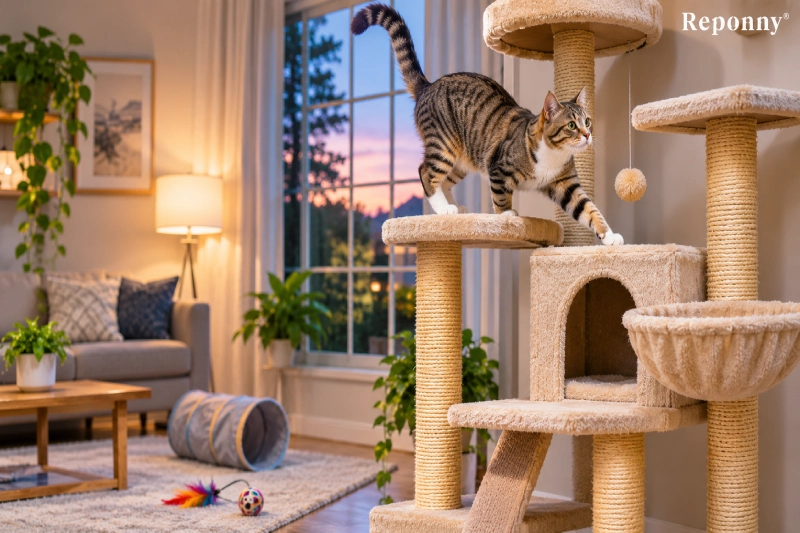
Instead of treating every vertical movement as a problem, provide safe places designed for climbing.
FelineVMA guidance recommends environmental resources that allow cats to exercise natural behaviors and maintain control over their surroundings. Safe elevated locations are also important for resting and security.
Consider:
- a stable cat tree,
- wall-mounted cat shelves,
- window perches,
- or secure elevated beds.
Make sure furniture cannot tip over during an enthusiastic 2 a.m. sprint.
Make the Zoomie Route Safer
If your cat is going to run, make sure it can run safely.
Check areas where zoomies usually happen.
Remove:
- unstable decorations,
- exposed cords,
- breakable objects,
- open windows,
- unstable shelves,
- toxic plants,
- and anything the cat could become trapped inside.
Use secure window screens.
Make sure cat trees are stable.
Keep slippery clutter off major running paths.
Zoomies can involve high speed and poor judgment.
Your cat may normally navigate the coffee table perfectly.
At maximum zoomie velocity, calculations become slightly less reliable.
Do Not Use Punishment
Do not:
- yell,
- chase,
- spray water,
- hit,
- or physically restrain a cat simply for having zoomies.
Normal play and activity are not behaviors that deserve punishment.
Punishment may add fear without meeting the cat’s underlying need for activity.
Instead:
redirect.
If the cat is attacking ankles:
use a toy.
If the cat is racing across fragile furniture:
create safer running and climbing areas.
If nighttime activity has become a learned routine:
change the routine.
Behavior management is more effective when you address why the behavior is happening.
Should You Lock Your Cat Out of the Bedroom?
Sometimes this is reasonable.
If a healthy cat repeatedly runs across your body at night despite appropriate enrichment and routine changes, bedroom access does not have to be unlimited.
VCA notes that keeping a disruptive cat out of the bedroom can be part of nighttime management, provided the cat has access to appropriate resources elsewhere.
That area should include:
- a comfortable sleeping place,
- water,
- litter-box access,
- scratching opportunities,
- appropriate toys,
- and safe climbing or perching options.
But consistency is critical.
If the door remains closed for twenty minutes while the cat meows and scratches, and then you open it:
you may teach the cat that twenty minutes of persistence works.
Also make sure that the cat’s nighttime disturbance is not caused by illness before treating it purely as a behavioral problem.
Why Does My Cat Attack My Feet During Nighttime Zoomies?
Because moving feet can look like prey.
A cat running at high arousal may suddenly notice:
your toes moving beneath the blanket.
The sequence becomes:
movement → focus → stalk → pounce → bite.
This is especially common in kittens and young cats.
Do not turn it into a wrestling game.
If your hands and feet become toys, the cat may continue the behavior as an adult.
Instead, provide an appropriate object:
- wand toy,
- kicker toy,
- toy mouse,
- or ball.
The message should be:
toys are for hunting; humans are not.
Why Does My Cat Meow During the Zoomies?
Excited cats may vocalize during high activity.
VCA notes that some cats meow during zoomie episodes.
If the meowing occurs only during brief playful running and the cat otherwise appears healthy, it may simply reflect excitement.
But nighttime vocalization deserves more attention when it becomes:
- persistent,
- new,
- apparently distressed,
- or common in an older cat.
Cornell identifies unexplained nighttime vocalization as one possible sign of cognitive dysfunction in senior cats and also notes that hyperthyroidism and hypertension can contribute to nighttime vocalization.
So:
kitten chirping while sprinting = often normal
is very different from:
senior cat wandering and crying through the house every night.
When Zoomies Might Signal Hyperthyroidism
Most zoomies are normal.
But a new increase in activity in a middle-aged or older cat deserves more attention.
Cornell’s updated 2026 hyperthyroidism guidance describes hyperthyroidism as a common disease of middle-aged and older cats.
Typical signs can include:
- weight loss,
- increased appetite,
- increased thirst,
- increased urination,
- vomiting,
- diarrhea,
- and hyperactivity.
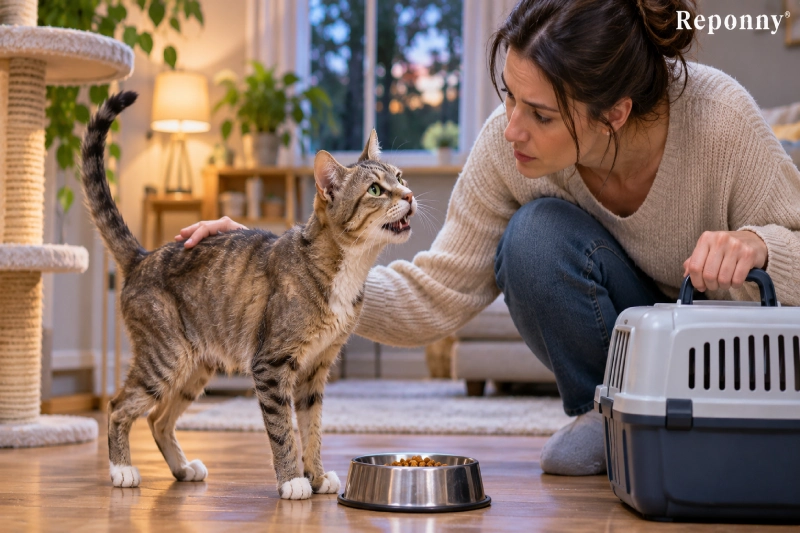
So imagine a 13-year-old cat that previously slept quietly at night but suddenly begins:
running around the house, demanding food constantly and losing weight despite eating more.
Do not simply celebrate that your senior cat has “become young again.”
Schedule a veterinary examination.
Hyperthyroidism is treatable, but it should be diagnosed properly.
Nighttime Activity in Senior Cats Can Have Other Causes
Aging changes the interpretation of nighttime activity.
Cornell describes feline cognitive dysfunction as a condition that can become noticeable in cats around ten years of age or older.
Possible signs include:
- altered sleep-wake cycles,
- nighttime vocalization,
- disorientation,
- wandering,
- staring at walls,
- reduced play,
- and changes in litter-box behavior.
A senior cat wandering at night may not be experiencing ordinary playful zoomies at all.
Cornell also emphasizes that similar behavior can result from medical conditions such as:
- hyperthyroidism,
- hypertension,
- arthritis,
- kidney disease,
- vision loss,
- and neurological disease.
This is why changes in older cats should not automatically be explained as:
“just getting old.”
If the nighttime behavior is new, schedule an examination.
Zoomies vs. Feline Hyperesthesia
Occasionally, what looks like zoomies may actually be something different.
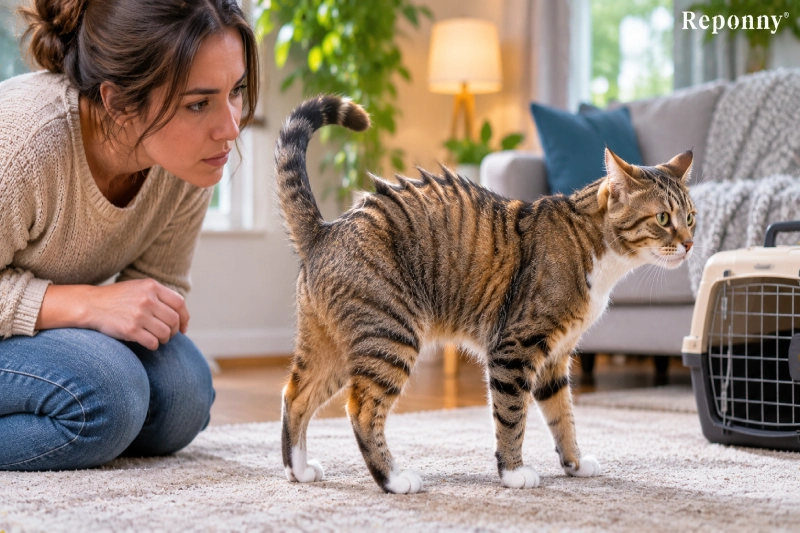
Feline hyperesthesia is a poorly understood condition involving extreme sensitivity, often along the back and near the base of the tail.
Cornell lists possible signs including:
- rippling skin,
- dilated pupils,
- intense scratching,
- tail chasing,
- sudden biting,
- vocalization,
- and episodes in which the cat suddenly reacts or runs.
VCA similarly describes affected cats as sometimes suddenly startling and dashing away, often with skin movement, vocalization or self-directed grooming and biting.
Normal zoomies
Running.
Pouncing.
Playful behavior.
Cat settles normally afterward.
More concerning pattern
Sudden frantic running combined with:
skin rippling + biting at back/tail + intense scratching + obvious sensitivity.
That pattern deserves veterinary assessment.
Pain, parasites, allergies and neurological problems may need to be ruled out before hyperesthesia is diagnosed.
Zoomies vs. Itching or Skin Problems
A cat with severe itching may also suddenly:
run, stop, lick intensely, scratch, bite its skin and run again.
That does not necessarily represent playful energy.
Cornell notes that excessive licking may occur when skin is itchy or when a body area is painful. Parasites, allergies and other dermatologic problems can be involved.
Pay attention if “zoomies” repeatedly include:
- biting at the tail base,
- intense licking,
- scratching,
- hair loss,
- red skin,
- scabs,
- or frequent interruption to groom one specific area.
That pattern deserves a veterinary evaluation.
When Should You See a Veterinarian About Zoomies?
Occasional zoomies in an otherwise healthy cat usually require no treatment.
Contact your veterinarian when the behavior:
- starts suddenly in an older cat,
- increases dramatically,
- continues for unusually long periods,
- looks distressed rather than playful,
- includes aggression that is new or severe,
- occurs with weight loss,
- occurs with excessive hunger or thirst,
- is accompanied by unusual nighttime vocalization,
- includes confusion or disorientation,
- occurs with skin rippling or self-biting,
- accompanies painful litter-box behavior,
- or occurs alongside another major change in health or personality.
VCA advises veterinary evaluation when zoomies become abnormally frequent or when hyperactivity or aggression increases unexpectedly.
VCA also emphasizes that sudden general changes in a cat’s activity, behavior, appetite, litter-box habits or appearance can be early signs of illness.
The important principle is:
normal zoomies are usually brief, playful and familiar.
A dramatic change deserves investigation.
A Practical Evening Routine for a Cat With Nighttime Zoomies
You do not need to completely redesign your life.
Try creating a predictable evening sequence.
For example:
6:30 p.m. — short interactive play
Let your cat stalk and chase.
7:00 p.m. — normal meal
Use the planned daily food allowance.
8:30 p.m. — independent enrichment
Puzzle feeder, toy rotation or exploration.
10:00 p.m. — final hunting-style play session
Allow several successful captures.
10:15 p.m. — small planned portion of normal food
Not an extra meal—part of the daily allowance.
10:30 p.m. onward — quieter household activity
Reduce intense play immediately before you want the cat to settle.
The exact times are not important.
Consistency is.
VCA recommends structuring daytime and evening feeding, play and social interaction to help align feline activity more closely with the household routine.
Cat Zoomies at a Glance
| What You Notice | What It May Mean |
|---|---|
| Young cat sprinting briefly in evening | Normal playful zoomies |
| Zoomies around dusk | Normal crepuscular activity |
| Indoor cat sleeps all day then runs at night | Stored energy / schedule mismatch |
| Zoomies followed by pouncing on toys | Predatory play |
| Cat wakes owner and receives food | Behavior may be reinforced |
| Brief sprint after litter-box use | Can occur normally |
| Running after litter box + straining or crying | Medical problem should be considered |
| Sudden hyperactivity + weight loss + huge appetite | Hyperthyroidism should be ruled out |
| Senior cat wandering and crying at night | Medical/cognitive evaluation recommended |
| Running + skin rippling + tail biting | Hyperesthesia, itch or pain should be considered |
| Zoomies + relaxed playful behavior | Usually normal |
| Abrupt major change from normal behavior | Veterinary evaluation recommended |
Frequently Asked Questions
Why Does My Cat Get the Zoomies at Night?
Cats naturally become more active around dawn and dusk.
If your cat has also spent much of the day resting, stored energy and normal hunting/play motivation can produce intense nighttime activity.
Are Cat Zoomies Normal?
Yes.
Brief episodes of running and pouncing are normal in many healthy cats, especially kittens and young adults.
Why Does My Cat Run Around Like Crazy at 3 a.m.?
Your cat may be following its natural activity rhythm, releasing stored energy, seeking interaction or repeating a behavior that has previously earned attention or food.
Why Does My Cat Have Zoomies After Pooping?
Some cats briefly sprint after using the litter box, and VCA recognizes this as a pattern that can occur normally. The exact cause is not firmly established.
If your cat strains, cries, has diarrhea or appears painful, contact your veterinarian.
Why Does My Cat Have Zoomies After Eating?
Eating may occur around periods when your cat is already socially or behaviorally active.
A brief playful episode afterward is not necessarily concerning.
Judge the behavior by your cat’s overall health and normal pattern rather than assuming food itself has caused a problem.
Why Does My Cat Attack Me During the Zoomies?
High-energy play can become directed toward moving hands, feet or ankles.
Redirect the cat toward a wand toy, kicker toy or other appropriate prey substitute rather than encouraging attacks on human skin.
How Do I Stop My Cat From Getting Zoomies at Night?
You may not need to eliminate zoomies completely.
Instead, shift more activity into the afternoon and evening through interactive play, enrichment and predictable feeding routines. Avoid rewarding disruptive nighttime behavior with food or attention.
Should I Play With My Cat Before Bed?
Yes.
A hunting-style play session before bedtime can provide an appropriate outlet for predatory behavior.
FelineVMA recommends interactive prey-like play and allowing cats to successfully capture the toy periodically.
Can an Automatic Feeder Help With Early-Morning Zoomies?
It can help when the cat repeatedly wakes you specifically for food.
VCA suggests timed feeders as one option for cats that wake very early expecting breakfast.
Why Is My Senior Cat Suddenly Hyperactive at Night?
A sudden change in an older cat should be evaluated.
Hyperthyroidism can cause hyperactivity together with weight loss, increased appetite, thirst and urination, while cognitive dysfunction and other age-related medical conditions can alter nighttime behavior.
Can Zoomies Be a Sign of Illness?
Occasionally.
Sudden extreme activity accompanied by weight loss, excessive hunger, unusual vocalization, confusion, skin rippling, self-biting, painful elimination or other health changes should be discussed with your veterinarian.
Final Thoughts
Nighttime cat zoomies can be spectacular.
One moment your home is silent.
The next, your cat is running down the hallway at full speed, climbing the cat tree, jumping across the sofa and attacking a toy that apparently became extremely dangerous thirty seconds earlier.
In most cases, nothing is wrong.
Zoomies are a normal expression of feline energy and play, particularly in kittens and young cats. VCA recognizes pent-up energy, insufficient stimulation, predatory motivation and simple playful behavior among common explanations.
The timing also makes sense.
Cats naturally become more active around dawn and dusk. If your indoor cat has spent most of the day sleeping while the household was quiet, evening may be when its behavioral day truly begins.
You do not need to eliminate that instinct.
Instead:
give it somewhere better to go.
Provide climbing.
Provide scratching.
Provide exploration.
Use prey-like toys.
Let your cat stalk.
Let it chase.
Let it pounce.
And let it successfully catch the toy.
Current FelineVMA guidance specifically emphasizes providing cats with opportunities for play and predatory behavior as part of a healthy indoor environment.
If nighttime zoomies are disrupting your sleep, shift more activity into the afternoon and evening.
Use predictable play and meal routines.
Avoid teaching your cat that waking you at 4 a.m. produces food.
And consider a timed feeder if early breakfast is the main trigger.
But also recognize when the pattern does not look like normal zoomies.
A young cat sprinting around the living room for three minutes and then falling asleep is one thing.
A 14-year-old cat that suddenly begins running, crying at night, eating constantly and losing weight is very different.
Cornell’s current 2026 guidance identifies hyperactivity as one possible sign of feline hyperthyroidism, particularly when accompanied by weight loss, increased appetite, thirst or urination.
Likewise, nighttime wandering and vocalization in a senior cat can occur with cognitive dysfunction or several other medical problems.
And frantic running accompanied by skin rippling, tail chasing or self-biting may represent something other than ordinary play.
So use the same rule that applies to almost every feline behavior:
know your cat’s normal.
If the zoomies are brief, playful and familiar:
enjoy them.
Make the house safe.
Maybe move the fragile vase.
If the behavior suddenly changes or comes with other symptoms:
call your veterinarian.
Most of the time, however, your cat is not running from ghosts.
It is simply a small predator with a lot of energy—and unfortunately, its preferred workout time may be just after you turn off the lights.