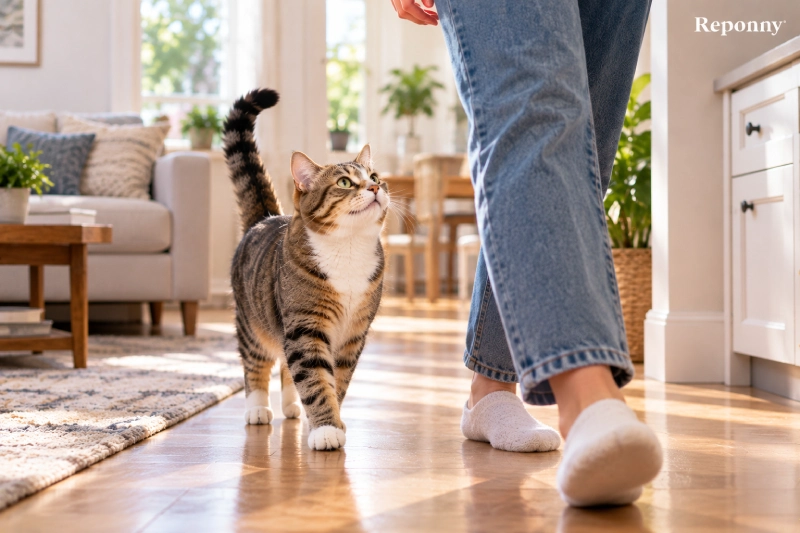
You stand up from the couch.
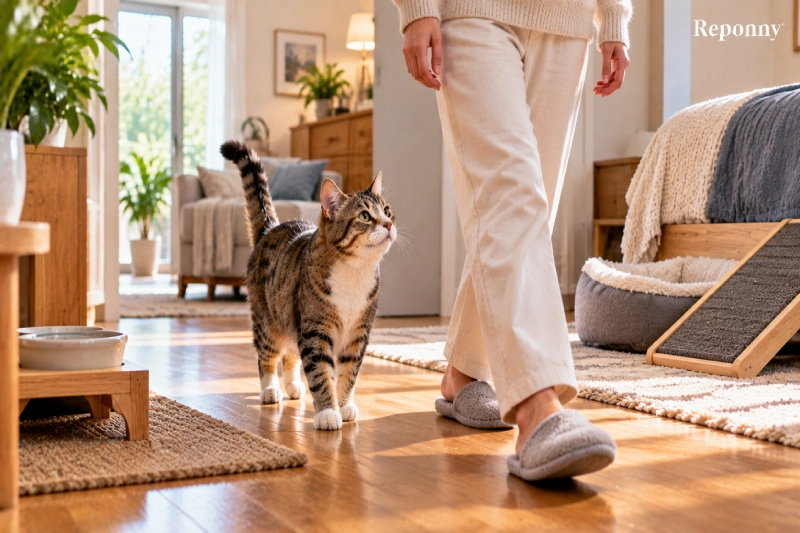
Your cat stands up too.
You walk into the kitchen.
Your cat follows.
You go upstairs.
A few seconds later, you hear paws behind you.
And when you close the bathroom door, suddenly your previously independent cat behaves as though you have disappeared forever.
So, why does your cat follow you everywhere?
For many cats, following a familiar person is completely normal. Your cat may enjoy your company, expect food or attention, be curious about what you are doing, or simply have learned that interesting things tend to happen when you move around the house.
Cats can also form meaningful attachment relationships with human caregivers. A well-known 2019 study found evidence that domestic cats can display distinct attachment patterns toward their caregivers, challenging the stereotype that cats are socially indifferent to people.
More recent research continues to support the importance of familiar people in feline social behavior. A 2024 study found that cats showed proximity-seeking and affiliative behaviors toward people after brief separation, while another study published in 2026 found that the physiological effects of human-cat interaction varied according to the individual cat’s potential attachment style and the type of interaction.
But following is not automatically proof that your cat is deeply attached—or anxious.
A sudden increase in clinginess can sometimes occur when a cat is stressed, aging, uncomfortable, or ill.
Quick answer: Your cat may follow you because it enjoys your company, wants attention, expects food, is curious about what you are doing, needs more stimulation, has learned that following gets rewarded, feels more secure near you, or is experiencing an age-related or medical change. If your normally independent cat suddenly becomes unusually clingy, especially with appetite, weight, mobility, litter-box, sleep, or vocalization changes, contact your veterinarian.
Is It Normal for a Cat to Follow Its Owner Everywhere?
Usually, yes.
Cats vary dramatically in how socially interactive they are.
One cat may spend most of the afternoon sleeping alone in another room.
Another may move from room to room with its owner throughout the day.
Cats Protection notes that some cats are naturally more inclined than others to follow their caregivers and seek attention. The organization also advises that a significant increase in clinginess should be discussed with a veterinarian because a medical issue can sometimes cause behavioral change.
The important question is not:
“Does my cat follow me?”
It is:
“Is this normal for my cat?”
A cat that has followed you around for five years and otherwise appears healthy is different from a cat that suddenly begins following you constantly this week.
Your cat’s normal baseline matters.
1. Your Cat Enjoys Being Near You
The simplest explanation is often the correct one.
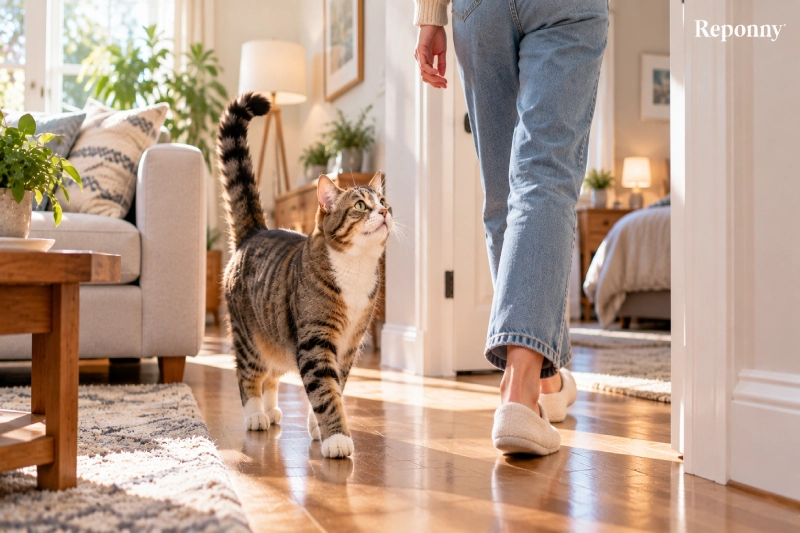
Your cat may follow you because you are socially important to it.
Despite their reputation for independence, domestic cats can form meaningful relationships with people.
In a 2019 attachment study, researchers used behavioral criteria adapted from human infant attachment research and found evidence that cats displayed distinct attachment styles toward their human caregivers.
A 2024 study using a secure-base-style test also found that cats showed affiliative behaviors and increased proximity to people following brief separation in an unfamiliar environment.
This does not mean every cat follows its owner because of attachment.
Following is not a diagnostic test for the strength of the human-cat bond.
But if your cat:
- follows you with relaxed posture,
- approaches with an upright tail,
- rubs against you,
- slow blinks,
- sleeps nearby,
- settles comfortably when you sit down,
- and voluntarily chooses your company,
the overall pattern strongly supports positive social affiliation.
Some cats simply prefer sharing space with their favorite people.
They do not necessarily need constant physical contact.
Your cat may follow you into the office, lie three feet away, and then go to sleep.
That still counts as choosing social proximity.
2. Your Cat Wants Attention
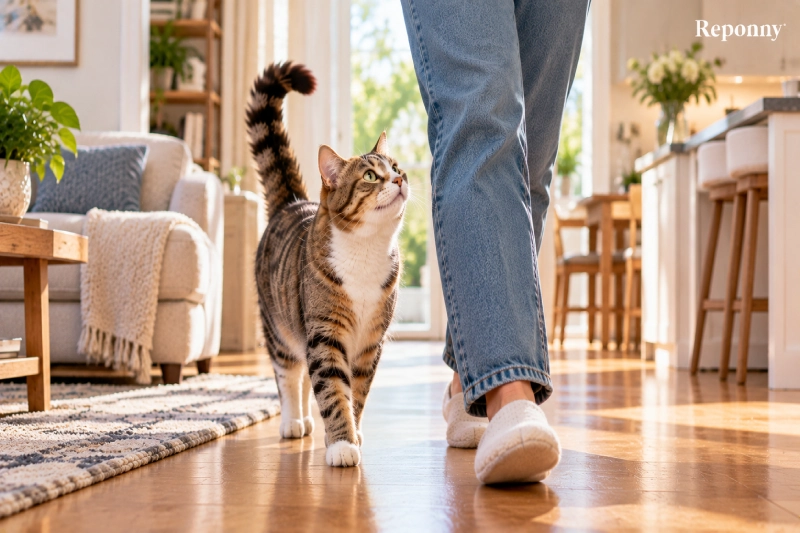
Sometimes your cat follows you because it wants interaction.
That interaction might be:
petting, play, grooming, talking, or simply companionship.
Cats Protection identifies attention-seeking as one common reason cats follow their owners.
You may notice the pattern most clearly after returning home.
Your cat follows you from room to room.
It rubs against your legs.
It meows.
It jumps onto furniture near you.
It may place itself directly between you and your computer.
This does not necessarily indicate unhealthy dependence.
Your cat may simply have spent several hours resting and now wants social interaction.
The Feline Veterinary Medical Association’s current environmental guidance emphasizes that cats need positive, consistent and predictable human-cat social interaction, while also stressing that each cat should be allowed to control the type and amount of contact it prefers.
So give your cat attention—but pay attention to its preferences.
One cat may enjoy ten minutes of interactive play.
Another wants cheek scratches.
Another simply wants to sit beside you.
Quality matters more than forcing constant physical contact.
3. Your Cat Thinks You Are Going to Feed It
There is another very practical possibility.
Your cat may follow you because you are:
the person who controls the food.
Consider what happens every day.
You wake up.
You walk toward the kitchen.
Food appears.
You stand up in the afternoon.
Maybe treats appear.
You open the refrigerator.
Interesting smells appear.
Cats are excellent at learning routines.
If movement toward a certain room reliably predicts food, your cat may follow whenever there is even a small chance that something edible is about to happen.
Cats Protection specifically lists food as one possible reason cats follow people and recommends checking that the cat is being fed an appropriate amount rather than simply responding to every food request.
Watch where your cat leads you
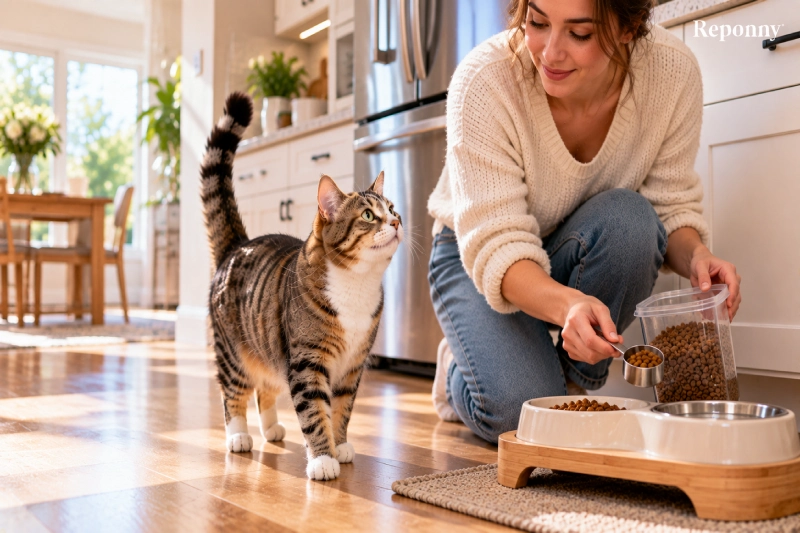
If your cat follows you and then:
stands beside the bowl, looks at you, meows, or walks toward the food cupboard,
the mystery may not be very complicated.
Your cat may have been escorting you to the kitchen.
Avoid turning every follow into a snack
If following you always results in food, the behavior may become increasingly persistent.
Feed according to your cat’s nutritional needs and predictable schedule rather than offering extra calories every time the cat appears behind you.
For highly food-motivated cats, puzzle feeders or dividing the daily allowance into several smaller meals may help.
4. Your Cat Is Curious About What You Are Doing
You may simply be interesting.
Cats pay close attention to changes in their territory.
When you move through the home, you may:
open doors, move objects, create sounds, introduce smells, expose cupboards, open windows, carry bags, or enter rooms the cat finds interesting.
From the cat’s perspective, following you may be an efficient way to monitor what is happening.
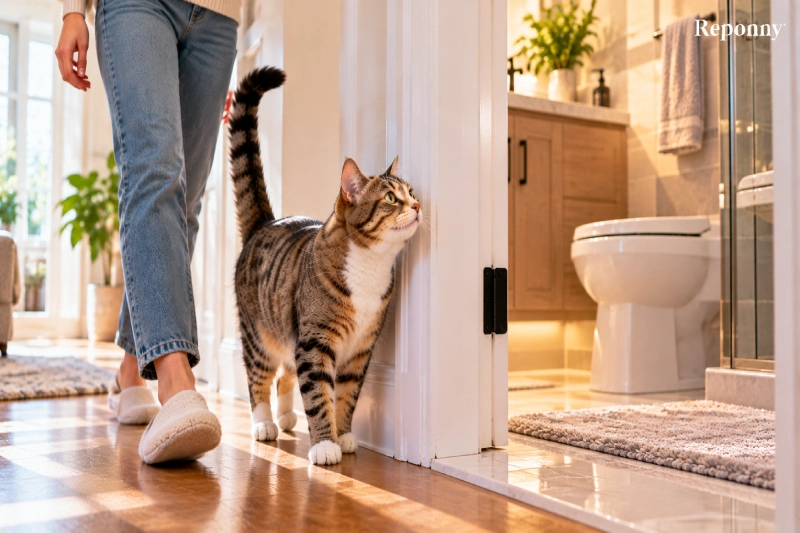
This becomes especially obvious in the bathroom.
You close a door that is normally open.
Water begins running.
You interact with objects.
Interesting smells appear.
And your cat suddenly insists on investigating.
This does not necessarily mean your cat cannot tolerate being separated from you.
It may simply dislike being excluded from something happening inside its territory.
Cats Protection’s current guidance on separation-related behavior specifically notes that a cat meowing when a person leaves or closes a door does not automatically have separation anxiety. Some cats simply dislike closed doors or want access to the space their owner entered.
So if your cat follows you into the bathroom every morning, the explanation may be less dramatic than it seems.
You are moving.
Something is happening.
Your cat wants to know what.
5. Your Cat May Need More Mental and Physical Stimulation
Sometimes constant following is partly about lack of alternatives.
Imagine an indoor cat’s day.
The food bowl is predictable.
The toys have been on the floor for months.
Nothing moves.
Nothing needs to be hunted.
There are few interesting places to climb.
Then you stand up.
Suddenly something is happening.
Following the human becomes the most interesting activity available.
Current Feline Veterinary Medical Association guidance emphasizes that cats require opportunities for:
- play,
- predatory behavior,
- climbing,
- hiding,
- scratching,
- exploration,
- and positive social interaction.
It specifically recommends interactive prey-like toys and food puzzles to provide outlets for natural hunting behavior.
International Cat Care also notes that lack of opportunity to perform natural behaviors can contribute to frustration, boredom and behavior problems, particularly in indoor cats.
Add more things worth doing
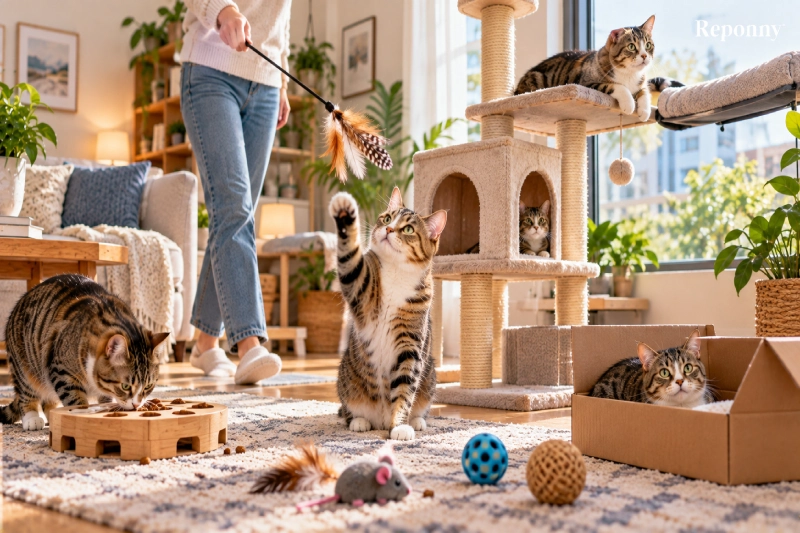
Try providing:
wand-toy sessions, puzzle feeders, cardboard boxes, elevated resting areas, scratching surfaces, window perches, rotating toys, tunnels, and safe opportunities to explore.
You are not trying to make your cat stop liking you.
You are expanding its world so that following you is one enjoyable activity among many, rather than the only interesting thing available.
6. Following You Has Been Rewarded in the Past
Cats learn from consequences.
Suppose your cat follows you into the kitchen.
You give it chicken.
Later it follows you into the bedroom.
You pet it.
Then it follows you to your desk.
You begin playing with it.
From the cat’s perspective:
following the human repeatedly produces good outcomes.
Why would it stop?
The reward does not have to be food.
Rewards can include:
- eye contact,
- talking,
- petting,
- picking the cat up,
- opening doors,
- play,
- access to a window,
- or simply your attention.
This is basic learning.
It does not mean your cat is manipulating you in some sinister way.
The cat is repeating a behavior that has worked before.
Does this mean you should ignore your cat?
No.
Social interaction is important.
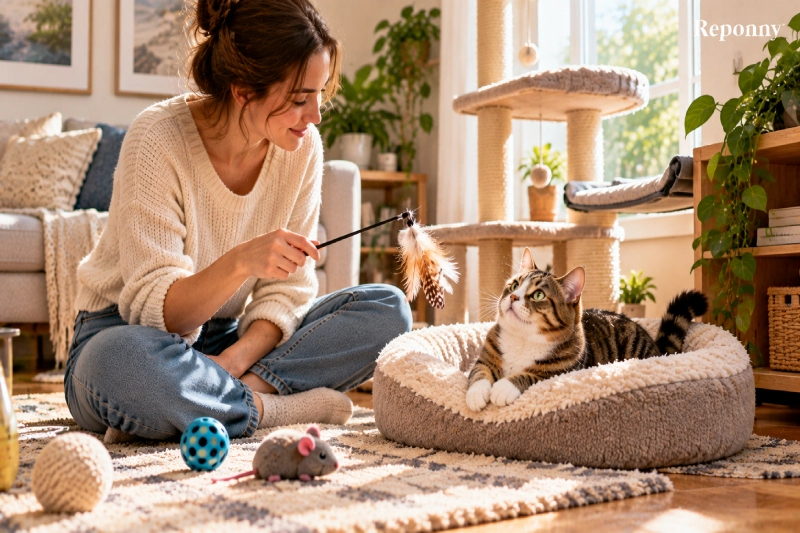
Instead, create predictable opportunities for attention so your cat does not need to follow you continuously to obtain it.
For example:
morning play → breakfast → afternoon interaction → evening play → dinner.
Predictability can make life easier for both you and the cat.
The Feline Veterinary Medical Association specifically recommends positive, consistent and predictable human-cat interaction tailored to each cat’s preferences.
7. Your Cat May Feel Safer Near You
Sometimes following reflects security rather than a request for food or entertainment.
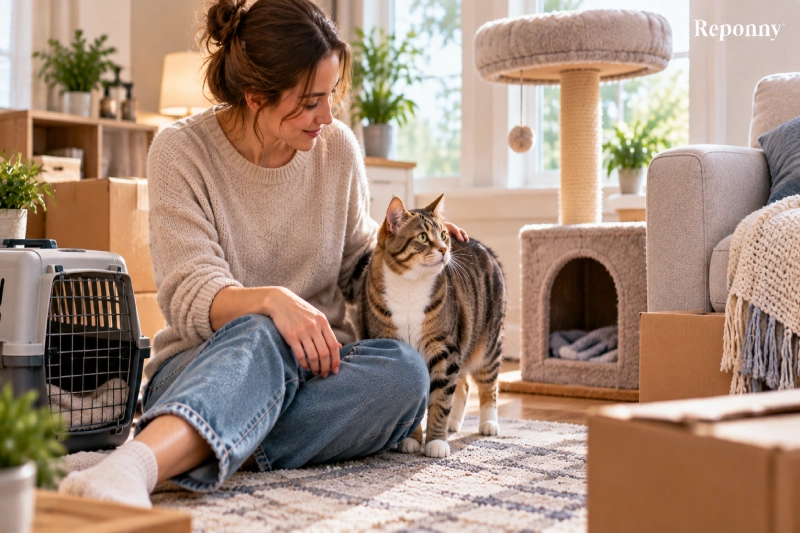
A familiar person may act as a reassuring social presence, especially when:
- visitors arrive,
- the household changes,
- construction is occurring,
- another animal has been introduced,
- unfamiliar noises are present,
- or the cat is adjusting to a new home.
Research on feline attachment supports the idea that the presence of familiar people can influence cats’ behavior in unfamiliar or stressful situations.
Cats Protection also notes that changes in routine can affect feline behavior and that cats may become more dependent on familiar patterns when circumstances change.
Look for other stress signals
If following increases because your cat feels insecure, you may also notice:
- hiding,
- increased vigilance,
- reduced play,
- appetite changes,
- excessive vocalization,
- overgrooming,
- sleep changes,
- house soiling,
- or conflict with other cats.
Following alone does not prove anxiety.
But following plus multiple stress signals deserves closer attention.
Give your cat choice
Do not solve insecurity by carrying the cat everywhere.
Instead, make the environment feel safer.
Provide elevated resting places, boxes, hiding areas, separate food and water resources, appropriate litter boxes, scratching areas and predictable routines.
FelineVMA guidance emphasizes that every cat should have access to safe places and multiple separated resources so it can avoid perceived threats and maintain control over its environment.
8. Sudden Clinginess Can Be a Sign of Aging, Pain or Illness
This is the reason owners should never ignore a major change.
Some cats become more dependent on familiar people as they age.
Cornell notes that older cats may require more emotional support and may become more dependent on familiar relationships. Senior cats can also have greater difficulty adapting to changes in routine.
But age itself is not a diagnosis.
A cat may become unusually clingy because it is experiencing:
- pain,
- sensory decline,
- weakness,
- disorientation,
- chronic disease,
- or another medical problem.
VCA specifically lists personality changes—including becoming clingier, crankier, more fearful or less sociable—among possible signs of illness.
Senior cats deserve particular attention
Cornell describes cognitive dysfunction in older cats as potentially causing:
- disorientation,
- sleep-wake changes,
- nighttime vocalization,
- reduced play,
- altered interaction,
- and other significant behavioral changes.
Importantly, Cornell stresses that medical problems such as arthritis, kidney disease, hyperthyroidism, hypertension, dental pain and neurological disease can produce behavioral changes that resemble cognitive decline.
So if your independent 14-year-old cat suddenly begins following you constantly while also:
meowing at night, appearing confused, losing weight, drinking more, moving stiffly, or changing litter-box habits,
schedule a veterinary examination.
Do not assume your cat has simply become more affectionate with age.
Does Following You Mean Your Cat Loves You?
It can be part of a strong social relationship.
But following alone does not prove love.
A cat may follow you because:
you are interesting, you provide food, you open doors, you offer attention, or you make the environment feel safer.
Often, several of these reasons occur at the same time.
A socially bonded cat may follow you into the kitchen because it likes being near you and hopes dinner is coming.
Those motivations are not mutually exclusive.
Other signs of positive social affiliation can include:
- approaching with an upright tail,
- rubbing against you,
- slow blinking,
- sleeping nearby,
- head bunting,
- grooming near you,
- purring during relaxed contact,
- or voluntarily returning to interact with you.
Attachment research shows that cats are capable of forming meaningful bonds with caregivers, but no single behavior should be used as a perfect measure of that bond.
Why Does My Cat Follow Me to the Bathroom?
Because bathrooms combine several things cats find interesting.
First, you disappeared behind a door.
Second, bathrooms contain:
running water, unusual smells, rugs, sinks, bathtubs, toilet paper, cabinets, and many interesting surfaces.
Third, you are often sitting still.
From your cat’s perspective, this may be an excellent opportunity for interaction.
Some cats also learn that bathroom visits are highly predictable.
Every morning you wake up, walk into the bathroom, and remain there for several minutes.
Your cat learns the routine.
Cats Protection’s 2026 guidance on separation-related behavior explicitly notes that cats may vocalize when people leave simply because they dislike closed doors or want access to the room—not because they necessarily have separation anxiety.
So the bathroom obsession is usually far less mysterious than social media makes it sound.
Does Following You Mean Your Cat Has Separation Anxiety?
Usually not.
This distinction is important.
Cats can form attachment relationships with people, but attachment and separation anxiety are not the same thing.
Cats Protection’s 2026 guidance states that true separation anxiety is thought to be uncommon in cats. Behaviors noticed after a cat has been left alone may more often reflect:
- boredom,
- frustration,
- disrupted routines,
- unmet stimulation needs,
- or loss of expected access to food or outdoor activity.
VCA uses the broader term separation-related distress for problems triggered by the absence of an attachment figure and notes that different animals can experience different underlying emotions.
Following you while you are home therefore does not diagnose separation anxiety.
Signs worth investigating
More concerning patterns occur specifically around departure or absence and may include:
persistent vocalization, inability to settle, inappropriate elimination, destructive scratching, refusal to eat, excessive agitation, or other substantial behavior changes.
If you suspect a separation-related problem, a camera can help show what actually happens after you leave.
Cats Protection notes that timing matters: a cat that briefly protests a closed door and then settles is very different from a cat that remains intensely distressed after a caregiver leaves.
Veterinary assessment should come first because medical problems can also alter behavior.
Why Does My Cat Follow Me but Not Other People?
Cats do not necessarily interact with every household member equally.
One person may:
feed the cat most often, play more gently, respect its boundaries, spend more time at home, provide access to favorite rooms, or simply have a predictable interaction style the cat prefers.
Cats also have individual social preferences.
Research into human-cat relationships suggests cats are capable of differentiated social bonds rather than responding identically to every person.
This does not necessarily mean the cat dislikes everyone else.
It may simply prefer following the person most strongly associated with positive and predictable experiences.
Why Does My Cat Follow Me and Meow?
Following plus meowing often makes the cat’s goal easier to identify.
Your cat may be asking for:
food, play, petting, access to a room, attention, or assistance.
Watch where the cat goes.
Does it:
walk toward the bowl?
Stand beside a closed door?
Lead you toward a toy?
Jump onto the bed?
Stop beside the water fountain?
Your cat may not simply be following.
It may be leading you somewhere.
However, if the vocalization and following are new, persistent or unusual, especially in an older cat, consider a medical cause.
Sudden personality changes and new vocalization are both reasons to pay closer attention to health.
Why Does My Cat Follow Me and Then Bite My Ankles?
This can be play or predatory behavior rather than social dependence.
Moving ankles are excellent moving targets.
A cat that lacks enough hunting-style play may:
follow, stalk, crouch, chase, and pounce at feet.
Do not encourage this behavior by deliberately wrestling with the cat using hands or feet.
Instead, provide appropriate predatory outlets such as:
- wand toys,
- toy mice,
- rolling toys,
- puzzle feeders,
- or short chase-and-catch play sessions.
Current FelineVMA environmental guidance specifically recommends toys that mimic prey and emphasizes allowing the cat to catch the “prey” periodically to prevent frustration.
If ankle attacks appear alongside defensive body language or sudden aggression, investigate more carefully.
Should You Stop Your Cat From Following You?
Usually, no.
If:
- your cat is healthy,
- the behavior is normal for that individual,
- the cat can settle independently,
- and following does not interfere with daily life,
there is no need to eliminate it.
Your cat is allowed to enjoy your company.
The concern is not closeness.
The concern is distress or inability to function independently.
For example, you may want to encourage greater independence if your cat cannot relax unless touching you, becomes extremely distressed whenever a door closes, or follows because there is virtually no other stimulation available.
VCA recommends independence-building exercises in cases of separation-related distress, including helping the animal learn to relax in a comfortable location while the caregiver remains temporarily unavailable.
This should be done gradually.
Do not suddenly lock a highly dependent cat away for hours in an attempt to “teach independence.”
How to Encourage Healthy Independence
You do not need to choose between having a bonded cat and an independent cat.
A healthy relationship can contain both.
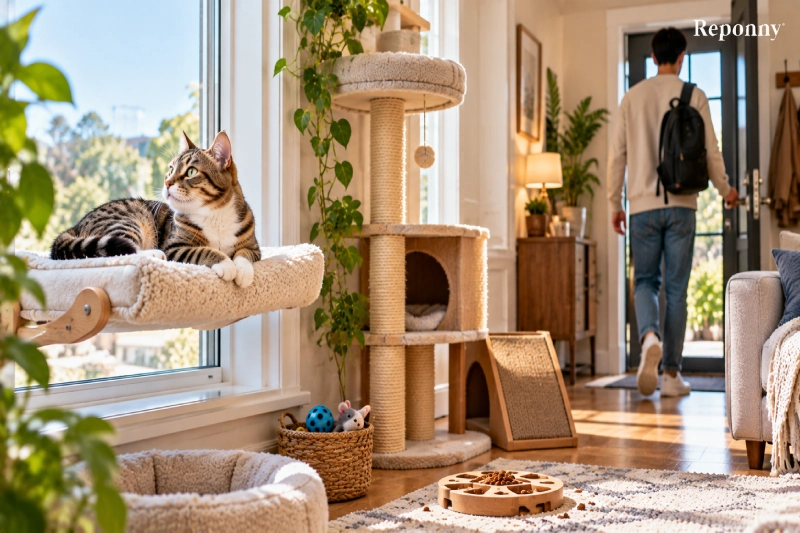
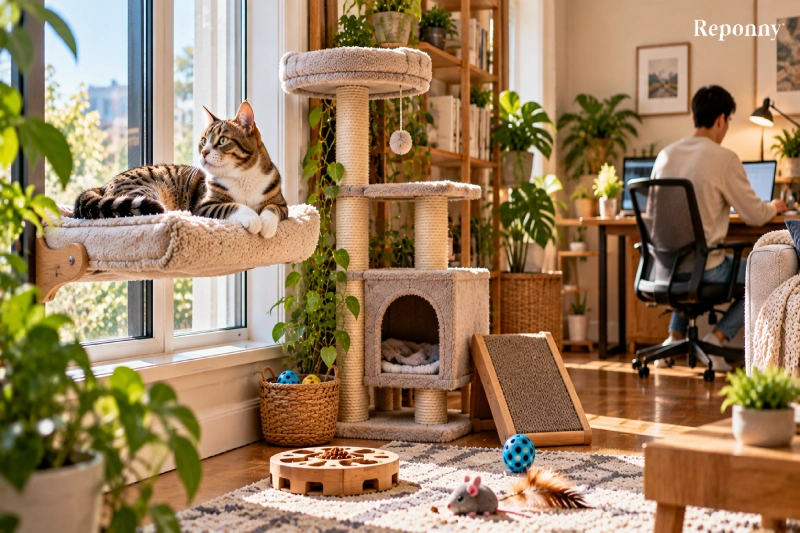
Give your cat rewarding places where it can relax without following you.
Examples include:
window perches, elevated beds, heated cat beds when appropriate, boxes, covered resting areas, cat trees, or quiet shelves.
Provide activities the cat can use without constant human involvement.
Puzzle feeders and safely accessible toys can help.
Create predictable times for social interaction so attention does not always depend on trailing you from room to room.
And respect periods when your cat chooses to be alone.
The Feline Veterinary Medical Association emphasizes that cats benefit when they can initiate, choose and control their social interactions.
Healthy independence is not emotional distance.
It is giving your cat options.
When Should Following Behavior Concern You?
Focus on change and accompanying symptoms.
Contact your veterinarian if your cat suddenly becomes much more clingy and you also notice:
- reduced or increased appetite,
- unexplained weight change,
- increased thirst,
- increased urination,
- vomiting or diarrhea,
- difficulty jumping,
- stiffness,
- hiding,
- nighttime yowling,
- disorientation,
- changes in litter-box behavior,
- breathing changes,
- unusual aggression,
- reduced grooming,
- or other personality changes.
VCA specifically advises that personality changes such as becoming unusually clingy can occur with illness.
Cornell similarly emphasizes that changes in senior-cat behavior should not simply be dismissed as normal aging because disease of many organ systems, pain and sensory changes can alter behavior.
The principle is simple:
A lifelong shadow cat may simply be a shadow cat.
A suddenly clingy cat deserves investigation.
A Quick Guide to Why Your Cat Follows You
| What You Notice | Possible Explanation |
|---|---|
| Relaxed tail-up following | Social affiliation / companionship |
| Following after you arrive home | Attention or social interaction |
| Following toward kitchen | Food expectation |
| Following whenever doors open | Curiosity / access |
| Constant following in under-stimulating home | Boredom / lack of enrichment |
| Following repeatedly produces treats or petting | Learned behavior |
| Increased following after move or household change | Stress / seeking security |
| Suddenly clingy senior cat | Medical, sensory or cognitive change should be considered |
| Distress mainly when you leave | Possible separation-related problem |
| Following + weight/appetite/litter-box changes | Veterinary evaluation recommended |
Frequently Asked Questions
Why Does My Cat Follow Me Everywhere?
Common reasons include companionship, attention, food expectation, curiosity, boredom, learned reinforcement, feeling safer near you, and age-related or medical changes.
Cats can form attachment relationships with human caregivers, but following behavior alone does not prove attachment or anxiety.
Does My Cat Follow Me Because It Loves Me?
Possibly in part.
Following may occur as part of a positive social bond, especially when combined with relaxed body language, tail-up greetings, rubbing, slow blinking and voluntarily resting near you.
But your cat may also be following because you provide food, play or access to interesting places.
Why Does My Cat Follow Me Into Every Room?
Your cat may enjoy your company or simply want to monitor what is happening in its territory.
Moving humans open doors, provide food, create activity and reveal interesting environments.
For some cats, following is therefore both social and practical.
Why Does My Cat Follow Me to the Bathroom?
Closed doors, running water, interesting smells, routine and the fact that you remain stationary for several minutes can all make the bathroom interesting.
Disliking a closed bathroom door does not automatically mean your cat has separation anxiety.
Why Does My Cat Follow Me and Meow?
Your cat may be requesting food, attention, play or access to something.
Watch where it goes next.
If following and vocalizing suddenly increase without an obvious reason, consider veterinary evaluation.
Why Does My Cat Follow Me but Not My Partner?
The cat may have developed a stronger routine or social preference with you.
You may also be the person most associated with feeding, play, positive handling or predictable interaction.
Cats can form differentiated relationships with familiar people.
Why Is My Cat Suddenly Following Me Everywhere?
A sudden change deserves more attention than lifelong following.
Stress, environmental change, pain, illness, sensory decline or age-related cognitive changes can alter how much a cat seeks proximity.
VCA specifically lists becoming unusually clingy as a potential personality change associated with illness.
Why Is My Senior Cat Suddenly So Clingy?
Some older cats become more dependent on familiar relationships, but new clinginess may also accompany pain, sensory decline, chronic illness or cognitive dysfunction.
Cornell recommends veterinary assessment for behavioral changes in senior cats rather than assuming they are simply part of aging.
Does Following Me Mean My Cat Has Separation Anxiety?
No.
True separation anxiety is thought to be uncommon in cats, and following you while you are home does not diagnose it.
Boredom, routine changes, frustration and social preferences can all create similar impressions.
How Do I Stop My Cat From Following Me?
If the behavior is harmless, you do not necessarily need to stop it.
If you want to encourage independence, provide attractive resting areas, puzzle feeders, climbing spaces, regular play and predictable social interaction.
Never punish a cat for following you.
Should I Worry if My Cat Never Follows Me?
No.
Some cats prefer greater physical distance while still maintaining strong social relationships with their caregivers.
A cat may show comfort through sleeping nearby, slow blinking, rubbing, greeting with an upright tail or voluntarily approaching at specific times.
Individual personality matters.
Final Thoughts
If your cat follows you everywhere, the behavior usually does not require a complicated explanation.
You may simply be important to your cat.
Research now provides good evidence that domestic cats are capable of forming meaningful attachment relationships with human caregivers, and familiar people can influence how cats behave during social and unfamiliar situations.
But attachment is only part of the picture.
Your cat may also follow because:
you provide food, attention, entertainment, access and predictability.
And sometimes the explanation is even simpler:
you stood up, something happened, and your cat wanted to see what it was.
That is why following you into the bathroom does not automatically mean separation anxiety.
Current Cats Protection guidance emphasizes that true separation anxiety appears to be uncommon in cats and that behaviors linked to a person’s absence may more often reflect boredom, frustration or disruption of normal routines.
What matters most is whether your cat appears comfortable.
A healthy cat that follows you with:
a loose body, soft eyes, relaxed ears and upright tail
is giving you a very different message from a cat that follows frantically while:
vocalizing, refusing food, hiding, appearing confused or showing other signs of stress.
And always pay attention to sudden changes.
Older cats in particular may become more dependent on familiar people, but Cornell warns that behavioral changes can also arise from pain, chronic disease, sensory decline or cognitive dysfunction.
So enjoy your feline shadow.
Give your cat attention.
Provide play and enrichment.
Let it investigate what you are doing.
But also give it safe places and interesting activities where it can relax independently.
The healthiest relationship is not one in which your cat must be beside you every second.
It is one in which your cat can choose to follow you—and feels equally safe when it chooses not to.