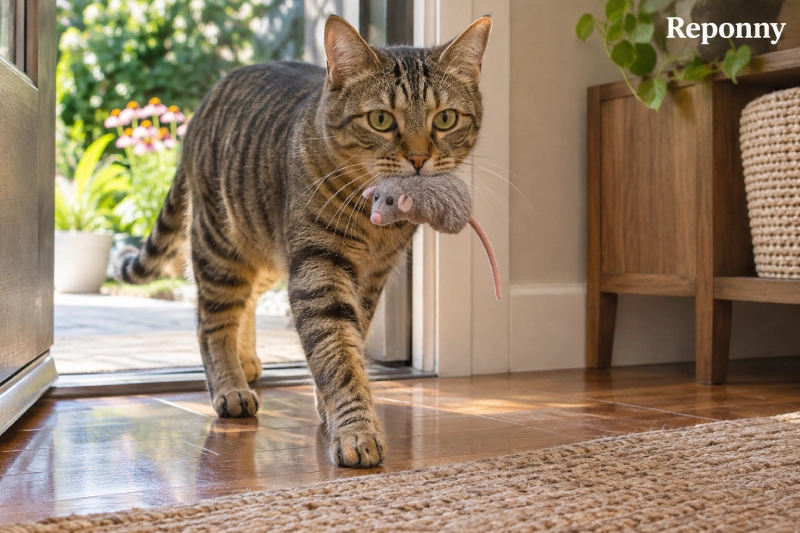
You walk into the kitchen in the morning and immediately realize your cat has brought something inside.
A mouse.
A bird.
A lizard.
Sometimes it is dead. Sometimes, unfortunately, it is still very much alive.
Your cat may sit nearby looking completely calm—as if nothing unusual has happened.
So why does your cat bring dead animals home?
Many owners assume their cat is giving them a gift.
Another popular explanation is that cats think humans are terrible hunters and are trying to teach us how to catch our own food.
Those stories are entertaining, but there is little evidence that either explanation is literally true.
Cats Protection explains that the more likely reason is much simpler: cats are natural predators, and after catching prey they may carry it back to a familiar core territory where they feel secure enough to eat, inspect or store it. For a pet cat, that safe territory is often your house.
The behavior is also not necessarily caused by hunger.
A well-fed cat can still have a powerful drive to stalk, chase, capture and kill prey. VCA notes that hunting motivation is not directly dependent on hunger; movement and high-pitched sounds can trigger predatory behavior even when a cat has recently eaten.
Quick answer: Cats bring dead or live animals home because hunting is an instinctive behavior and the home is often their safest territory. They are probably not intentionally giving you a present or teaching you to hunt. Well-fed cats can still hunt. Regular prey-like play, safe indoor living or controlled outdoor access, and appropriate enrichment can reduce hunting opportunities while allowing cats to express natural predatory behavior.
Why Do Cats Hunt in the First Place?
Domestic cats may sleep on beds, eat commercially prepared food and live entirely alongside humans.
But biologically, they remain predators.
Their bodies are designed for hunting.
Cats have:
- forward-facing eyes,
- excellent low-light vision,
- sensitive hearing,
- flexible bodies,
- sharp claws,
- powerful hind legs,
- and teeth adapted for capturing small prey.
VCA explains that even indoor cats retain the behavioral sequence associated with hunting and benefit from opportunities to:
seek → stalk → chase → pounce → capture.
The key point is that hunting is not simply a strategy for avoiding starvation.
It is also an instinctive behavioral system.
That is why a cat can eat breakfast at home and still chase a mouse an hour later.
Cats Protection similarly emphasizes that the drive to hunt is not necessarily caused by hunger.
Your Cat Can Hunt Even When It Is Well Fed
This is one of the biggest misconceptions about feline hunting.
Owners sometimes think:
“If I feed my cat more, it will stop catching mice.”
Usually, that is not how the behavior works.
A cat does not need to be hungry before responding to prey.
VCA notes that rapidly moving objects and high-pitched sounds can activate predatory behavior even in well-fed cats.
This makes sense when you consider how cats evolved.
For a small predator, waiting until severe hunger develops before beginning to hunt would be risky.
Wild prey is unpredictable.
A hunting opportunity may need to be taken when it appears.
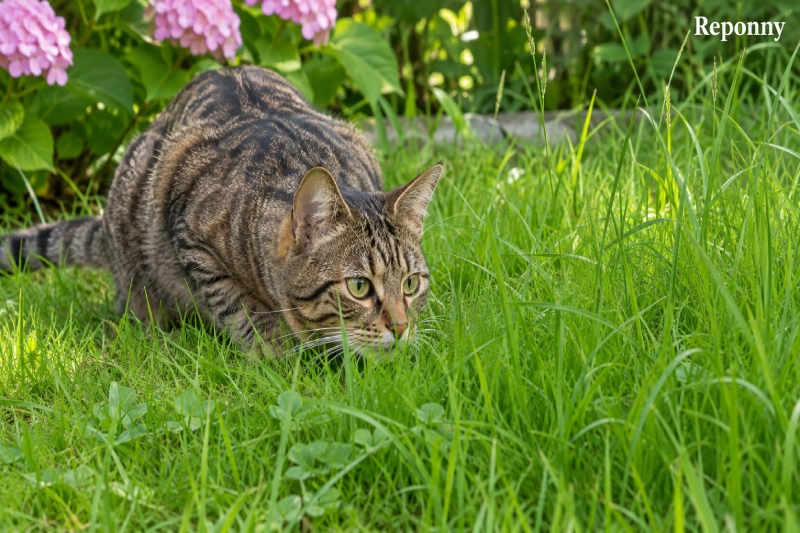
So your cat may finish a complete meal, walk outside and immediately begin stalking something moving through the grass.
That does not mean you are underfeeding your cat.
And feeding unlimited extra calories in an attempt to suppress hunting can create another problem:
obesity.
Feed your cat according to its nutritional and calorie needs—not according to the number of mice it catches.
Why Does My Cat Bring Dead Animals Home?
The most likely explanation is that your house is part of your cat’s safe core territory.
Cats Protection explains that after catching prey, a cat may prefer to take it somewhere it feels secure rather than eating or leaving it at the capture site where another animal could steal it.
That secure location may be:
- your kitchen,
- porch,
- bedroom,
- garage,
- doorstep,
- or even your bed.
From your perspective, the location may seem horrifying.
From your cat’s perspective, it may simply be the safest place available.
Cats Protection’s educational material also notes that cats commonly carry prey back toward their core territory, similar to behavior seen in wild felids.
So when your cat leaves a mouse beside your shoes, it probably is not carefully choosing a sentimental gift location.
It has brought prey into an area it knows well.
Is My Cat Giving Me a Gift?
Probably not in the human sense.
The idea is appealing because cats do sometimes leave prey near people.
But there is no strong evidence that a cat captures a mouse specifically to express:
“I brought this present for you.”
Cats Protection explicitly describes the “gift” explanation as a common misconception and instead points toward the safety of the cat’s home territory as the more plausible explanation.
That does not mean your relationship is irrelevant.
If your cat regularly brings prey into your home, it clearly considers the house a familiar and secure place.
In that broader sense, the behavior can reflect the fact that your cat feels safe in its home environment.
But that is different from deliberately selecting a mouse as a present for you.
Is My Cat Trying to Teach Me How to Hunt?
This is another popular story.
People sometimes compare pet cats with mother cats bringing prey to kittens and conclude:
“My cat thinks I am an incompetent kitten.”
There is not enough evidence to support that conclusion.
Mother cats can interact with prey around developing kittens as part of the kittens’ exposure to hunting behavior.
But an adult pet cat bringing a mouse into a human household does not automatically mean it is conducting a hunting lesson.
The safer interpretation is:
the cat captured prey and carried it into familiar territory.
We should be cautious about assigning detailed human-like intentions when simpler explanations fit the behavior.
Why Does My Cat Bring Live Animals Into the House?
Because the hunting sequence does not always end immediately with a kill.
A cat may capture an animal and carry it while it is still alive.
Cats Protection explains that cats sometimes repeatedly release and recapture prey. Although this can look like play, the behavior may help tire the prey and reduce the cat’s risk of injury during the final stages of capture.
A live mouse brought indoors can therefore become part of an unfinished predatory sequence.
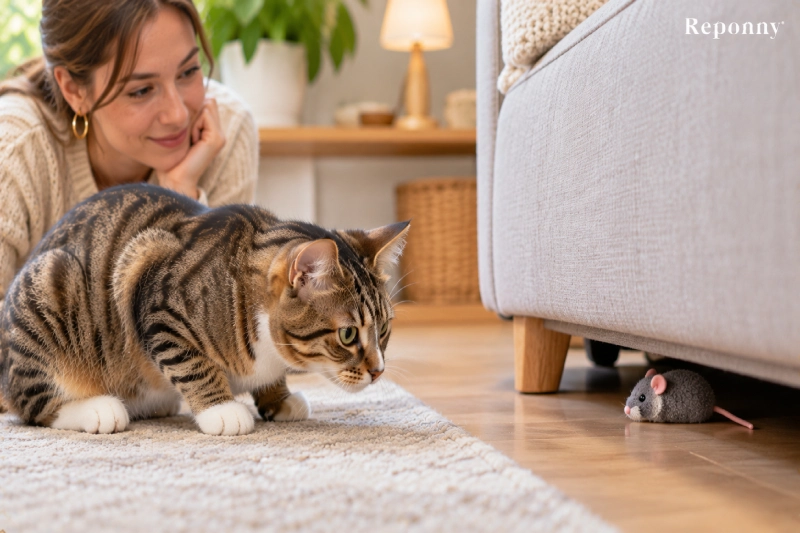
Unfortunately, your house may then provide the mouse with many excellent hiding places.
If this happens:
keep calm, move the cat to another secure room if you can do so safely, and avoid encouraging a high-speed chase through the house.
Do not punish the cat.
The behavior is instinctive.
Why Does My Cat “Play” With a Mouse Before Killing It?
What looks like cruelty to humans is not necessarily motivated by cruelty.
Cats are predators dealing with prey that may:
- bite,
- scratch,
- escape,
- or injure them.
Repeatedly releasing and recapturing prey may allow a cat to tire the animal while maintaining control.
Cats Protection describes this behavior as a hunting technique that can reduce the risk to the cat during capture.
This does not make the event pleasant to watch.
But interpreting feline predation through human moral concepts can make the behavior harder to understand.
The cat is performing a species-typical predatory sequence.
Why Does My Indoor Cat Carry Toy Mice Around?
Indoor cats often direct the same behavioral system toward toys.
A toy mouse can trigger:
- stalking,
- chasing,
- pouncing,
- grabbing,
- carrying,
- kicking,
- and “killing.”
VCA recommends using toys that mimic characteristics of real prey and allowing cats to complete successful capture sequences during play.
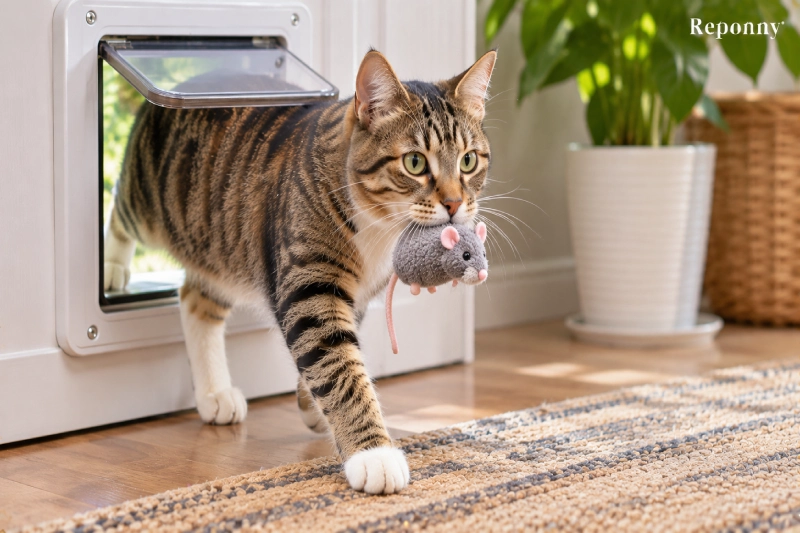
Some cats will then carry the toy to:
their bed, food area, owner’s bedroom, or another familiar location.
That does not necessarily require a special explanation.
Carrying objects is compatible with predatory behavior.
Cats Protection also notes that some cats bring home unusual objects—including toys or other interesting items—because they find them stimulating and may prefer to investigate them within their home territory.
So a toy mouse appearing on your pillow may be a much safer version of the same behavioral pattern.
What Animals Do Domestic Cats Hunt?
Domestic cats can capture a wide variety of small animals.
Depending on geography and opportunity, prey may include:
- mice,
- rats,
- voles,
- shrews,
- small birds,
- lizards,
- insects,
- amphibians,
- and other small animals.
A large citizen-science study in metropolitan France monitored prey brought home by 5,048 cats between 2015 and 2022.
Researchers recorded 36,568 prey items. Mammals made up about 68%, birds about 21%, and squamates such as lizards about 8%. The type of prey varied by season.
But there is an important limitation:
animals brought home do not represent everything a cat catches.
A 2026 study using GPS and cat-mounted cameras followed a much smaller group of 23 cats in suburban France. Cameras documented 31 captured prey animals, yet only one of those captures was detected through the traditional method of recording prey returned home. The authors cautioned that prey-return records can substantially underestimate actual predation, although the study’s small sample means the exact ratio should not be generalized to every cat.
So the mouse on your kitchen floor may represent only one part of your cat’s outdoor hunting activity.
Why Do Some Cats Hunt Much More Than Others?
Not every outdoor cat is an equally successful hunter.
Some cats rarely catch anything.
Others repeatedly return home with prey.
Several things may influence hunting behavior:
- age,
- individual temperament,
- outdoor access,
- local prey availability,
- season,
- habitat,
- experience,
- and opportunity.
The 2026 GPS-and-camera study found preliminary evidence that individual personality characteristics were associated with differences in both roaming range and hunting propensity. The authors emphasized that the study was small and that more data are needed.
A broader French citizen-science study also found seasonal differences in the types of prey returned home.
So two cats living in neighboring houses can have completely different hunting habits.
Is Hunting Bad for My Cat?
Hunting is normal behavior.
But unsupervised outdoor hunting can expose cats to additional health and safety risks.
Cornell notes that outdoor cats have greater exposure to:
- infectious disease,
- parasites,
- vehicle trauma,
- fights,
- wildlife,
- and predators.
For these reasons, Cornell recommends keeping cats indoors or using safer options such as outdoor enclosures or supervised harness walks.
Hunting prey introduces additional risks.
These include parasites and exposure to toxins carried by prey.
Wild Prey Can Carry Parasites
Rodents and other prey can transmit parasites to cats.
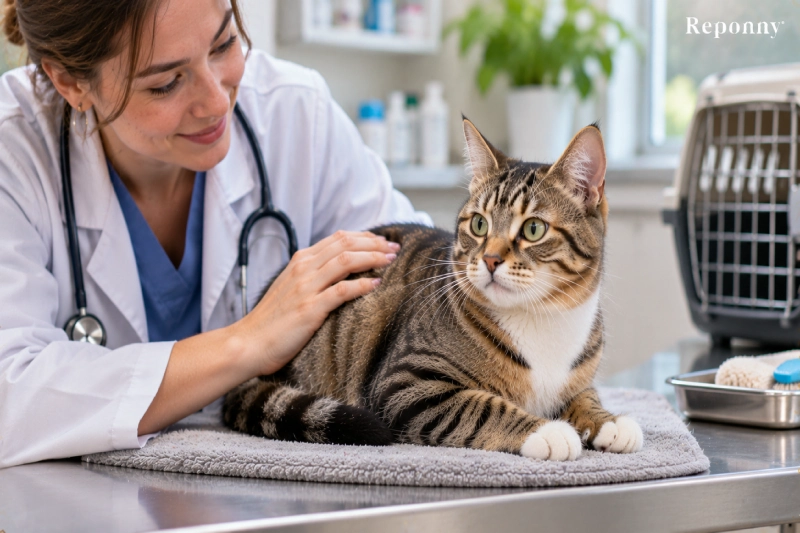
Cornell explains that cats may acquire certain tapeworm infections by eating infected rodents.
Cats can also acquire Toxoplasma gondii by eating infected prey.
Cornell notes that ingestion of tissue cysts in infected prey or raw meat is a major route of Toxoplasma infection in cats and recommends preventing cats from eating rodents or roaming unsupervised as part of risk reduction.
Wild birds and other animals can also expose cats to pathogens.
Cornell notes that Salmonella infection is more common among cats that eat raw meat or wild birds and animals.
This does not mean every mouse your cat catches will make it sick.
It means hunting adds exposures that a commercially fed indoor cat may otherwise avoid.
What About Poisoned Rodents?
This is another reason to discourage cats from eating captured rodents.
Rodenticides can poison non-target animals.
Merck’s current veterinary toxicology guidance notes that pets may be exposed either directly by eating rodenticide bait or indirectly by consuming poisoned rodents or carrion.
For anticoagulant rodenticides, secondary poisoning can occur after eating contaminated prey.
VCA notes that such secondary poisoning is uncommon but is possible, especially in cats that repeatedly consume rodents in environments where rodenticides are used.
Different rodenticides behave differently, so risk cannot be estimated simply by looking at the rodent.
If you suspect your cat has eaten poisoned prey or rodenticide bait:
contact your veterinarian or an animal poison service promptly.
Do not wait for symptoms.
Should You Let Your Cat Eat the Animal It Caught?
It is safer not to encourage it.
Even if your cat appears perfectly capable of eating prey, wild animals can carry:
- parasites,
- bacteria,
- toxins,
- or foreign material.
Cats Protection recommends removing dead prey rather than allowing the cat to consume it.
Feed a nutritionally complete commercial diet rather than relying on wildlife as part of your cat’s meals.
If your cat frequently eats prey, tell your veterinarian.
Parasite-prevention recommendations may need to reflect your cat’s lifestyle and exposure.
What Should You Do When Your Cat Brings Home a Dead Animal?
Try not to react dramatically.
Do not yell at the cat.
Do not punish it.
Cats Protection notes that punishment is unlikely to stop instinctive hunting behavior and may simply create stress.
Instead:
- Move your cat away from the animal if necessary.
- Wear gloves when handling the carcass.
- Place the animal in appropriate household waste according to local rules.
- Wash your hands thoroughly afterward.
- Clean any contaminated surfaces.
- Check your cat for visible wounds if there was a struggle.
Cats Protection specifically recommends gloves and careful hand washing when disposing of small dead prey.
If the prey is unusual, potentially poisonous, or your cat appears injured or ill afterward, contact your veterinarian.
What If the Animal Is Still Alive?
First, separate your cat from the prey if you can do so safely.
Placing the cat in another room prevents repeated recapture and reduces stress on the wild animal.
Avoid handling wildlife with bare hands.
If the animal appears injured, contacting a licensed wildlife rehabilitator or appropriate local wildlife authority may be the safest option.
Do not attempt to rehabilitate injured wildlife yourself unless qualified to do so.
If the animal appears capable of escaping safely, reduce noise, remove pets and allow a clear route out when appropriate.
The exact response depends on the species and local wildlife regulations
Should You Punish Your Cat for Hunting?
No.
Your cat is not trying to upset you.
Hunting is normal feline behavior.
Punishment does not remove the underlying motivation.
Cats Protection advises against shouting at or punishing cats for bringing prey home because the cat is unlikely to understand why it is being punished.
Punishment may instead cause:
- fear,
- avoidance,
- stress,
- or damage to the human-cat relationship.
A better approach is to reduce opportunities to hunt while providing acceptable outlets for the same behavioral needs.
How Can You Reduce Your Cat’s Hunting?
You may not be able to eliminate hunting motivation completely.
But you can substantially reduce opportunities for successful predation.
The most effective strategy is also the simplest:
Keep Your Cat Indoors or Use Controlled Outdoor Access
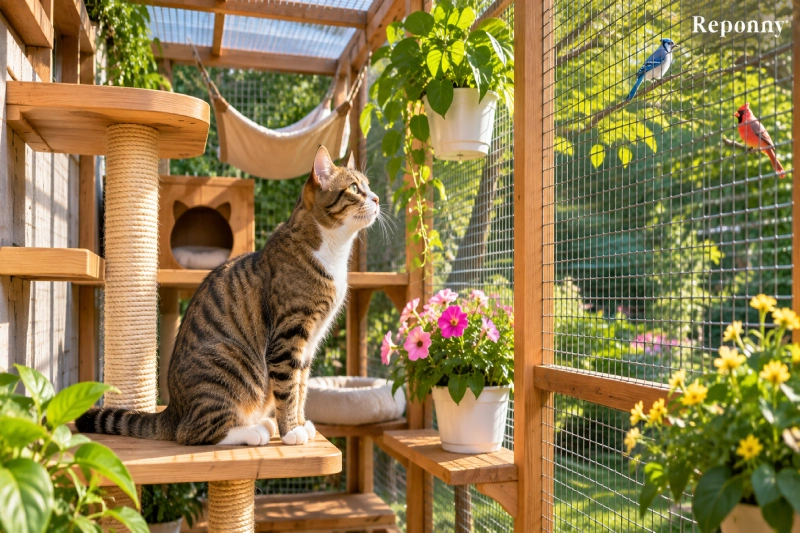
Cornell recommends indoor living, secure outdoor enclosures or supervised leash-and-harness activity because unsupervised outdoor access exposes cats to both safety risks and opportunities to prey on wildlife.
A secure catio can provide:
- fresh air,
- sunlight,
- smells,
- visual stimulation,
- climbing,
- and outdoor observation
without allowing unrestricted hunting.
Supervised harness walks are another option for cats that tolerate them.
This does not mean an indoor cat should live in an empty environment.
Indoor living works best when the cat receives meaningful enrichment.
Use Daily Hunting-Style Play
Play is one of the best ways to redirect predatory behavior.
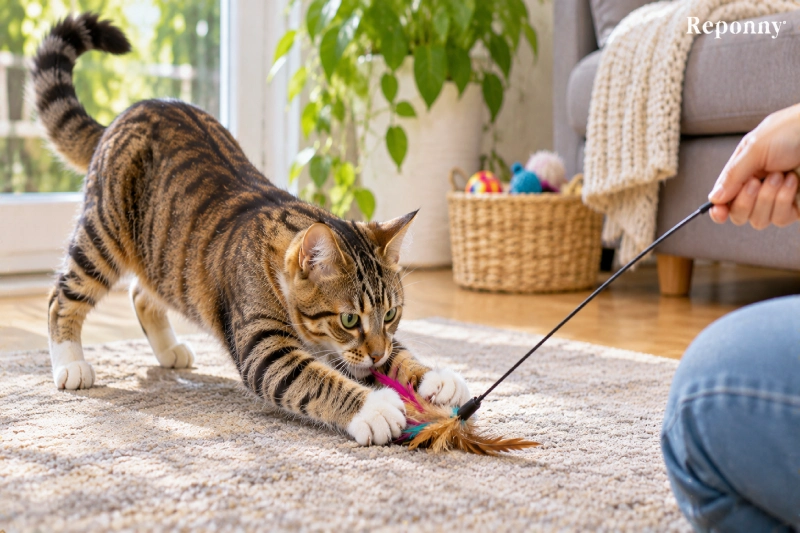
VCA recommends toys that allow cats to:
stalk → chase → pounce → capture.
Wand toys are especially useful because they can imitate prey while keeping human hands away from claws and teeth.
Try moving the toy like an animal rather than waving it constantly in your cat’s face.
A mouse-like toy can:
hide, pause, run, and disappear.
A bird-like toy can:
flutter, land, freeze, and move again.
And most importantly:
let your cat catch it.
VCA notes that cats need successful captures during play so the activity does not become continuously frustrating.
Several short sessions are often better than one extremely long session.
Morning and evening may work especially well because cats often show increased predatory activity around dawn and dusk.
Can More Play Actually Reduce Hunting?
There is some experimental evidence that it can.
A 2021 controlled study involved 219 households and 355 cats.
Owners who introduced approximately 5–10 minutes of daily object play recorded a 25% reduction in the number of wild animals captured and brought home compared with control and pre-intervention periods.
That does not mean five minutes of play will make every outdoor cat stop hunting.
The study measured prey brought home, not every predation event, and individual cats differ considerably.
But it provides useful evidence that meeting some of the cat’s predatory behavioral needs through play may reduce hunting in at least some cats.
This is a particularly attractive strategy because it benefits the cat regardless of the effect on wildlife.
Can Food Reduce Hunting?
Possibly—but interpret the evidence carefully.
The same 2021 study found that households feeding a commercial diet high in meat-derived protein recorded a 36% reduction in prey brought home compared with control and baseline periods.
However, this does not mean:
- every high-protein food prevents hunting,
- grain-free food is necessary,
- or owners should switch diets purely to stop predation.
The tested diet had several characteristics, and the study did not establish exactly which nutritional factor caused the difference.
Your first priority should still be a complete and balanced diet appropriate for your cat’s life stage and health.
Do not switch to an inappropriate food simply because the packaging says “high meat” or “grain-free.”
What About Puzzle Feeders?
Puzzle feeders are excellent enrichment tools for many cats.
But interestingly, the 2021 predation study found that the particular puzzle-feeder intervention tested was associated with an increase in prey brought home, rather than a decrease.
That does not mean puzzle feeders are bad.
They can still provide:
- mental stimulation,
- slower feeding,
- food-search behavior,
- and activity.
It simply means they should not be presented as a proven method for reducing wildlife predation.
This is a good example of why cat-care recommendations should distinguish general enrichment benefits from specific claims about hunting reduction.
Do Bells Stop Cats From Killing Birds?
Not reliably.
The 2021 controlled study found no discernible reduction in total prey returned home from the bell intervention.
A colorful Birdsbesafe-style collar cover reduced birds brought home by about 42% in that study but did not produce a clear reduction in mammals.
If any collar is used outdoors, safety is important.
Use only a cat-appropriate quick-release/breakaway collar designed to release if it becomes caught.
No collar device should be considered a substitute for controlled outdoor access if your goal is to prevent hunting as reliably as possible.
Keep Cats Away From Wildlife Feeding Areas
Bird feeders can unintentionally create predictable hunting locations.
Cats Protection recommends positioning wildlife feeders where cats cannot easily reach or ambush animals and keeping cats indoors temporarily when vulnerable fledglings are present in the garden.
If you feed birds:
avoid placing feeders beside fences, sheds, shrubs or other structures that provide cats with easy ambush points.
A bird feeder should not double as a feline hunting station.
Should You Keep Your Cat Indoors at Night?
Keeping a cat indoors for part of the day can reduce hunting opportunities, but the most reliable prevention is controlled rather than unrestricted outdoor access.
Cats often show strong activity around dawn and dusk, and VCA notes these periods are natural times for predatory behavior and interactive play.
If your cat normally goes outdoors, transitioning to more indoor time works best when you replace outdoor opportunities with:
- climbing,
- play,
- window viewing,
- scratching,
- hiding,
- food enrichment,
- and safe exploration.
Simply closing the door without improving the indoor environment may create frustration.
Can You Completely Remove a Cat’s Hunting Instinct?
Probably not—and that should not be the goal.
Predatory behavior is a normal part of feline biology.
Instead of trying to make your cat not be a cat, provide safe ways to express the behavioral sequence.
An indoor hunting game can include:
search → stalk → chase → pounce → catch → eat a small meal.
That is much more satisfying than simply waving a laser pointer endlessly.
VCA recommends prey-like toys and emphasizes successful capture during play.
The goal is:
preserve the behavior while changing the target.
A feather toy is much safer than a songbird.
A toy mouse is much safer than a wild rodent.
Does Hunting Mean My Cat Is Aggressive?
No.
Predatory behavior and social aggression are different behavioral systems.
A cat can be:
gentle with humans, affectionate with another household cat, and highly motivated to hunt a mouse.
Predatory behavior does not require anger.
The cat may stalk prey silently and calmly without:
- hissing,
- growling,
- defensive ears,
- or the other signals associated with fear-based aggression.
Do not interpret a successful hunter as a “mean” cat.
It is expressing species-typical behavior.
Why Does My Cat Bring Me Toys Instead of Animals?
This is usually a much easier behavior to live with.
Toy carrying may be connected with:
- play,
- predatory behavior,
- excitement,
- object interest,
- or learned interaction with people.
Some cats carry a toy into the bedroom and vocalize loudly.
Others drop toys at their owner’s feet.
If your cat enjoys retrieving or presenting toys, use it as an opportunity for play.
VCA notes that some cats naturally enjoy fetch and other object-based games.
A toy brought to you can therefore become a productive routine:
cat delivers toy → human starts play session.
That is a much safer outcome than wildlife appearing in the living room.
A Quick Guide to Cats Bringing Home Prey
| What Happens | Most Likely Explanation |
|---|---|
| Well-fed cat still hunts | Hunting drive is not simply hunger |
| Cat carries dead mouse home | Home may be a safe core territory |
| Cat brings live prey indoors | Capture sequence may not be complete |
| Cat releases and catches prey repeatedly | Predatory handling / tiring prey |
| Cat brings toy mice to bedroom | Predatory/object-carrying behavior |
| Cat hunts much more than another cat | Individual differences are normal |
| Cat eats rodents | Parasite and toxin exposure may increase |
| Cat brings prey home frequently | Returned prey may underestimate total hunting |
| Owner punishes hunting | Unlikely to remove instinct; may cause stress |
| More prey-like play provided | May help redirect hunting behavior |
Frequently Asked Questions
Why Does My Cat Bring Me Dead Animals?
Your cat is probably carrying captured prey back to a familiar, secure territory rather than deliberately giving you a gift.
Cats Protection identifies the safety of the cat’s home territory as a likely explanation for prey being brought indoors.
Is My Cat Giving Me a Present?
Probably not in the human sense.
Although “gift giving” is a popular interpretation, there is little evidence that cats intentionally catch animals as presents for their owners.
Is My Cat Trying to Teach Me How to Hunt?
There is not strong evidence supporting this popular explanation.
Bringing prey home is more simply explained by normal predatory behavior and returning prey to familiar territory.
Why Does My Cat Hunt Even Though I Feed It?
Because hunting motivation is not the same thing as hunger.
VCA notes that well-fed cats still stalk and capture moving prey.
Why Does My Cat Bring Live Mice Into the House?
The predatory sequence may not be complete.
Cats sometimes carry prey while it is still alive and may release and recapture it during hunting behavior.
Should I Let My Cat Eat the Mouse It Caught?
It is safer not to encourage this.
Wild rodents may expose cats to parasites, bacteria or toxins. Cornell documents transmission of tapeworms and Toxoplasma through consumption of infected prey.
Can My Cat Get Sick From Eating Mice?
Yes.
Possible risks include parasites and infectious organisms. Poisoned rodents can also pose a toxicological risk in some situations.
Should I Punish My Cat for Bringing Dead Animals Home?
No.
Hunting is instinctive, and punishment is unlikely to eliminate the behavior. It may instead increase stress.
Does Playing With My Cat Reduce Hunting?
It may.
A controlled 2021 study found that approximately 5–10 minutes of daily object play was associated with a 25% reduction in prey captured and brought home during the study period.
Do Cat Bells Stop Hunting?
Not reliably.
A 2021 controlled study did not find a discernible reduction in total prey brought home by cats wearing bells.
Is It Better to Keep a Hunting Cat Indoors?
Controlled indoor living is the most reliable way to prevent hunting wildlife.
Cornell recommends keeping cats indoors or providing safer alternatives such as secure outdoor enclosures and supervised harness walks because unrestricted outdoor access also increases exposure to disease, parasites, trauma and wildlife conflict.
Final Thoughts
Finding a dead animal on your floor is not one of the more charming parts of living with a cat.
But it helps to understand what your cat is actually doing.
Your cat is not being cruel to you.
It probably is not criticizing your hunting skills.
And it is unlikely to be carefully selecting a mouse as a romantic present.
It is behaving like a predator.
Cats retain a powerful behavioral drive to stalk, chase and capture prey even when humans provide all of their food. VCA specifically notes that hunting motivation is not dependent on hunger.
After a successful capture, your cat may bring prey back to the house because the home represents a familiar and secure core territory.
That behavior is natural.
But natural does not mean it has no consequences.
Outdoor hunting can expose cats to parasites, infectious organisms, poisoned rodents, injury and other hazards. It can also affect wildlife, and the animals owners discover at home may represent only a fraction of actual catches. A small 2026 camera study illustrates this limitation particularly clearly: researchers recorded 31 captures but detected only one through prey returned home.
Fortunately, protecting wildlife does not require eliminating your cat’s predatory behavior.
You can redirect it.
Provide prey-like toys.
Let your cat stalk.
Let it chase.
Let it pounce.
And importantly:
let it catch the toy.
Research provides some evidence that even a short daily hunting-style play routine may reduce prey brought home.
For the strongest protection, consider keeping your cat indoors with good enrichment, using a secure catio, or providing supervised outdoor activity rather than unrestricted roaming. Cornell recommends these approaches because they protect both the cat and wildlife.
If prey does appear in your house, remain calm.
Remove it safely.
Wash your hands.
Do not punish your cat.
Then think about how you can provide that same ancient hunting sequence with a much better ending:
a wand toy instead of a bird, a toy mouse instead of a real one, and a safe cat returning to the couch when the hunt is over.