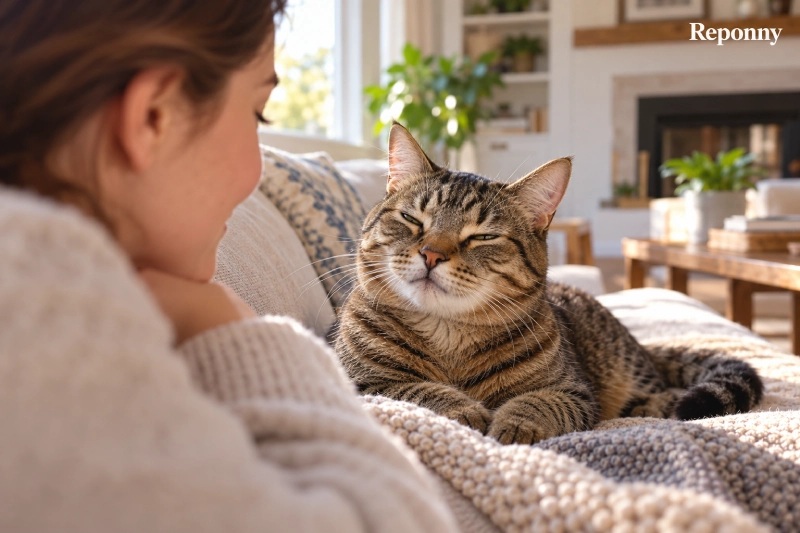
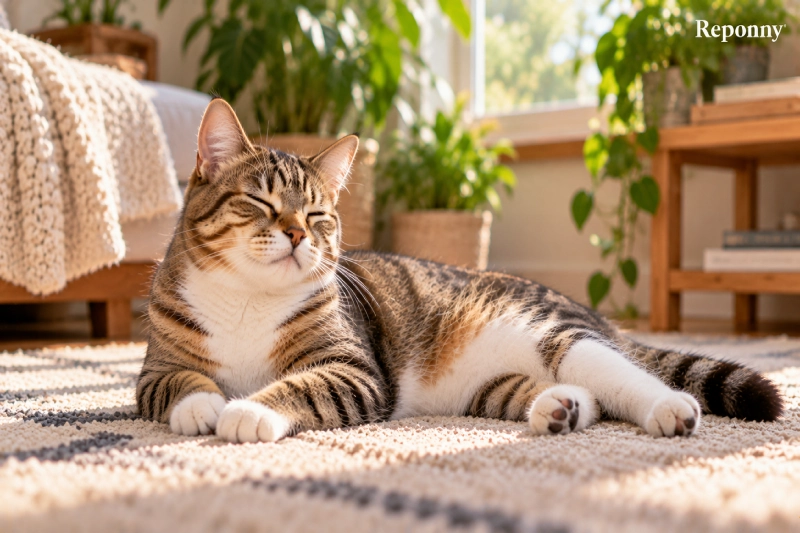
You look across the room and your cat is staring at you.
Then something subtle happens.
Its eyelids slowly begin to lower. The eyes almost close completely. A moment later, they gently open again.
Maybe your cat repeats the movement.
Many cat owners call this the “slow blink,” “cat kiss,” or “cat smile.”
And unlike many popular interpretations of animal behavior, there is scientific evidence suggesting that slow blinking really can play a role in positive communication between cats and humans.
In a 2020 study published in Scientific Reports, researchers found that cats produced more eye-narrowing movements when their owners slow-blinked at them than when the owners were simply present without interacting. In a second experiment, cats were also more likely to approach an unfamiliar researcher after that person slow-blinked at them compared with maintaining a neutral expression.
That does not mean every slow blink literally translates to:
“I love you.”
A better interpretation is:
“I feel comfortable enough to relax around you.”
Slow blinking appears to be a subtle, non-threatening social signal.
But—as with almost every form of feline body language—context matters.
Cats may also narrow their eyes when stressed, tired, or experiencing an eye problem. Frequent blinking, persistent squinting, redness, discharge, cloudiness, or keeping one eye closed deserves a completely different interpretation.
Quick answer: Cats often slow blink when they feel relaxed and comfortable around a person or another cat. Research shows that cats respond to human slow blinking and may be more willing to approach afterward. You can try slow blinking back by softly narrowing your eyes for a moment and then looking away. However, persistent squinting or frequent blinking—especially in one eye—can indicate pain or eye disease and should be checked by a veterinarian.
What Is a Cat Slow Blink?
A true slow blink is different from an ordinary reflex blink.
Researchers studying cat-human communication describe the slow-blink sequence as a combination of:
- gradual partial eye closure,
- one or more half-blinks,
- prolonged narrowing of the eyes,
- sometimes followed by complete eye closure,
- and then a relaxed reopening.
The movement is usually smooth rather than rapid.
The cat’s face generally remains relaxed.
In comfortable situations you may also see:
- neutral or forward ears,
- loose whiskers,
- relaxed facial muscles,
- a comfortably positioned body,
- and a loose or upright tail.
The 2020 Scientific Reports study specifically focused on these eye-narrowing movements rather than simply counting ordinary blinks.
That distinction is important.
A cat repeatedly blinking rapidly because its eye hurts is not necessarily giving you affectionate slow blinks.
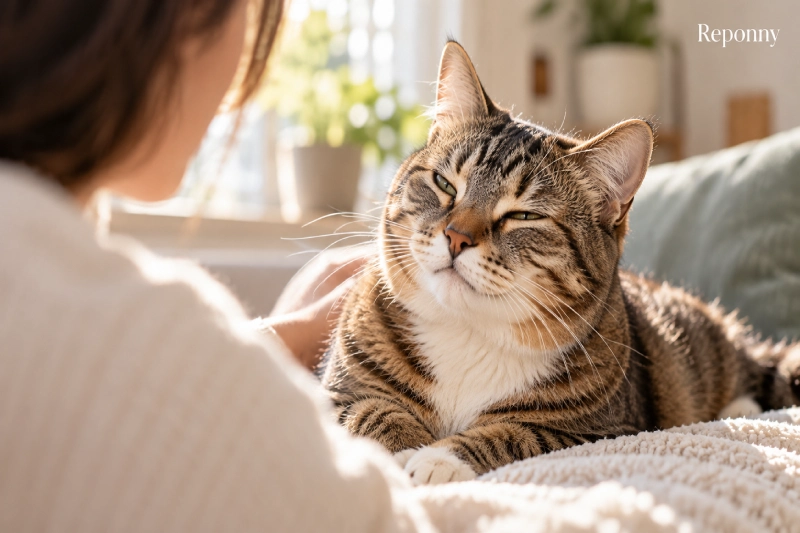
What Does It Mean When a Cat Slow Blinks at You?
In a relaxed context, the most reasonable interpretation is:
your cat feels comfortable and is communicating in a non-threatening way.
Cats Protection similarly describes slow blinking as commonly occurring when cats feel relaxed around another cat or person, although it cautions that the scientific evidence is still limited and that context remains important.
So instead of translating a slow blink as a sentence such as:
“I love you more than anything.”
it is safer to think of it as:
“Everything seems okay here.”
or:
“I am comfortable with this interaction.”
That may sound less romantic, but from a cat’s perspective it is meaningful.
Cats are both predators and potential prey animals.
Vision is essential for monitoring their environment.
Temporarily narrowing or closing the eyes during a calm interaction may therefore fit naturally with a state in which the cat does not feel an immediate need to remain hyper-alert.
What Did the Scientific Slow-Blink Study Find?
The most frequently cited experimental evidence comes from research published in Scientific Reports in October 2020.
Researchers conducted two experiments.
Experiment 1: Owners Slow-Blinked at Their Cats
Cat owners were instructed to perform slow-blink movements toward their cats.
The researchers compared this with periods when the owner was present but was not deliberately interacting with the cat.
Cats produced significantly more:
- half-blinks,
- and eye-narrowing movements
when their owners slow-blinked at them.
That suggests cats were not simply blinking randomly.
Their behavior changed in response to the person’s facial signal.
Experiment 2: An Unfamiliar Person Slow-Blinked
The researchers then tested cats with an unfamiliar experimenter.
After the experimenter performed the slow-blink sequence, cats were more likely to approach the person’s outstretched hand than after the experimenter maintained a neutral expression.
The researchers concluded that slow blinking appears to function as a form of positive cat-human communication.
Importantly, they did not prove that slow blinking literally means affection or love.
The results support a positive social interpretation—but feline emotions remain more complicated than a single facial movement.
Why Might Slow Blinking Feel Friendly to Cats?
Researchers still do not know exactly how slow blinking developed.
One interesting possibility is that it helps interrupt prolonged direct staring.
The 2020 researchers noted that sustained staring can potentially be perceived as threatening during social interactions, while eye narrowing breaks that intense visual signal.
Think about the difference.
Hard stare
Eyes wide open.
Face directed straight toward the cat.
No blinking.
Body approaching directly.
For a nervous cat, that can feel intense.
Slow-blink interaction
Eyes soften.
Eyelids narrow.
The person does not loom forward.
The gaze becomes less intense.
This may communicate a much safer social intention.
Cats Protection likewise advises people not to stare continuously at cats because direct staring can feel threatening, and suggests slow blinking as a gentler way to communicate with a relaxed cat.
Is a Cat Slow Blink Really a “Kiss”?
You will often hear slow blinking called a:
“cat kiss.”
It is a lovely nickname.
But it is not a literal scientific translation.
There is currently no experiment capable of showing that a cat performing a slow blink is experiencing exactly the same emotional concept humans call a kiss or saying:
“I love you.”
What research does support is more modest:
- cats respond to human slow blinking,
- slow blinking appears associated with positive interaction,
- and cats may become more willing to approach someone after a slow-blink exchange.
So calling it a “cat kiss” is fine informally.
Just remember that the scientifically supported interpretation is closer to relaxation and positive/non-threatening communication.
Can You Slow Blink Back at Your Cat?
Yes.
This is one of the simplest ways to experiment with feline communication.
You do not need to exaggerate the movement.
Try this:
- Sit or stand calmly several feet away.
- Avoid leaning directly over your cat.
- Look gently toward your cat without staring intensely.
- Slowly lower your eyelids until your eyes are almost closed.
- Hold them softly narrowed for a brief moment.
- Slowly reopen them.
- Relax your gaze or look slightly away.
Then wait.
Your cat may:
- slow blink back,
- remain where it is,
- turn its head away,
- approach you,
- or simply ignore you.
All of those responses are acceptable.
The goal is communication—not forcing a reaction.
VCA describes slow blinking as a friendly greeting signal, while the experimental evidence shows that cats can respond positively to human slow-blink behavior.
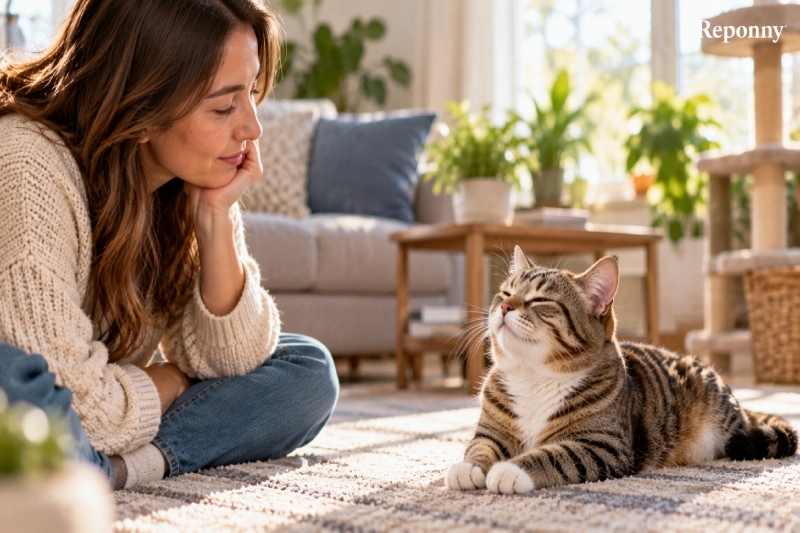
Do Not Force Eye Contact
A slow blink works best as a low-pressure interaction.
Do not grab your cat’s head and make it look at you.
Do not move your face extremely close.
Do not repeatedly stare until the cat responds.
If your cat turns away, hides, lowers its body, flattens its ears, or walks off, respect that decision.
Cats Protection specifically recommends allowing shy cats to approach people in their own time and notes that direct approaches can be threatening. Slow blinking can be used from a comfortable distance without forcing contact.
A successful interaction may be very subtle.
Your cat does not need to come running into your arms for the communication to matter.
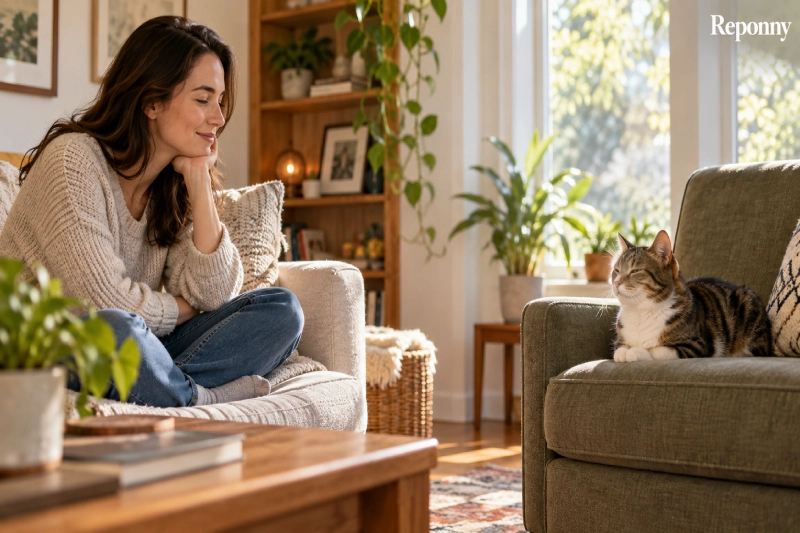
Why Does My Cat Slow Blink From Across the Room?
This is one of the most common places owners notice the behavior.
Your cat may be:
- sitting on a windowsill,
- lying on the sofa,
- resting on a cat tree,
- or sitting across the room
when it catches your eye and slowly narrows its eyelids.
If the rest of the body is relaxed, this fits very well with the idea of slow blinking as calm social communication.
Distance may actually make the interaction easier for some cats.
The cat does not need to worry about immediate touching or restraint.
It can simply acknowledge your presence while remaining in a comfortable location.
You can slow blink back and then return to whatever you were doing.
For a shy cat, quiet interactions like this can sometimes be more useful than repeatedly trying to pick the cat up.
Why Does My Cat Slow Blink While I Pet It?
If your cat is:
- voluntarily staying beside you,
- purring,
- keeping the body loose,
- maintaining neutral ears,
- and slow blinking,
the overall pattern strongly suggests relaxation.
But continue observing the whole body.
A cat can initially enjoy petting and eventually become overstimulated.
Watch for changes such as:
- tail-tip flicking,
- increasingly forceful tail movement,
- ears rotating backward,
- skin twitching,
- body tension,
- looking repeatedly toward your hand.
Those signals may tell you more about the cat’s current tolerance than an earlier slow blink.
Slow blinking is not unlimited permission to continue touching.
Why Does My Cat Slow Blink and Then Look Away?
This can be completely normal.
Looking away can reduce the intensity of direct visual contact.
In a relaxed social interaction, the sequence:
look → slow blink → turn head away
may simply keep the interaction non-confrontational.
Cats do not need continuous eye contact to maintain a social connection.
In fact, staring continuously may make some cats uncomfortable.
Cats Protection recommends slow blinking and gently turning the head away as a way of communicating relaxed intentions to a comfortable cat.
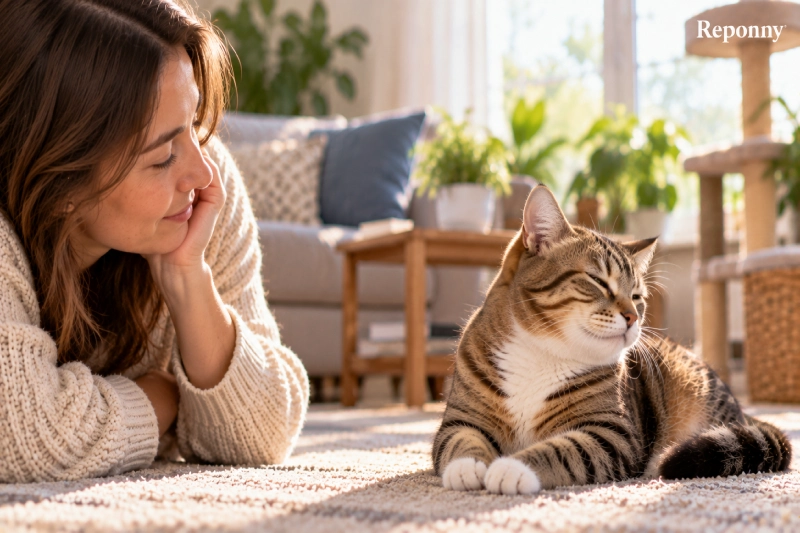
Does a Slow Blink Mean Your Cat Trusts You?
It may be associated with comfort and trust, but this wording should not be taken too literally.
Closing the eyes while another animal or person is nearby means temporarily reducing visual monitoring of the environment.
That makes it understandable why people interpret the behavior as vulnerability and trust.
VCA describes slow blinking in positive terms associated with relaxation, trust and affection.
However, scientific research has directly demonstrated behavioral responses, not the private emotional experience of “trust” itself.
So:
“My cat slow blinked, therefore it definitely trusts me completely”
is stronger than the evidence supports.
A better interpretation is:
“My cat appears relaxed and comfortable during this interaction.”
When that happens repeatedly over time—along with approaching you, sleeping nearby, rubbing against you and maintaining relaxed body language—it can certainly contribute to a larger picture of social comfort.
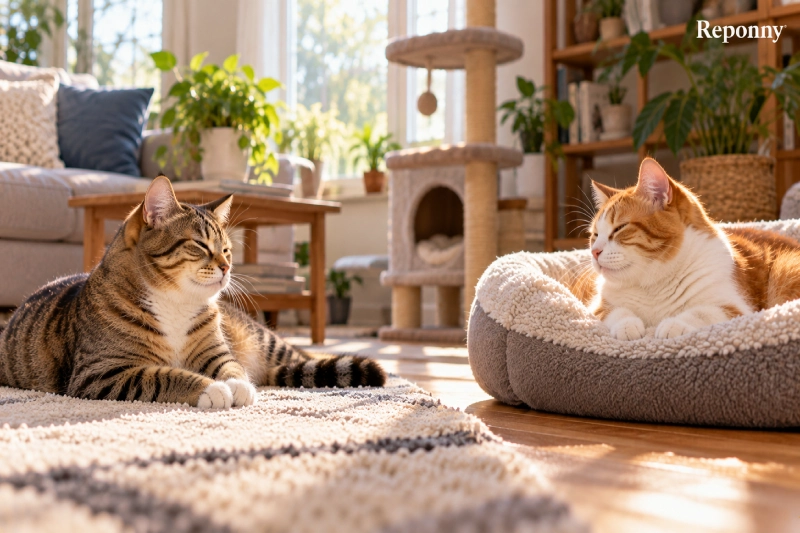
Can Cats Slow Blink at Other Cats?
Yes.
Slow eye narrowing is not limited to human-cat interaction.
Cats use a variety of visual signals with other cats, including:
- eye position,
- ear position,
- tail posture,
- body orientation,
- and facial tension.
VCA describes slow blinking between cats as one of several visual cues that can accompany friendly interaction.
You may see bonded cats resting near each other with:
- loose bodies,
- soft eyes,
- neutral ears,
- and occasional eye narrowing.
But again, context is essential.
Two cats intensely staring while blocking one another’s access to resources are not having the same interaction simply because one eventually blinks.
Can a Stressed Cat Slow Blink?
Possibly.
This is one reason it is better not to treat slow blinking as an infallible sign of happiness.
Cats Protection’s 2025 behavioral guidance notes that although slow blinking commonly occurs around people cats feel comfortable with, it can also occur in stressful circumstances, and the exact meaning still requires context.
For example, consider:
Cat A
Soft eyes.
Loose body.
Tail resting naturally.
Ears neutral.
Slow blink.
This strongly supports relaxation.
Cat B
Body crouched.
Tail tightly wrapped.
Ears sideways.
Trying to retreat.
Occasional eye narrowing.
Calling Cat B “happy” because of one blink would ignore far more important signals.
Always give the whole body more weight than one isolated movement.
Slow Blink vs. Squinting: Know the Difference
This distinction is extremely important.
A behavioral slow blink is typically:
- temporary,
- smooth,
- symmetrical,
- associated with a relaxed face,
- and followed by normal eye opening.
Painful squinting may look different.
The cat may:
- keep one eye partly closed,
- blink repeatedly,
- rub the eye,
- avoid bright light,
- develop redness,
- show eye discharge,
- or keep the third eyelid visible.
Cornell lists squinting and frequent blinking among signs of conjunctivitis.
Corneal ulcers may cause:
- squinting,
- eye rubbing,
- discharge,
- corneal cloudiness,
- and sensitivity to bright light.
So if your cat seems to be “slow blinking” constantly with the same eye, do not automatically interpret it as affection.
It may be discomfort.
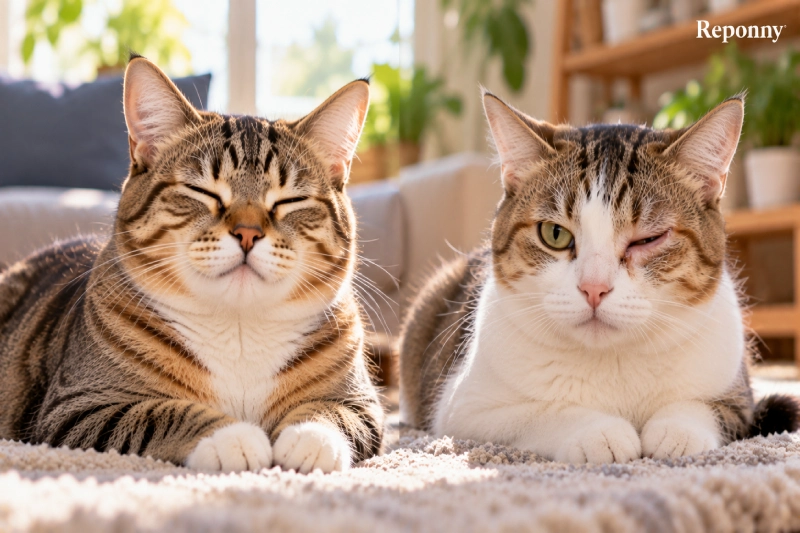
What Does It Mean When a Cat Winks With One Eye?
An occasional one-eye wink can happen normally.
Your cat may briefly close one eye because of:
- normal blinking variation,
- something passing near the eye,
- grooming,
- or simple momentary irritation.
But persistent one-sided squinting is not the same thing as a slow blink.
Cornell advises that healthy feline eyes should generally be bright and clear, with pupils of equal size, little or no discharge, and no persistent squinting.
Contact your veterinarian if one eye repeatedly stays partly closed or you notice:
- redness,
- discharge,
- swelling,
- cloudiness,
- rubbing,
- light sensitivity,
- unequal pupils,
- or a visible third eyelid.
Eye problems can worsen quickly, and some are painful.
When Frequent Blinking Could Mean an Eye Problem
Several feline eye disorders can cause increased blinking or squinting.
Conjunctivitis
Cornell lists:
- frequent blinking,
- squinting,
- redness,
- swelling,
- and watery or thicker discharge
among possible signs.
Corneal Ulcer
A damaged corneal surface can cause:
- squinting,
- discharge,
- eye rubbing,
- cloudiness,
- and sensitivity to light.
Glaucoma
Cornell notes that feline glaucoma can sometimes cause:
- squinting,
- a dilated pupil that does not respond normally to light,
- cloudiness,
- and enlargement of the affected eye.
Those conditions require veterinary assessment.
The rule is simple:
A relaxed slow blink comes and goes. A painful eye often continues to look abnormal.
Should You Slow Blink at a Shy Cat?
You can try—but do it without pressure.
For a shy or newly adopted cat:
- sit at a comfortable distance,
- position your body slightly sideways,
- avoid leaning over the cat,
- keep movements slow,
- soften your gaze,
- perform one or two slow blinks,
- then look away.
Cats Protection recommends sitting quietly with shy cats, allowing them to approach voluntarily and using slow eye narrowing as a non-threatening signal.
Do not expect instant results.
Trust develops through:
- predictable routines,
- safe hiding places,
- gentle interaction,
- food,
- play,
- choice,
- and repeated experiences in which the cat’s boundaries are respected.
Slow blinking can support that process.
It cannot replace it.
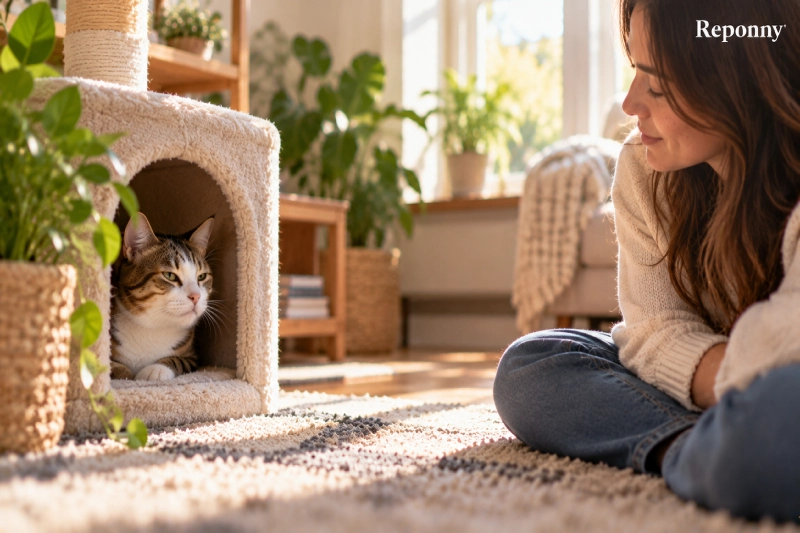
What if Your Cat Never Slow Blinks at You?
Do not worry.
Not every cat communicates in exactly the same way.
Cats Protection explicitly notes that some cats may not slow blink frequently and that this does not mean they dislike or distrust their owners.
Your cat may instead show social comfort by:
- approaching with its tail upright,
- rubbing against you,
- head bunting,
- sleeping near you,
- following you around,
- kneading,
- purring,
- grooming near you,
- sitting with its back toward you,
- or choosing to remain in the same room.
A cat that confidently sleeps beside you for hours is not required to pass a slow-blink test.
Behavior should always be interpreted as a pattern.
Do Kittens Slow Blink?
Kittens gradually develop the same visual communication repertoire seen in adult cats.
A relaxed kitten may soften or narrow its eyes during social interaction, although young kittens are often more active and easily distracted than adults.
Do not worry if a playful kitten spends far more time:
- stalking,
- chasing,
- climbing,
- pouncing,
- and staring at toys
than exchanging slow blinks.
As with adult cats, judge the kitten’s overall comfort through:
- posture,
- play,
- appetite,
- willingness to explore,
- social interaction,
- ears,
- tail,
- and facial expression.
Can You Use Slow Blinking at the Veterinarian?
Possibly as part of calm handling—but do not expect it to eliminate fear.
The 2020 research suggests that slow blinking can influence how cats respond to unfamiliar people. Cats were more likely to approach an unfamiliar experimenter after a slow-blink interaction than after a neutral expression.
That makes slow blinking an interesting low-risk communication tool.
However, veterinary stress involves many factors:
- unfamiliar smells,
- transportation,
- dogs,
- restraint,
- previous experiences,
- unusual surfaces,
- and physical discomfort.
Slow blinking should complement—not replace—good feline handling practices.
Give the cat space when possible and let veterinary professionals manage necessary examination safely.
Slow Blink, Normal Blink and Painful Squint: Quick Comparison
| Eye Behavior | What It May Mean |
|---|---|
| Slow, smooth narrowing of both eyes | Often relaxation / positive social communication |
| Slow blink followed by relaxed approach | Friendly interaction likely |
| Normal quick blink | Normal eye lubrication/protection |
| Repeated rapid blinking | May indicate irritation or stress depending on context |
| One eye persistently partly closed | Possible pain or eye disease |
| Squinting + discharge/redness | Veterinary evaluation recommended |
| Squinting + cloudy eye | Possible ocular disease; prompt veterinary care |
| Slow blink + crouched tense body | Do not assume happiness; consider stress context |
How to Read the Whole Cat
Slow blinking becomes much more useful when combined with other body-language signals.
Likely relaxed
- soft eyes,
- slow blinking,
- neutral ears,
- relaxed whiskers,
- loose body,
- natural tail,
- normal breathing.
Possibly anxious
- wide or intermittently narrowed eyes,
- ears angled sideways,
- crouched posture,
- tail close to body,
- scanning environment,
- attempting to retreat.
Clearly fearful or defensive
- flattened ears,
- very tense posture,
- dilated pupils,
- puffed or tucked tail,
- hissing,
- growling,
- defensive swatting.
The cat’s eyes are only one part of the conversation.
Frequently Asked Questions
Why Do Cats Slow Blink at You?
Slow blinking appears to function as a form of positive, non-threatening communication.
A controlled 2020 study found that cats produced more eye-narrowing movements after owners slow-blinked at them and were more likely to approach an unfamiliar person after a slow-blink interaction.
Does a Slow Blink Mean My Cat Loves Me?
It may be associated with positive social comfort, but science cannot translate it literally as “I love you.”
A more evidence-based interpretation is that your cat appears relaxed and comfortable during the interaction.
Is Slow Blinking a Sign of Trust?
It can accompany relaxed, trusting interactions.
However, body language and context should be considered before assigning a specific emotional meaning.
Should I Slow Blink Back at My Cat?
Yes.
Gently narrow your eyes, briefly close or almost close them, reopen them slowly, and then relax your gaze.
Research suggests cats can respond positively to this type of human facial signal.
Why Does My Cat Slow Blink and Purr?
If the cat also has relaxed posture, soft ears and loose muscles, slow blinking plus purring usually fits a comfortable social interaction.
Remember that purring itself can occur in other emotional states, so the entire body still matters.
Why Does My Cat Slow Blink From Across the Room?
A relaxed cat may be communicating socially without needing to approach physically.
Slow blinking from a comfortable distance can fit a calm, low-pressure interaction.
What Does It Mean When My Cat Winks at Me?
An occasional one-eye blink may be harmless.
Persistent one-sided squinting, however, can indicate eye irritation, injury or disease—especially when accompanied by redness, discharge, rubbing or cloudiness.
Is My Cat Slow Blinking or Squinting From Pain?
Look for persistence and additional symptoms.
A behavioral slow blink is usually temporary and relaxed.
Painful squinting may continue and may be associated with:
- redness,
- discharge,
- light sensitivity,
- rubbing,
- swelling,
- cloudiness,
- or keeping one eye closed.
Cornell advises veterinary assessment for abnormal squinting or eye changes
Why Doesn’t My Cat Slow Blink?
Some cats simply use other social signals more often.
Not slow blinking does not mean your cat dislikes you.
Look at the whole relationship instead.
Can Slow Blinking Help a Shy Cat Trust Me?
It can be one low-pressure communication technique.
Sit quietly, avoid direct approaches, slow blink from a comfortable distance, and allow the cat to choose whether to approach.
Building confidence requires time and repeated safe experiences.
Final Thoughts
The slow blink is one of the most subtle—and fascinating—parts of feline communication.
For years, cat owners informally described it as a:
“cat kiss.”
Scientific research now gives us a better reason to take the behavior seriously.
In controlled experiments, cats produced more eye-narrowing movements when humans slow-blinked at them, and they were more willing to approach an unfamiliar person after a slow-blink interaction.
That does not give us a perfect translation.
A slow blink probably does not literally mean:
“I love you.”
But in the right context it appears to be part of positive, relaxed and non-threatening communication.
And you can participate.
Sit quietly.
Soften your face.
Avoid an intense stare.
Slowly narrow your eyes.
Briefly close them.
Then relax your gaze.
Your cat may blink back.
It may approach you.
Or it may simply remain where it is.
All three responses are fine.
The point is not to force your cat to perform.
It is to communicate in a way that respects how cats naturally use visual signals.
At the same time, remember that not every narrowed eye is a slow blink.
Persistent squinting, rapid blinking, eye discharge, redness, cloudiness, a visible third eyelid, or one eye remaining partly closed can indicate an ocular problem. Cornell lists squinting and frequent blinking among signs associated with several feline eye disorders.
So read the complete picture:
eyes + ears + whiskers + tail + posture + context + changes from normal behavior.
When all of those signals point toward relaxation, a slow blink is one of the nicest quiet conversations you can have with your cat.