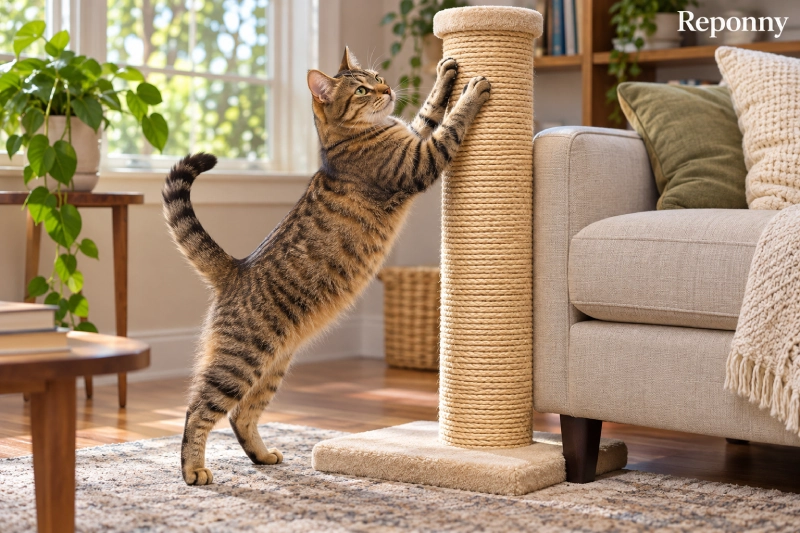
You buy your cat a scratching post.
Your cat looks at it.
Walks past it.
And then scratches the side of your sofa.
Again.
For cat owners, few normal feline behaviors are as frustrating as furniture scratching.
A scratched couch can look terrible. Carpet can become frayed. Doorframes can develop deep claw marks. And because the cat often returns to exactly the same location, it may feel as though the behavior is deliberate.
But your cat is probably not trying to destroy your furniture.
And it is almost certainly not taking revenge.
Scratching is a normal, necessary feline behavior. The Feline Veterinary Medical Association explains that cats scratch to help renew the claws, stretch their limbs and communicate through both visible marks and scent. VCA similarly describes scratching as a normal form of territorial and scent communication rather than simple misbehavior.
That means the goal should not be:
“How do I make my cat stop scratching?”
A better question is:
“How do I give my cat a scratching surface it prefers more than my furniture?”
The answer usually depends on four things:
location, orientation, texture and stability.
A beautiful scratching post hidden in a spare room may be useless if your cat prefers scratching vertically beside the sofa where the family spends most of its time.
Likewise, a cat that scratches carpet may ignore a tall sisal post because it prefers a horizontal surface.
Quick answer: Cats scratch furniture because scratching is a natural behavior used for claw maintenance, stretching and scent/visual communication. To redirect it, place sturdy scratching surfaces where your cat already scratches, match the orientation and texture your cat prefers, reward appropriate scratching and temporarily protect furniture. Do not punish your cat or expect scratching to stop completely.
Why Do Cats Scratch?
Scratching serves several purposes at the same time.
The FelineVMA identifies three major functions: helping remove old outer nail material and expose newer claw underneath, marking territory visually and chemically, and stretching the limbs.
This explains why scratching remains important even for cats that:
live entirely indoors, have their nails trimmed regularly, receive plenty of food, and have no other cats in the home.
Scratching is built into normal feline behavior.
Your cat does not need to have a “behavior problem” to scratch.
The problem is usually only where the cat chooses to do it.
1. Scratching Helps Maintain the Claws
A cat’s claws do not simply grow longer like human fingernails.
The outer layers can become worn and eventually shed.
The FelineVMA describes scratching as helping dislodge older claw material and expose a newer, sharper claw underneath.
You may occasionally find small, curved pieces that look like hollow claws near your cat’s scratching post.
These are often shed claw sheaths rather than an entire claw falling out.
This is normal.
So when your cat repeatedly pulls its claws through cardboard, sisal or upholstery, part of the behavior may be routine claw maintenance.
That is one reason simply trimming the nails does not eliminate the need to scratch.
The cat still needs the behavior.
2. Cats Scratch to Stretch
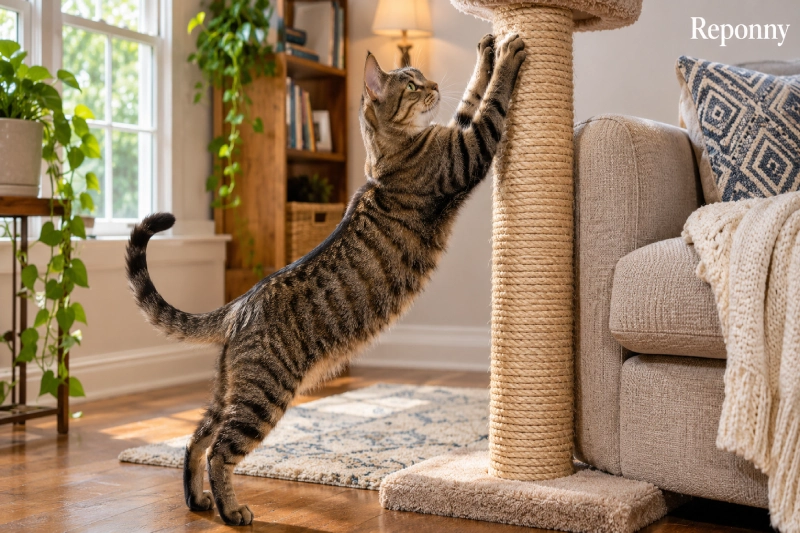
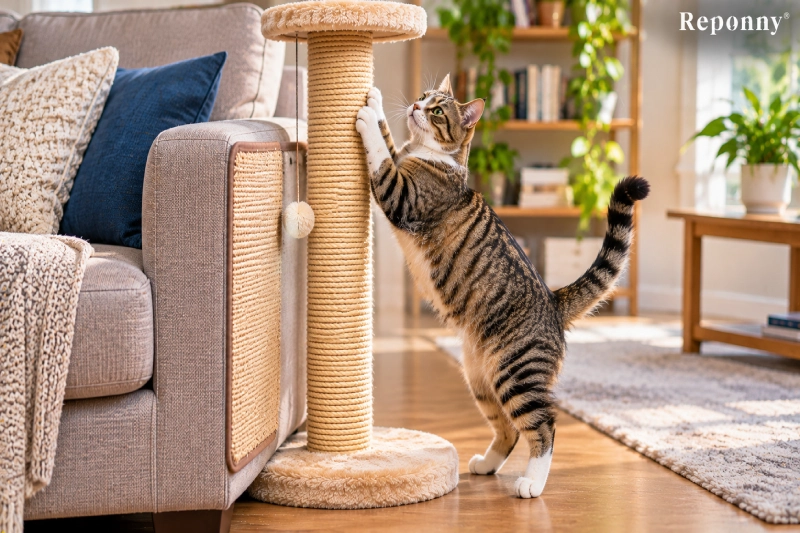
Watch a cat use a good vertical scratching post.
The hind feet remain on the floor.
The front legs reach upward.
The back lengthens.
The shoulders extend.
The toes spread.
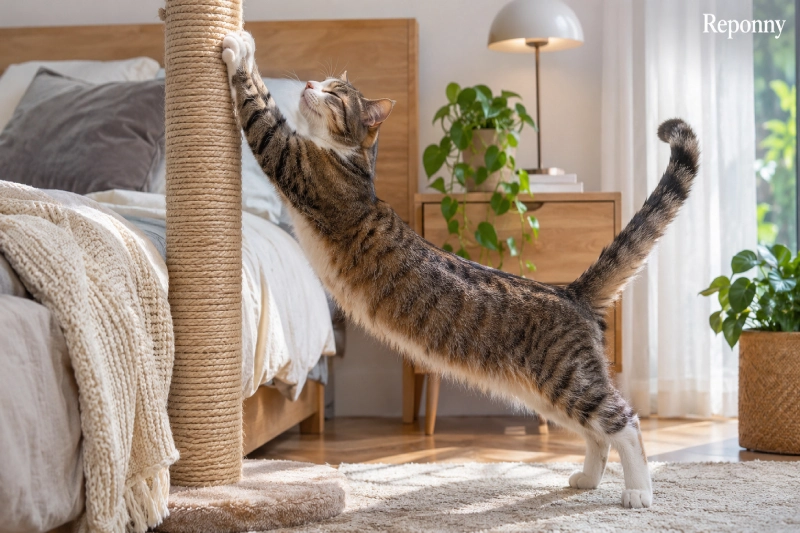
Scratching provides a full-body stretch.
The FelineVMA specifically identifies stretching the limbs as one of the major reasons cats scratch.
This also explains why many cats scratch shortly after waking.
Think about your own behavior when you get out of bed.
You stretch.
Cats often do something similar—but combine the stretch with scratching.
That is why placing a scratching surface close to a favorite sleeping location can work remarkably well.
Current FelineVMA guidance specifically recommends putting a scratcher near sleeping areas because cats often stretch and scratch after waking.
3. Scratching Leaves a Visual Message
A used scratching post looks used.
Fibers become shredded.
Cardboard becomes torn.
Wood develops claw marks.
That damage is not necessarily a failure of the scratching surface.
It can be part of the point.
Scratching produces visible marks that communicate that a cat has interacted with a location.
VCA explains that cats often choose prominent objects for scratching because scratching is a marking behavior.
This is one reason owners sometimes misunderstand where scratching posts should go.
Humans often want to hide them.
The cat may want exactly the opposite.
A post placed:
behind a door, in an unused basement or in an isolated corner
may not satisfy the same behavioral function as the sofa corner in the center of family activity.
Your cat may prefer to scratch somewhere noticeable.
4. Cats Also Leave Scent When They Scratch
Scratching is not only visual.
Cats also have scent-related structures associated with their paws.
The FelineVMA describes scratching as a way cats mark areas both visually and chemically through pheromonal communication.
Humans usually cannot detect this scent.
Other cats can.
This helps explain why a cat may repeatedly return to the same scratching location.
The site already contains:
visible scratch marks + familiar scent information.
From the cat’s perspective, that makes it a well-established communication point.
Covering the damage without providing another appropriate scratching surface nearby may therefore fail.
The cat may simply return.
Why Does My Cat Scratch the Sofa When It Has a Scratching Post?
This is probably the most important practical question.
Usually, the cat is not rejecting scratching posts as a concept.
It is rejecting that particular scratching post in that particular location.
VCA recommends offering different textures, shapes and orientations because individual cats have different preferences. Current FelineVMA guidance similarly recommends experimenting with several scratching surfaces rather than assuming one design will work for every cat.
Your sofa may be better than the scratching post because it is:
more stable, taller, more visible, more satisfying to tear, located in a socially important area or positioned exactly where the cat naturally wants to scratch.
Instead of asking:
“Why won’t my cat use the scratching post?”
Study the furniture.
Your cat has already shown you what it likes.
Vertical vs. Horizontal Scratchers
Orientation matters.
Many cats prefer vertical scratching.
Others prefer horizontal scratching.
Some use both.
The FelineVMA recommends vertical posts that allow the cat to stretch fully and specifically suggests a horizontal scratching surface when a cat repeatedly scratches carpet.
So observe your cat.
If your cat scratches:
the side of the sofa, doorframes or walls,
start with a vertical scratching surface.
If your cat scratches:
carpet, rugs or the floor,
try a horizontal pad.
If it scratches the corner between the floor and furniture, an angled scratcher may also be worth trying.
A common mistake is offering only one orientation and assuming the cat is being difficult when it refuses to use it.
It may simply be the wrong shape.
How Tall Should a Cat Scratching Post Be?
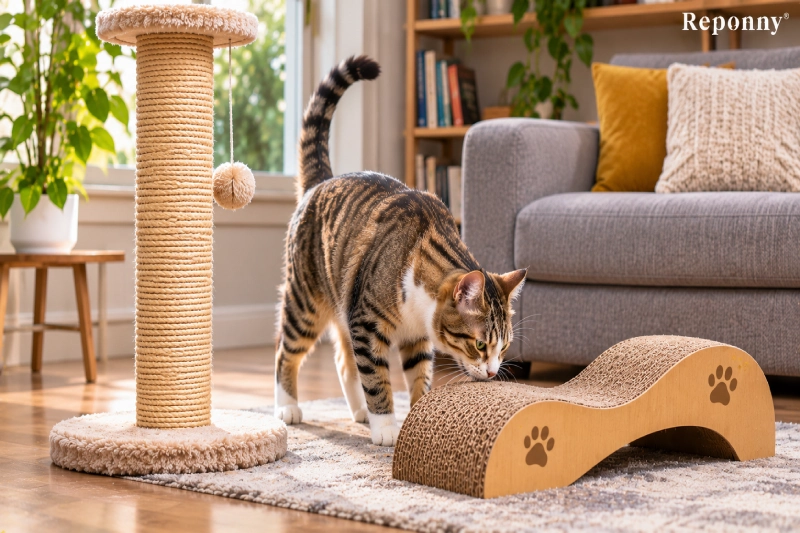
Tall enough for your cat to stretch properly.
The FelineVMA recommends a vertical post that is taller than the cat’s body length so the cat can extend fully while scratching. VCA similarly advises that a vertical post should allow a cat standing on its hind legs to reach upward with the front legs fully extended.
This matters more than many owners realize.
A short scratching post may technically be a scratcher.
But if your cat cannot stretch while using it, the sofa may feel much better.
The base also needs to be stable.
Imagine scratching something that falls toward you every time you apply pressure.
You probably would not keep using it.
Neither will many cats.
A good vertical post should remain steady during vigorous scratching.
Which Scratching Material Is Best?
There is no single material every cat prefers.
The FelineVMA lists several common options including:
sisal, corrugated cardboard, carpet and wood.
VCA also recommends testing different textures and notes that many cats prefer surfaces where the claws can dig in and visibly damage the material.
Look at the surface your cat already scratches.
A cat destroying a textured sofa arm may prefer something rough and fibrous.
A cat scratching cardboard boxes may love corrugated cardboard pads.
A cat scratching wood trim may prefer a wood-based scratching surface.
The cat is already performing a preference test for you.
Use that information.
Where Should You Put a Scratching Post?
Location is often more important than appearance.
Current FelineVMA guidance recommends placing scratchers:
near sleeping areas and near the location where inappropriate scratching is already happening.
VCA also recommends prominent locations rather than unused corners because scratching is partly a marking behavior.
So if your cat scratches the left side of the sofa:
put the post directly beside the left side of the sofa.
Not across the room.
Not upstairs.
Not in the laundry room.
Put it where the behavior already happens.
Once the cat reliably uses the post, you can gradually move it a small distance if necessary.
But do not move it so far that the location stops making sense to your cat.
Why Does My Cat Scratch Near Doors and Windows?
These locations can be socially and territorially important.
A door or window may contain:
outside smells, neighborhood-cat odors, activity from people or animals and boundaries between different spaces.
FelineVMA guidance notes that increased scratching near windows or doors can occur when a cat can see or smell another cat or when the scent profile of an area changes.
If your cat suddenly begins scratching heavily beside one window, look outside.
Is another cat visiting the yard?
Is a neighborhood cat spraying near the house?
Has something changed outside?
In those cases, simply buying a new scratching post may not solve the entire problem.
You may also need to reduce the environmental stressor.
Stress Can Increase Scratching
Normal scratching is not a sign of anxiety.
But increased or newly distributed scratching can be.
The FelineVMA notes that scratching and marking may increase during stress or anxiety, particularly when important resources feel threatened or restricted.
VCA also advises looking for household changes when scratching suddenly expands into new locations. Possible triggers can include a new pet, a move, family schedule changes or social conflict.
Ask what happened before the scratching changed.
Did you introduce another cat?
Move furniture?
Bring home a dog?
Change work hours?
Start renovations?
Has an outdoor cat begun visiting?
Look for other stress-related changes too, such as hiding, reduced interaction, urine marking or appetite changes.
Scratching may be only one piece of the picture.
Multi-Cat Tension Can Cause More Scratching
Cats in the same house do not automatically belong to one social group.
Some are close friends.
Some peacefully coexist.
Others live in chronic low-level tension.
The FelineVMA’s current environmental guidance emphasizes that multi-cat households should provide separated resources so each cat can access food, water, litter areas, resting locations and scratching surfaces without being blocked or challenged.
If one cat guards the only scratching post, the other cat may choose:
the sofa.
That is not stubbornness.
It is a resource-access problem.
In multi-cat homes, provide multiple scratching locations rather than expecting every cat to use one post.
How to Redirect Your Cat Away From Furniture
Redirecting scratching works best when you make the appropriate choice easier and more rewarding than the inappropriate one.
Start with the exact place your cat already scratches.
Place an appropriate scratcher directly beside or in front of that location.
Match the orientation.
Match the texture as closely as practical.
Make sure the surface is stable.
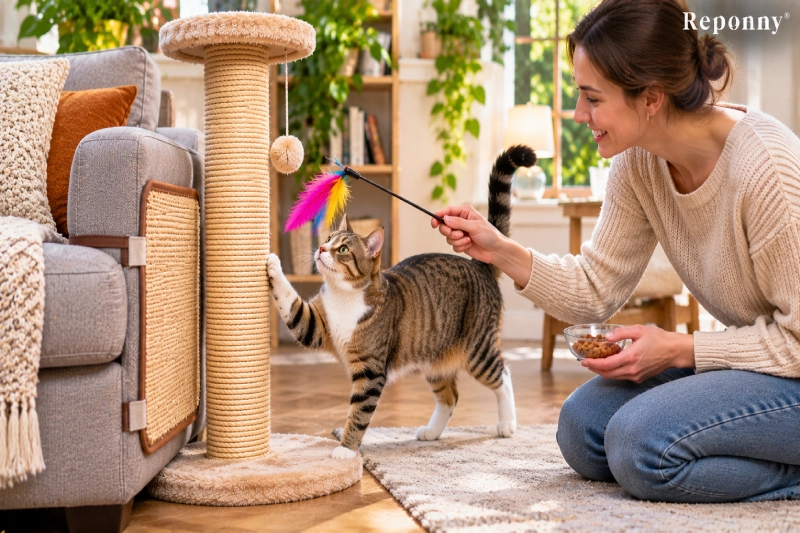
Then reward your cat when it uses the new surface.
The FelineVMA recommends positive reinforcement, with rewards delivered immediately after appropriate scratching. Rewards may include treats, catnip, play, petting or another interaction the individual cat values.
The timing matters.
Reward:
scratch → immediately.
Not ten minutes later.
The cat needs a clear connection between the behavior and the outcome.
Protect the Furniture While Your Cat Learns
During the transition, temporarily make the furniture less appealing or less accessible.
VCA recommends strategies such as furniture protection or covering preferred inappropriate scratching surfaces while providing a desirable scratching alternative in the same location.
The key part is:
never remove the old option without adding a good new option.
If you cover the sofa and provide nothing else, your cat may simply select another piece of furniture.
Temporary furniture protection works best as part of a redirection plan—not as the entire plan.
Should You Use Catnip on a Scratching Post?
For cats that respond to catnip, it may help make a scratching area more interesting.
VCA lists catnip, toys and food rewards among possible ways to encourage a cat to approach an appropriate scratching area.
But catnip is not magic.
Not every cat responds strongly to it.
And even a cat that loves catnip may ignore a poorly located or unstable post.
Think of catnip as:
an extra attraction
rather than:
a substitute for correct scratcher design.
Do Pheromone Products Help?
Sometimes they may be useful, particularly where stress-related marking is part of the problem.
FelineVMA behavioral guidance notes that synthetic feline pheromones can be helpful for some cats experiencing distress, while appropriate scratching surfaces and positive reinforcement remain important parts of behavior modification.
If scratching has suddenly increased along with other signs of stress, discuss the broader situation with your veterinarian rather than relying only on a plug-in or spray.
Environmental causes still need to be addressed.
Do Not Punish Your Cat for Scratching
Yelling may stop scratching for five seconds.
It does not teach your cat where to scratch instead.
The FelineVMA warns that verbal or physical punishment—including squirt bottles—can increase protective emotions such as fear, make learning harder and damage the human-cat relationship.
Punishment is especially unhelpful because scratching itself is normal.
Your cat is not violating a feline rule.
It is violating a human furniture rule that it does not understand.
Teach an alternative.
That works much better.
Why Does My Cat Scratch the Carpet?
Some cats prefer horizontal scratching.
The FelineVMA specifically recommends offering a horizontal scratcher when a cat repeatedly scratches carpet.
Try a large cardboard or horizontal textured pad directly over or beside the favorite carpet location.
Small scratchers may move too much.
A large stable pad usually gives the cat a more satisfying surface.
Again:
match the behavior rather than forcing the cat to adapt to the product you happened to buy.
Why Does My Cat Scratch the Bed or Mattress?
A mattress can be attractive for several reasons.
It is:
large, stable, textured and located in a socially important area.
Your scent is also strongly present.
If your cat repeatedly scratches one part of the bed, place an appropriate scratcher nearby.
A vertical scratcher may work near the bed frame.
A horizontal pad may work if the cat scratches the top or side from a low position.
Study the angle first.
Then match it.
Why Does My Cat Scratch Right After Waking Up?
Because scratching and stretching frequently occur together.
The FelineVMA specifically recommends placing scratching surfaces close to sleeping areas for this reason.
If your cat wakes on the sofa and immediately scratches its side, placing a tall scratcher beside that sofa may solve much of the problem.
The sequence then becomes:
wake → stretch → scratch post
instead of:
wake → stretch → scratch sofa.
Why Does My Cat Scratch When I Come Home?
Several things may be happening.
Your arrival increases activity.
The cat may become excited.
Your entrance may also change the scent and social environment.
And if you previously respond to scratching with attention, the behavior can become part of the greeting routine.
Look at the location and context.
If the cat scratches the same post every time you arrive home, that may simply be a normal marking/stretching routine.
You do not need to stop appropriate scratching.
Do Kittens Need Scratching Posts?
Yes.
VCA notes that scratching begins early in life and recommends providing appropriate scratching options from kittenhood.
It is much easier to teach:
“scratch this”
before the kitten spends six months learning:
“the couch is my scratching post.”
Offer both horizontal and vertical options early.
Keep them stable.
Place them where the kitten spends time.
Reward appropriate use.
Senior Cats May Change Scratching Preferences
An older cat that once loved a tall vertical post may eventually prefer a lower or horizontal scratcher.
FelineVMA behavior guidance specifically notes that scratching preferences can change with age and that senior cats may shift toward horizontal surfaces.
Arthritis or reduced mobility may make a full vertical stretch uncomfortable.
If your senior cat suddenly stops using its favorite post, do not assume it has become stubborn.
Try a more accessible scratcher.
And if the change is accompanied by stiffness, reduced jumping or other mobility changes, ask your veterinarian about pain.
Does Nail Trimming Stop Furniture Scratching?
No.
Trimming can reduce damage.
It does not remove the behavioral need to scratch.
The FelineVMA recommends regular nail trimming as one tool for living successfully with a clawed cat while still providing appropriate scratching surfaces.
Nail trimming may make accidental scratches shallower.
But the cat still needs:
stretching, claw maintenance and marking behavior.
So think:
nail trim + scratcher
not:
nail trim instead of scratcher.
What About Nail Caps?
Temporary synthetic nail caps may be an option for some cats.
The FelineVMA includes them among alternatives that can reduce property damage while preserving the claws.
They do require maintenance and correct application.
Some cats tolerate them better than others.
If you are unsure whether nail caps are appropriate for your cat, ask your veterinary team to demonstrate proper use.
They should not replace environmental enrichment or scratching surfaces.
Is Declawing a Solution to Furniture Scratching?
The FelineVMA strongly opposes elective declawing.
Declawing—also called onychectomy—is not simply trimming or permanently removing the nail.
It involves amputation of the third phalanx, the final bone of each affected toe. The FelineVMA states that declawing is not medically necessary in most situations and lists potential complications including pain, infection, nerve trauma, lameness and chronic neuropathic pain.
The organization recommends alternatives including:
appropriate scratching surfaces, regular nail trimming, temporary nail caps, environmental enrichment and management of underlying stress.
Scratching is normal behavior.
Furniture problems should be addressed by changing the environment and redirecting the behavior—not by removing the cat’s ability to perform a normal behavior.
When Excessive Scratching Deserves Veterinary Attention
A cat scratching furniture does not normally need medical treatment.
But a sudden major increase in scratching can sometimes accompany stress, social conflict or physical discomfort.
FelineVMA guidance recommends investigating stress when scratching frequency suddenly increases and also advises considering pain and inter-cat conflict.
Contact your veterinarian when new scratching occurs alongside changes such as:
hiding, aggression, withdrawal, urine marking, reduced appetite, mobility problems or another substantial change in behavior.
The issue may be larger than the sofa.
A Quick Guide to Furniture Scratching
| What You Notice | What to Try |
|---|---|
| Cat scratches sofa side | Tall vertical scratcher beside sofa |
| Cat scratches carpet | Large horizontal scratching pad |
| Cat ignores short post | Taller, more stable post |
| Cat scratches immediately after sleeping | Put scratcher near sleeping area |
| Cat scratches near door/window | Consider scent or outdoor-cat triggers |
| Cat prefers cardboard | Offer corrugated cardboard |
| Cat repeatedly scratches same furniture spot | Put scratcher directly at that location |
| Multiple cats share one post | Add separated scratching resources |
| Scratching suddenly increases | Look for stress, conflict or pain |
| Cat uses new scratcher | Reward immediately |
| Owner punishes scratching | Stop punishment; redirect instead |
| Senior cat stops using vertical post | Try accessible horizontal option |
Frequently Asked Questions
Why Do Cats Scratch Furniture?
Cats scratch to maintain their claws, stretch and leave visual and chemical signals.
Furniture often provides exactly the stable, textured and prominently located surface a cat wants.
Is My Cat Scratching the Couch to Be Naughty?
No.
Scratching is normal feline behavior rather than revenge or deliberate property destruction.
The goal should be to redirect the behavior toward an acceptable surface.
How Do I Stop My Cat From Scratching Furniture?
Provide an appealing scratcher directly beside the area your cat already scratches.
Match the cat’s preferred orientation and texture, make sure the scratcher is stable and reward its use immediately.
Why Won’t My Cat Use the Scratching Post?
The post may be too short, unstable, poorly located or covered in a texture your cat dislikes.
Try different materials and both vertical and horizontal options.
Where Is the Best Place for a Cat Scratching Post?
Near locations your cat already scratches and near favorite sleeping areas.
Prominent locations generally work better than isolated corners because scratching also functions as communication.
What Is the Best Material for a Cat Scratching Post?
There is no universal best material.
Common preferences include sisal, corrugated cardboard, carpet and wood.
Experiment to discover what your individual cat prefers.
Should a Scratching Post Be Tall?
For vertical scratching, yes.
It should allow your cat to stand on the hind legs and fully extend the front legs without the post becoming unstable.
Should I Spray My Cat With Water for Scratching the Sofa?
No.
FelineVMA guidance warns that punishment such as squirt bottles can increase fear and interfere with learning.
Use environmental management and positive reinforcement instead.
Can Stress Make Cats Scratch More?
Yes.
Increased scratching or marking can occur during stress, anxiety, environmental change or inter-cat conflict.
Does Trimming My Cat’s Nails Stop Scratching?
No.
Nail trimming may reduce damage but does not eliminate the cat’s need to stretch, maintain the claws and perform scent/visual marking.
Provide scratching surfaces even if you trim your cat’s nails.
Should I Declaw My Cat to Protect Furniture?
The FelineVMA strongly opposes elective declawing.
Declawing involves amputation of the third phalanx and can cause both short- and long-term complications. Behavioral and environmental alternatives are recommended instead.
Final Thoughts
Your cat is not scratching the sofa because it hates your furniture.
And it is not doing it to punish you for coming home late.
Scratching is a normal feline behavior.
The Feline Veterinary Medical Association identifies three major functions:
claw renewal, communication and stretching.
Once you understand that, furniture scratching becomes much easier to solve.
Do not fight the need to scratch.
Change the target.
Watch where your cat scratches.
Watch the angle.
Watch the texture.
Then reproduce those features in something you actually want scratched.
If the cat stands tall against your sofa, provide a stable vertical surface tall enough for a full stretch.
If it destroys carpet, provide a horizontal scratcher.
If it scratches immediately after waking, put the scratcher beside the sleeping area.
If it repeatedly marks the same sofa corner, put the new scratcher directly there.
Location matters.
Texture matters.
Stability matters.
And individual preference matters.
Current FelineVMA guidance specifically recommends offering different types of scratching surfaces because the ideal setup varies from cat to cat.
Then make the correct behavior rewarding.
When your cat scratches the appropriate surface:
reward it.
Use whatever that individual cat values—food, play, attention or another positive interaction.
And avoid punishment.
FelineVMA behavior guidance warns that verbal punishment, physical punishment and squirt bottles can increase fear and make learning more difficult.
Also pay attention to changes.
A cat that has scratched one sofa corner for years may simply prefer that location.
A cat that suddenly begins intensely scratching windows, doors and several new surfaces may be telling you something about its environment.
Stress, household changes and conflict with other cats can increase scratching behavior.
Finally, remember that claws are not a design flaw.
They are part of being a cat.
The FelineVMA strongly opposes elective declawing and recommends behavioral and environmental alternatives because declawing is an amputation, not a simple nail-removal procedure.
Your furniture and your cat do not have to be enemies.
Give the cat a scratching surface that makes sense from the cat’s point of view, put it where the cat actually wants to use it, reward the right choice and protect the furniture during the transition.
The goal is not a cat that never scratches.
It is a cat that walks past the sofa and chooses the scratching post instead.