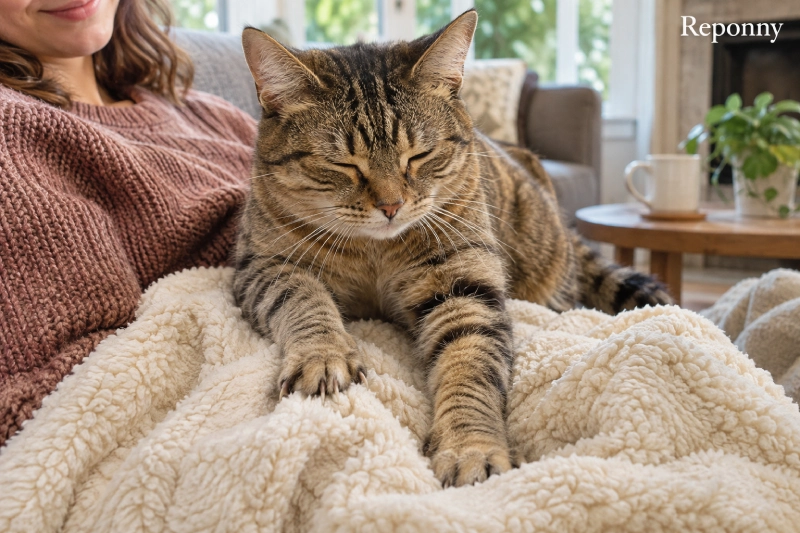
Your cat climbs onto your lap, turns in a small circle, and then begins pressing one front paw into you.
Then the other.
Left. Right. Left. Right.
Sometimes the claws come out. Sometimes the purring starts. Some cats even become so relaxed that they drool.
Cat owners commonly call this behavior “making biscuits” because the alternating paw movements look remarkably similar to someone kneading dough.
But why do cats knead?
The behavior begins extremely early in life. Nursing kittens rhythmically press their paws against their mother’s abdomen around the mammary glands, helping stimulate milk flow. Some cats retain this behavior long after weaning, and adult kneading is commonly associated with comfort, relaxation and positive emotional states.
Adult cats may also knead before settling down to sleep, stretch their muscles while doing it, or potentially leave scent from glands around their paws. And although kneading usually occurs when a cat feels comfortable, a sudden change in the behavior can occasionally accompany stress, pain or illness.
Quick answer: Cats knead because the behavior begins during nursing and can remain associated with comfort into adulthood. Adult cats commonly knead when relaxed, before sleeping, or while interacting with people they feel comfortable around. Kneading may also help stretch the paws and legs or deposit scent. However, unusually frequent kneading combined with hiding, appetite changes or other abnormal behavior can sometimes signal stress or discomfort.
What Is Cat Kneading?
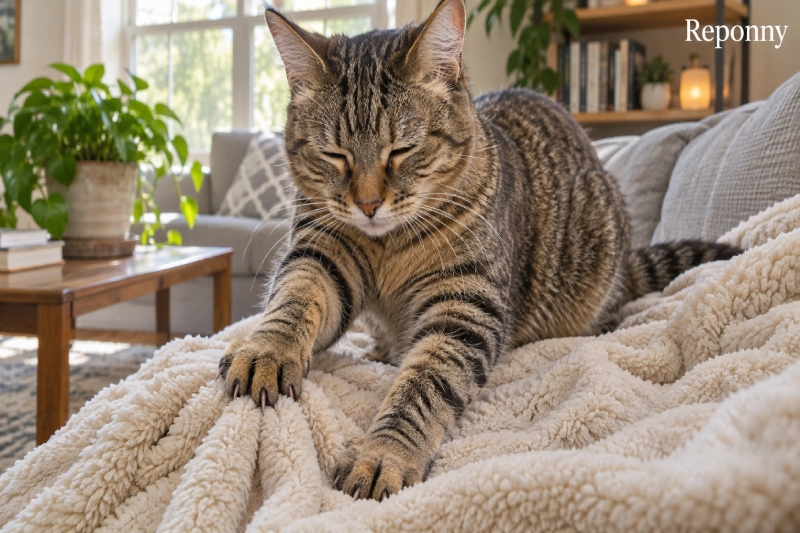
Kneading is a rhythmic movement in which a cat alternates pressure between its front paws against a surface.
The sequence usually looks like:
left paw → right paw → left paw → right paw.
Some cats keep their claws retracted.
Others extend and retract their claws during each movement.
Common kneading surfaces include:
soft blankets, beds, pillows, clothing, another friendly animal, and—very often—the owner’s lap.
Cats Protection describes kneading as a retained juvenile behavior commonly seen in adult cats, often on soft surfaces such as laps and fleece blankets. It is generally associated with contentment.
Kneading may last only a few seconds or continue for several minutes before the cat settles down.
Some cats knead frequently throughout their lives.
Others rarely do it at all.
Both can be normal.
Why Do Kittens Knead Their Mother?
The behavior begins during nursing.
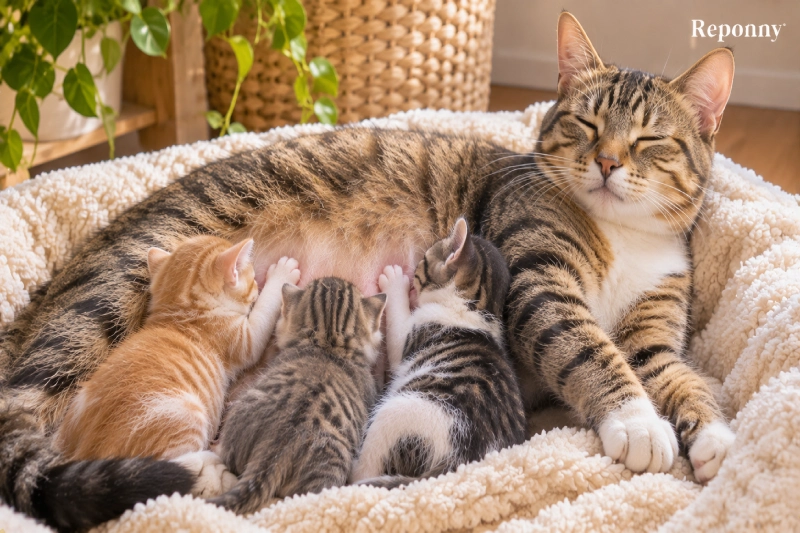
Young kittens press rhythmically against their mother’s abdomen while feeding.
VCA explains that this pressure helps stimulate milk production and milk flow from the mammary glands.
At that stage of life, kneading occurs during an extremely positive biological situation:
the kitten is warm, close to its mother, receiving milk, and physically secure.
That early association may help explain why the same movement often appears during deeply relaxed moments in adulthood.
Cats Protection similarly describes adult kneading as a juvenile behavior retained from nursing, when kittens use the movement to encourage milk flow.
So when your adult cat kneads a blanket, it is not literally expecting the blanket to produce milk.
Instead, a behavior established during early kittenhood appears to remain part of the adult cat’s behavioral repertoire.
1. Your Cat Feels Relaxed and Comfortable
This is probably the most common explanation for adult kneading.
Imagine your cat’s typical kneading session.
It finds a soft blanket.
It circles once or twice.
It begins pressing its paws rhythmically.
The eyes become partially closed.
Purring starts.
A few minutes later, the cat curls up and falls asleep.
That entire behavioral sequence strongly suggests relaxation.
Cats Protection describes kneading in adult cats as commonly associated with contentment, while VCA notes that cats often knead when they feel comfortable and relaxed.
Other signs supporting a relaxed interpretation include soft eyes, neutral ears, loose muscles, relaxed whiskers and a comfortable tail position.
In this context, kneading is generally nothing to worry about.
Your cat has simply found a comfortable place and is settling in.
2. Your Cat May Be Showing That It Feels Safe With You
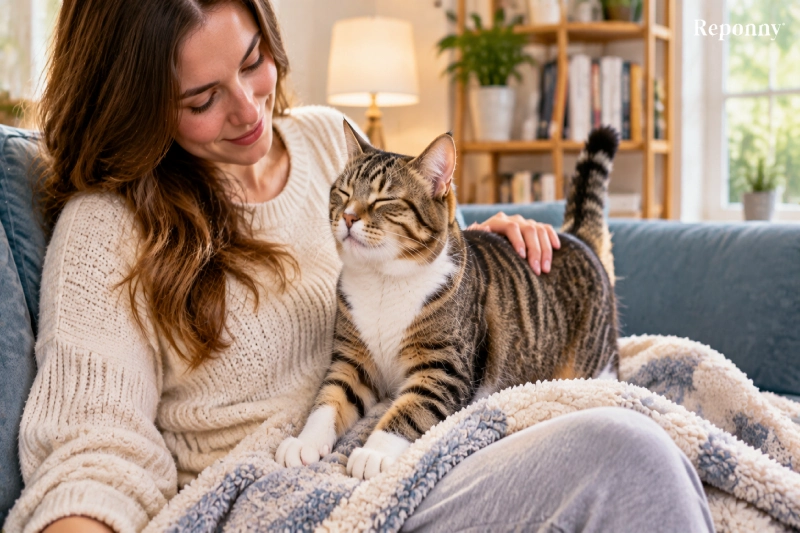
If your cat kneads directly on your lap, chest or stomach, there is usually a simple reason:
you are a comfortable place to rest.
VCA notes that cats typically knead people and animals around whom they feel relaxed, so kneading during calm social contact can be part of a positive interaction.
That does not mean kneading has a literal translation such as:
“I love you.”
Cats do not provide us with a perfect dictionary.
But consider the context.
A cat voluntarily climbs onto you, lowers its body, begins kneading, purrs, softens its eyes and eventually falls asleep.
The complete pattern is consistent with trust and comfort.
There is also another practical reason your lap may be especially attractive:
it is warm, soft and smells strongly like you.
Cats Protection notes that cats can associate familiar human scent with safety and may seek clothing, blankets or other objects carrying the smell of a trusted person.
So when your cat kneads your lap, you may be functioning as a combination of:
trusted companion + warm bed + familiar-smelling resting place.
3. Kneading May Help Cats Prepare a Comfortable Sleeping Spot
You may notice that your cat frequently kneads immediately before lying down.
One proposed explanation comes from ancestral resting behavior.
VCA notes that free-living cats did not have manufactured beds and blankets. Pressing or patting vegetation may have helped create a more comfortable resting surface, and some of this instinctive behavior may remain in domestic cats.
This explanation is plausible, but it should not be presented as a proven historical fact.
We cannot observe the exact evolutionary origin of every modern kneading behavior.
What we can observe is that many cats incorporate kneading into a recognizable bedtime ritual.
The sequence may look like:
circle → sniff → knead → turn around → lie down → sleep.
So if your cat spends two minutes kneading its expensive memory-foam bed before finally lying down, the bed probably is not uncomfortable.
The ritual itself may simply be important.
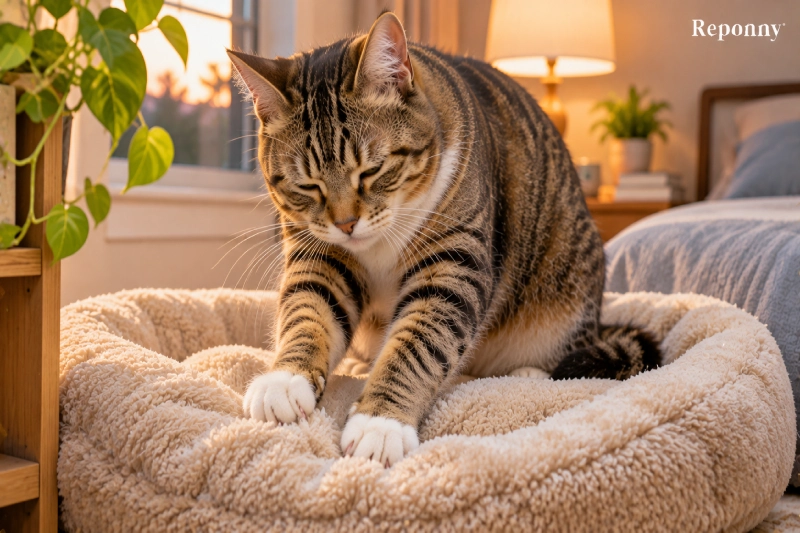
4. Your Cat May Be Leaving Its Scent
Cats experience their environment through smell far more intensely than humans do.
Scent is an important communication system.
Cats Protection confirms that cats have scent glands around the paw area and leave chemical signals when using their paws during behaviors such as scratching.
VCA also notes that cats have pheromone-secreting glands in their feet and can deposit scent onto surfaces.
Because kneading repeatedly presses the paws against a surface, veterinary behavior sources propose that scent deposition may be one function of the behavior.
The wording may is important.
We have much stronger direct evidence for paw scent marking during scratching than for kneading specifically.
Still, it is biologically plausible that pressing the paws onto a favored blanket, bed or person contributes scent information.
For your cat, that familiar scent may help make a resting location feel even more secure.
5. Kneading Can Also Be a Stretch
Watch your cat carefully during a vigorous kneading session.
The toes spread.
The claws may extend.
The wrists flex.
The front legs alternate between extension and compression.
Sometimes the shoulders move too.
Kneading therefore provides a gentle stretch for the paws, legs and upper body.
VCA includes stretching among the possible functions associated with “making biscuits.”
This makes sense when you consider when kneading often happens.
Cats commonly stretch after waking and before settling into a new position.
A kneading session can combine:
stretching + scent behavior + relaxation + preparation for rest
rather than having only one purpose.
Animal behaviors often have multiple functions.
6. Some Cats May Knead to Self-Soothe
This is where context becomes particularly important.
Kneading normally happens during relaxation.
But cats may also repeat familiar comforting behaviors when they are stressed or uncomfortable.
VCA notes that cats experiencing pain or illness may sometimes purr and knead as a form of self-soothing.
This does not mean that kneading is usually a sign of pain.
Quite the opposite.
Most kneading in otherwise healthy cats is normal.
The concern is a change from your cat’s usual behavior.
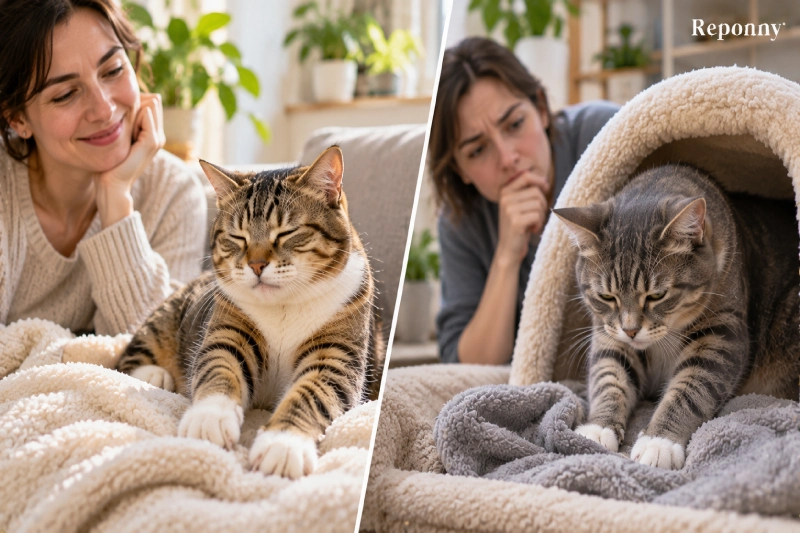
For example:
Normal pattern
Your cat kneads its favorite blanket every evening before sleeping.
It eats normally, plays normally, uses the litter box normally and appears relaxed.
More concerning pattern
Your cat rarely kneaded before but suddenly begins hiding underneath the bed, kneading intensely while purring, eating less and avoiding interaction.
VCA specifically advises considering the entire behavioral picture if kneading suddenly becomes much more frequent or occurs in unusual locations together with other changes.
The same behavior can have different meanings depending on context.
Why Does My Cat Knead Me but Not Other People?
Cats have individual preferences.
Your cat may choose your lap because you:
sit still longer, have a softer blanket, interact more gently, provide warmth, or simply smell more familiar and reassuring.
You may also have a stronger social relationship with that particular cat.
This does not necessarily mean your cat dislikes other family members.
Kneading is only one behavior.
A cat may knead one person but:
sleep beside another, play with someone else, or greet a different family member enthusiastically at the door.
Avoid turning feline behavior into a competition.
The more useful interpretation is:
your cat feels comfortable enough to knead in this particular situation.
Why Does My Cat Knead With Its Claws Out?
Because claw movement can be part of normal kneading.
Cats Protection notes that some cats extend and retract their claws while rhythmically kneading.
Unfortunately, what is comfortable for the cat may be significantly less comfortable for your thighs.
The cat usually is not intentionally scratching you.
It is performing the normal paw movement.
Do not punish the cat, shout, or push it aggressively away.
Instead, place a thick blanket between your lap and the paws.
Regular nail trimming can also reduce discomfort. VCA recommends keeping claws appropriately trimmed when kneading causes accidental injury or damages fabrics.
If you cannot comfortably tolerate lap kneading, gently redirect your cat onto a soft blanket beside you.
The goal is not to eliminate the behavior.
It is to give the cat a safer place to perform it.
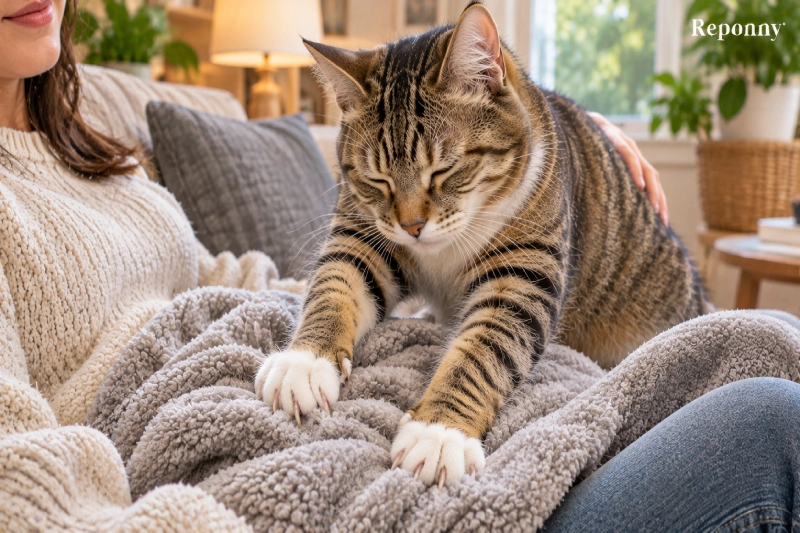
Why Does My Cat Purr While Kneading?
Purring and kneading frequently occur together because both are strongly associated with relaxed, comforting situations.
Kneading begins during nursing in kittenhood.
Purring also occurs early in life and frequently accompanies comfortable social interaction.
So an adult cat climbing onto a soft blanket, kneading rhythmically and purring is displaying a combination of behaviors strongly associated with security and relaxation.
Cats Protection notes that adult cats may appear highly focused while kneading and may purr during the behavior.
Again, though, purring does not guarantee happiness.
Cats can purr when uncomfortable.
The most reliable interpretation comes from the complete picture.
A cat kneading and purring on your lap with loose muscles and soft eyes is very different from a cat hiding alone, refusing food and purring unusually.
Why Does My Cat Drool While Kneading?
Some cats become so relaxed while kneading that they salivate.
Cats Protection’s current behavior guide specifically notes that some adult cats purr and even salivate while kneading. In otherwise healthy cats, this is not generally considered problematic.
If your cat has always produced a little drool during intensely relaxed kneading sessions and otherwise appears completely normal, that pattern may simply be characteristic of that individual cat.
However, new or excessive drooling outside those situations is different.
Dental disease, mouth pain, nausea, toxin exposure and other medical problems can cause salivation.
So the question again becomes:
Is this normal for my cat?
Longstanding “happy drooling” during kneading is one thing.
Sudden unexplained drooling is worth discussing with your veterinarian.
Why Does My Cat Knead and Suck on a Blanket?
Kneading and suckling are both associated with early kitten behavior.
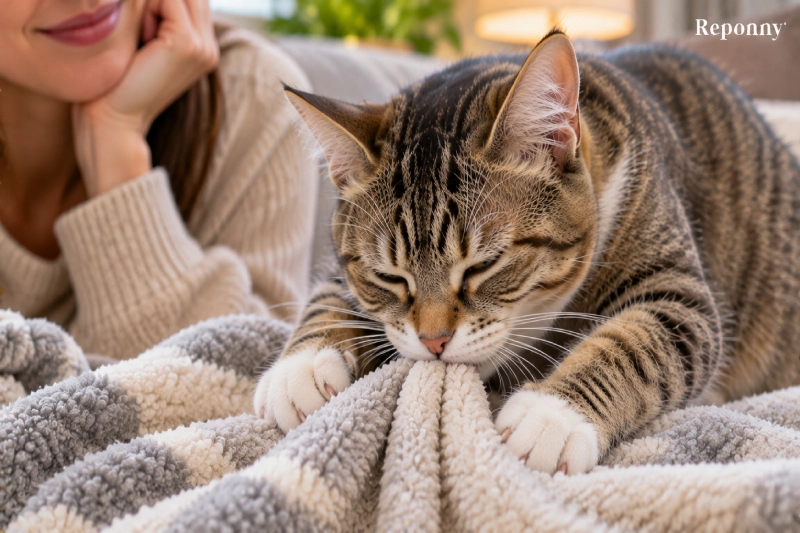
Some adult cats continue not only kneading but also sucking on:
blankets, sweaters, fleece, wool or other soft fabrics.
Cats Protection refers to this retained behavior as wool sucking when it involves blankets or clothing. It may accompany kneading and can persist into adulthood in some cats.
Occasional sucking without swallowing material may not cause a problem.
The concern begins when the cat:
chews or eats the fabric.
VCA explains that persistent ingestion of wool, fabric, plastic or other non-food objects can be a form of pica and may lead to serious complications, including gastrointestinal obstruction.
If your cat is actually swallowing pieces of blanket, thread or fabric, contact your veterinarian.
A swallowed foreign object can become life-threatening.
Why Does My Cat Knead My Stomach or Chest?
Because these areas are:
warm, soft, elevated and close to you.
From your cat’s perspective, they may be excellent resting surfaces.
Your breathing and body warmth may also contribute to a predictable, comfortable environment.
You do not need to interpret the exact location symbolically.
A cat kneading your stomach is not necessarily trying to communicate something different from a cat kneading your lap.
If the claws hurt, place a thick blanket over yourself before allowing the cat to settle.
Why Does My Cat Knead Before Sleeping?
This is extremely common.
Kneading can become part of a resting ritual.
VCA notes that cats may knead beds, rugs or sofas before settling and suggests the behavior may be related both to security and to ancestral nest-preparation behavior.
You may see your cat:
walk onto a blanket, circle, knead for thirty seconds, turn around, knead again, and finally lie down.
Nothing needs fixing.
If the cat is comfortable, allow the ritual.
Do All Cats Knead?
No.
Some cats knead every day.
Some do it occasionally.
Others barely knead after kittenhood.
Cats Protection notes that although kneading begins in kittenhood, not every adult cat retains the behavior to the same degree.
A cat that never kneads is not necessarily unhappy or poorly bonded with you.
It may express comfort in other ways, such as:
slow blinking, purring, sleeping nearby, head bunting, rubbing, or approaching with an upright tail.
There is no requirement for a happy adult cat to “make biscuits.”
Should You Stop a Cat From Kneading?
Usually, no.
Kneading is normal feline behavior.
Punishing it can create unnecessary stress.
If the behavior causes a problem, modify the environment rather than trying to eliminate the instinct.
A thick designated blanket can protect your lap.
Regular nail care can reduce scratches.
A comfortable cat bed can provide another kneading surface.
If the cat begins kneading somewhere you do not want it to, calmly redirect it toward the preferred surface.
VCA recommends redirecting rather than punishing cats whose kneading causes damage or discomfort.
Do not declaw a cat simply because kneading scratches furniture or people.
There are much safer ways to manage the behavior.
When Can Kneading Become a Problem?
Most kneading requires no intervention.
What matters is a sudden or extreme change.
Contact your veterinarian if kneading suddenly becomes much more frequent and is accompanied by changes such as:
hiding, reduced appetite, reduced play, unusual posture, difficulty jumping, increased vocalization, aggression when touched or changes in litter-box behavior.
VCA notes that painful cats may display behavioral changes and may sometimes purr or knead in situations where those behaviors would not normally occur.
Also seek advice when kneading is closely associated with persistent fabric chewing or swallowing.
VCA warns that ingestion of non-food material can cause dental injury, gastrointestinal obstruction and potentially serious complications.
Do not worry about normal bedtime kneading.
Pay attention to change, context and additional symptoms.
Kneading Behavior at a Glance
| What You See | Likely Explanation |
|---|---|
| Kneading a soft blanket before sleeping | Relaxation / bedtime ritual |
| Kneading your lap with loose body posture | Comfort and positive social interaction |
| Kneading while purring | Often deep relaxation |
| Kneading with claws extending | Normal variation of the behavior |
| Kneading then lying down | Rest preparation |
| Kneading familiar bedding repeatedly | Comfort; scent deposition may contribute |
| Kneading plus light drooling during relaxation | Can be normal for some cats |
| Kneading plus suckling a blanket | Retained juvenile behavior |
| Kneading plus swallowing fabric | Possible pica / veterinary concern |
| Sudden excessive kneading while hiding or acting ill | Stress, pain or illness should be considered |
Frequently Asked Questions
Why Do Cats Knead?
Kneading originates during kittenhood, when nursing kittens press their paws against their mother’s abdomen to help stimulate milk flow. Many cats retain the behavior into adulthood, where it is commonly associated with comfort and relaxation.
Why Does My Cat Knead Me?
Your lap is warm, soft and familiar.
If your cat voluntarily climbs onto you, kneads and displays relaxed body language, it likely feels comfortable and secure during the interaction.
Does Kneading Mean My Cat Loves Me?
It can be part of a positive social interaction, but it is better not to translate one behavior literally as “love.”
Kneading on you generally suggests that your cat feels relaxed enough to use you as a comfortable resting surface.
Why Does My Cat Knead Blankets?
Soft blankets may resemble the comfortable surfaces cats naturally prefer for resting.
Kneading also commonly occurs immediately before sleep and may be part of a nest-preparation ritual.
Why Does My Cat Knead and Purr?
Both behaviors commonly occur when cats feel relaxed.
Cats Protection notes that adult cats frequently purr while performing retained juvenile kneading behavior.
Why Does My Cat Knead With Its Claws?
Some cats naturally extend and retract their claws during the alternating paw movement.
Keep the nails appropriately trimmed and use a thick blanket if lap kneading becomes uncomfortable.
Why Does My Cat Knead and Drool?
Some cats salivate when extremely relaxed while kneading. Cats Protection notes that this can occur in otherwise normal adult cats.
New or unexplained drooling outside these situations should be evaluated separately.
Why Does My Cat Knead and Suck Blankets?
Both behaviors can be retained from kittenhood.
Occasional suckling may occur in adult cats, but chewing or swallowing fabric can become dangerous and may indicate pica.
Do Cats Knead to Mark Their Territory?
Possibly.
Cats have scent-producing glands associated with their paws, and scent deposition is an important part of feline communication. VCA proposes that kneading may contribute to scent marking, although direct evidence is stronger for behaviors such as scratching.
Why Has My Cat Suddenly Started Kneading Much More?
A change may simply reflect a new favorite blanket or resting routine.
However, if increased kneading occurs together with hiding, appetite changes, unusual purring, reduced mobility or other behavioral changes, speak with your veterinarian because some cats may knead as a self-soothing behavior when uncomfortable.
Should I Stop My Cat From Kneading Me?
Not unless it causes a problem.
Place a thick blanket between your cat and your skin, maintain appropriate nail care, or gently redirect the cat to a nearby soft surface rather than punishing it.
Final Thoughts
Kneading is one of the clearest examples of kitten behavior remaining with a cat long after it has grown up.
The movement begins with a practical purpose.
Nursing kittens rhythmically press their paws against their mother’s abdomen to stimulate milk flow.
For many adult cats, the behavior remains closely associated with comfort.
That is why kneading so often appears alongside:
soft blankets, warm laps, purring, partially closed eyes and bedtime.
Your cat may also knead as part of preparing a resting place, stretching its front legs or possibly leaving scent from glands associated with the paws.
But no single explanation applies to every kneading session.
Animal behavior is rarely that simple.
The best way to interpret your cat is to look at the complete context.
A cat gently kneading your lap while purring and falling asleep is most likely comfortable.
A cat suddenly kneading compulsively while hiding, eating less and behaving unusually deserves a closer look.
And if kneading is paired with sucking on blankets, distinguish harmless comfort behavior from actual ingestion. Swallowing wool, thread or fabric can lead to dangerous gastrointestinal obstruction.
Most of the time, however, there is no problem to solve.
Provide a soft surface.
Protect your lap if necessary.
Keep the claws appropriately maintained.
And allow your cat to make its biscuits.
It is one of those small feline rituals that connects the adult cat in your home to behaviors it first learned during the earliest days of life.