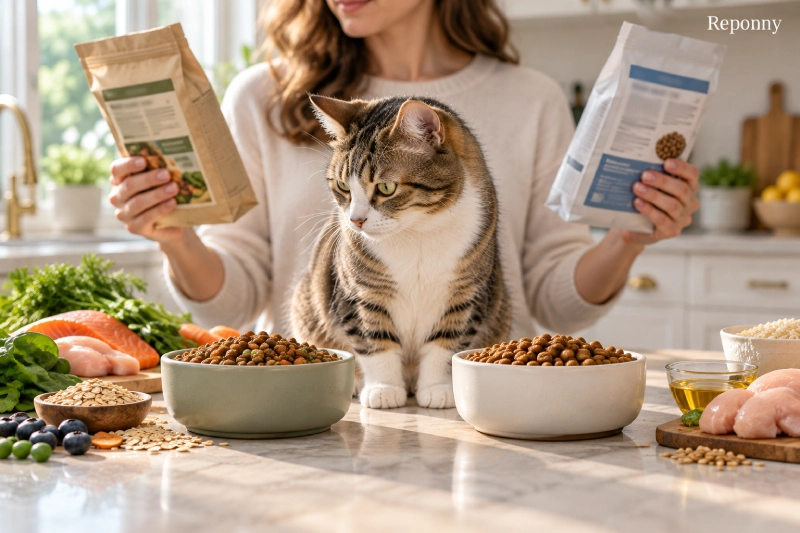
Walk through a premium pet-food aisle and you may see cat food labeled:
organic, certified organic, natural, non-GMO, responsibly sourced, free-range, human-grade, or made with organic ingredients.
These claims can make organic cat food sound automatically cleaner, safer, or more nutritious than conventional food.
But “organic” describes how certain ingredients are produced and handled—it does not automatically tell you whether a cat food provides better nutrition.
Under the USDA National Organic Program, certified organic agricultural products must follow specific production standards. Organic crop production restricts many synthetic pesticides and fertilizers and prohibits methods such as genetic engineering, irradiation, and sewage sludge. Organic livestock must be managed according to additional rules concerning organic feed, medication, and living conditions.
Those standards are meaningful if organic agricultural practices matter to you.
However, the USDA organic seal does not mean that a cat food contains more protein, more taurine, fewer calories, better mineral balance, or more appropriate nutrition for your individual cat.
AAFCO specifically notes that USDA does not consider organic foods necessarily safer, healthier, or more nutritious than conventionally produced foods.
Quick answer: Organic and regular cat foods can both provide excellent nutrition. Organic certification tells you primarily about how agricultural ingredients were produced—not whether the finished food is nutritionally superior. For your cat, prioritize a complete and balanced diet appropriate for life stage, calories, nutrient profile, manufacturer expertise, and your cat’s health before deciding whether organic sourcing is worth the additional cost.
What Does “Organic” Mean on Cat Food?
In the United States, organic is a regulated agricultural labeling term.
The FDA does not establish the definition of organic. Organic claims are governed through the USDA’s National Organic Program. Foods carrying organic claims still need to comply with other applicable food or animal-feed requirements.
For pet food, AAFCO explains that while pet-food-specific organic rules continue to develop, products marketed as organic must comply with National Organic Program requirements.
That means a manufacturer cannot simply place the word organic on the front because it sounds healthier.
Certification and ingredient percentages matter.
Understanding the USDA Organic Label
Not all organic claims mean the same thing.
USDA distinguishes several categories.
| Label Claim | Organic Content | USDA Organic Seal? |
|---|---|---|
| 100% Organic | Essentially all qualifying ingredients organic | Yes |
| Organic | At least 95% certified organic content | Yes |
| Made With Organic… | At least 70% certified organic content | No |
| Specific organic ingredients only | Less than 70% organic content | No seal |
USDA states that products represented simply as organic must contain at least 95% certified organic content, while products labeled made with organic ingredients must contain at least 70%. Products below 70% may identify individual certified-organic ingredients in the ingredient list but cannot market the entire product as organic.
So these statements are not equivalent:
Organic Chicken Cat Food
and
Cat Food Made With Organic Chicken.
Read the exact wording.
What Makes Organic Ingredients Different?
Organic standards regulate how agricultural ingredients are produced.
Organic Crops
USDA organic crop standards include requirements such as:
- no prohibited substances applied to the land for at least three years before harvest,
- restrictions on synthetic fertilizers and pesticides,
- prohibition of genetic engineering,
- prohibition of sewage sludge,
- prohibition of ionizing radiation,
- and use of approved crop-management practices.
That does not mean organic crops are grown without any pest-control substances.
USDA maintains a National List of Allowed and Prohibited Substances. Some naturally derived substances are permitted, and certain synthetic materials are allowed under specific circumstances.
Therefore:
organic does not mean pesticide-free.
It means pesticide and production practices must comply with organic rules.
What About Organic Meat in Cat Food?
Organic livestock production has additional requirements.
USDA standards include:
- organically produced feed,
- restrictions on antibiotics,
- prohibition of hormones under organic production rules,
- preventive health-care practices,
- and specified living-condition requirements, including outdoor access.
One important nuance is animal welfare.
Organic rules do not allow farmers to withhold necessary medical treatment simply to preserve organic status.
If an animal becomes sick, appropriate treatment must be provided. If treatment involves a prohibited substance, such as an antibiotic that is not permitted under the organic standard, products from that animal can no longer be sold as organic.
This is different from the idea that an organic animal would simply be left untreated.
Organic Does Not Automatically Mean More Nutritious
This is one of the most important distinctions.
A chicken raised under organic standards and a conventionally raised chicken may come from different production systems.
But your cat ultimately needs nutrients, including:
- protein,
- taurine,
- arginine,
- essential fatty acids,
- vitamins,
- minerals,
- adequate calories,
- and water.
The organic label does not tell you whether those nutrients are provided in the correct amounts.
Tufts veterinary nutrition specialists have noted that research has not demonstrated meaningful nutritional health advantages of organic pet food for dogs or cats. They also point out that nutrient differences seen between organically and conventionally produced human foods tend to be relatively small and may have little practical significance when the finished pet food is already formulated to be complete and balanced.
This means:
organic chicken does not automatically provide better feline nutrition than conventional chicken.
What matters is how the entire diet is formulated.
Complete and Balanced Matters More Than Organic
If you are choosing between two foods, start with the nutritional adequacy statement.
AAFCO describes this statement as perhaps the most important part of a pet-food label.
Complete means the food contains all required nutrients.
Balanced means they are present in appropriate ratios.
For example, imagine two foods.
Food A
100% organic ingredients.
Beautiful packaging.
But it is labeled:
“For intermittent or supplemental feeding only.”
Food B
Uses conventional ingredients.
But it is complete and balanced for adult maintenance and comes from a manufacturer with strong formulation and quality-control practices.
For a healthy adult cat’s everyday diet, Food B would generally make more sense as the nutritional foundation.
Organic sourcing cannot compensate for an incomplete diet.
Is Organic Cat Food Safer?
Not automatically.
Organic certification establishes compliance with a particular agricultural production system.
AAFCO explicitly notes that USDA does not consider organic foods necessarily safer than conventionally produced foods.
Pet-food safety also depends on factors such as:
- ingredient sourcing,
- manufacturing hygiene,
- microbial control,
- storage,
- nutrient testing,
- supplier verification,
- packaging,
- and quality-control systems.
An organic ingredient can still be contaminated if poorly handled.
A conventional ingredient can be safe and nutritionally appropriate when properly produced and processed.
Therefore, if food safety is your priority, ask about the manufacturer’s quality-control procedures, not only whether the ingredients are organic.
WSAVA similarly recommends evaluating a pet-food company’s nutritional expertise, formulation practices, quality control, and ability to provide detailed nutrient information rather than choosing primarily from ingredient-list marketing.
Does Organic Mean Pesticide-Free?
No.
This is a common misunderstanding.
Organic farming limits and prohibits many conventional synthetic pesticides, but certain substances may still be used.
USDA explains that synthetic substances are generally prohibited unless specifically allowed, while nonsynthetic substances are generally permitted unless specifically prohibited.
Therefore:
Organic = regulated pesticide practices
not:
Organic = zero pesticides of any kind.
If reducing exposure to certain agricultural chemicals is personally important to you, choosing certified organic ingredients may still align with that goal.
But “pesticide-free” is not an accurate definition of organic.
Does Organic Mean Non-GMO?
USDA organic standards prohibit genetic engineering in organic production.
So certified organic agricultural ingredients are produced without genetically engineered methods prohibited by the National Organic Program.
However, that does not mean a conventional food containing genetically engineered crops is automatically unsafe.
The organic label communicates production method, not a scientifically established superiority of the final cat food.
When choosing food for your cat, nutritional adequacy should remain the first priority.
Organic vs. Natural Cat Food: They Are Not the Same
This distinction is extremely important.
Organic is tied to USDA production and certification standards.
Natural is a different labeling concept.
AAFCO’s pet-food labeling guidance treats organic and natural as separate claims, and AAFCO notes that terms such as natural do not themselves indicate safety.
A cat food can therefore be:
- natural but not organic,
- organic but not marketed as natural,
- both,
- or neither.
Do not use the words interchangeably.
A package covered in green leaves with the phrase natural recipe is not necessarily certified organic.
Look for the actual organic claim and certification information.
Organic Does Not Mean Grain-Free
Another common confusion is:
organic = grain-free.
That is false.
Organic cat food may contain:
- organic rice,
- organic oats,
- organic barley,
- organic corn,
- or other organically produced grains.
Likewise, a grain-free diet may contain no organic ingredients whatsoever.
These labels answer different questions.
Organic: How were agricultural ingredients produced?
Grain-free: Does the food contain grains?
Neither term tells you automatically:
- how much protein is present,
- how much carbohydrate is present,
- whether calories are appropriate,
- or whether the food is nutritionally complete.
Read the actual nutrition information.
Organic Does Not Mean Low-Carbohydrate
The same applies to carbohydrates.
An organic food can contain substantial amounts of:
- organic rice,
- potatoes,
- peas,
- lentils,
- tapioca,
- or other starch sources.
A conventional food could contain less carbohydrate.
Do not choose organic food as a shortcut for a high-protein or low-carbohydrate diet.
If those nutritional characteristics matter, check the actual protein, carbohydrate, calorie, and moisture information.
Is Organic Cat Food Better for Allergies?
Usually not simply because it is organic.
Food allergies involve an immune reaction to specific food components, most often proteins.
Whether the chicken was organically or conventionally raised does not necessarily change the fact that it is chicken protein.
If your cat reacts to chicken, switching from conventional chicken food to organic chicken food may not solve the problem.
A suspected food allergy is better investigated through a veterinarian-directed elimination diet using an appropriate novel or hydrolyzed protein rather than by randomly switching to organic products.
Organic is not the same thing as:
hypoallergenic.
Is Organic Cat Food Easier to Digest?
There is no general evidence that organic certification itself makes cat food more digestible.
Digestibility depends on factors including:
- ingredient characteristics,
- processing,
- formulation,
- fiber level,
- fat content,
- protein quality,
- and the individual cat.
A conventionally sourced ingredient can be highly digestible.
An organic ingredient can be poorly tolerated by an individual animal.
If your cat has gastrointestinal problems, choose food according to the cat’s medical needs rather than assuming that organic food will automatically be gentler.
Can Organic Cat Food Contain By-Products?
The word organic and the word by-product describe completely different things.
Organic tells you about production standards.
A by-product describes a type of animal-derived ingredient under feed definitions.
Animal organs and other tissues sometimes described as by-products can contain highly valuable nutrients for cats.
Do not assume that a food is nutritionally superior simply because its ingredient list looks more like a human restaurant menu.
WSAVA warns that ingredient lists do not reliably show ingredient quality, digestibility, or the overall quality of a finished pet food.
For an obligate carnivore, organ tissues can be nutritionally valuable.
Does Organic Cat Food Taste Better?
Maybe to your cat—but not because the certification guarantees it.
Palatability depends on:
- aroma,
- fat content,
- texture,
- freshness,
- protein sources,
- moisture,
- and the cat’s individual preferences.
One cat may love an organic pâté.
Another may refuse it and prefer a conventional shredded food.
Cats do not read marketing labels.
If both foods provide appropriate nutrition, the food your cat reliably eats in the correct amount often has the practical advantage.
Organic Wet Food vs. Organic Dry Food
Organic certification does not change the fundamental differences between wet and dry foods.
Organic wet food may offer:
- high moisture,
- softer texture,
- strong aroma,
- potentially lower carbohydrate depending on formulation.
Organic dry food may offer:
- convenience,
- longer bowl stability,
- ease of portioning,
- compatibility with some puzzle feeders.
But these characteristics come from the food format and formulation, not from the organic label.
An organic kibble can still be calorie-dense.
An organic canned food can still contain more calories than your individual cat needs.
Always check:
kcal per cup, can, or pouch.
Is Organic Food Better for Kittens?
A kitten’s first nutritional priority is not organic certification.
It is complete and balanced nutrition for growth.
Growing kittens require carefully controlled amounts of:
- protein,
- taurine,
- calcium,
- phosphorus,
- fatty acids,
- vitamins,
- minerals,
- and calories.
AAFCO emphasizes selecting pet food for the correct species and life stage.
So if choosing between:
an organic adult-maintenance food
and
a conventional food complete and balanced for kitten growth,
the growth-appropriate diet is the better nutritional choice.
If you want organic food for your kitten, make sure it is also nutritionally suitable for growth or all life stages.
What About Senior Cats?
Senior cats should not be moved to organic food simply because they are older.
Older cats may develop changing needs involving:
- calories,
- protein,
- muscle preservation,
- dental health,
- hydration,
- appetite,
- kidney function,
- or gastrointestinal health.
A senior cat with chronic kidney disease, for example, may benefit much more from a veterinary therapeutic diet with carefully adjusted phosphorus and other nutrients than from switching to an ordinary organic diet.
The medical formulation takes priority.
Organic certification cannot substitute for disease-specific nutrition.
What About Cats With Kidney Disease, Diabetes or Urinary Problems?
For cats with medical conditions, nutritional requirements become even more important.
Kidney disease
Phosphorus, calories, protein strategy, hydration, and other nutrient factors may need adjustment.
Diabetes
Carbohydrate content, calories, body weight, and feeding consistency may matter.
Urinary disease
Moisture, minerals, urine chemistry, and therapeutic formulation may matter.
In any of these situations:
organic vs. regular should usually be a secondary question.
If a veterinarian recommends a therapeutic diet, do not replace it with a general organic food simply because the ingredient sourcing sounds better.
Is Organic Cat Food Worth the Higher Price?
That depends on what you expect from it.
Organic products often cost more because certification, sourcing, production practices, and ingredient availability can increase costs.
Tufts veterinary nutrition experts have noted that organic pet foods can be substantially more expensive and that evidence has not demonstrated additional health benefits for dogs or cats sufficient to conclude that organic food is nutritionally superior.
That does not mean buying organic is a waste of money.
You may value:
- organic farming practices,
- restrictions on certain pesticides,
- avoidance of prohibited genetic-engineering methods,
- livestock production standards,
- or personal environmental and sourcing preferences.
Those are legitimate purchasing priorities.
But if your budget forces you to choose between:
organic certification
and
a reputable complete and balanced food that consistently fits your cat’s nutritional needs,
prioritize the nutritional adequacy of the diet.
Your cat does not require an organic label to be healthy.
How to Compare Organic and Regular Cat Food
Do not start with the ingredient farming method.
Use this order.
| Priority | What to Check |
|---|---|
| 1 | Complete and balanced nutritional adequacy |
| 2 | Correct life stage |
| 3 | Calories per cup, can, or pouch |
| 4 | Protein and overall nutrient profile |
| 5 | Moisture level |
| 6 | Individual health requirements |
| 7 | Manufacturer expertise and quality control |
| 8 | Whether your cat eats and tolerates the food |
| 9 | Organic certification and sourcing preferences |
| 10 | Cost and long-term affordability |
AAFCO emphasizes nutritional adequacy, species, life stage, and feeding directions when selecting pet food.
WSAVA also recommends looking beyond attractive ingredient claims to information such as who formulates the food and how the company manages quality control.
Questions to Ask Before Buying Organic Cat Food
Before spending more, ask yourself:
Does It Carry a Legitimate Organic Claim?
Look carefully at whether the package says:
organic
or merely:
made with organic chicken.
They represent different percentages.
Is It Complete and Balanced?
This matters more than organic status for an everyday diet.
Is It Appropriate for My Cat’s Life Stage?
Adult maintenance food is not automatically appropriate for kittens.
How Many Calories Does It Contain?
Organic ingredients still contain calories.
Does My Cat Have a Medical Condition?
Therapeutic requirements may take priority.
Who Formulated the Food?
Manufacturer expertise matters.
Does the Company Perform Appropriate Quality Control?
Organic farming certification does not replace manufacturing quality assurance.
Can I Afford It Long Term?
A food works best when you can feed it consistently.
Common Organic Cat Food Myths
Myth 1: Organic Cat Food Is Automatically Healthier
Reality: Organic describes production methods. It does not guarantee superior feline nutrition. AAFCO notes that USDA does not consider organic food necessarily safer, healthier, or more nutritious.
Myth 2: Organic Means Pesticide-Free
Reality: Organic standards restrict many substances but permit approved pest-control materials.
Myth 3: Organic Means Grain-Free
Reality: Organic grains exist.
Myth 4: Organic Means Low-Carb
Reality: Organic foods can contain rice, peas, potatoes, or other carbohydrate sources.
Myth 5: Organic Means Hypoallergenic
Reality: A cat allergic to chicken may still react to organic chicken.
Myth 6: Organic Means Complete and Balanced
Reality: A product must independently meet nutritional adequacy standards to make a complete-and-balanced claim.
Myth 7: Conventional Cat Food Is Automatically Low Quality
Reality: Conventional foods vary enormously. Many are professionally formulated, nutritionally complete diets produced under extensive quality-control programs.
Frequently Asked Questions
Is Organic Cat Food Better for Cats?
Not necessarily.
There is currently no convincing evidence that organic pet food provides superior health outcomes for cats simply because the ingredients are organically produced. Nutritional formulation remains more important.
Is Organic Cat Food Safer?
Organic certification does not automatically mean the finished food is safer.
Food safety also depends on manufacturing, pathogen control, ingredient testing, storage, and quality assurance.
What Does USDA Organic Mean on Cat Food?
A product represented as organic generally must contain at least 95% certified organic content and comply with USDA National Organic Program standards.
What Does “Made With Organic Chicken” Mean?
Products in the made with organic category must contain at least 70% certified organic ingredients overall. The specifically named organic ingredient must comply with organic requirements, but the product does not qualify to use the USDA organic seal.
Does Organic Cat Food Contain Pesticides?
Organic does not mean pesticide-free.
Organic production allows certain approved substances while prohibiting many conventional synthetic pesticides and production methods.
Is Organic Cat Food Non-GMO?
USDA organic standards prohibit genetic engineering as an organic production method.
Is Organic Cat Food Grain-Free?
Not necessarily.
An organic cat food may contain certified-organic rice, oats, barley, or other grains.
Is Organic Food Better for Cats With Allergies?
Not automatically.
Organic certification does not remove the proteins that commonly trigger food allergies. A cat sensitive to chicken may react to both conventional and organic chicken.
Is Organic Cat Food Better for Kittens?
Only if it is also complete and balanced for growth.
The correct nutritional life stage is more important than organic certification.
Should Senior Cats Eat Organic Food?
There is no general requirement.
Choose senior nutrition according to body condition, muscle mass, health, appetite, and any diagnosed medical conditions.
Is “Natural” the Same as “Organic”?
No.
They are separate labeling concepts. Organic claims are tied to USDA production standards, while natural claims follow different pet-food labeling definitions.
Is Organic Cat Food Worth the Money?
It may be worth the additional cost if organic agricultural practices and ingredient sourcing are important to you and the product also meets your cat’s nutritional needs.
There is no need to feel that your cat is receiving inferior nutrition simply because a suitable complete and balanced diet uses conventionally produced ingredients.
Final Thoughts
The difference between organic and regular cat food is real—but it is often misunderstood.
Organic certification primarily describes how agricultural ingredients were produced and handled.
USDA standards regulate areas such as:
prohibited agricultural chemicals, genetic engineering, livestock feed, medication practices, and certification requirements.
Those standards may matter greatly to you.
But they do not tell you whether the finished cat food contains the right amount of:
protein, taurine, fat, calories, phosphorus, vitamins, minerals, moisture, or other essential nutrients.
And they do not prove that your cat will live longer or be healthier simply because its food is organic.
AAFCO makes this distinction clearly: organic foods are not considered necessarily safer, healthier, or more nutritious than conventionally produced foods.
For your cat, start with:
complete and balanced nutrition → correct life stage → appropriate calories → individual health needs → manufacturer quality → actual response to the food.
Then consider organic certification.
If two foods meet those nutritional criteria and you prefer organic farming practices—and the higher price fits your budget—choosing organic is perfectly reasonable.
If a conventional food better matches your cat’s nutritional needs, is made by a manufacturer you trust, and keeps your cat healthy, you do not need to feel that you are choosing an inferior diet.
The best cat food is not necessarily the one with the most impressive farming claim on the front.
It is the one that provides safe, complete, balanced, appropriate nutrition your individual cat can thrive on consistently.