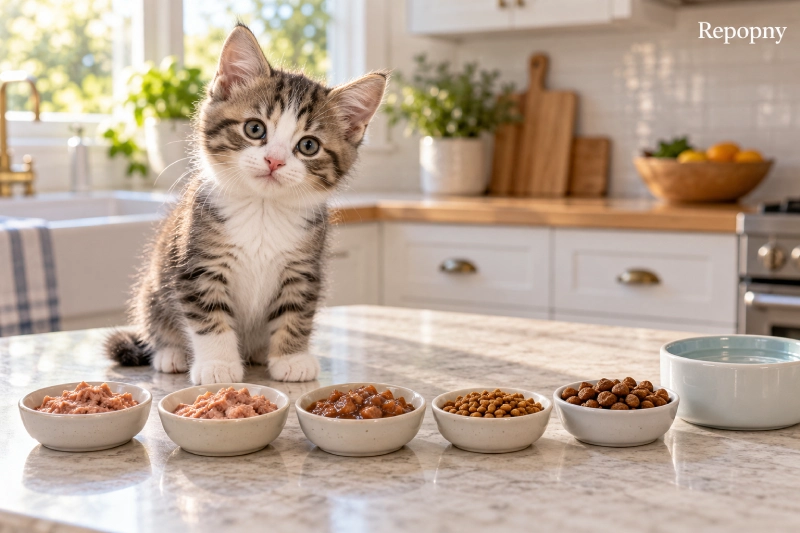
The first six months of a kitten’s life are a period of exceptionally fast growth.
During these months, your kitten is building muscle, bone, organs, immune function, and a rapidly developing brain—all while playing, exploring, and seemingly burning energy every minute it is awake.
That is why feeding a kitten is not the same as feeding a miniature adult cat.
Kittens need more calories and nutrients relative to their body size, and because their stomachs are still small, those calories are usually easier to provide through several small meals rather than one or two large portions.
By around eight weeks, most kittens are fully weaned and eating solid kitten food. From there, meal frequency can gradually decrease as the kitten grows. VCA notes that kittens are generally fully weaned at about eight weeks, while Cornell recommends more frequent meals through the first six months of life.
Quick answer: From 8–12 weeks, aim for about 4 small meals per day. Around 3–4 months, many kittens do well with 3–4 meals daily. From 4–6 months, about 3 meals per day is often practical. Around six months, many kittens can begin transitioning toward 2 meals daily, while continuing to eat a complete and balanced kitten/growth diet until roughly 9–12 months of age.
Kitten Feeding Schedule at a Glance
A practical feeding schedule from eight weeks to six months can look like this:
| Kitten Age | Meals Per Day | Main Feeding Goal |
|---|---|---|
| 8–12 weeks | 4 small meals | Support rapid growth with small frequent meals |
| 3–4 months | 3–4 meals | Continue high-energy growth nutrition |
| 4–5 months | 3 meals | Maintain steady growth without overfeeding |
| 5–6 months | 3 meals | Monitor body condition as growth begins slowing |
| Around 6 months | Transition toward 2–3 meals | Adjust calories as growth rate slows |
This schedule is a starting point, not a rigid rule.
Cornell says kittens generally do well with three meals daily until around six months, while Merck recommends 3–4 daily meals for kittens under four months and notes that feeding frequency can gradually decrease with age.
Your kitten’s food, body weight, body condition, activity, health, and growth rate will determine the actual amount required.
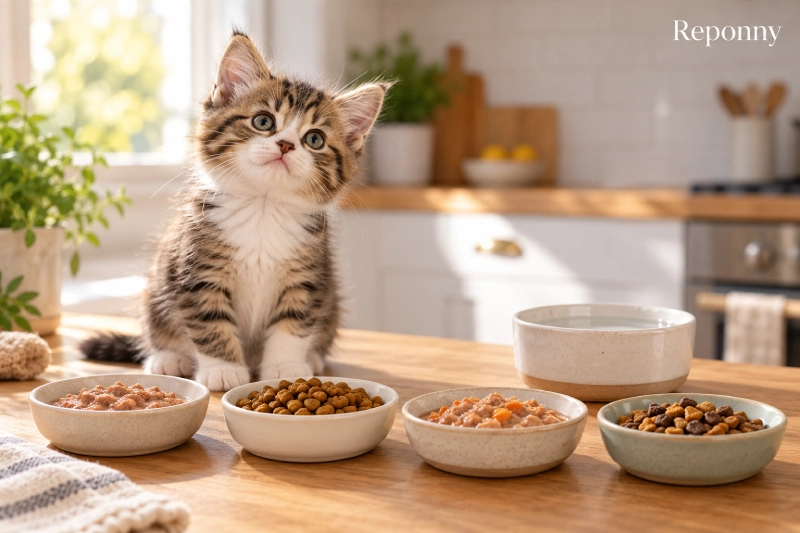
What Should an 8-Week-Old Kitten Eat?
At approximately eight weeks, most kittens have completed—or are completing—the weaning process.
VCA states that kittens are typically fully weaned from their mother’s milk at around eight weeks of age.
At this point, the foundation of the diet should be food specifically formulated for:
growth,
kittens,
or all life stages if its nutritional adequacy statement confirms that it meets growth requirements.
AAFCO recognizes growth as a distinct nutritional life stage because growing kittens need different quantities and ratios of nutrients from adult cats.
An eight-week-old kitten should not simply receive an adult cat food because the pieces are small enough to eat.
Look at the nutritional adequacy statement on the package.
For a kitten, you want wording indicating that the food provides complete and balanced nutrition for growth or an appropriate all-life-stages formulation.
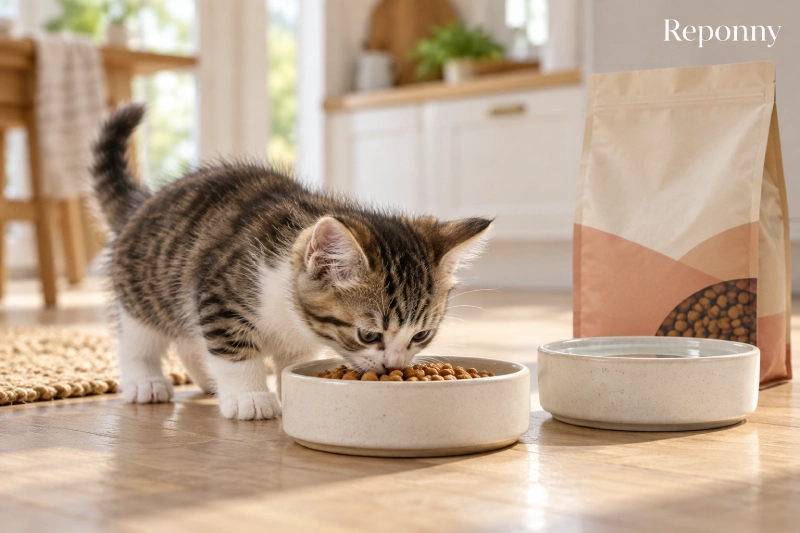
Why Kittens Need Food Formulated for Growth
Kittens are not only smaller than adult cats.
Their nutritional priorities are different.
Merck explains that growing kittens require additional:
- calories,
- protein,
- fat,
- vitamins,
- and minerals
to support rapid growth and development.
AAFCO nutrient standards also reflect this difference. For example, the minimum crude protein level on a dry-matter basis is higher for growth and reproduction than for adult maintenance.
Growing kittens are also particularly sensitive to the quality and balance of dietary protein and amino acids.
This is why a random mixture of:
chicken, tuna, milk, rice, eggs, or human leftovers
cannot simply replace a properly formulated kitten diet.
The food needs to provide all required nutrients in appropriate ratios.
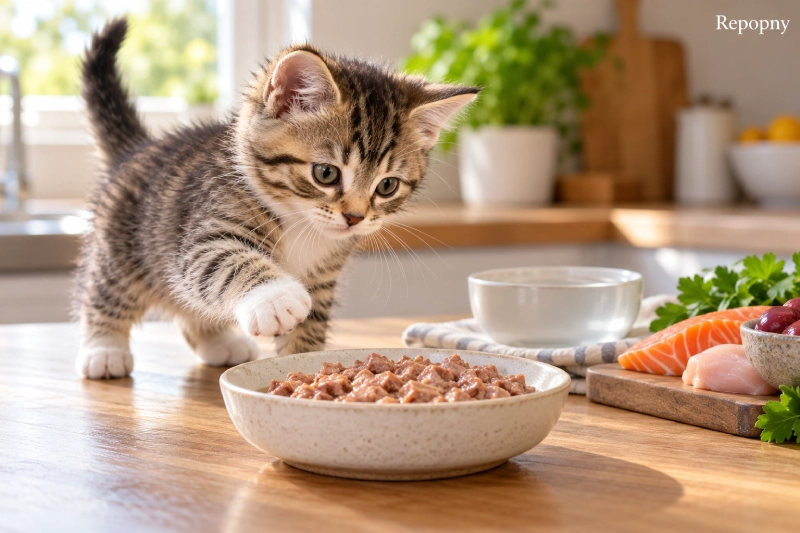
Feeding an 8- to 12-Week-Old Kitten
At this age, growth is extremely rapid and the stomach is still relatively small.
Four small meals per day is a practical routine for many kittens.
For example:
7:00 a.m. — Breakfast
11:30 a.m. — Midday meal
4:00 p.m. — Afternoon meal
8:30 p.m. — Evening meal
You do not need to follow these exact times.
The goal is to spread food throughout the day rather than expecting a young kitten to consume its entire calorie requirement in one or two large meals.
Merck recommends multiple daily feedings for young kittens, specifically around 3–4 meals daily when they are under four months old.
If you work outside the home, a timed feeder can help provide the midday meal.
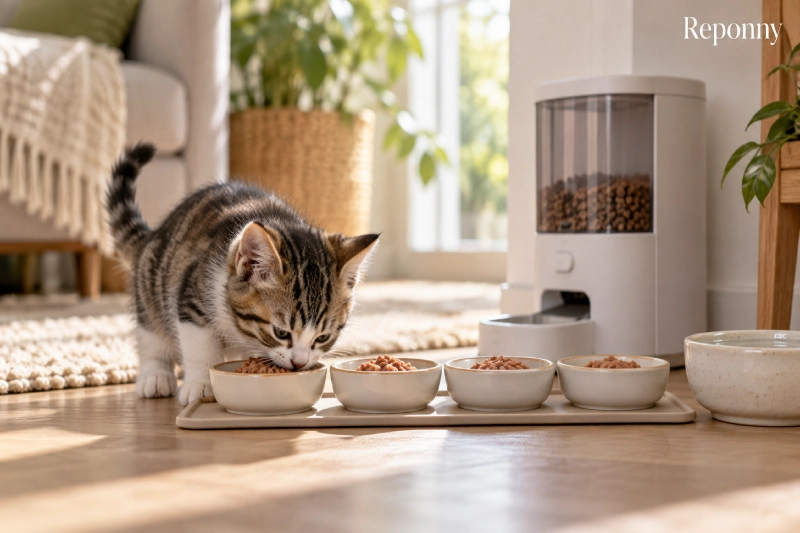
Feeding a 3-Month-Old Kitten
By three months, your kitten may look considerably larger and more coordinated, but it is still growing rapidly.
Continue feeding a complete kitten/growth diet.
Many kittens at this age do well with:
3–4 meals each day.
Do not reduce food simply because the kitten suddenly looks less tiny.
Growth continues quickly during the first several months. Merck notes that kitten growth is especially rapid during the first 3–4 months.
Your kitten may also go through periods where appetite seems unusually strong.
Rather than responding by endlessly filling the bowl, follow the feeding instructions for the particular food and monitor growth and body condition.
Package feeding recommendations are useful starting points but may need adjustment for the individual animal. AAFCO explicitly notes that feeding directions are guidelines and may need to be modified based on the animal’s condition and activity.
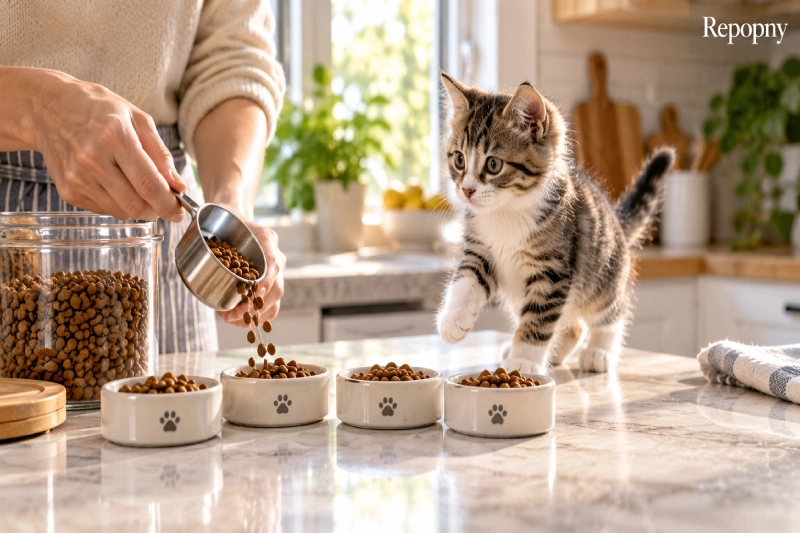
Feeding a 4-Month-Old Kitten
At around four months, three meals daily often becomes a practical routine.
For example:
Morning
Afternoon
Evening
The kitten is still growing quickly, so this is not the time to switch to adult maintenance food.
Merck recommends feeding kitten food until adulthood, generally around 9–12 months, and VCA similarly notes that kittens should remain on growth-formulated food until growth is complete, typically around 12 months.
At four months, continue watching:
- weight,
- body condition,
- appetite,
- stool quality,
- activity,
- and overall growth.
Your veterinarian can also monitor whether your kitten’s growth rate is appropriate during routine vaccination and wellness visits.
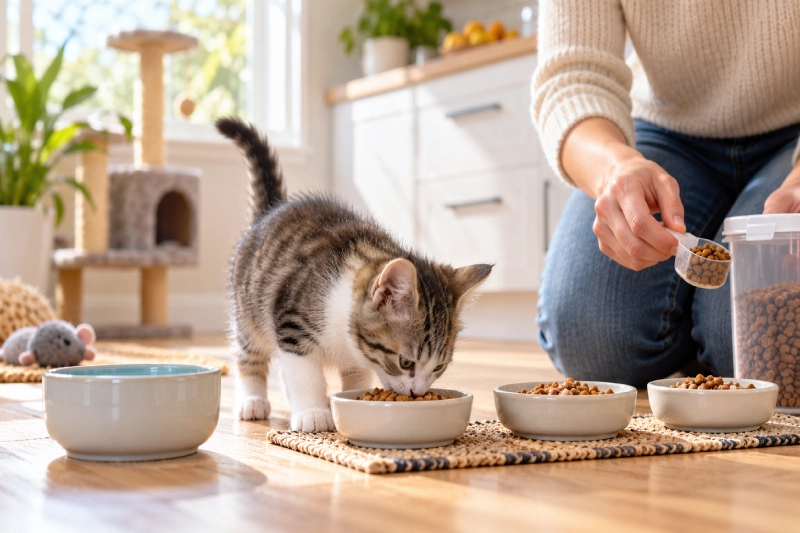
Feeding a 5-Month-Old Kitten
By five months, your kitten may begin looking more like a young adult.
That does not mean nutritional growth is finished.
Continue with approximately three measured meals daily if that schedule works well for your kitten.
Around this period, growth begins slowing compared with the explosive first few months.
Merck reports that kitten growth begins to plateau around 150–160 days of age, although overall growth continues beyond this point.
This is an important time to pay closer attention to body condition.
A five-month-old kitten still requires growth nutrition, but unlimited calories are not necessarily beneficial.
Healthy growth means reaching appropriate adult size without becoming overweight.
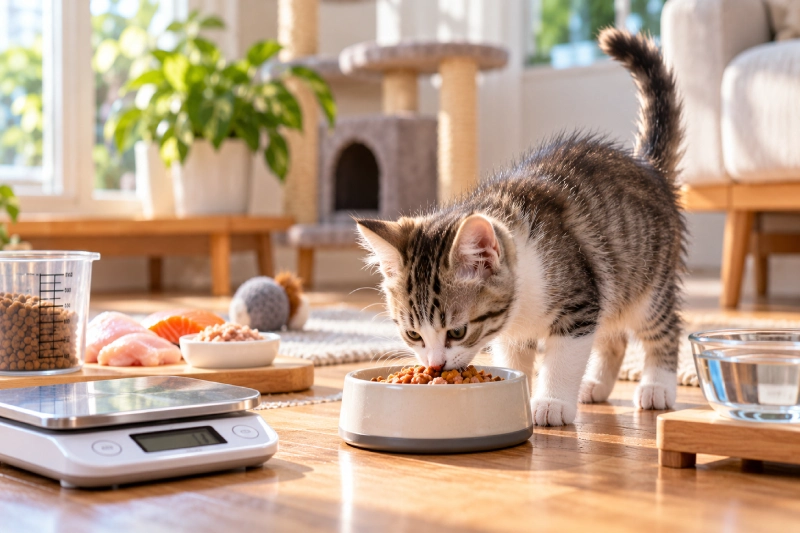
Feeding a 6-Month-Old Kitten
Six months is an important transition point.
VCA notes that kittens are around 75% of their adult size by six months, and energy needs have declined substantially compared with the earliest growth phase—particularly in kittens that have been spayed or neutered.
Cornell says that between six months and one year, twice-daily feeding is generally appropriate.
You do not have to switch from three meals to two overnight.
A gradual transition might look like:
Before six months: breakfast + afternoon + dinner
then:
After six months: breakfast + dinner
or continue three smaller meals if that works better for your kitten and total calories remain appropriate.
Importantly, reducing meal frequency does not mean switching to adult food at six months.
Most kittens should continue eating food formulated for growth until roughly 9–12 months, depending on growth and veterinary guidance.
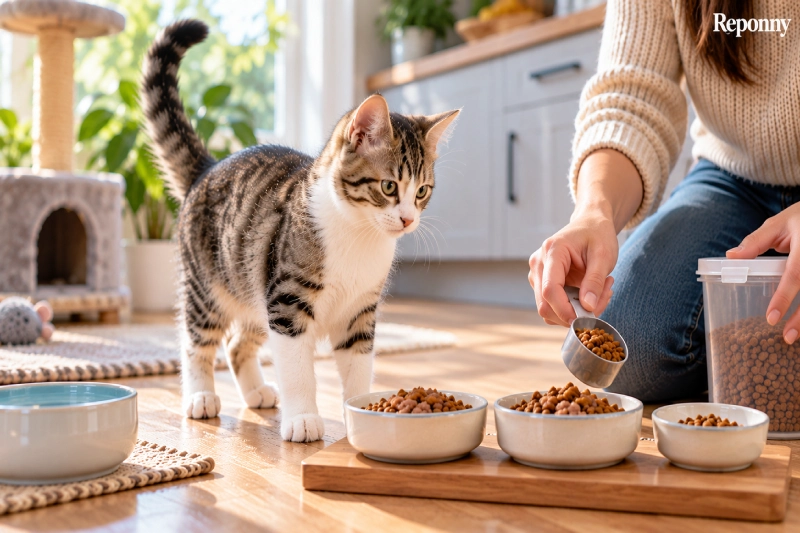
How Much Food Should a Kitten Eat?
There is no reliable universal answer such as:
“Half a cup per kitten per day.”
Different kitten foods contain different numbers of calories.
One dry kitten food may contain considerably more calories per cup than another.
One small can of wet kitten food may contain 70 calories, while another may provide 120.
AAFCO requires pet-food labels to provide calorie information expressed per kilogram and a familiar unit such as per cup or can.
That means the correct feeding process is:
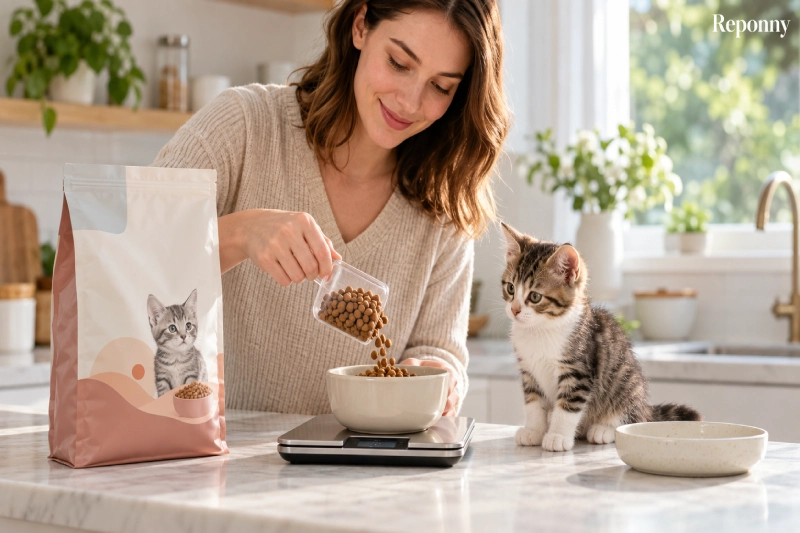
1. Determine your kitten’s approximate calorie needs.
2. Check the calories in the specific food.
3. Calculate the appropriate daily amount.
4. Divide that amount among the day’s meals.
Merck lists healthy kitten energy needs at approximately 2.5 × resting energy requirement (RER) as a general starting estimate, while emphasizing that calorie calculations must be adjusted according to the animal’s actual response.
Because kittens grow rapidly, their portions need regular reassessment.
Should Kittens Be Free-Fed?
You will find different recommendations because kitten calorie requirements are high and healthy kittens can sometimes self-regulate reasonably well.
Merck notes that growing kittens may be fed ad libitum or several times daily to meet their energy needs.
However, unlimited food is not necessary for every kitten.
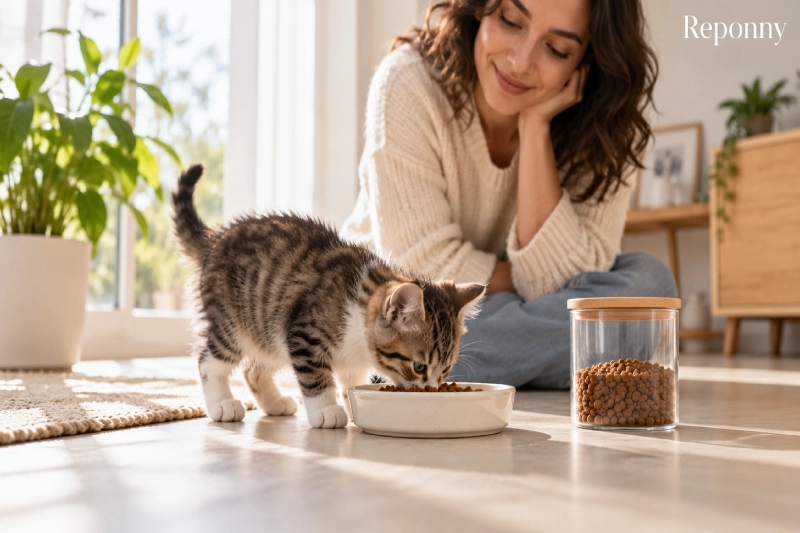
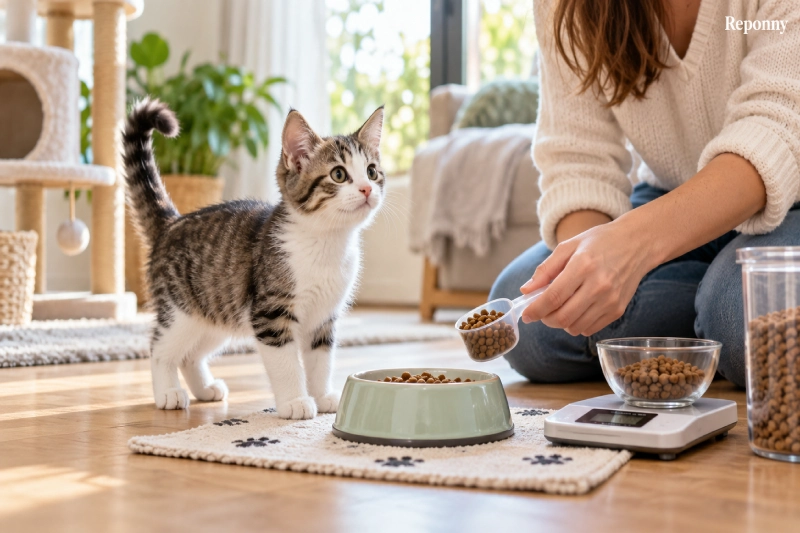
Measured meals provide several advantages:
- you know approximately how much the kitten eats,
- appetite changes are easier to notice,
- weight gain is easier to monitor,
- and healthy feeding habits are established early.
If you prefer allowing a kitten to graze, one compromise is to measure the entire daily food allowance first rather than continuously refilling the bowl.
That provides flexibility while maintaining awareness of total intake.
Wet Food, Dry Food or Both for Kittens?
All three approaches can work.
The important requirement is that the food is complete and balanced for growth.
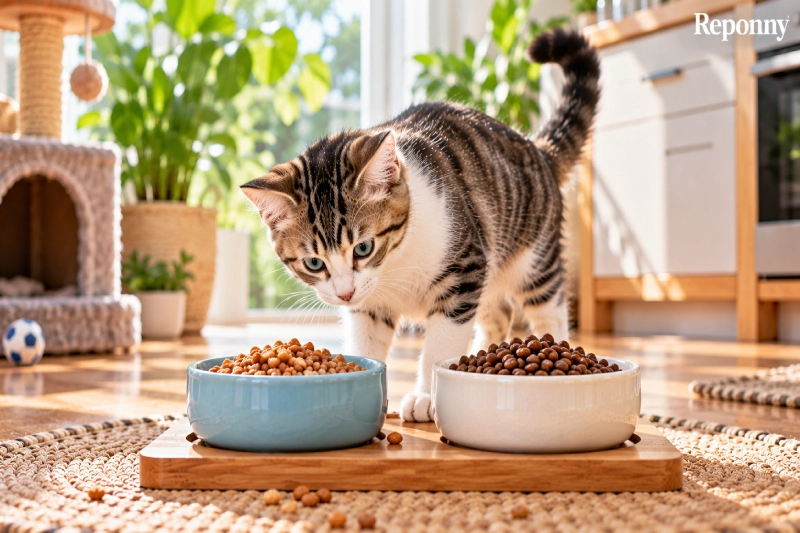
Wet kitten food
Advantages can include:
- high moisture,
- soft texture,
- strong aroma,
- easy chewing.
Dry kitten food
Advantages can include:
- convenience,
- easy measuring,
- compatibility with timed feeders,
- and higher calorie density in a smaller volume.
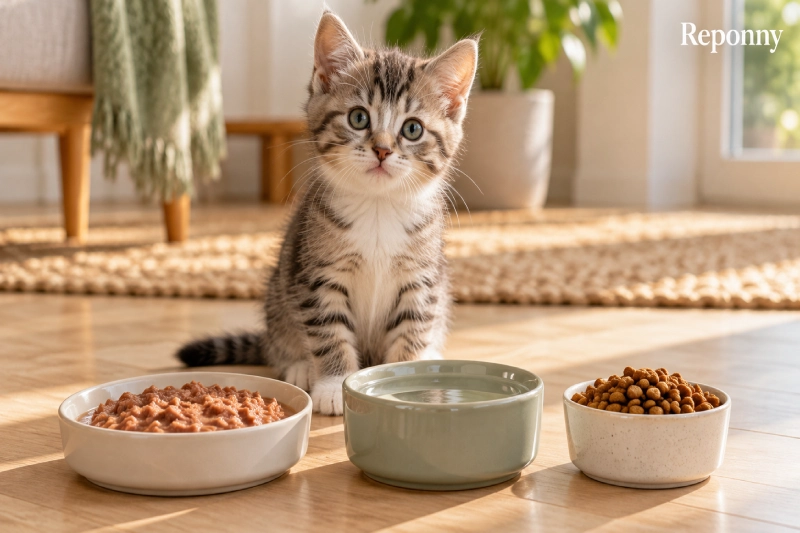
Mixed feeding
Many owners feed both.
For example:
wet food at breakfast and dinner + a measured dry-food meal during the day.
If you use both, remember to calculate the total calories from both foods.
Do not give the full recommended daily quantity of wet food plus the full daily quantity of dry food.
That could substantially exceed the kitten’s energy needs.
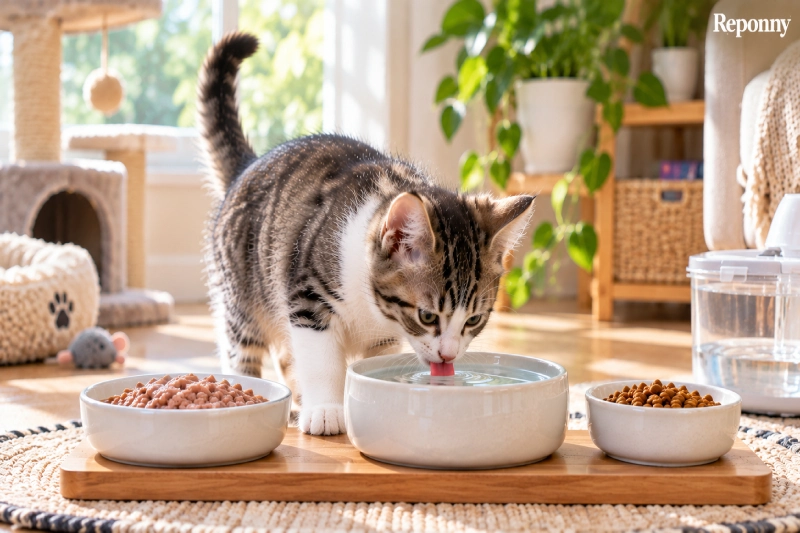
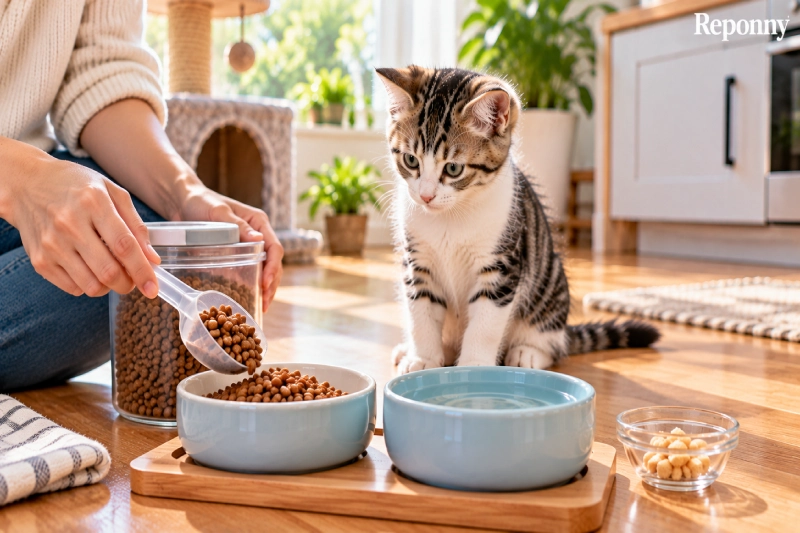
Kittens Still Need Fresh Water
Milk is not the everyday drink for a weaned kitten.
Once a kitten is eating solid food, clean fresh water should always be available.
Cornell emphasizes that cats should have access to fresh water at all times, while wet food can contribute significantly to total water intake because of its high moisture content.
Use a shallow, stable water bowl that the kitten can reach easily.
Clean it regularly and replace the water daily.
If your kitten eats primarily dry food, drinking becomes particularly important because kibble contains much less moisture than wet food.
Can an 8-Week-Old Kitten Drink Cow’s Milk?
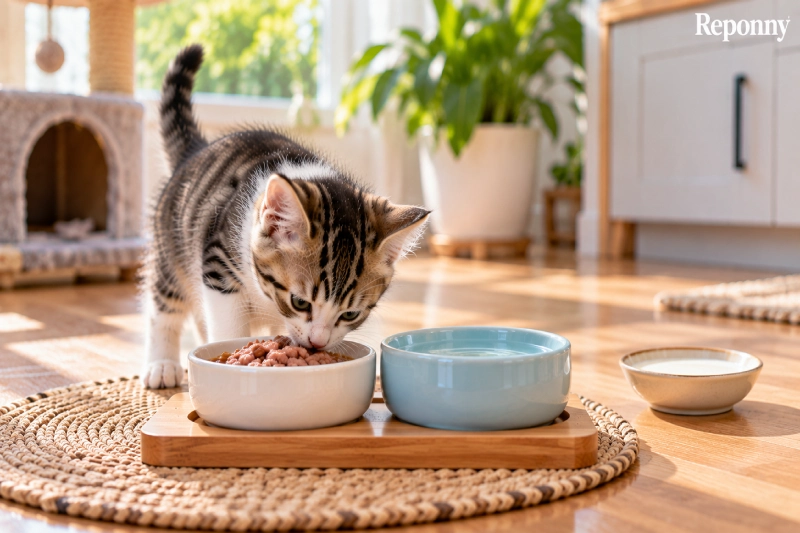
Ordinary cow’s milk is not necessary for a fully weaned eight-week-old kitten.
By this stage, nutrition should normally come from complete kitten food plus fresh water.
Young kittens that have not been successfully weaned are different and may need an appropriate kitten milk replacer, ideally under veterinary or experienced neonatal-care guidance.
Cow’s milk is not equivalent to a mother cat’s milk and should not be used as the standard replacement.
Once the kitten is eating solid kitten food, there is usually no nutritional need to continue offering milk.
What About Treats for Kittens?
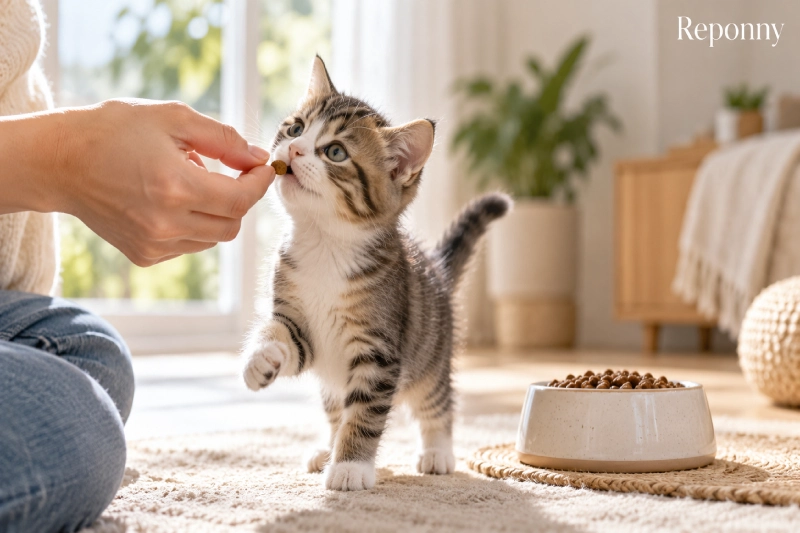
Treats are not necessary for growth.
If you use them for training or bonding, keep portions very small.
The majority of a kitten’s calories should come from a complete and balanced growth diet because every calorie displaced by nutritionally incomplete treats reduces the amount of properly formulated food the kitten consumes.
Tiny pieces of an appropriate commercial kitten treat or plain cooked cat-safe meat may be used occasionally, assuming your veterinarian has no concerns.
Avoid turning table scraps into a substantial part of the diet.
A growing kitten has less nutritional room for dietary mistakes than a healthy adult cat.
How to Know Whether Your Kitten Is Growing Properly
Growth should be monitored rather than guessed.
VCA notes that proper kitten nutrition should support healthy growth that is neither too rapid nor too slow.
Useful things to monitor include:
- body weight,
- body condition,
- appetite,
- energy level,
- stool quality,
- coat condition,
- and veterinary growth assessment.
Merck reports that young kittens may gain roughly 50–100 grams per week during the rapid early growth period, although breed, genetics, health, and environment influence growth.
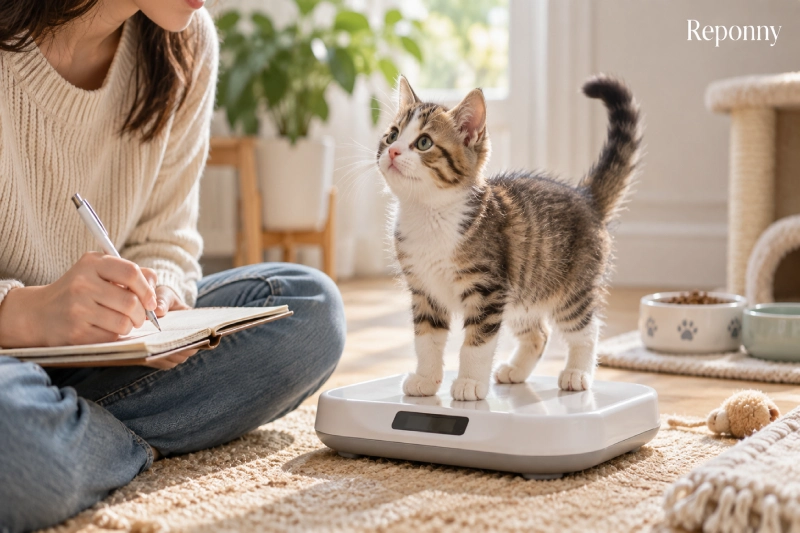
A simple home habit is to weigh your kitten regularly using the same scale.
Record the results.
A pattern over several weeks is usually more informative than a single number.
What Changes After Spaying or Neutering?
Many kittens are spayed or neutered during this general growth period.
That does not mean they should immediately switch to adult cat food.
However, calorie needs can change.
VCA notes that by six months, kittens’ energy requirements are already significantly lower than in early kittenhood, particularly if they have been spayed or neutered.
This makes portion monitoring increasingly important.
Continue feeding a growth-appropriate diet, but watch:
- body condition,
- waistline,
- weight gain,
- and the feeding recommendation.
Do not assume that a growing kitten can never become overweight.
Healthy growth is the goal—not maximum growth.
When Should You Switch From Kitten Food to Adult Food?
Do not automatically switch at six months.
Merck notes that kittens are generally transitioned to an adult diet somewhere between 8 and 12 months, while other veterinary guidance commonly places the transition around 9–12 months as growth approaches completion.
VCA similarly recommends continuing a growth-formulated food until the kitten is fully grown, typically around 12 months.
Individual timing can vary.
Your veterinarian can help decide based on:
- breed,
- body size,
- growth rate,
- body condition,
- neuter status,
- and overall health.
When the time arrives, transition gradually rather than changing food overnight.
Common Kitten Feeding Mistakes
Several feeding mistakes are especially easy to make during the first six months.
Feeding adult food too early
Adult maintenance food may not provide nutrients in the quantities and ratios designed specifically for growth.
Giving too much milk
A weaned kitten does not need ordinary cow’s milk.
Constantly filling the bowl
Rapid growth requires calories, but unlimited calories can still lead to excessive weight gain.
Guessing portions by eye
Food calorie density varies considerably.
Feeding too many treats
Treats can displace nutritionally complete growth food.
Changing foods repeatedly
Frequent abrupt dietary changes can contribute to digestive upset or food rejection.
Ignoring poor appetite
A growing kitten that suddenly stops eating deserves attention.
Feeding homemade food without professional formulation
Growth requires especially careful nutrient balance. A homemade recipe that is slightly deficient can become much more consequential when fed every day during development.
When Should You Contact a Veterinarian?
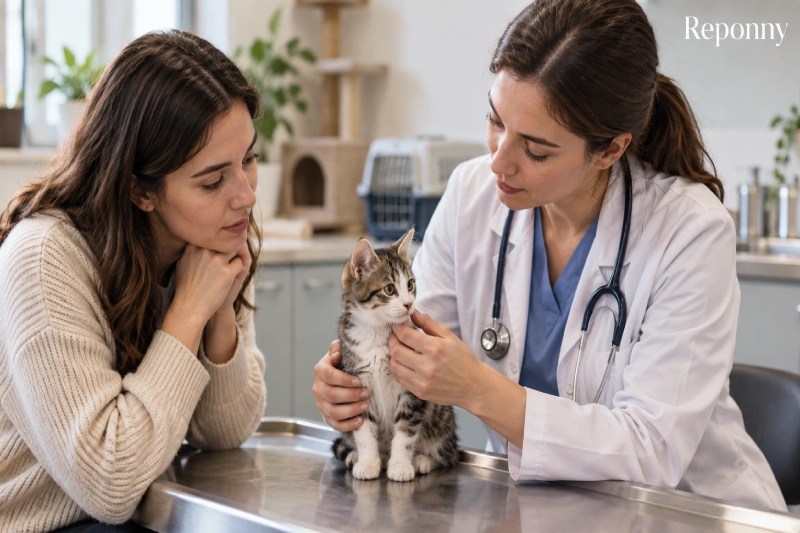
A kitten’s appetite may vary slightly from meal to meal, but significant changes should not be ignored.
Contact your veterinarian if your kitten:
- repeatedly refuses food,
- is losing weight,
- stops gaining weight as expected,
- has repeated vomiting,
- develops persistent diarrhea,
- appears weak or unusually sleepy,
- has a swollen or painful abdomen,
- struggles to chew or swallow,
- or shows another significant behavioral or physical change.
Young kittens have less body reserve than healthy adult cats, so illness and dehydration can become more important more quickly.
Feeding advice online cannot replace an examination when a kitten appears unwell.
Frequently Asked Questions
How Often Should an 8-Week-Old Kitten Eat?
A practical schedule is about four small meals per day. Merck recommends 3–4 daily meals for kittens under four months because they have high growth demands and relatively small stomachs.
How Often Should a 3-Month-Old Kitten Eat?
Most three-month-old kittens do well with three to four meals daily.
Continue using complete and balanced food formulated for kitten growth.
How Often Should a 4-Month-Old Kitten Eat?
Around four months, many kittens can comfortably move toward three meals per day, provided their total calorie intake remains appropriate.
How Often Should a 6-Month-Old Kitten Eat?
Around six months, many kittens can begin transitioning from three meals toward two meals per day. Cornell generally recommends twice-daily feeding between six months and one year.
Should a 6-Month-Old Kitten Eat Adult Cat Food?
Usually not yet.
Kittens should generally continue eating a diet formulated for growth until approximately 9–12 months, depending on development and veterinary guidance.
Can Kittens Eat Both Wet and Dry Food?
Yes.
Both can be appropriate if they provide complete and balanced nutrition for growth. Mixed feeding can also work well as long as total daily calories from both foods are considered.
How Much Should My Kitten Eat?
Use the feeding directions and calorie information on your specific kitten food as a starting point, then adjust based on weight, body condition, growth, and veterinary guidance. AAFCO requires complete and balanced foods to provide feeding directions appropriate to life stage.
Should I Leave Food Out All Day for My Kitten?
Some growing kittens can be fed free-choice, but scheduled measured meals make it easier to monitor appetite and calories. Merck considers either ad-lib feeding or multiple meals acceptable for growing kittens.
Final Thoughts
From eight weeks to six months, your kitten’s nutritional needs change quickly.
A simple schedule to remember is:
8–12 weeks: about 4 small meals daily
3–4 months: about 3–4 meals daily
4–6 months: about 3 meals daily
Around 6 months: gradually consider 2–3 meals daily
But meal frequency is only one part of good kitten nutrition.
The food itself should be complete and balanced for growth, calories should support steady development without excessive weight gain, and fresh water should always be available.
Continue kitten/growth food beyond six months. Most kittens do not transition completely to adult maintenance food until approximately 9–12 months of age.
Most importantly, follow your kitten rather than a rigid chart.
Monitor weight.
Watch body condition.
Pay attention to appetite and stool.
Adjust portions as the kitten grows.
And use regular veterinary visits to confirm that development is progressing normally.
Those first several months pass quickly, but good feeding habits established now can help create a strong nutritional foundation for adulthood.