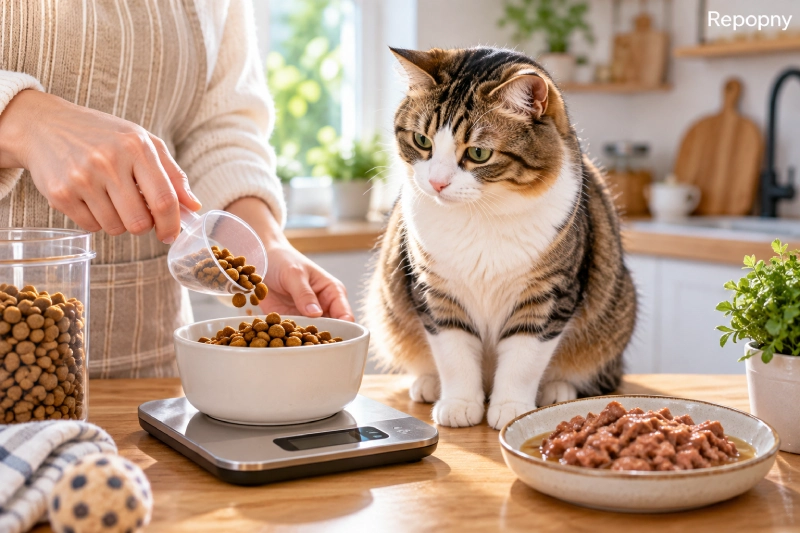
Figuring out how much to feed a cat each day sounds simple until you start looking at food labels, calorie charts, body weight, age, activity level, and different types of cat food.
Two cats that weigh the same may not need exactly the same amount of food. A young, active cat may require more calories than a quiet indoor cat. A kitten needs substantially more energy for growth, while a senior cat may need adjustments depending on body condition, muscle mass, activity, and health.
The safest way to determine how much your cat should eat is to think in terms of daily calories, not just cups, cans, or pouches.
This guide explains how to estimate your cat’s daily food needs by weight and age, how to read calorie information on cat food labels, how often to feed, and how to recognize when portions need adjusting.
Quick answer: A healthy adult cat weighing about 8.8 lb (4 kg) may need roughly 225–250 calories per day as a starting point, but individual needs vary. Weight, body condition, age, activity, neuter status, and health all matter.
How Much Should an Adult Cat Eat Per Day?
There is no single feeding amount that works for every cat.
The World Small Animal Veterinary Association provides calorie ranges for healthy adult cats in ideal body condition. These numbers are useful starting points, not fixed prescriptions.
Daily Calorie Guide for Healthy Adult Cats
| Cat Weight | Approx. Daily Calories |
|---|---|
| 4.4 lb / 2 kg | 160–170 kcal |
| 5.5 lb / 2.5 kg | 180–190 kcal |
| 6.6 lb / 3 kg | 200–210 kcal |
| 7.7 lb / 3.5 kg | 215–230 kcal |
| 8.8 lb / 4 kg | 225–250 kcal |
| 9.9 lb / 4.5 kg | 240–270 kcal |
| 11 lb / 5 kg | 250–290 kcal |
| 12.1 lb / 5.5 kg | 260–310 kcal |
| 13.2 lb / 6 kg | 265–330 kcal |
| 14.3 lb / 6.5 kg | 275–350 kcal |
| 15.4 lb / 7 kg | 280–370 kcal |
These ranges assume an average healthy adult cat at an appropriate body condition.
A 5 kg cat does not automatically need 290 calories. One cat might maintain an ideal weight closer to the lower end, while a highly active cat may need more.
That is why your cat’s weight trend and body condition matter just as much as the number on the chart.
Why Calories Matter More Than Cups or Cans
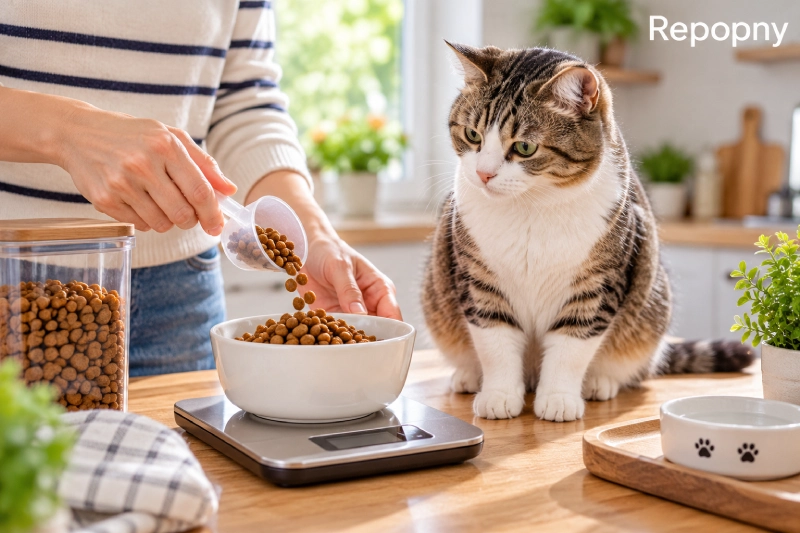
A cup of one dry food can contain a very different number of calories from a cup of another.
The same applies to canned food.
For example, imagine your cat needs about 240 calories per day.
If one dry food contains:
400 kcal per cup
then:
240 ÷ 400 = 0.6 cup per day
That is a little more than half a cup for the entire day.
But if another food contains only:
300 kcal per cup
then:
240 ÷ 300 = 0.8 cup per day
The physical portion is much larger even though both provide the same calories.
That is why simply asking:
“How many cups should my cat eat?”
does not give enough information.
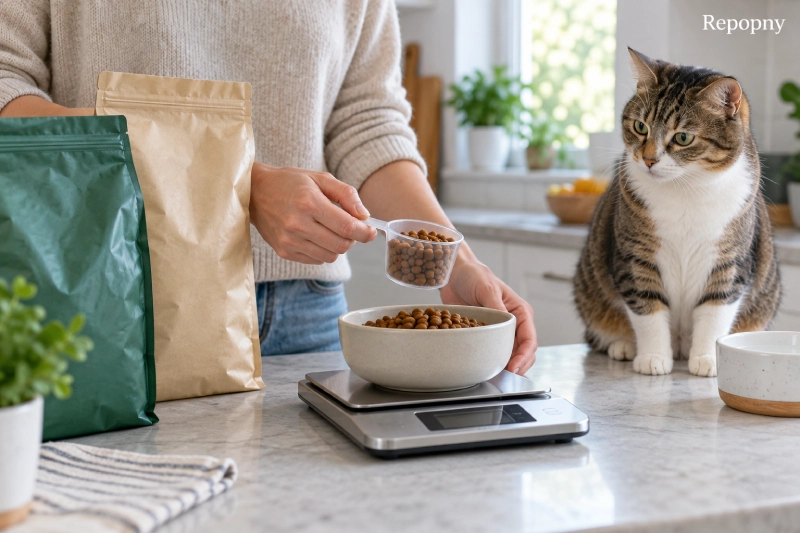
Look for the Calorie Content information on the food package. It may be listed as kcal per cup, kcal per can, kcal per pouch, or kcal per kilogram.
Feeding instructions on cat food packaging can be useful as an initial guide, but Cornell notes that those directions are based on an average cat and may provide more food than a less-active individual actually needs.
A Simple Formula for Estimating Your Cat’s Calorie Needs
Veterinarians can estimate energy needs using a calculation called Resting Energy Requirement, or RER.
A commonly used formula is:
RER = 70 × body weight in kilograms^0.75
For cats between approximately 2 kg and 45 kg, another simplified formula sometimes used is:
RER = (30 × body weight in kg) + 70
RER represents basic resting energy needs. Maintenance calories are then estimated by multiplying RER according to life stage and individual circumstances.
For healthy adult cats, Merck lists these starting factors:
- Neutered adult cat: approximately 1.2 × RER
- Intact adult cat: approximately 1.4 × RER
- Cat prone to obesity: approximately 1.0 × RER
- Growing kitten: approximately 2.5 × RER
These calculations are only starting estimates and should be adjusted according to the individual cat’s response.
Example: A 4 kg Neutered Adult Cat
Approximate RER:
70 × 4^0.75 ≈ 198 calories
Then:
198 × 1.2 ≈ 238 calories/day
That falls comfortably within WSAVA’s approximate 225–250 kcal/day range for a healthy 4 kg adult cat.
You do not need to perform this calculation every day. It is mainly useful for understanding why body weight alone does not determine the final feeding amount.
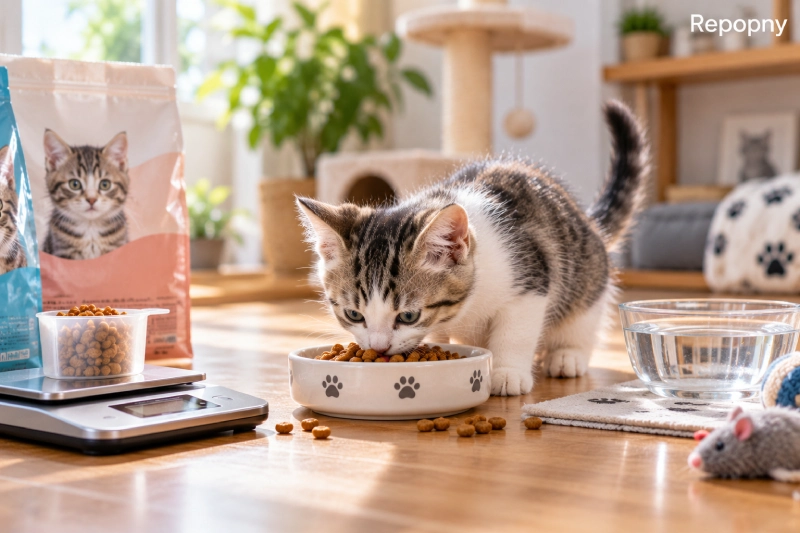
How Much Should You Feed a Kitten?
Kittens need considerably more energy relative to their body weight than adult cats because they are growing.
Their bones, muscles, organs, immune system, and nervous system are still developing.
Food should be labeled as complete and balanced for growth or otherwise appropriate for kittens.
Merck lists healthy kitten energy needs at approximately 2.5 times RER as a starting estimate.
But meal frequency also matters.
Cornell recommends that kittens generally eat:
Up to around 6 months: about three meals per day.
6 months to 1 year: usually around two meals per day.
Once the cat reaches adulthood, once- or twice-daily feeding is appropriate for many healthy cats.
Young kittens should not simply be given adult cat portions based on their current small body weight. Their calorie requirements relative to their size are much higher.
Why kitten food is different
Kitten food is generally formulated to support growth and provides the appropriate balance of nutrients and energy for development.
A kitten also grows rapidly, so portions may need to be adjusted frequently.
Monitor:
- weight gain,
- body condition,
- appetite,
- stool quality,
- energy level,
- and your veterinarian’s growth assessment.
How Much Should You Feed an Adult Cat?
Most cats reach adulthood at around one year, although physical development varies somewhat among individuals.
For healthy adults, the goal is no longer rapid growth.
Instead, feeding should provide enough calories to maintain:
- a healthy body weight,
- good muscle condition,
- normal activity,
- and overall health.
For many indoor cats, the biggest feeding problem is not too little food.
It is too many calories.
Indoor cats may spend much of their day sleeping or resting. Cornell notes that indoor cats may expend fewer calories than cats that spend time outdoors.
This means an indoor cat should not automatically receive the full amount printed on a food package if that amount causes gradual weight gain.
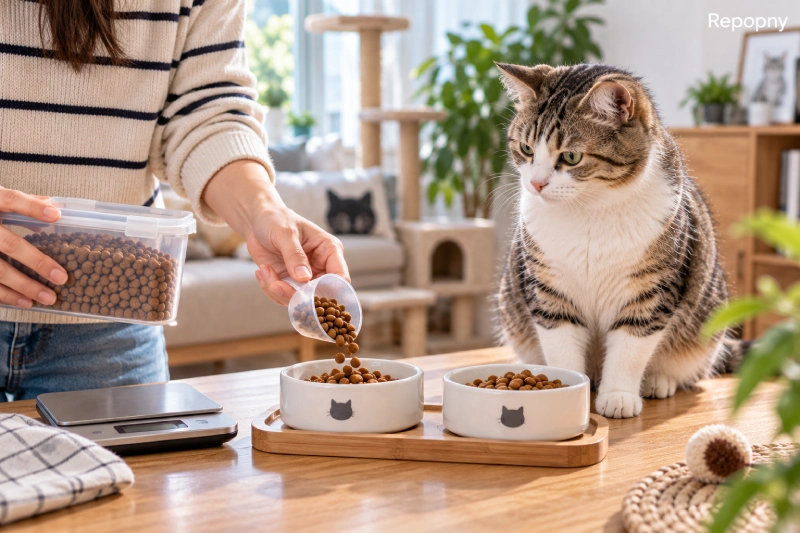
A practical method is:
- Estimate the appropriate daily calorie intake.
- Measure all food.
- Track your cat’s weight and body condition.
- Adjust portions gradually if necessary.
Avoid making dramatic calorie reductions without veterinary guidance, particularly in overweight cats.
Cats that suddenly consume too little food can develop serious health problems.
How Much Should You Feed a Senior Cat?
Senior cats should not automatically be fed less simply because they are older.
Some older cats become less active and gain weight.
Others lose muscle and body weight as they age or develop health conditions that alter appetite or nutrient needs.
Cornell notes that senior cats can generally continue a similar meal frequency unless a veterinarian recommends otherwise.
What matters most is monitoring changes.
Pay attention if an older cat:
- begins losing weight,
- becomes unusually hungry,
- stops finishing meals,
- drinks substantially more,
- has difficulty chewing,
- loses muscle,
- or becomes noticeably less active.
These changes should not simply be dismissed as “old age.”
A veterinarian may recommend a different diet or calorie target based on the cat’s medical condition and body composition.
Does Breed Change How Much a Cat Should Eat?
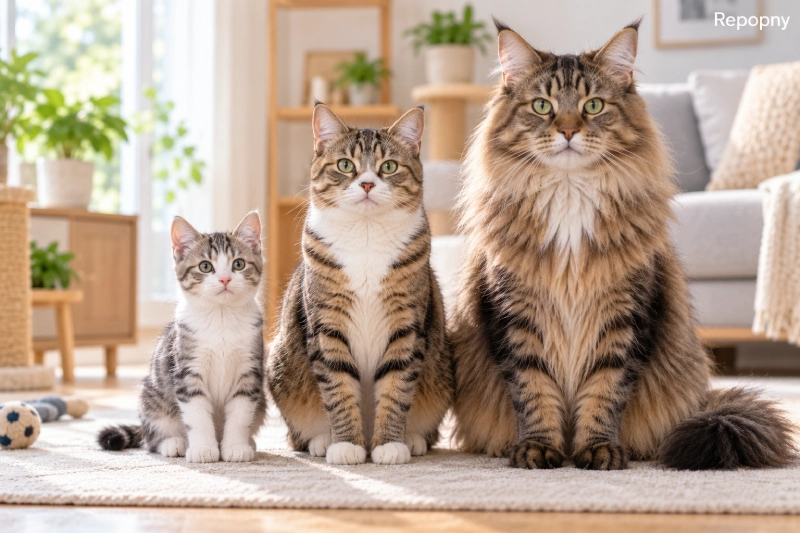
Breed can influence typical adult size, but breed name alone is not a reliable way to determine how much food a cat needs.
A naturally large cat should not be fed according to the same body-weight target as a naturally small cat.
For example, the correct question is not:
“How much should a Maine Coon eat?”
Instead, consider:
- actual body weight,
- ideal body weight,
- body condition,
- muscle condition,
- activity,
- age,
- neuter status,
- and health.
Two cats of the same breed can have noticeably different calorie requirements.
This is why feeding by ideal body condition is more useful than relying on breed averages alone.
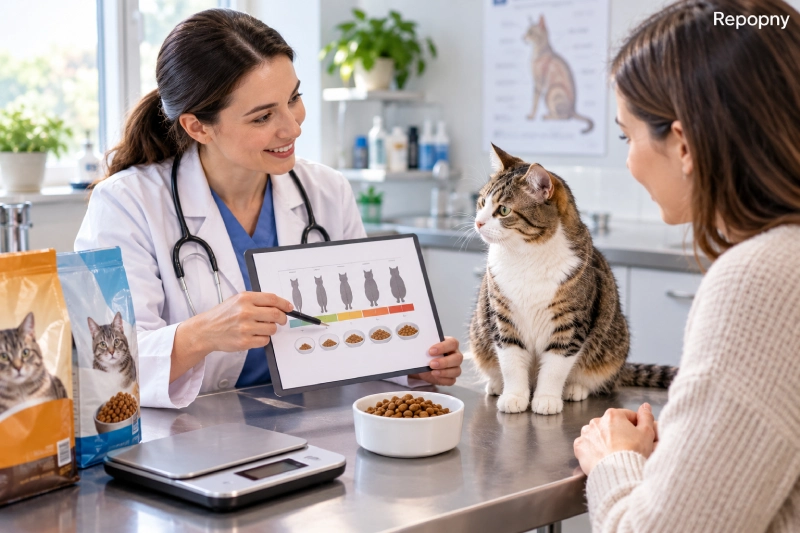
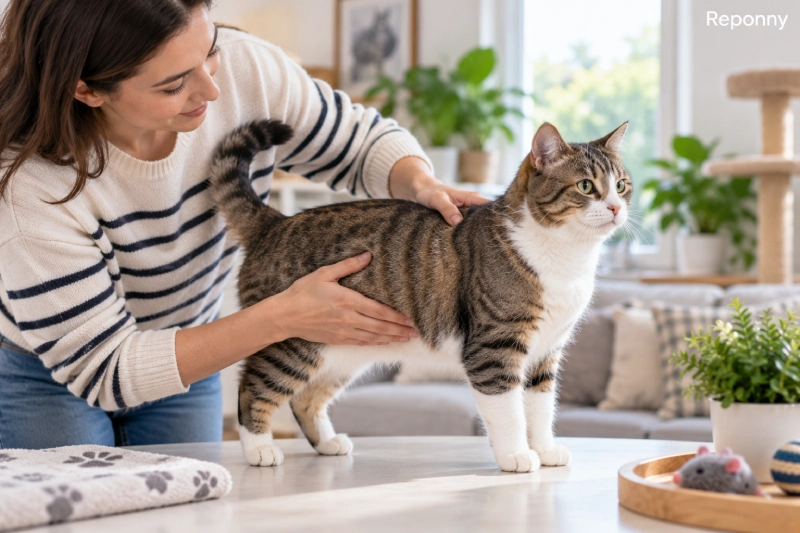
Cornell describes a 9-point body condition scale in which a score around 5/9 represents ideal body condition, characterized by appropriate proportions, ribs that can be felt beneath a slight fat covering, and a visible waist behind the ribs.
How Often Should You Feed Your Cat?
Meal frequency is different from total daily calories.
You can divide the same daily calorie allowance into one, two, three, or several smaller meals.
Cornell provides the following general schedule: kittens younger than six months usually do well with three meals per day; cats from six months to one year generally do well with two; and most adult cats can be fed once or twice daily.
However, many cats naturally prefer multiple small meals.
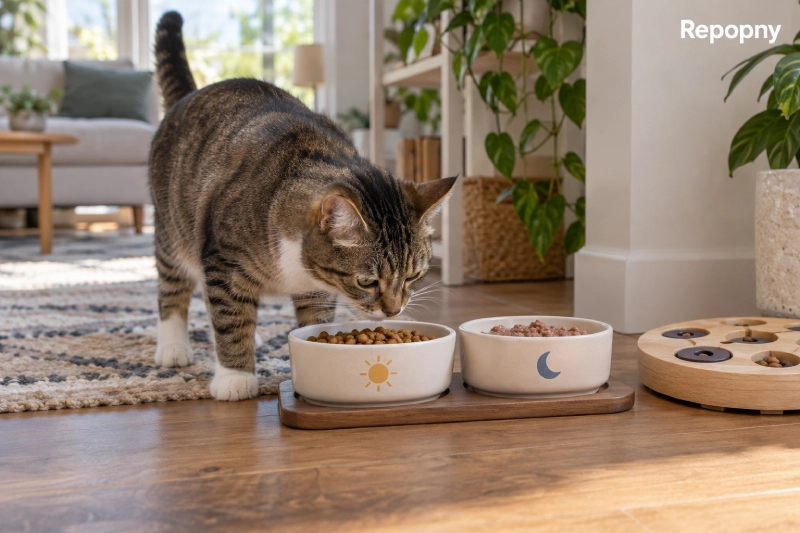
For indoor cats, smaller measured meals can also provide opportunities for enrichment.
You might divide food between:
- breakfast,
- dinner,
- puzzle feeders,
- food-dispensing toys,
- or small controlled snacks.
The key is that all of those calories must still fit within the cat’s total daily allowance.
Leaving an unlimited bowl of kibble available all day can work for some self-regulating cats, but Cornell notes that free feeding can result in overeating and unwanted weight gain in others.
How Much Wet Food Should I Feed My Cat?
Do not calculate wet food by the number of cans alone.
Check how many calories are in each can or pouch.
Suppose your cat needs:
240 kcal/day
and the wet food contains:
80 kcal per can
Then:
240 ÷ 80 = 3 cans per day
But another brand may contain:
120 kcal per can
In that case:
240 ÷ 120 = 2 cans per day
Same cat.
Same calorie goal.
Very different number of cans.
Wet foods also come in different can sizes, so statements like “feed two cans per day” are meaningless unless calorie content and can size are known.

How Much Dry Food Should I Feed My Cat?
The same principle applies to kibble.
Imagine a dry food contains:
380 kcal per cup
and your cat needs:
230 kcal per day
Calculation:
230 ÷ 380 ≈ 0.61 cup
That means a little over half a cup for the whole day.
Because dry food is calorie-dense, seemingly small differences in portion size can add meaningful calories.
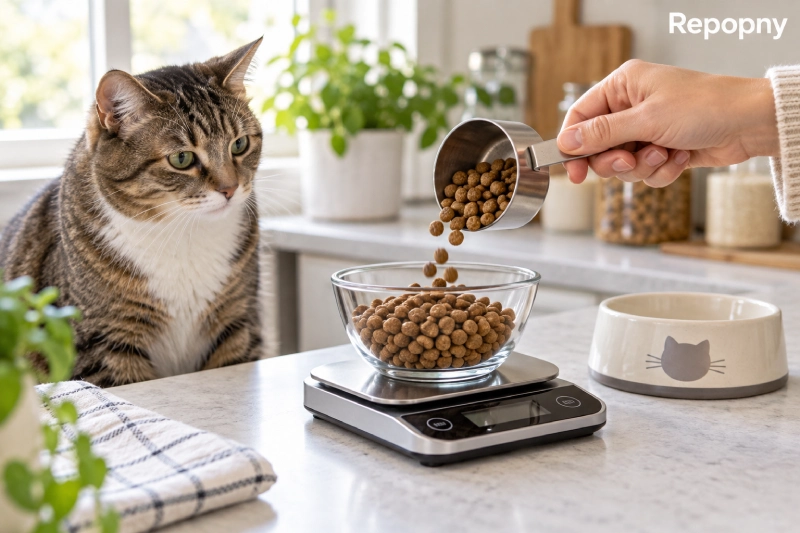
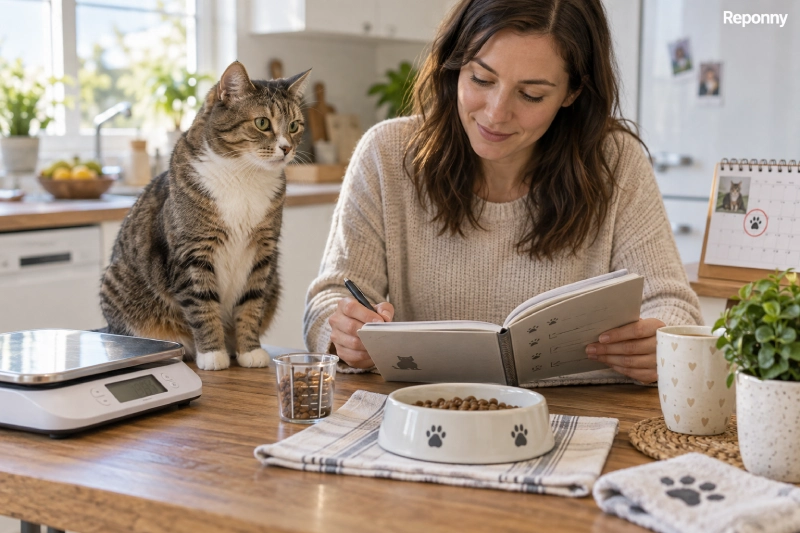
A kitchen measuring cup is better than estimating by eye.
A digital gram scale can be even more accurate, especially for cats on tightly controlled feeding plans.
What If You Feed Wet and Dry Food Together?
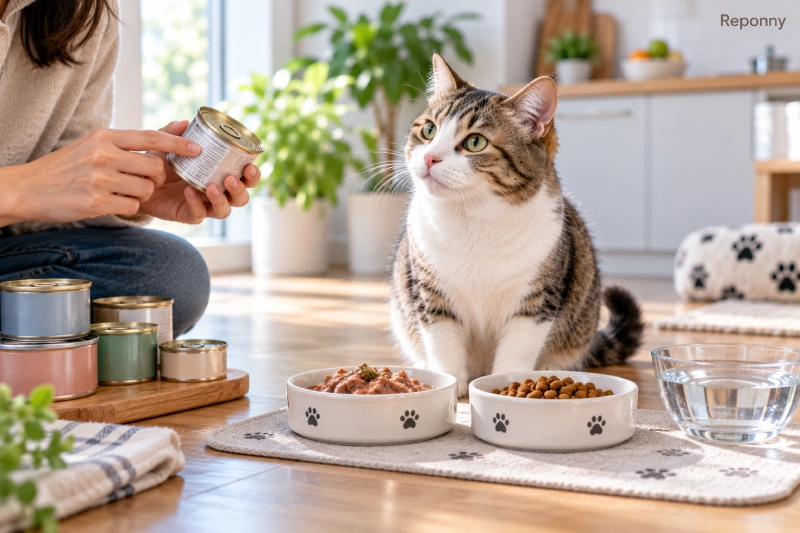
Mixed feeding is completely manageable as long as you calculate total calories from both foods.
For example, suppose your cat needs approximately:
240 kcal/day
You decide to feed one can of wet food containing:
100 kcal
That leaves:
140 kcal for dry food.
If the kibble contains:
400 kcal per cup
then:
140 ÷ 400 = 0.35 cup
So the daily plan might be:
1 can wet food + approximately 0.35 cup dry food
instead of giving the full recommended serving of both foods.
One common mistake is to feed the full wet-food recommendation plus the full dry-food recommendation.
That can result in significantly more calories than intended.
Don’t Forget Treat Calories
Treats count.
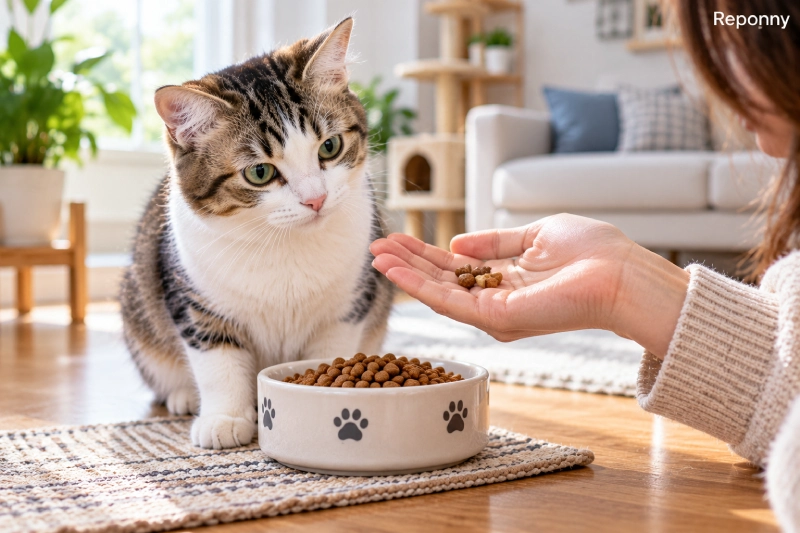
So do pieces of chicken from dinner, lickable treats, table scraps, and extra kibble handed out during the day.
Cornell suggests treats should generally make up no more than about 10–15% of a cat’s daily calories.
If a cat needs 220 calories per day and receives 40–50 calories of treats, those treats have already consumed a significant percentage of the daily calorie allowance.
For routine feeding, keeping treat calories modest makes it easier to ensure most nutrition comes from a complete and balanced diet.
How Do You Know If You’re Feeding the Right Amount?
The scale and your cat’s body condition provide the answer over time.
A feeding calculation may tell you to start at 230 calories per day, but the real test is what happens after several weeks.
If your cat remains at a healthy body condition and stable weight, the amount may be appropriate.
If weight steadily increases, calorie intake may be too high.
If weight steadily falls unexpectedly, the cat may need more calories—or there may be an underlying medical issue.
Cornell emphasizes that cats vary substantially in the amount of food they need and recommends using body condition and veterinary guidance to determine and maintain an appropriate weight.
Signs of an ideal body condition may include:
- ribs that can be felt without a thick fat covering,
- a visible waist when viewed from above,
- appropriate abdominal contour,
- stable weight,
- good muscle condition.
You should not aim for a specific number on the scale simply because another cat of the same breed weighs that amount.
When Should You Change Your Cat’s Portion?
Consider reassessing food intake when:
- your cat gains or loses noticeable weight,
- activity level changes significantly,
- the cat is spayed or neutered,
- you change to a food with different calorie density,
- a kitten approaches adulthood,
- an adult becomes less active,
- your veterinarian diagnoses a medical condition,
- or a senior cat begins losing muscle or appetite.
Do not make aggressive food reductions in an overweight cat without professional guidance.
Cornell warns that a cat that refuses to eat can develop serious medical problems, and cats that stop eating and lose weight should be evaluated by a veterinarian.
Weight loss in cats should be gradual and controlled rather than achieved by simply withholding food.
Frequently Asked Questions
Is 1 Cup of Cat Food a Day Too Much?
It can be.
If a dry food contains 400 calories per cup and your cat needs only 220 calories daily, one cup would provide almost twice the intended calories.
Always check the food’s kcal-per-cup value.
Is Half a Cup of Dry Food Enough for a Cat?
Possibly.
Half a cup of a 400 kcal/cup food provides around 200 calories.
Half a cup of a 300 kcal/cup food provides only 150 calories.
The correct amount depends on the food and the individual cat.
Should Indoor Cats Eat Less?
Indoor cats can have lower energy needs if they are less active, but indoor status alone does not determine the correct portion.
Activity and body condition should guide adjustment. Cornell notes that strictly indoor cats may expend fewer calories than cats that spend time outdoors.
Should I Feed My Cat Once or Twice a Day?
Most healthy adult cats can be fed once or twice daily, although many owners prefer two or more smaller meals.
Kittens generally need more frequent meals.
Why Is My Cat Always Hungry?
Possible explanations range from learned begging behavior and insufficient calories to increased activity or medical problems.
If your cat suddenly becomes unusually hungry, especially with weight loss, increased thirst, vomiting, or other changes, arrange a veterinary assessment rather than simply increasing the food indefinitely.
Final Thoughts
The best answer to “How much should I feed my cat?” is not a universal number of cups or cans.
Start with your cat’s:
ideal weight + estimated calorie needs + age + activity + body condition + health status.
Then check the calorie content of the actual food.
For a healthy adult cat, a reputable calorie chart or veterinary energy calculation can provide a useful starting point. From there, monitor body weight and body condition and adjust gradually.
For kittens, pregnant or nursing cats, overweight cats, senior cats losing muscle, or cats with medical conditions, feeding requirements can be substantially different.
When in doubt, ask your veterinarian to help establish an appropriate ideal weight and daily calorie target.
The goal is not to feed the smallest or largest portion possible.
It is to provide the amount that keeps your individual cat healthy, active, and at an appropriate body condition.