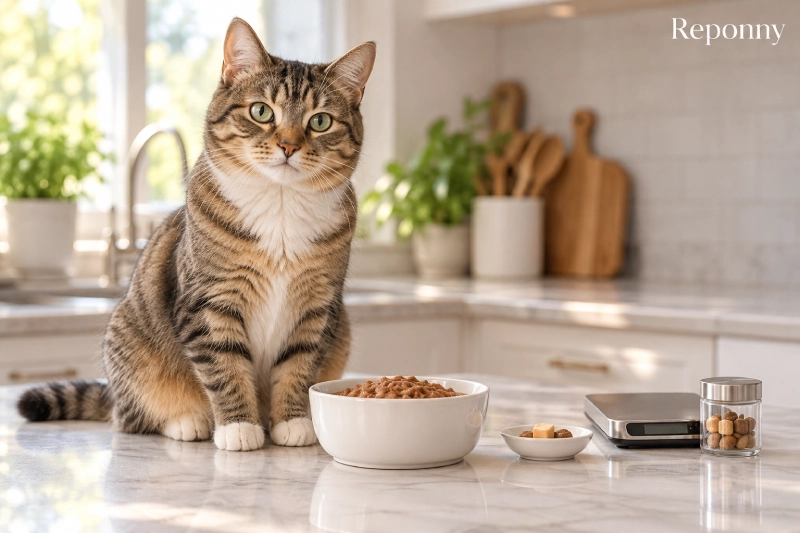
Treats can be one of the easiest ways to bond with your cat.
They can reward good behavior, make training easier, help a shy cat build trust, provide enrichment, or simply give your cat a small moment of excitement during the day.
But treats also contain calories.
And because cats are much smaller than humans, what looks like a tiny snack to us can represent a surprisingly large percentage of a cat’s daily energy intake.
The general veterinary recommendation is straightforward:
Treats should provide no more than about 10% of your cat’s total daily calories.
The remaining 90% or more should come from a complete and balanced food appropriate for your cat’s life stage. WSAVA and VCA both use this 10% guideline because too many treats can add excess calories while diluting the nutritional balance of the main diet.
That means the right question is not simply:
“How many treats can my cat have?”
It is:
“How many calories from treats can my cat have?”
One brand may contain one calorie per treat, while another contains four or five. Ten pieces of one product could therefore contain fewer calories than three pieces of another.
Quick answer: Keep treats, toppers, table foods, and other extras combined to 10% or less of your cat’s daily calorie intake. A healthy adult cat eating around 200 calories per day would have a treat allowance of roughly 20 calories per day.
The 90/10 Rule for Cat Treats
The easiest way to think about treats is the 90/10 rule.
At least:
90% of daily calories → complete and balanced cat food
No more than:
10% of daily calories → treats, toppers, snacks, and human foods
VCA explains that most treats are not complete and balanced. They may taste great, but they do not necessarily contain every essential amino acid, fatty acid, vitamin, and mineral a cat needs in the correct proportions.
AAFCO similarly classifies most treat and snack products as foods that are not intended to provide complete nutrition. They are generally designed to supplement the main diet rather than replace it.
Imagine your cat requires 200 calories per day.
A reasonable starting point would be:
180 calories or more from complete cat food
and
up to approximately 20 calories from treats and extras.
That 20-calorie allowance includes everything outside the main diet—not 20 calories of commercial treats plus chicken plus lickable treats plus table scraps.
How Many Treat Calories Can a Cat Have Per Day?
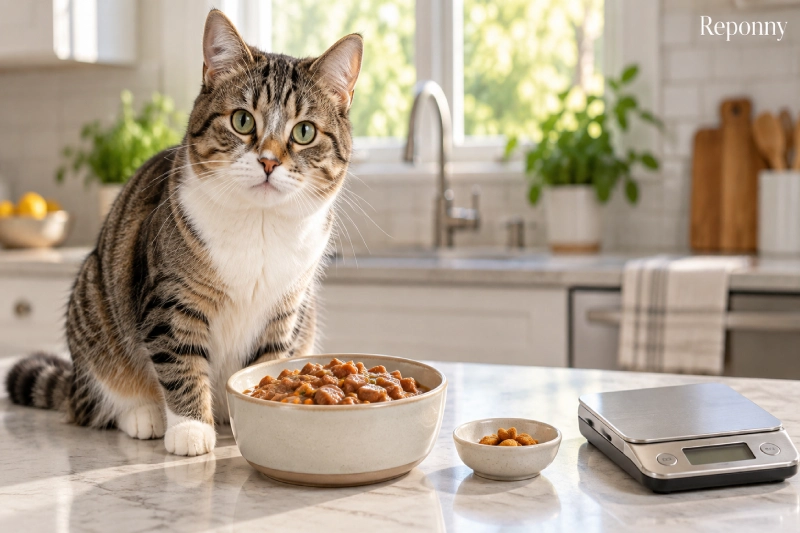
WSAVA provides a practical treat-calorie guide for healthy adult cats in ideal body condition.
| Cat’s Body Weight | Approximate Maximum Calories From Treats Per Day |
|---|---|
| 2.5 kg / 5.5 lb | 18 kcal |
| 3 kg / 6.6 lb | 20 kcal |
| 3.5 kg / 7.7 lb | 21 kcal |
| 4 kg / 8.8 lb | 22 kcal |
| 4.5 kg / 9.9 lb | 24 kcal |
| 5 kg / 11 lb | 25 kcal |
| 5.5 kg / 12.1 lb | 26 kcal |
| 6 kg / 13.2 lb | 26 kcal |
| 7 kg / 15.4 lb | 28 kcal |
These are estimates for average healthy adult cats at an ideal body condition, not guaranteed requirements for every individual cat. WSAVA notes that the actual calorie requirement should be individualized with the veterinary healthcare team.
Age, neuter status, activity level, body condition, health, and metabolism can all affect energy needs.
An overweight 12-pound indoor cat should not automatically receive more treats simply because it weighs more than an ideal-weight 9-pound cat.
For an overweight cat, calorie targets should usually be based on a veterinary weight-management plan rather than simply on current body weight.
Why Counting Treats Is Less Useful Than Counting Calories
Suppose Treat A contains:
1 calorie per piece.
Your 20-calorie allowance could theoretically accommodate up to 20 pieces.
Now suppose Treat B contains:
4 calories per piece.
Five pieces already reach 20 calories.
VCA reports that many small commercial cat treats contain approximately 1–4 calories each, although products vary.
This is why advice such as:
“Give your cat five treats per day”
is not particularly useful unless we know which treat.
Always check the package for calories.
Pet-food calorie statements may be expressed as:
- kcal per treat,
- kcal per piece,
- kcal per ounce,
- or kcal per kilogram.
If the package does not clearly state calories per piece, the manufacturer may provide the information online or by customer service.

Why Too Many Treats Can Become a Problem
Treats can create problems in two main ways:
too many calories and too little nutritional balance.
Extra Calories Add Up Quickly
Cats have relatively small daily calorie requirements.
If your cat needs 200 calories per day and receives an additional 40 calories in treats, that is a 20% calorie increase.
If the main food portion remains unchanged, those extra calories can contribute to gradual weight gain.
VCA specifically warns that excessive treat intake can contribute to overweight and obesity.
AAHA also emphasizes limiting treats during feline weight management because even seemingly small snacks can add a meaningful number of calories.
Treats Can Dilute a Balanced Diet
Imagine a cat eats fewer and fewer bites of complete food because it receives chicken, tuna, treats, lickable snacks, and other extras all day.
Calories may still be adequate.
But those calories increasingly come from foods that were never designed to provide complete feline nutrition.
AAFCO explains that most treats are exempt from complete-and-balanced nutritional adequacy requirements because they are intended only as occasional rewards.
The issue is therefore not that treats are “bad.”
It is that they should remain extras.
Treats Can Reduce Appetite for Regular Food
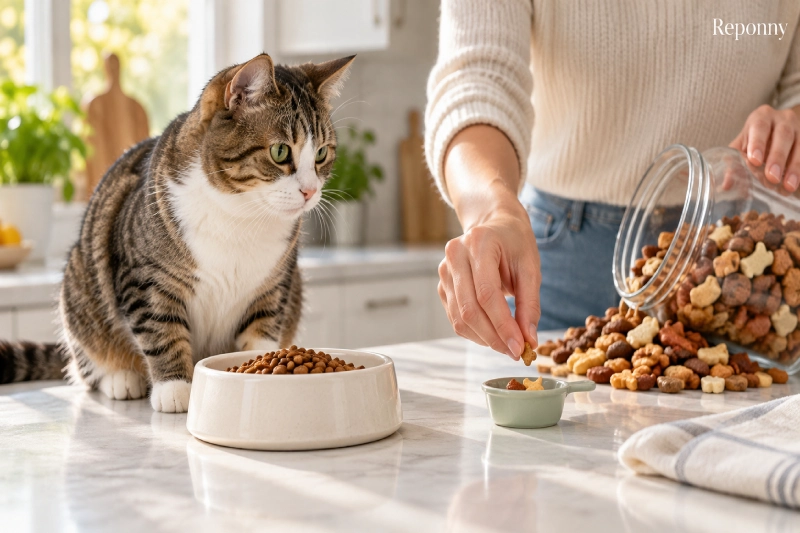
Too many snacks may also make your cat less interested in meals.
VCA notes that excessive treats can interfere with appetite for regular complete food.
This can create a cycle:
Cat receives treats → cat is less hungry → cat refuses dinner → owner worries → owner offers more treats → cat waits for treats instead of eating dinner.
Some cats learn this pattern quickly.
If your cat seems increasingly picky, count all food consumed for several days.
You may discover that the cat receives more calories between meals than you realized.
Treats given by children, spouses, grandparents, or multiple family members still count toward the same daily allowance.
What Counts as a Treat?
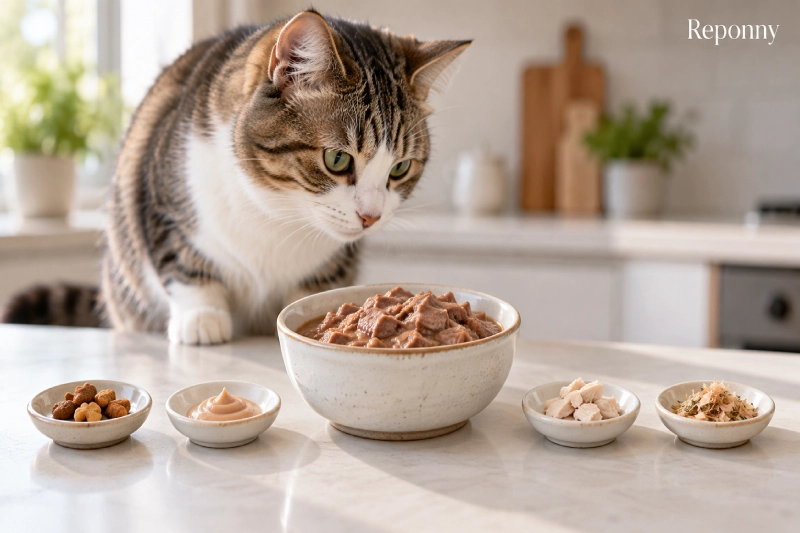
Owners often count crunchy commercial treats but forget several other sources of calories.
Your cat’s treat budget should include:
- commercial crunchy treats,
- soft treats,
- freeze-dried treats,
- lickable treats,
- food toppers,
- plain chicken,
- fish,
- egg,
- cheese or dairy,
- table scraps,
- pill pockets,
- foods used to hide medication,
- and training rewards.
Even small amounts add up over an entire day.
If you add chicken to breakfast and a lickable topper to dinner, those calories belong in the same overall treat allowance as the crunchy treats you use for training.
A Simple Daily Treat Budget
One of the easiest ways to prevent accidental overfeeding is to prepare the day’s treats in advance.
Suppose your cat may have up to 20 treat calories.
In the morning, place no more than that day’s allowance in a small container.
Everyone in the household uses treats from that container.
When it is empty, the day’s treat allowance is finished.
VCA recommends measuring out the day’s treats as a simple strategy to avoid over-treating.
This method is particularly useful in multi-person households.
Without a system, one cat might receive:
three treats from you, four from your partner, two from a child, and another handful from a visitor.
Nobody thinks they gave very much.
The cat thinks everyone is wonderful.
The calorie total tells a different story.

You Can Use Regular Cat Food as a Treat
A treat does not have to come from a treat package.
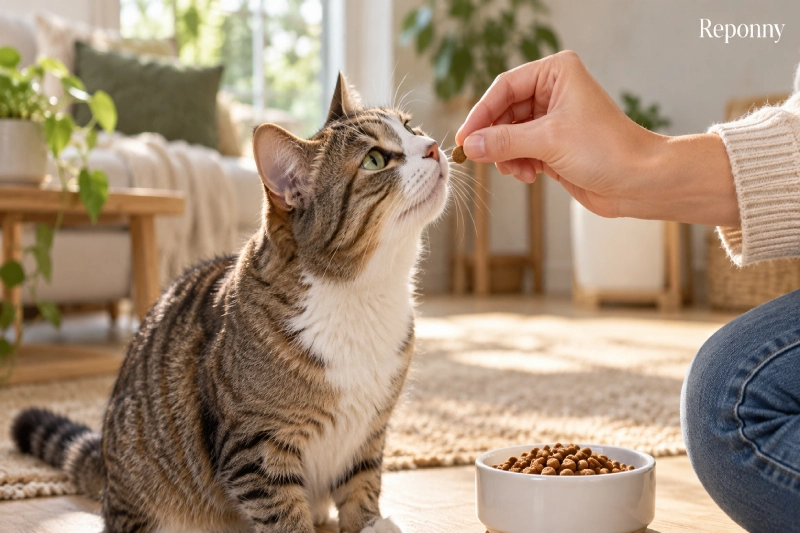
One of the easiest ways to reward your cat without adding extra calories is to reserve part of the cat’s normal daily ration.
For a cat eating dry food, you can set aside several pieces of kibble from breakfast and use them for:
- training,
- puzzle toys,
- rewards after grooming,
- carrier training,
- or bonding sessions.
Those pieces are already part of the daily diet.
You are simply changing how they are delivered.
This can be especially useful for cats on calorie-controlled diets.
It also avoids displacing complete nutrition with large amounts of incomplete snacks.
What Are Healthy Treats for Cats?
There is no single perfect treat for every cat.
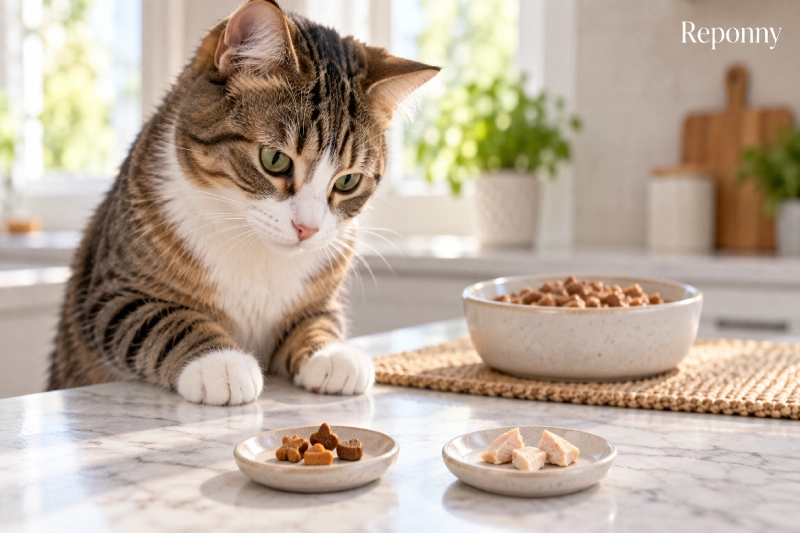
For most healthy cats, a practical treat should be:
- safe,
- palatable,
- small,
- easy to portion,
- and reasonably low in calories.
Commercial cat treats can be perfectly acceptable when used appropriately.
A tiny amount of certain plain cooked foods can also work.
Examples may include:
plain cooked chicken, turkey, egg, or boneless cooked fish in very small quantities.
However, human foods are not complete diets and should remain within the treat allowance.
VCA recommends choosing lower-calorie treats and accounting for all extra calories.
The healthiest treat is often not the product with the longest ingredient list or the most impressive marketing claim.
It is the treat you can give in a tiny, controlled portion without disrupting the main diet.
Foods You Should Not Use as Cat Treats
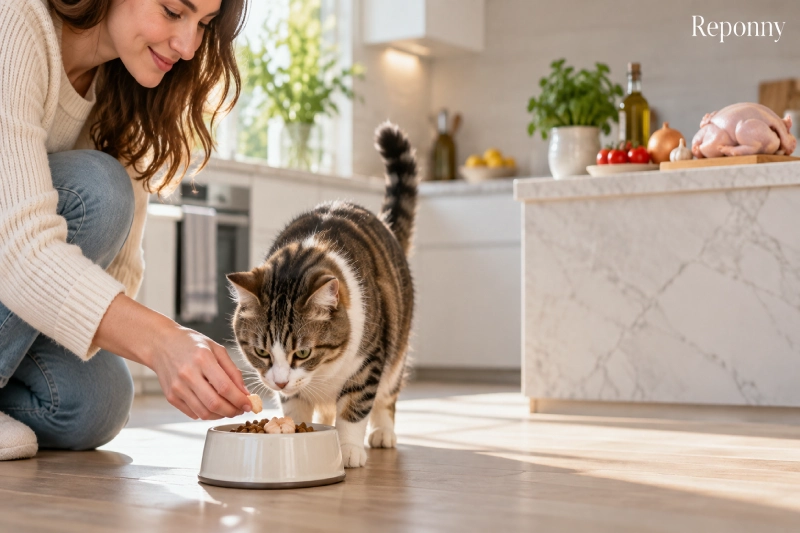
Some foods are inappropriate or potentially dangerous.
WSAVA’s feline treat guidance advises avoiding several categories, including:
- onion, garlic, shallots, leeks, and chives,
- chocolate,
- alcohol,
- caffeinated drinks,
- raw yeast dough,
- xylitol-containing products,
- raw animal-based treats,
- and bones.
Milk and dairy can also cause digestive problems because many adult cats have limited ability to digest lactose.
Avoid Bones
Raw and cooked bones can cause injury, obstruction, or other complications. WSAVA specifically advises against bones as treats for cats.
Be Careful With Raw and Freeze-Dried Raw Treats
“Freeze-dried” does not automatically mean sterile.
Raw animal products can carry pathogens. If you prefer animal-protein treats, fully cooked products are generally the more conservative food-safety choice.
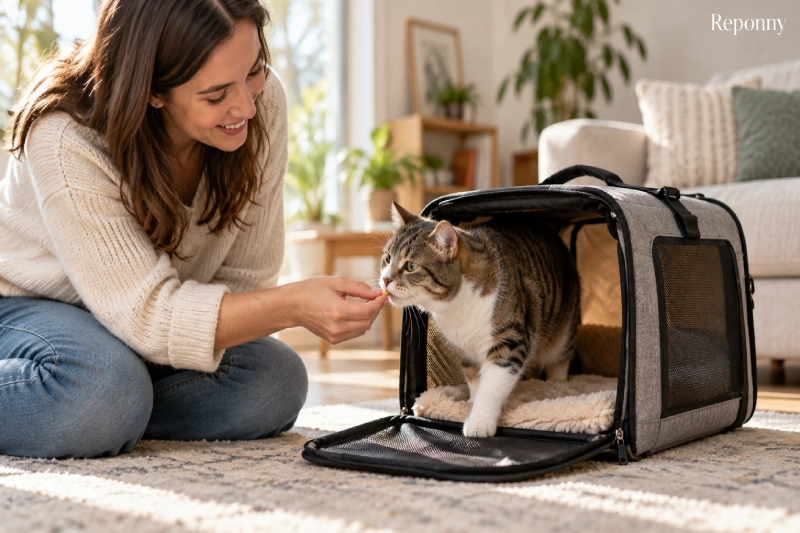
Treats for Training a Cat
Treats can be extremely useful training tools.
Cats can learn:
- to enter a carrier,
- come when called,
- tolerate nail trimming,
- use a scratching post,
- accept grooming,
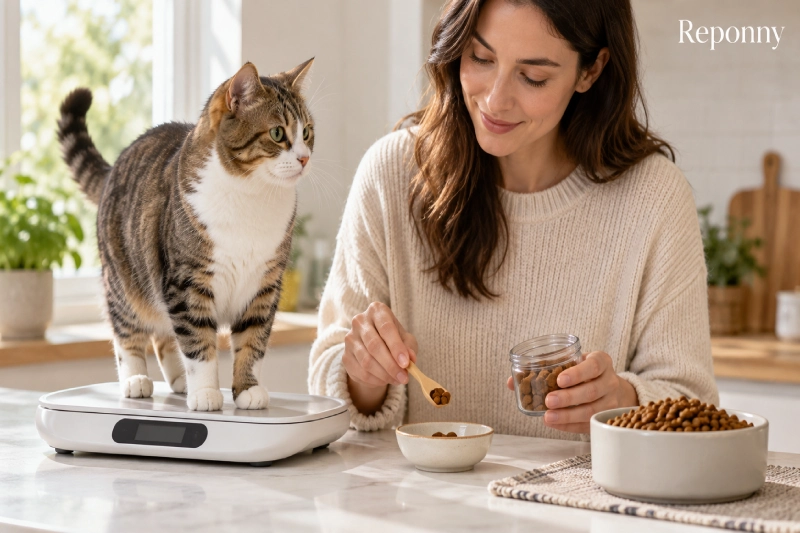
- step onto a scale,
- or perform simple cues.
The trick is to use very small rewards.
A cat does not need a full treat after every successful behavior.
If the treat can safely be broken into several smaller pieces, one piece may provide multiple rewards.
VCA recommends using food rewards strategically while staying within the overall 10% calorie allowance.
For repeated training sessions, using part of the normal meal can be even easier.
A hungry-but-not-starved cat may happily work for ordinary kibble if that kibble is delivered interactively.
Treats for Overweight Cats
An overweight cat can still enjoy rewards.
But food rewards may need to become smaller or less frequent.
AAHA recommends limiting treats as part of feline weight management and notes that an 8-pound cat in ideal body condition may have only around 20 treat calories per day.
For an overweight cat, the veterinarian may recommend an even more carefully controlled calorie plan.
Helpful strategies include:
- reserving part of the normal food ration for treats,
- breaking treats into smaller pieces,
- choosing lower-calorie options,
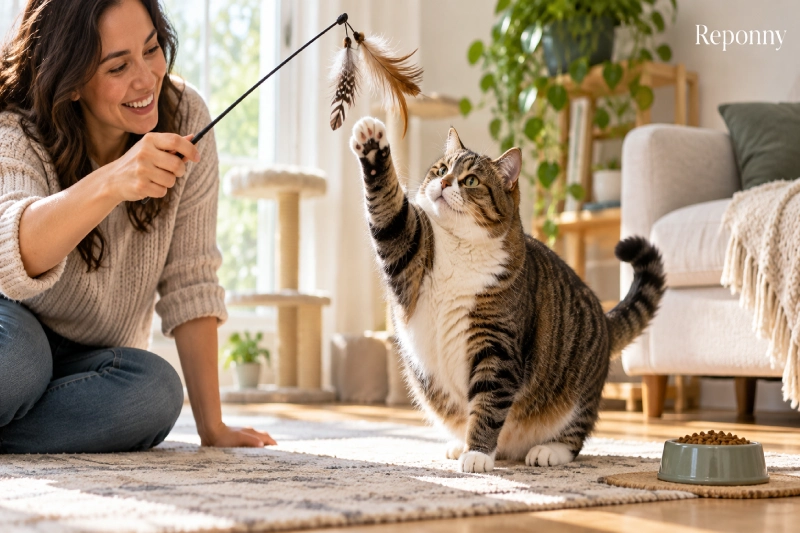
- replacing some food rewards with play,
- using brushing or affection when the cat enjoys it,
- and using food puzzles rather than providing extra food.
The 2026 AAHA feline diabetes guidance also suggests replacing food treats with playtime for cats at risk of diabetes, helping increase activity while reducing unnecessary calories.
Treats for Kittens
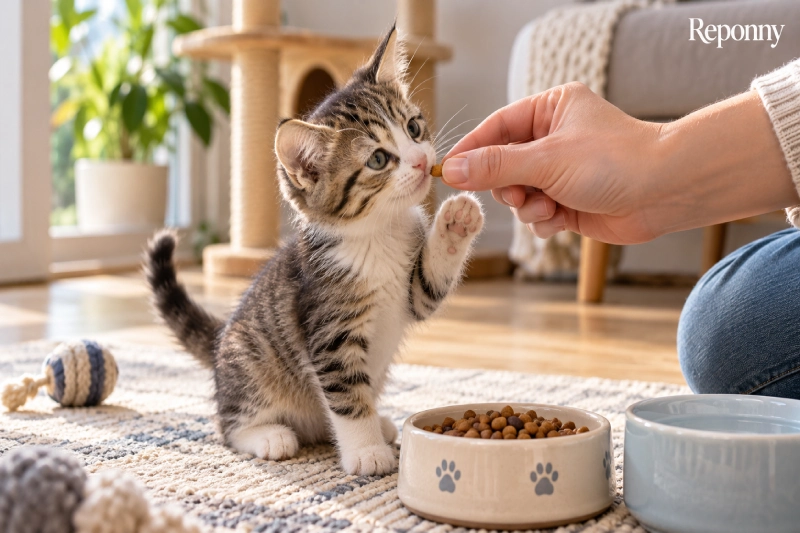
Kittens have high nutritional demands because they are growing rapidly.
That makes their complete and balanced growth diet particularly important.
VCA recommends keeping treats within the same general limit of about 10% of total calories, allowing the overwhelming majority of nutrition to come from properly formulated kitten food.
Treats can still be useful for:
- socialization,
- carrier training,
- handling,
- nail-trimming practice,
- and positive veterinary experiences.
Keep the pieces tiny.
A kitten is much smaller than an adult cat, so even a standard cat treat can represent a relatively large calorie load.
You can also use pieces of the kitten’s normal kibble as rewards.
Treats for Senior Cats
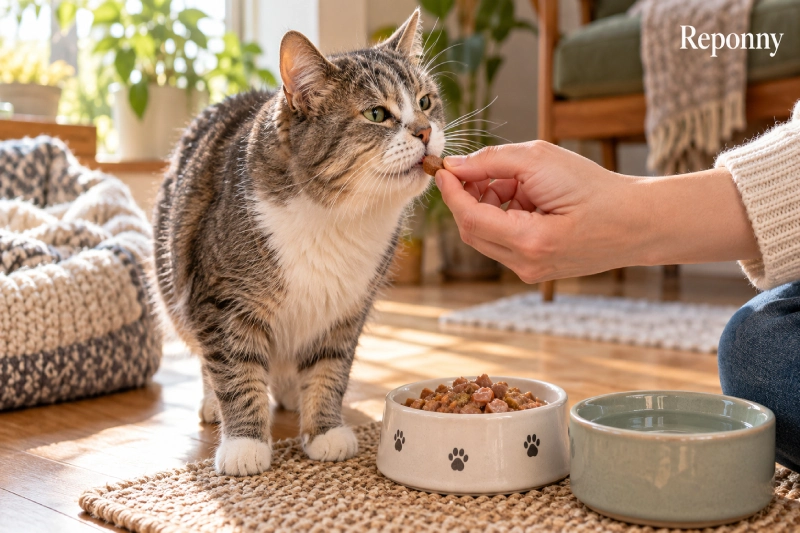
Healthy senior cats can still enjoy treats, but older cats are more likely to have conditions that affect what foods are appropriate.
Examples include:
- kidney disease,
- diabetes,
- dental disease,
- gastrointestinal disorders,
- food sensitivities,
- or obesity.
A senior cat with dental pain may struggle with a hard crunchy treat.
A cat with chronic kidney disease may need carefully controlled nutrient intake.
A diabetic cat may have a diet designed to support glucose control.
Therefore, treat selection becomes more individualized with age and disease.
Do not assume a treat marketed as “senior” is automatically appropriate for your individual cat.
Treats and Prescription Diets
This deserves special attention.
If your cat is eating a veterinary therapeutic diet, ordinary treats can sometimes interfere with the reason that diet was prescribed.
VCA gives examples including food allergies and prescription urinary diets, where inappropriate treats may undermine dietary management.
This matters for cats with conditions such as:
- food allergies,
- urinary disease,
- kidney disease,
- diabetes,
- gastrointestinal disease,
- obesity,
- or other conditions requiring therapeutic nutrition.
During a food-allergy elimination trial, even one small treat containing the suspected protein can interfere with the test.
For some therapeutic diets, your veterinarian may recommend compatible treats or suggest using pieces of the prescription food itself as rewards.

What About Dental Treats?
Some treats are specifically designed to support oral health.
The Veterinary Oral Health Council, or VOHC, evaluates dental products and awards its Seal of Acceptance to products that demonstrate effectiveness against plaque and/or tartar according to its standards.
Its current cat list includes several edible dental treats with accepted plaque or tartar claims.
If you want a treat specifically for dental benefit, looking for the VOHC Seal of Acceptance is more meaningful than relying only on words such as:
“dental,” “fresh breath,” or “oral care.”
However, dental treats still contain calories.
They still belong in the daily treat budget.
And they do not eliminate the need for veterinary dental examinations or other appropriate home dental care.
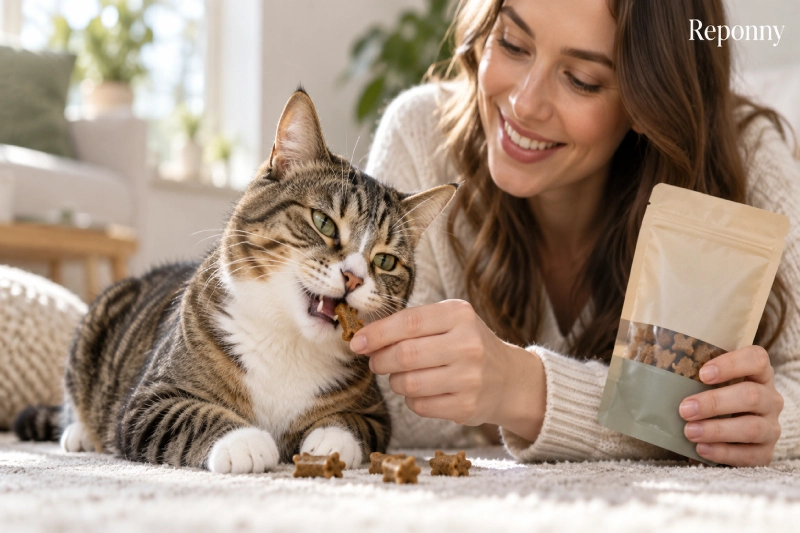
Can You Give Treats Every Day?
Yes, many healthy cats can have a small amount of treats every day.
The issue is not necessarily frequency.
It is total calories and nutritional balance.
Five calories of treats every day may fit comfortably into one cat’s diet.
Fifty calories every day may be excessive.
WSAVA’s recommendation is based on the proportion of total daily energy, not on a requirement to provide treats only once or twice per week.
Some cats do not need food treats every day at all.
Affection, play, brushing, access to a favorite window, or interactive toys can function as rewards too.
Don’t Forget Lickable Treats and Toppers
Lickable treats can be useful.
They may help with:
- training,
- medication,
- grooming,
- nail trimming,
- veterinary handling,
- or bonding.
But they are still food.
The same applies to toppers sprinkled over meals.
VCA emphasizes that both toppers and treats should remain within approximately 10% of daily calories to avoid unbalancing the total diet.
Check the package.
A pouch may look small but can still contain a meaningful portion of a cat’s daily treat allowance.
If you use only half today, refrigerate or store the remainder according to the manufacturer’s directions rather than feeling obligated to feed the entire package.
How to Know If You Are Giving Too Many Treats
Possible warning signs include:
- gradual weight gain,
- reduced appetite at regular meals,
- increasingly selective eating,
- regularly exceeding the recommended feeding plan,
- multiple family members giving treats independently,
- or treats becoming a large portion of the diet.
Body-condition monitoring is especially useful.
WSAVA identifies approximately 4–5 on a 9-point Body Condition Score scale as ideal for most adult cats.
If your cat is gradually becoming heavier, do not look only at the measured meals.
Count:
treats + toppers + table food + food used with medication + everything else that contains calories.
Sometimes the meals are perfectly measured and the extras are the real issue.
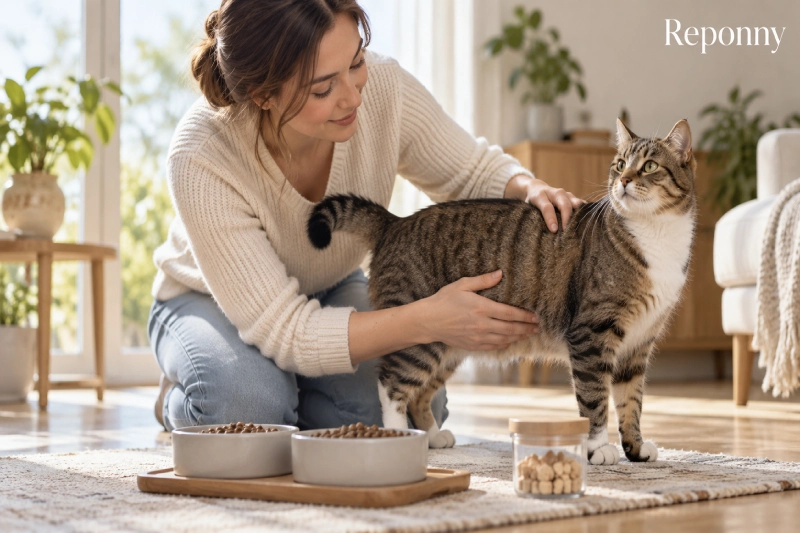
A Practical Cat Treat Checklist
Before offering a treat, ask:
| Question | Why It Matters |
|---|---|
| How many calories does it contain? | Determines how it fits the daily allowance |
| Is it safe for cats? | Some human foods and bones are dangerous |
| Is my cat’s main diet complete and balanced? | Treats should not replace proper nutrition |
| Is my cat overweight? | Calorie allowance may need tighter control |
| Does my cat have a medical condition? | Some treats can interfere with treatment |
| Is my cat on a prescription diet? | The treat may not be compatible |
| Can I make the treat smaller? | Tiny rewards often work just as well |
| Could I use regular cat food instead? | Avoids adding extra calories |
| Could play or affection work instead? | Not every reward needs to be food |
Frequently Asked Questions
How Many Treats Can I Give My Cat a Day?
There is no universal number because treats differ in calorie content.
Keep all treat calories combined to no more than approximately 10% of your cat’s daily energy intake.
Is 10 Treats a Day Too Many for a Cat?
It depends on the treats.
If each contains one calorie, ten treats equal 10 calories.
If each contains four calories, ten treats equal 40 calories—which may be excessive for an average cat.
Check calories per treat.
How Many Calories From Treats Can a 10-Pound Cat Have?
A cat weighing about 10 pounds is close to 4.5 kg.
WSAVA’s guide estimates roughly 24 calories per day from treats for an average healthy 4.5-kg adult cat in ideal body condition.
Individual calorie needs vary, so this is a starting estimate rather than a prescription.
Can Cats Have Treats Every Day?
Yes, many healthy cats can have small treats daily as long as the total remains within the calorie budget and the main diet stays nutritionally complete.
Are Cat Treats Healthy?
Some can fit perfectly well into a healthy diet.
Most treats are not intended to be complete and balanced, however, so quantity matters more than marketing claims such as “natural” or “premium.”
Can I Give My Cat Chicken as a Treat?
A tiny amount of plain, fully cooked, boneless chicken can be an occasional treat for many healthy cats.
Do not season it with onion, garlic, sauces, or excessive salt, and include its calories in the daily treat allowance.
Are Lickable Cat Treats Okay?
They can be, provided they are safe for your cat and their calories are included in the daily treat allowance.
Do not assume an entire pouch must be fed at once.
Are Freeze-Dried Treats Healthy?
They can be calorie-efficient and simple in ingredients, but products made from raw animal ingredients may still carry food-safety considerations.
Check the product preparation method and calorie information.
Can Overweight Cats Have Treats?
Yes, but treat calories should be carefully controlled.
Using part of the normal daily food ration or substituting play and enrichment for some food rewards may be particularly useful.
Can Cats on Prescription Food Have Treats?
Ask your veterinarian first.
Some therapeutic diets can be undermined by ordinary treats, especially diets used for food allergies, urinary conditions, and other medical problems
Are Dental Treats Good for Cats?
Some dental treats have demonstrated benefits.
Look for products carrying the VOHC Seal of Acceptance for feline plaque and/or tartar claims.
Remember to count their calories.
Final Thoughts
Treats can absolutely be part of a healthy cat’s life.
The important question is not whether your cat receives treats.
It is how much of the diet those treats represent.
For most healthy cats, a simple rule works well:
90% or more of daily calories from complete and balanced cat food.
10% or less from all treats, toppers, snacks, and human foods combined.
For a cat eating around 200 calories per day, that means a treat budget of approximately 20 calories.
And remember: 20 calories may be only a few pieces of a calorie-dense treat.
Check the label.
Measure portions.
Make sure every family member follows the same daily allowance.
When possible, break treats into tiny pieces or use part of your cat’s regular food for training.
If your cat is overweight, some rewards can be replaced with play, attention, grooming, or environmental enrichment.
And if your cat has diabetes, kidney disease, urinary problems, food allergies, obesity, or another condition—or is eating a veterinary therapeutic diet—ask your veterinarian before adding treats.
The goal is not to eliminate enjoyment.
It is to keep treats where they belong:
as a small bonus on top of a nutritionally complete diet—not a second diet of their own.