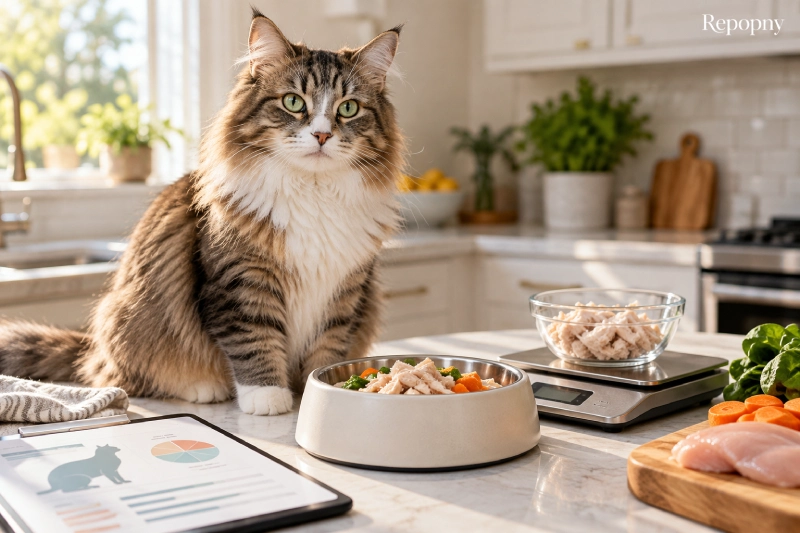
Preparing food for your cat at home can sound appealing. You control the ingredients, know exactly what goes into the bowl, and can avoid foods your cat dislikes.
But homemade cat food is much more complicated than cooking chicken, adding rice, and serving dinner.
Cats are obligate carnivores with highly specific nutritional requirements. They need appropriate amounts and ratios of protein, essential amino acids such as taurine and arginine, fats, fatty acids, vitamins, minerals, and water. A meal can look fresh and wholesome while still being seriously deficient in one or more essential nutrients.
Cornell Feline Health Center describes home-prepared cat food as difficult and time-consuming to formulate correctly and generally recommends nutritionally balanced commercial foods unless a veterinarian recommends a home-formulated diet for a specific reason.
That does not mean homemade cat food is always inappropriate. A carefully formulated home-prepared diet can be useful in some situations—but it should be designed for the individual cat, ideally with the help of a veterinary nutrition specialist.
Quick answer: Homemade cat food can be nutritionally appropriate when it is formulated specifically for a cat by a qualified veterinary nutrition professional and prepared exactly as directed. Random internet recipes, meat-only diets, improvised supplements, and raw diets can create nutritional deficiencies or food-safety risks.
Why Homemade Cat Food Is Harder Than It Looks
A cat does not simply need “meat.”
A complete feline diet must provide many nutrients in precise proportions.
For example, cats require dietary taurine, preformed vitamin A, arachidonic acid, and comparatively high levels of several amino acids and vitamins. Merck notes that cats also have higher requirements for nutrients including arginine, niacin, and vitamin B6 than dogs.
This is where homemade feeding often goes wrong.
An owner may prepare chicken breast, beef, fish, or another high-protein ingredient and assume that because the cat is a carnivore, the diet must be complete.
It is not.
Muscle meat alone is particularly poor at providing the proper calcium-to-phosphorus balance. Merck notes that predominantly meat-based diets can cause calcium deficiency and secondary nutritional problems.
A nutritionally complete diet therefore requires formulation—not just ingredient selection.
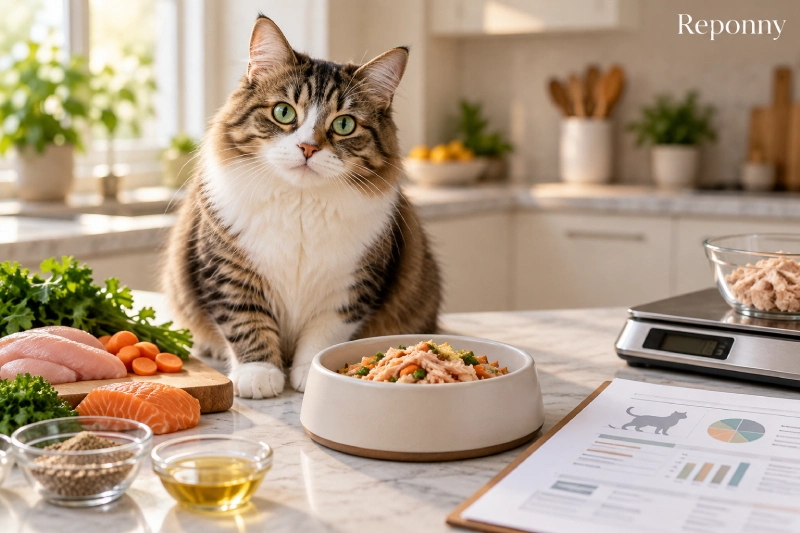
What Research Says About Homemade Cat Food Recipes
One of the clearest warnings about homemade recipes comes from research conducted at the University of California, Davis.
Researchers evaluated 114 homemade cat food recipes collected from books and online sources. Ninety-four contained enough information to undergo nutritional analysis.
None of those 94 recipes provided all of the essential nutrients needed to meet the National Research Council’s recommended allowances for healthy adult cats. Some diets were deficient in multiple nutrients, and certain recipes supplied less than half of recommended amounts for nutrients such as choline, iron, zinc, thiamine, vitamin E, and manganese.
Some recipes also included potentially dangerous ingredients such as garlic, onion, or leek.
This does not prove that every possible homemade cat diet is deficient.
It demonstrates something more useful:
A recipe being published online—or even appearing professionally written—does not guarantee that it is nutritionally complete.
Merck similarly states that nutritional diseases are most commonly seen when cats and dogs are fed unbalanced homemade diets, whereas a home-prepared diet formulated by a board-certified veterinary nutritionist can be nutritionally appropriate.

Homemade Does Not Automatically Mean Healthier
“Homemade” can sound healthier because we associate home cooking with fresh ingredients and fewer processed foods.
But human nutritional intuition does not translate perfectly to cats.
A bowl containing fresh chicken, liver, vegetables, and fish may look impressive and still be nutritionally unbalanced.
A commercial food formulated to meet recognized feline nutritional standards may look less exciting while providing a far more appropriate balance of essential nutrients.
Cornell explains that commercially prepared cat foods are developed to provide appropriate nutrient and calorie balance. The center generally recommends complete commercial diets unless a home-prepared formula has been recommended for a medical or individual reason.
The question should therefore not be:
“Does this meal look natural?”
It should be:
“Does this entire diet consistently meet my cat’s nutritional requirements?”
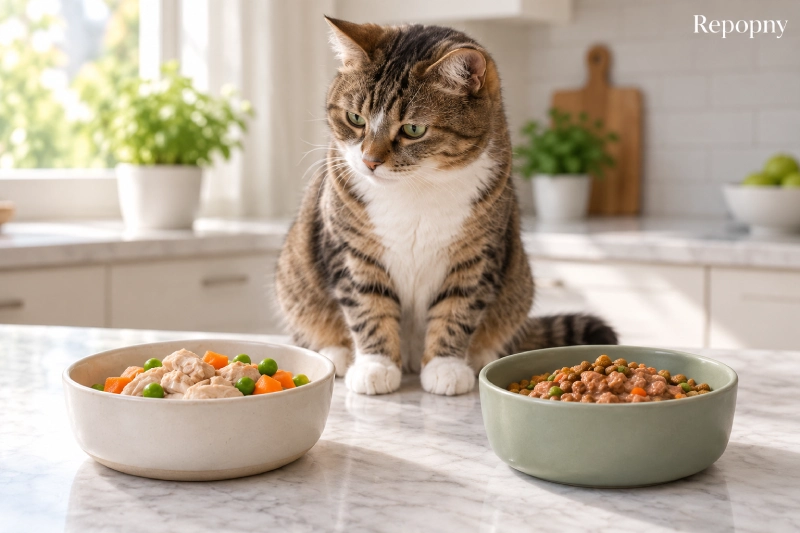
The Nutrients Homemade Cat Diets Commonly Get Wrong
Several areas deserve particular attention.
| Nutritional Area | Why It Matters |
|---|---|
| Taurine | Essential for normal heart, vision and other body functions |
| Calcium & phosphorus | Correct balance is important for bones and many physiological processes |
| Essential fatty acids | Cats require specific fatty acids, including arachidonic acid |
| Vitamins | Both deficiencies and excessive amounts can cause harm |
| Trace minerals | Zinc, copper, manganese, iodine and others must be appropriately balanced |
| Amino acids | Cats have specific requirements including taurine and arginine |
| Calories | Portions must maintain healthy body weight and muscle condition |
One important misconception is that adding a general multivitamin will automatically fix a meat-based recipe.
It may not.
A supplement must match the recipe precisely. Adding too little can leave deficiencies; adding too much can create excesses.
Cornell specifically cautions that more vitamins and minerals are not necessarily better and that supplementation can be harmful when added unnecessarily.
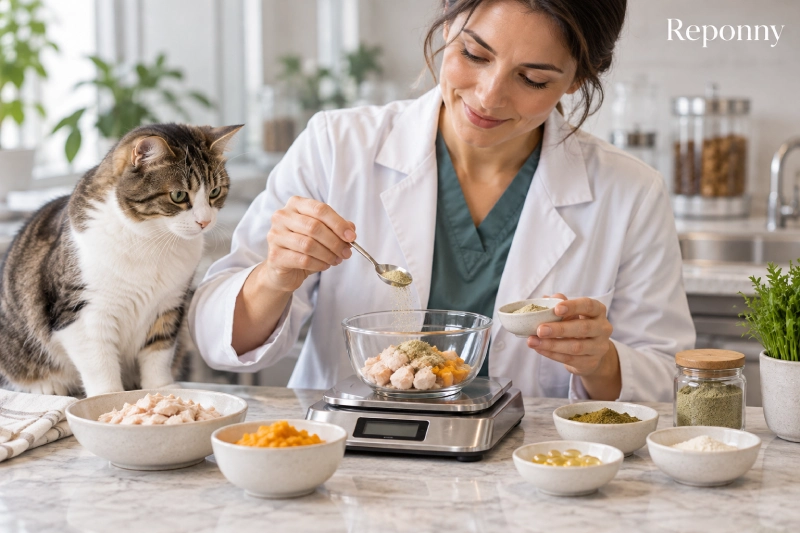
Taurine Is Essential—but Taurine Alone Does Not Make a Diet Complete
Taurine receives a great deal of attention in homemade cat food discussions, and for good reason.
Cats require dietary taurine. Inadequate taurine over time can contribute to serious health problems.
But adding taurine powder to chicken does not transform chicken into a complete feline diet.
Cats still require appropriate:
protein and amino-acid balance, fatty acids, vitamins, calcium, phosphorus, trace minerals, and other nutrients.
This is why homemade feeding should be viewed as a complete formulation problem rather than a single-supplement problem.
Merck notes that cats have several distinctive dietary requirements beyond taurine, including dietary vitamin A and arachidonic acid and increased requirements for certain other nutrients.
Why Feeding Meat Alone Is Risky
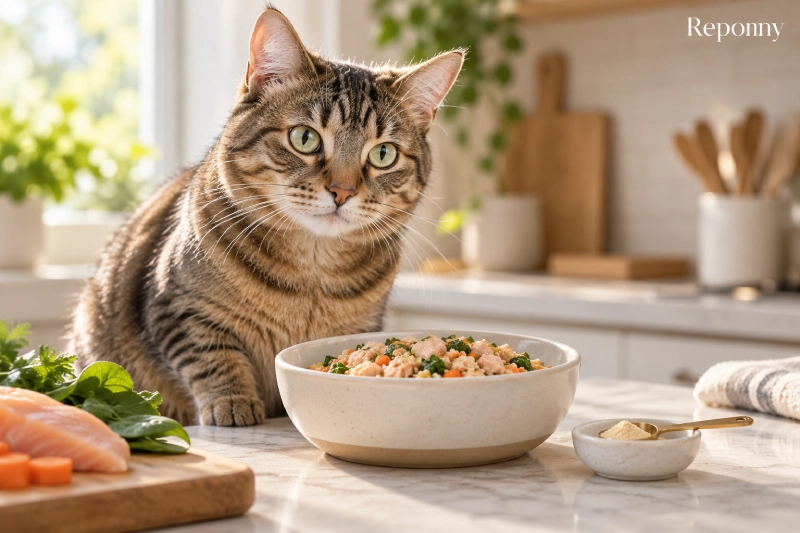
Meat is nutritionally valuable for cats, but muscle meat alone does not recreate a whole prey diet or a scientifically formulated cat food.
One major problem is mineral balance.
Meat is generally rich in phosphorus but relatively low in calcium.
Merck reports that predominantly meat-based diets can produce calcium deficiency and that homemade feline diets frequently fail to achieve an appropriate calcium-to-phosphorus balance.
This risk may be particularly serious for growing kittens because skeletal development requires appropriate mineral nutrition.
Feeding liver as a major part of the diet creates a different problem. Liver can provide high levels of vitamin A, and excessive liver consumption may produce vitamin A toxicity.
The lesson is not that meat or liver is “bad.”
The lesson is that ingredient proportions matter.
Should Homemade Cat Food Be Raw or Cooked?
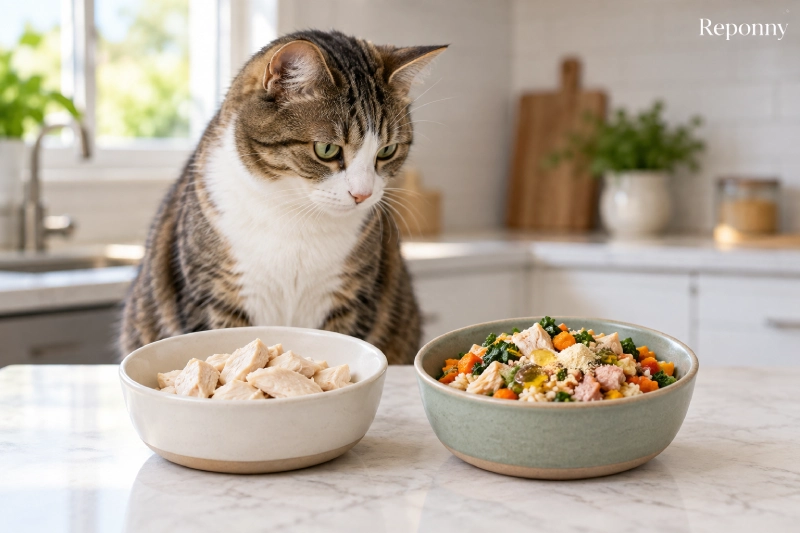
Cooking is generally the safer option from a food-safety perspective.
Raw meat can carry bacteria, parasites, and other pathogens capable of affecting cats and people in the household.
Cornell states that scientific evidence has not established clear health benefits from raw or “gently cooked” diets sufficient to outweigh their infectious-disease concerns, and the Feline Health Center does not recommend raw diets.
Merck likewise advises against feeding cats raw meat and raw dairy products because of health risks.
Raw diets also introduce another issue: nutrient availability.
Merck notes that some raw ingredients contain compounds such as thiaminases in certain raw fish, avidin in raw egg white, and other antinutritional factors that can interfere with nutrient availability. Cooking can destroy some of these compounds, although cooking can also change the concentration or availability of other nutrients.
This reinforces why simply converting an internet raw recipe into a cooked recipe—or vice versa—can alter its nutritional profile

Food Safety Matters Even With Cooked Homemade Food
Home cooking gives you control over preparation, but it also makes you responsible for food handling.
Prepared food should be handled much like perishable human food.
Ingredients should be stored correctly, equipment kept clean, portions refrigerated or frozen appropriately, and food left at room temperature only for a reasonable period.
Cross-contamination matters too.
A cutting board used for raw poultry should not immediately be used for cooked food without appropriate cleaning.
Cats with chronic illness, young kittens, elderly animals, and people in the household with weakened immune systems can make food-safety precautions even more important.
A homemade feeding plan should therefore cover both nutritional formulation and kitchen hygiene.

Do You Need Supplements in Homemade Cat Food?
A professionally formulated homemade diet often requires specific supplements.
That is normal.
A cat cannot reliably obtain all required nutrients simply because a recipe contains several whole foods.
But supplementation must be precise.
If a veterinary nutrition specialist specifies a particular calcium source, vitamin-mineral supplement, taurine quantity, oil, or other ingredient, substitutions can change the nutritional profile of the entire recipe.
This is one of the most important differences between ordinary human cooking and therapeutic feline nutrition.
In normal cooking, replacing turkey with chicken may make little practical difference.
In a carefully formulated cat diet, replacing ingredients, supplements, weights, or cooking methods may change calories or nutrient concentrations enough that the finished recipe no longer matches the formulation.
Cornell’s veterinary nutrition service specifically develops individualized home-prepared formulations for patients when needed.

When Can a Homemade Diet Make Sense?
Commercial complete and balanced food is appropriate for many cats.
However, home-prepared diets can sometimes be useful.
Cornell’s veterinary nutrition service notes that customized home diets may be designed to support wellness or help manage chronic disease when commercially available products do not meet an individual patient’s needs.
For example, a veterinarian might consider a carefully formulated home diet when a cat has unusually complex dietary restrictions, certain food sensitivities, or a medical condition requiring a combination of nutrients not readily available in commercial foods.
The important distinction is:
Homemade because it has been medically or nutritionally formulated
versus
homemade because a recipe looked healthy online.
The first can be a legitimate nutritional strategy.
The second carries much more uncertainty.
How to Make Homemade Cat Food More Safely
If you are committed to home-prepared feeding, the safest approach begins before you start cooking.
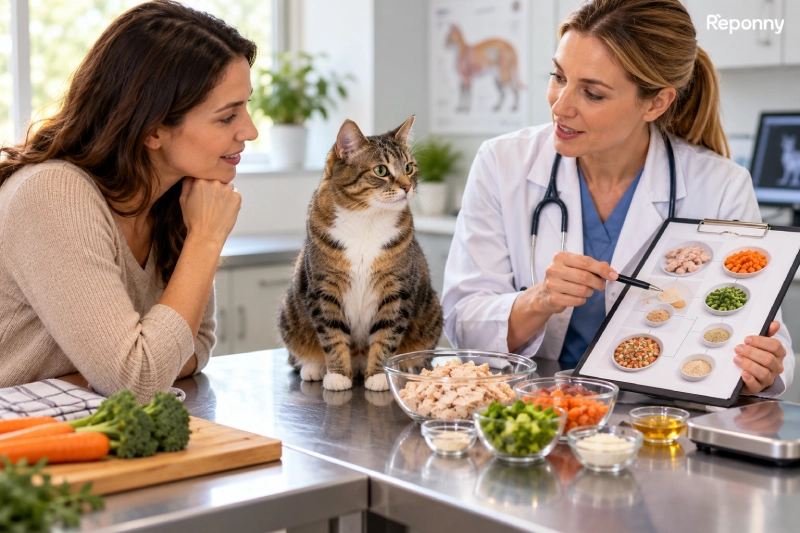
Use a recipe created for your individual cat by a properly qualified veterinary nutrition professional. Follow the specified ingredients, gram weights, cooking methods, supplements, and portion sizes exactly. Do not casually remove ingredients, substitute supplements, or change preparation methods without asking the professional who formulated the diet.
After the diet begins, monitor your cat’s body weight, appetite, stool, activity, coat condition, and general health. Schedule veterinary follow-up as recommended, particularly if the diet was created for a medical condition.
A homemade diet should be treated more like a nutritional prescription than an ordinary recipe.
Merck recommends a recipe formulated by a board-certified veterinary nutritionist rather than relying on internet recipes or books.
Common Homemade Cat Food Mistakes
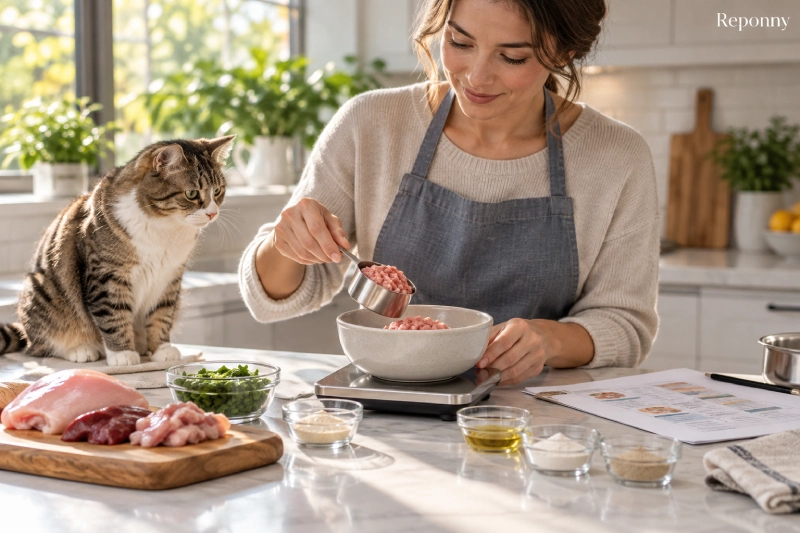
The biggest mistakes are usually not dramatic.
They are small changes repeated every day.
| Common Mistake | Why It Can Be a Problem |
|---|---|
| Feeding mostly muscle meat | Can create mineral and nutrient imbalance |
| Guessing supplement amounts | Risks deficiency or excess |
| Replacing ingredients freely | Changes calories and nutrient composition |
| Feeding raw meat routinely | Adds pathogen and food-safety risk |
| Using online recipes without analysis | Nutritional completeness is uncertain |
| Leaving out calcium source | Can seriously distort calcium-phosphorus balance |
| Feeding large amounts of liver | Can produce excessive vitamin A |
| Assuming vegetables make a meal balanced | Cats still require specific feline nutrients |
| Using a dog recipe for a cat | Cats have distinct nutrient requirements |
| Ignoring calories | Homemade food can still cause obesity or weight loss |
One of the most dangerous assumptions is that “variety balances everything out.”
It may not.
Feeding chicken today, fish tomorrow, and beef the next day does not guarantee an average balance of calcium, taurine, vitamins, minerals, or calories over time.
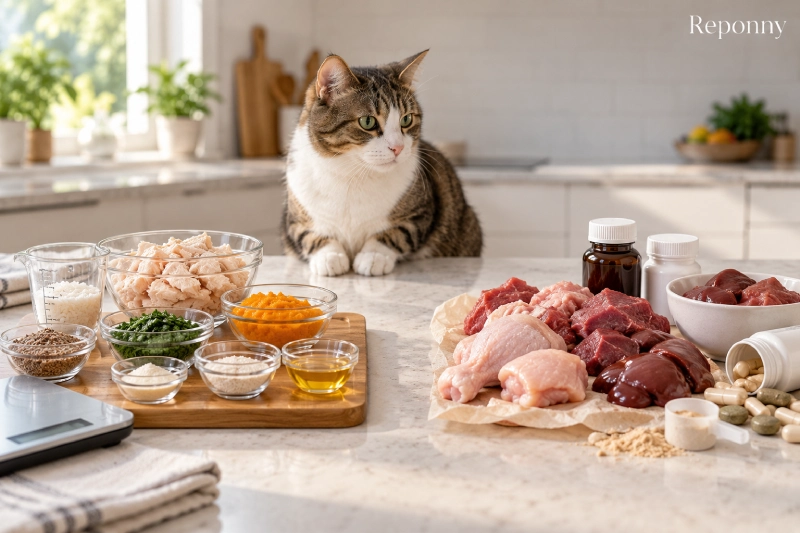
What About Homemade Food as an Occasional Topper?
This is different from feeding homemade food as the entire diet.
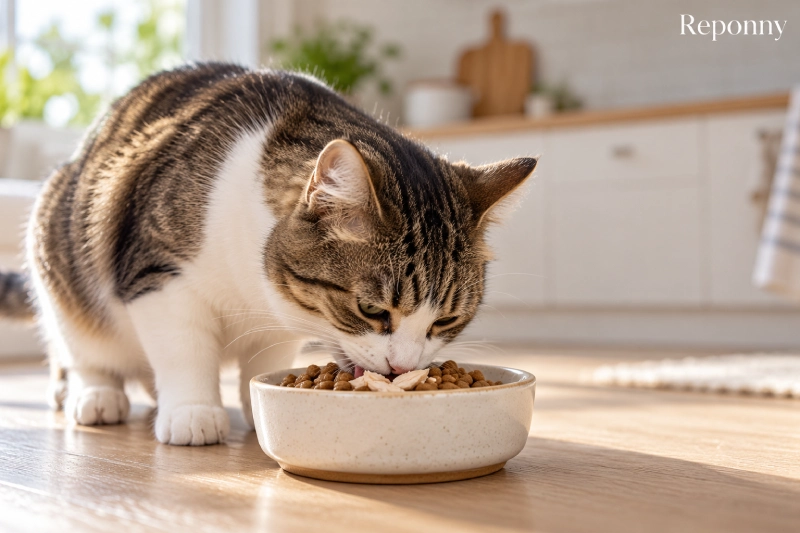
A tiny amount of plain cooked chicken, turkey, or another cat-safe food can sometimes be used as a treat or topper for a healthy cat.
The key is quantity.
Cornell recommends that treats remain a relatively small part of daily intake—generally no more than about 10–15% of total daily calories—because treats are not normally complete and balanced.
If extras become a significant portion of the diet, they can dilute the nutrient balance provided by the complete food.
For example, repeatedly topping every meal with large amounts of plain chicken can gradually turn an otherwise balanced feeding plan into one in which too much of the cat’s calories come from nutritionally incomplete food.
Think of homemade extras as extras, not as a second diet.
Should Kittens Eat Homemade Food?
Extra caution is warranted with kittens.
Growth places demanding nutritional requirements on the diet.
Errors involving calcium, phosphorus, calories, protein, vitamins, or other nutrients can have more significant consequences during development than they might in a healthy adult.
Merck specifically notes that nutritional imbalances involving calcium, phosphorus, and vitamin D can result in skeletal disorders, and homemade diets for cats often fail to achieve appropriate mineral balance.
Therefore, a homemade kitten diet should not be improvised.
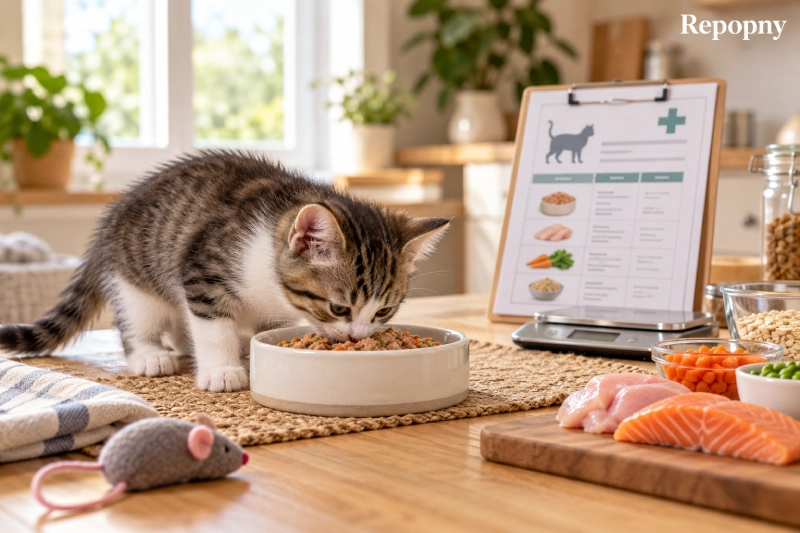
If you want to feed home-prepared food to a growing kitten, use a formulation specifically designed for feline growth, not an adult-cat recipe and certainly not a general meat-based meal.
Homemade Diets for Cats With Medical Conditions
A homemade diet should not be used to self-treat disease.
Cats with kidney disease, urinary disorders, diabetes, gastrointestinal disease, food allergies, pancreatitis, heart disease, obesity, or other chronic conditions may need very specific nutritional modifications.
Changing protein, phosphorus, sodium, fat, fiber, or calories without understanding the medical context may interfere with treatment.
This is where professionally formulated home-prepared diets can sometimes be useful.
Cornell’s nutrition specialists design customized home diet plans to support pets with chronic disease when appropriate.
The key is that medical diets should be built around the diagnosis and the individual patient, not a general article or social-media recipe.

Frequently Asked Questions
Is Homemade Cat Food Better Than Commercial Cat Food?
Not inherently.
A well-formulated homemade diet can be appropriate, but an unbalanced homemade diet may be nutritionally worse than a complete commercial diet. Cornell generally recommends nutritionally balanced commercial foods unless a home-prepared diet has been professionally formulated for a specific reason.
Can I Feed My Cat Chicken and Rice Every Day?
Chicken and rice alone do not constitute a complete feline diet.
Long-term feeding of a limited ingredient combination can leave important nutrient gaps, particularly minerals, vitamins, fatty acids, and essential amino acids. Merck specifically warns that diets based on a limited number of foods are often inadequate.
Can Cats Live on Meat Alone?
Not safely as a long-term feeding strategy.
Muscle meat alone does not provide an appropriate calcium-to-phosphorus ratio or all required vitamins, minerals, and other feline nutrients.
Do I Need to Add Taurine to Homemade Cat Food?
A professionally formulated homemade recipe may include taurine supplementation, but the correct amount depends on the entire recipe and preparation method.
Do not assume taurine alone makes the diet nutritionally complete.
Is Raw Homemade Cat Food Healthier?
There is no established evidence showing that raw diets provide a clear health advantage sufficient to outweigh their infectious-disease and food-safety risks. Cornell does not recommend raw or gently cooked raw-style diets for cats because of possible bacteria, viruses, and parasites.
Can I Use Recipes From YouTube, Facebook or Blogs?
A recipe should not be assumed complete simply because it looks professional.
UC Davis found widespread nutrient deficiencies among homemade feline recipes from books and online sources.
Can Homemade Food Be Used as a Treat?
A small amount of plain, cat-safe cooked food can be used as an occasional treat for many healthy cats. Keep extras limited so they do not displace too much of the complete and balanced diet.
Final Thoughts
Homemade cat food is not inherently good or bad.
The real issue is formulation.
Cats have nutritional requirements that are easy to underestimate. A meal based on fresh meat may provide plenty of protein while still being deficient in calcium, taurine, trace minerals, vitamins, fatty acids, or other essential nutrients.
Research has shown that many published homemade feline recipes fail to provide complete nutrition.
That is why the safest long-term options are usually either a reputable complete and balanced commercial cat food or a homemade diet specifically formulated for your individual cat by a qualified veterinary nutrition professional.
If you choose home cooking, precision matters.
Follow the recipe exactly.
Measure ingredients accurately.
Use the specified supplements.
Practice good food hygiene.
Do not casually substitute ingredients.
And have your cat’s weight and health monitored over time.
Cooking for your cat can be an act of care—but the healthiest homemade meal is not necessarily the one that looks freshest.
It is the one that reliably provides everything your cat needs, in the right amounts, every day.