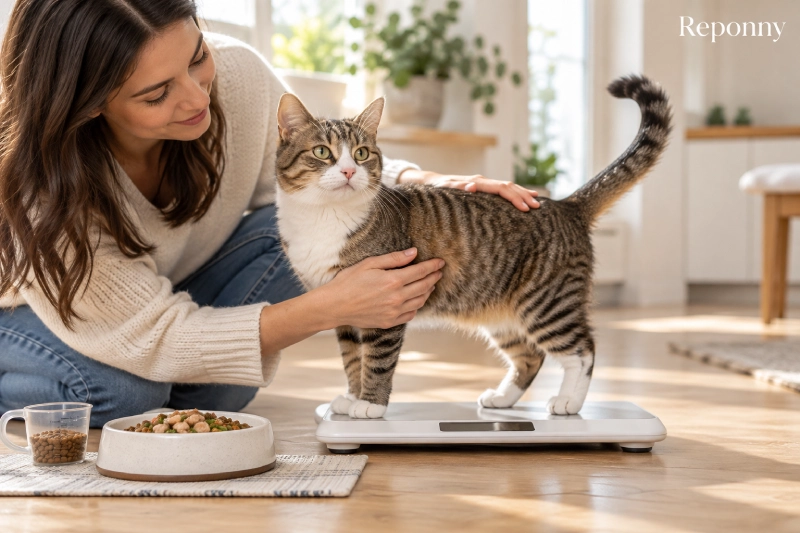
A healthy weight can affect almost every part of your cat’s life.
It influences how easily your cat jumps, plays, grooms, climbs stairs, uses the litter box, and maintains normal mobility as it ages. Excess body fat is also associated with health problems including diabetes and arthritis.
But determining a healthy cat weight is not as simple as looking for one “perfect” number on the scale.
A small-framed adult cat and a large-framed adult cat can both be healthy at very different weights. What matters more is whether your cat has an appropriate Body Condition Score, muscle condition, and stable weight for its individual body structure.
Cornell Feline Health Center uses a nine-point Body Condition Score system in which approximately 5/9 represents ideal condition. At ideal condition, the ribs should be easy to feel under a slight fat covering, there should be a visible waist behind the ribs, and the abdominal fat pad should remain relatively small.
Quick answer: There is no single ideal weight for every cat. Instead, aim for an appropriate body condition—usually around 5/9 BCS—and monitor weight regularly. If your cat needs to lose weight, do it gradually under veterinary guidance. Rapid food restriction can be dangerous and may contribute to hepatic lipidosis.
What Is a Healthy Weight for a Cat?
There is no universal number.
A cat’s healthy weight depends on factors such as:
- body frame,
- breed,
- sex,
- age,
- muscle mass,
- activity,
- and individual genetics.
That is why two cats weighing exactly 11 pounds may have completely different body conditions.
One may be muscular and lean.
The other may carry substantial excess body fat.
The number on the scale is therefore most useful when combined with Body Condition Score (BCS) and Muscle Condition Score (MCS).
AAHA recommends documenting body condition regularly because calorie needs vary with age, neuter status, activity, health, and body composition.
Instead of asking:
“Should my cat weigh 10 pounds?”
ask:
“At this weight, does my cat have an ideal body and muscle condition?”
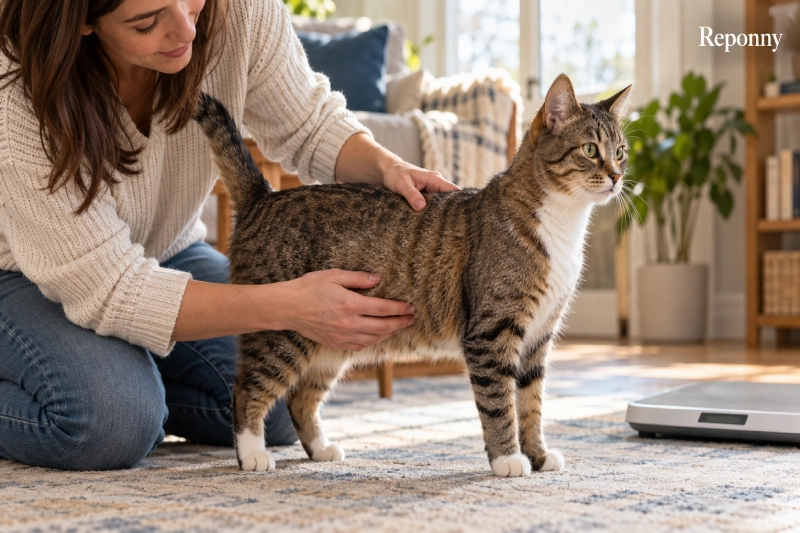
How to Check Your Cat’s Body Condition at Home
A nine-point BCS scale is commonly used.
Cornell describes 5/9 as ideal. AAHA considers 6/9 to 7/9 overweight and approximately 8/9 or higher obese.
You can perform three simple checks.
Rib Check
Run your hands gently along your cat’s rib cage.
At an ideal body condition, you should be able to feel the ribs relatively easily beneath a small amount of fat.
If you must press firmly through a thick layer before finding the ribs, your cat may be overweight.
If the ribs are extremely prominent with almost no tissue covering them, the cat may be underweight.
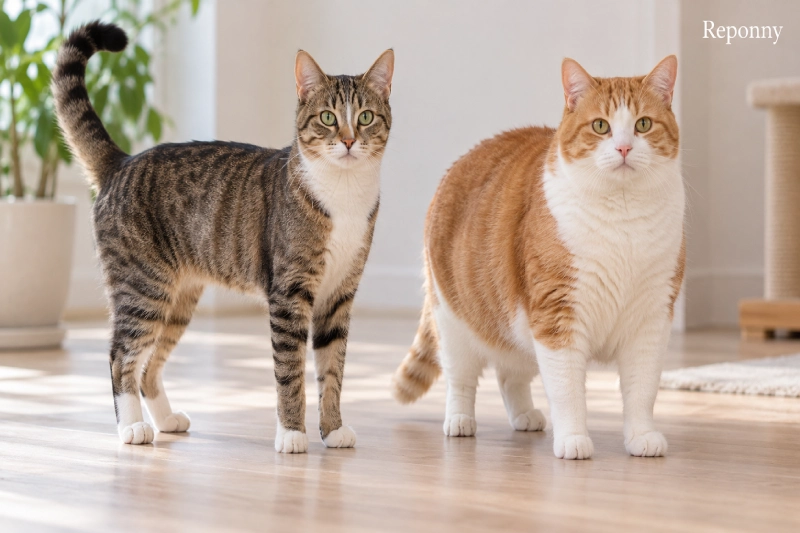
Overhead Check
Look down at your standing cat from above.
An ideal-weight cat should have a visible waist behind the ribs.
An overweight cat may appear oval or rounded with little visible waist.
Side Check
Look at your cat from the side.
A healthy cat generally has some abdominal tuck rather than a large, rounded abdomen.
Cornell also notes that cats with severe obesity may have heavy fat deposits over the lower back, face, and limbs and a large abdominal fat pad.
Do Not Confuse the Primordial Pouch With Obesity
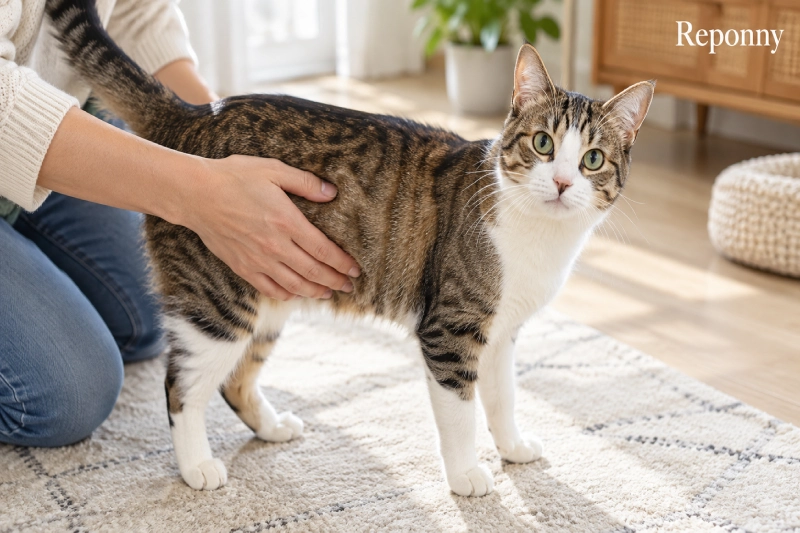
Many cats have loose skin and fatty tissue hanging along the lower abdomen.
This is commonly called the primordial pouch.
Its presence alone does not mean your cat is overweight.
A lean cat can have a noticeable abdominal pouch while still having:
- easily palpable ribs,
- a visible waist,
- and an ideal BCS.
Judge the entire body rather than focusing only on the belly.
If you are uncertain, your veterinarian can assess BCS and show you exactly where excess fat is accumulating.
Body Weight and Muscle Condition Are Not the Same Thing
Body weight alone can hide important changes.
A senior cat, for example, may lose muscle while gaining fat and remain almost exactly the same weight on the scale.
That is why veterinarians also evaluate Muscle Condition Score.
Muscle loss may be most noticeable around:
- the spine,
- shoulders,
- hips,
- skull,
- and thighs.
Monitoring both body fat and muscle becomes particularly important in senior cats and cats with chronic disease.
AAHA recommends using both body-condition and muscle-condition scoring when evaluating nutrition and weight.
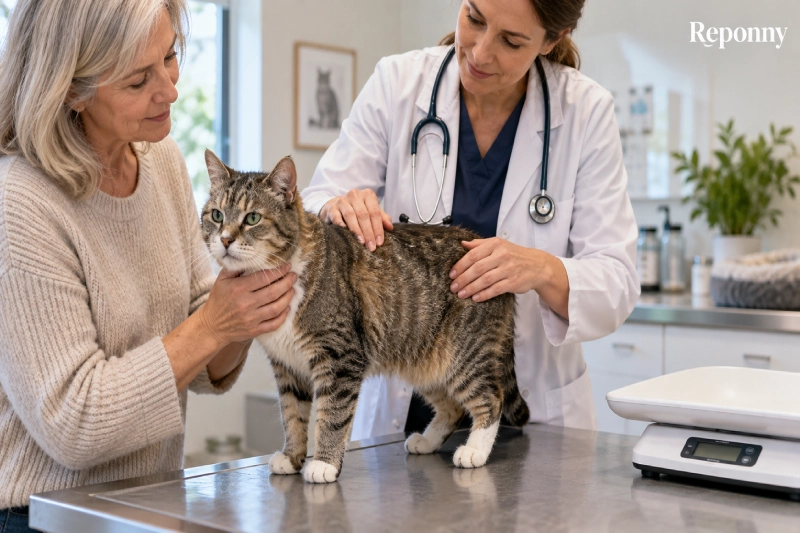
Why Excess Weight Matters
Extra body fat is not merely a cosmetic issue.
Cornell describes obesity as the most common nutrition-related problem in cats and notes associations with conditions including arthritis and diabetes.
AAHA likewise identifies excess body weight as a risk factor for several chronic problems, including diabetes and mobility-related disease.
An overweight cat may also:
- exercise less,
- have difficulty grooming,
- struggle to jump,
- become less tolerant of heat,
- and lose physical flexibility.
Unfortunately, weight gain often occurs gradually.
When you see your cat every day, a small monthly increase can be difficult to notice.
That is why periodic weighing and body-condition checks are so useful.
Why Do Indoor Cats Gain Weight?
Weight gain ultimately occurs when calorie intake exceeds energy expenditure over time.
Several factors can contribute.
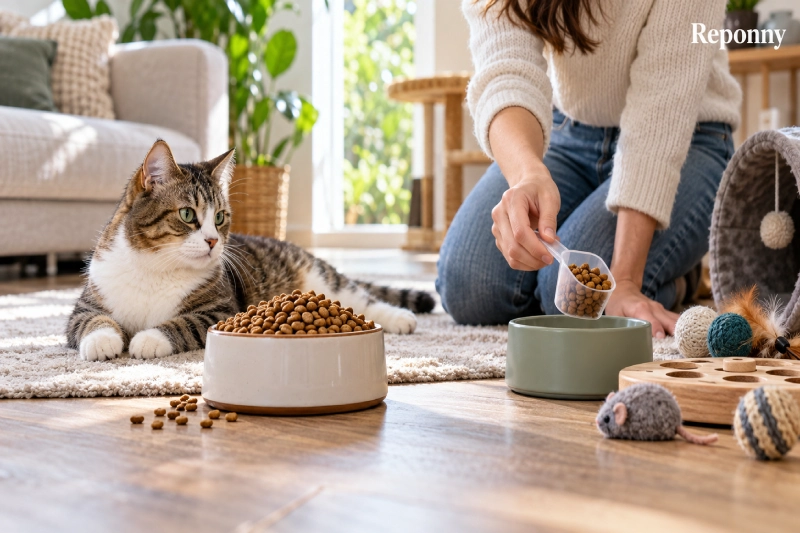
Free Feeding
A constantly full bowl makes it difficult to know how much a cat consumes.
Cornell identifies unrestricted free feeding as an important contributor to excessive calorie intake in some cats.
Too-Large Portions
Even a small amount of extra kibble can provide meaningful calories because dry cat food is often energy-dense.
Too Many Treats
Treats, chicken, toppers, lickable snacks, pill pockets, and table foods all contribute calories.
Low Activity
Indoor cats may have fewer opportunities to climb, hunt, explore, and chase.
Neutering
AAHA identifies neutering as a risk factor for feline weight gain and emphasizes adjusting calorie intake as needed.
Age
Activity and calorie needs change through life.
The amount that kept a young cat lean may become excessive several years later.
How Many Calories Does Your Cat Need?
Calorie calculations can provide a useful starting point, but they are not exact prescriptions.
One commonly used equation estimates Resting Energy Requirement (RER):
RER = 70 × body weight in kg^0.75
Veterinary guidelines then apply factors based on life stage, neuter status, activity, and weight goal.
AAHA lists approximate maintenance factors such as:
- 1.2–1.4 × RER for many neutered adult cats,
- 1.0 × RER for obesity-prone or inactive cats,
- with different factors used for growth, reproduction, and weight management.
Merck likewise emphasizes that energy calculations are only starting estimates and must be adjusted according to the individual cat’s response.
That last point matters most.
If a mathematical formula suggests 240 calories but your cat steadily gains excess fat at that intake, 240 calories is not the correct maintenance intake for that individual cat.
Monitor the cat, not just the calculator.
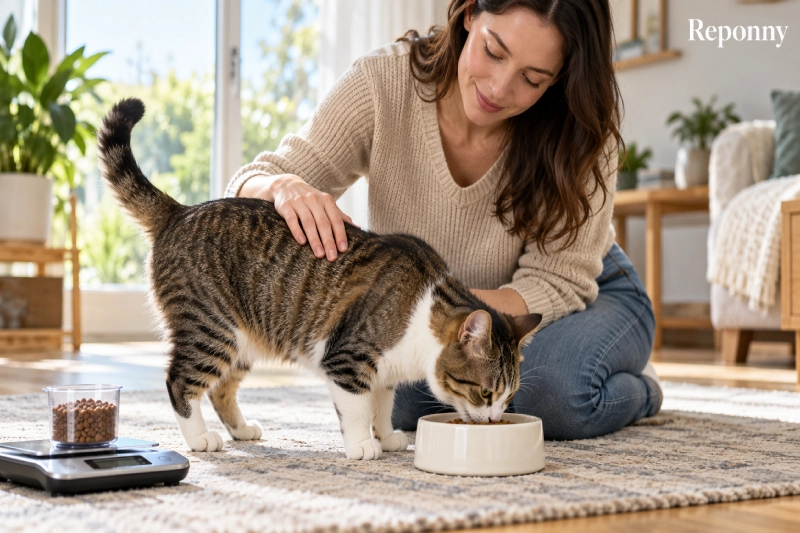
Measure Food Instead of Guessing
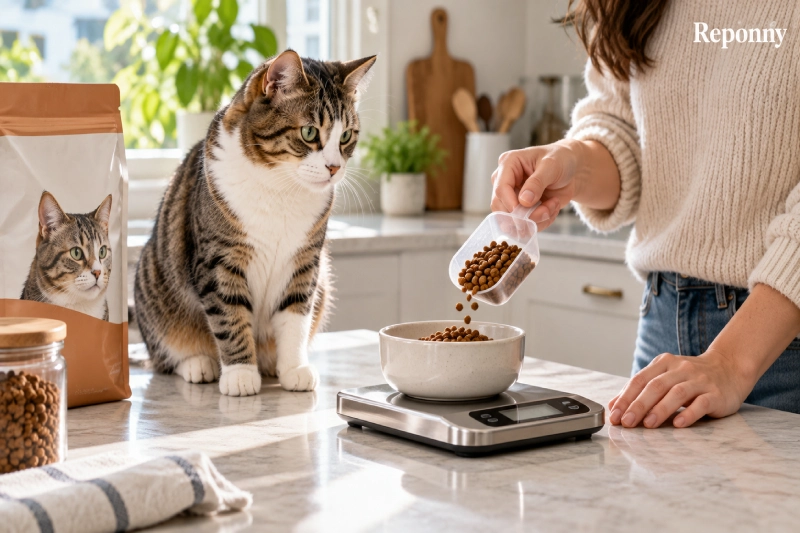
Eyeballing portions is surprisingly inaccurate.
If possible, use a digital kitchen scale and measure food in grams.
This is especially useful with dry food.
One person’s “half cup” can look very different from another person’s half cup.
You should also check the package for:
kcal per cup, can, pouch, or kilogram.
Suppose a dry food contains 450 calories per cup.
An extra quarter-cup provides more than 110 additional calories—potentially a huge surplus for a cat.
Measuring accurately can be one of the simplest changes you make.
Scheduled Meals Can Make Weight Management Easier
Free feeding is not automatically wrong for every cat.
Some cats regulate intake well.
But if your cat is gaining too much weight, measured scheduled meals usually provide much better control.
Merck recommends dividing the daily calorie allowance among multiple meals during weight management.
Instead of:
constantly refilling the bowl
try:
measured breakfast + measured afternoon meal + measured dinner.
An automatic feeder can help if you are away during the day.
Remember:
More meals do not mean more food.
Divide the same daily calorie allowance into smaller portions.
Treat Calories Count Too
Your cat’s daily calorie intake includes much more than the main meals.
Count:
- crunchy treats,
- lickable treats,
- chicken,
- tuna,
- toppers,
- table food,
- pill pockets,
- and food used during training.
Merck recommends keeping treats below approximately 10% of total calorie intake so they do not disrupt nutritional balance.
For weight loss, the veterinarian may recommend an even tighter allowance.
An easy strategy is to reserve some of your cat’s normal kibble ration and use it as training rewards.
That way, the reward does not add extra calories.
Can You Simply Feed Less of the Current Food?
Sometimes only a modest portion adjustment is needed to prevent gradual weight gain.
But substantial weight loss is different.
AAHA warns that severely restricting an ordinary maintenance food can also reduce vitamins, minerals, and other nutrients because the food was formulated to provide adequate nutrition at normal maintenance intake. Therapeutic weight-loss diets are specifically designed to provide essential nutrients while calories are restricted.
This is why a veterinarian may recommend a dedicated weight-management food for an obese cat.
Such diets may use:
- higher protein,
- modified fiber,
- lower calorie density,
- and other nutritional adjustments
to help preserve lean tissue while allowing calorie restriction.
The solution should not be:
“Feed almost nothing.”
It should be:
“Provide fewer calories while still supplying complete nutrition.”
Protein Matters During Weight Loss
When a cat loses weight, the goal is to lose fat, not large amounts of muscle.
Merck notes that adequate dietary protein is particularly important in weight-loss diets and that many veterinary weight-management formulations contain increased protein.
This supports lean body mass while calories are reduced.
That is another reason why simply reducing a normal diet by an extreme amount may be inferior to using an appropriately formulated calorie-restricted diet.
Muscle preservation matters for:
- mobility,
- metabolic health,
- strength,
- and healthy aging.
How Fast Should a Cat Lose Weight?
Cat weight loss should be gradual.
Veterinary recommendations generally aim for approximately 0.5–2% of body weight per week, depending on the individual cat, with around 1% per week often used as a practical goal.
AAHA warns against rapid weight loss and cites approximately 1–2% per week as an upper safe target in many weight-loss programs. Merck describes roughly 1% per week as a reasonable goal.
For example, a 15-pound cat losing about 1% per week would lose roughly:
0.15 lb per week, or about 2.4 ounces.
That may seem slow.
Slow is intentional.
Feline weight management is measured in months, not days.
Never Crash-Diet an Overweight Cat
This is one of the most important rules in feline weight management.
Do not suddenly stop feeding or severely restrict calories because you want rapid results.
Overweight cats are particularly vulnerable to hepatic lipidosis, also called fatty liver disease, when food intake becomes inadequate.
Cornell specifically warns that sudden starvation can place an overweight cat at risk and recommends gradual weight reduction under veterinary guidance.
Merck likewise states that starvation is never a safe or humane feline weight-loss method and emphasizes that cats must continue consuming adequate calories and nutrients.
If your dieting cat refuses the new food, contact your veterinarian.
Do not assume hunger will eventually force the cat to eat.

Exercise Helps—But Diet Still Matters
Cats do not need to run five miles.
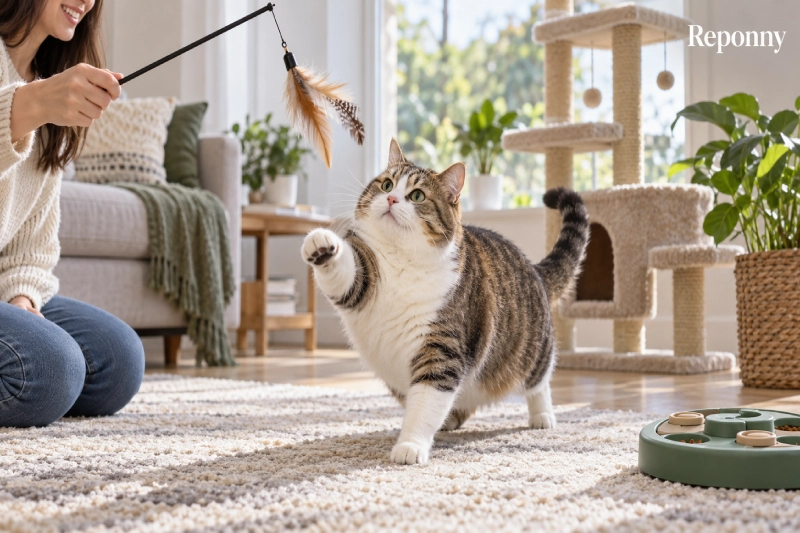
Short, frequent periods of activity can make a meaningful difference.
Try:
- wand toys,
- feather toys,
- lightweight balls,
- climbing towers,
- food puzzles,
- hide-and-seek games,
- tossing pieces of the measured food ration,
- or encouraging movement between safe elevated spaces.
AAHA recommends regular activity and interactive toys as part of feline weight management.
Start gradually if your cat is obese or has been inactive.
An overweight cat may have arthritis or poor exercise tolerance.
Several short play sessions can be better than one intense session.
And remember:
Exercise cannot reliably compensate for unlimited calories.
Activity and portion control work together.
Use Puzzle Feeders to Slow Eating
Puzzle feeders can help in two ways.
They can make food last longer and encourage movement or problem-solving.
Instead of placing all dry food in one bowl, put part of the measured daily ration into:
- a rolling feeder,
- puzzle board,
- treat ball,
- or hidden feeding station.
The key phrase is:
measured daily ration.
Food from the puzzle should replace some bowl food—not become extra calories.
This can also provide useful enrichment for indoor cats.
Multi-Cat Households Need Individual Feeding Plans
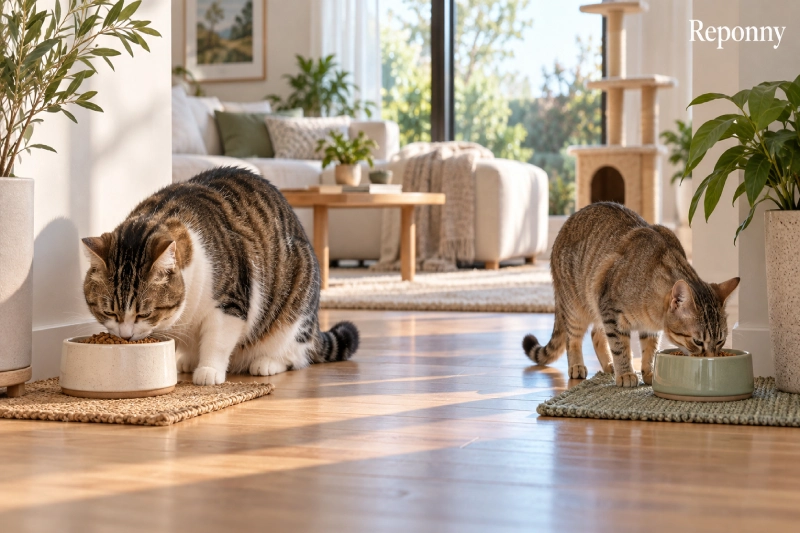
Weight management becomes harder when several cats share food.
One overweight cat may eat:
its own breakfast, half of another cat’s breakfast, and whatever remains in the bowls throughout the day.
Meanwhile, the smaller cat may not eat enough.
Solutions include:
- feeding cats in separate rooms,
- supervising meals,
- removing bowls after feeding,
- using microchip-activated feeders,
- and tracking each cat’s weight individually.
Do not put every cat in the household on the same calorie restriction simply because one cat needs to lose weight.
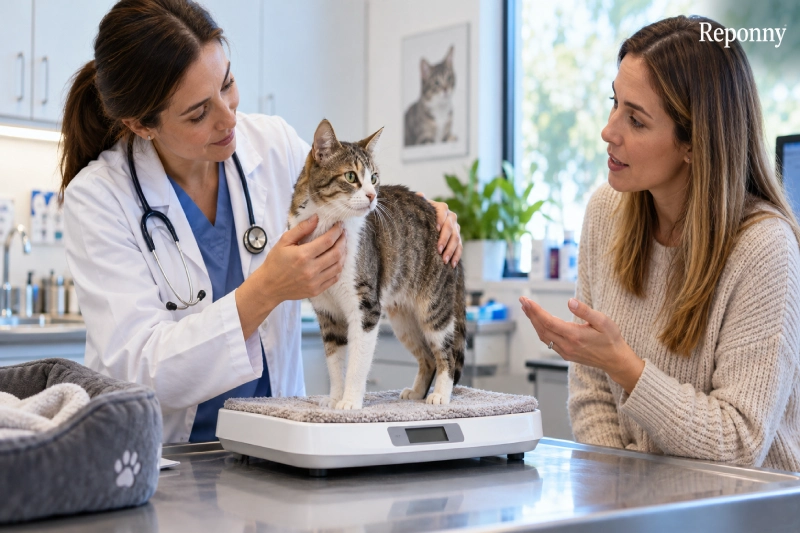
How Often Should You Weigh Your Cat?
For general prevention, monthly weighing can make gradual changes easier to spot.
During an active weight-loss program, more frequent monitoring is useful.
Merck recommends checking weight approximately every two weeks during weight reduction and adjusting the plan according to the response.
AAHA similarly recommends regular tracking rather than waiting months between assessments.
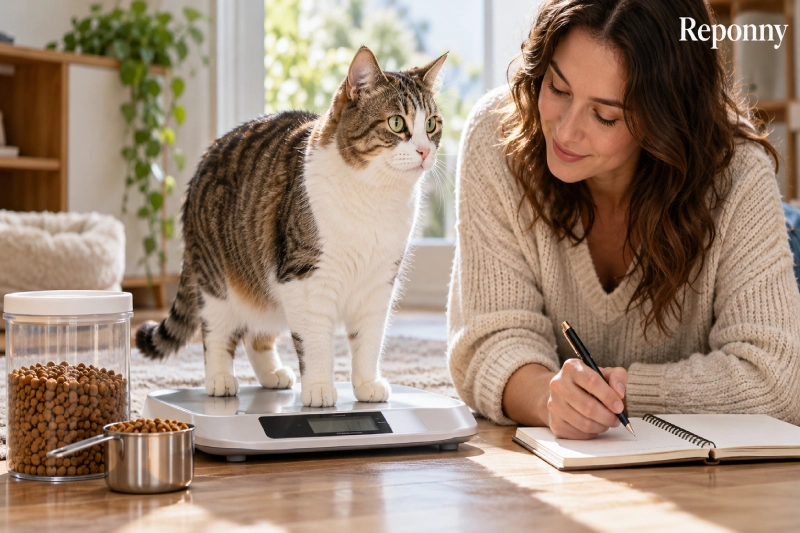
Use the same scale whenever possible.
Record:
- date,
- weight,
- food amount,
- treat allowance,
- and any notable health changes.
A simple spreadsheet or phone note is enough.
Trends matter more than tiny day-to-day fluctuations.
Maintaining a Healthy Weight After Weight Loss
Reaching target weight is not the end of the process.
The long-term goal is weight maintenance.
Merck distinguishes between the short-term goal of reaching ideal body condition and the long-term goal of maintaining it.
After successful weight loss, your veterinarian may gradually adjust calories upward until the cat’s weight stabilizes.
Continue:
- measured feeding,
- regular weighing,
- treat control,
- daily activity,
- and periodic BCS assessment.
Returning immediately to the old feeding routine is likely to recreate the same problem.
The habits that helped your cat reach a healthy weight should become the new normal.
What If Your Cat Is Underweight?
Healthy weight management is not only about obesity.
Unexpected weight loss matters too.
A cat may become underweight because of:
- insufficient calorie intake,
- dental disease,
- kidney disease,
- hyperthyroidism,
- diabetes,
- gastrointestinal disease,
- cancer,
- or another health problem.
Do not simply pour more food into the bowl without considering why weight is being lost.
Cornell advises veterinary examination when a cat refuses food and loses weight.
Senior cats deserve particular attention because muscle loss can accompany chronic disease even when appetite still seems reasonable.
The correct solution depends on the cause.
Frequently Asked Questions
What Is the Ideal Weight for a Cat?
There is no single ideal weight for every cat.
Body frame, breed, sex, muscle mass, and individual structure vary. Body Condition Score is usually more useful than aiming for a universal number.
Cornell considers approximately 5/9 BCS ideal.
How Can I Tell if My Cat Is Overweight?
Check whether:
- the ribs are difficult to feel,
- the waist has disappeared,
- the body looks rounded from above,
- and substantial abdominal or body fat is present.
AAHA generally classifies 6–7/9 BCS as overweight and 8–9/9 as obese.
Is My Cat Fat or Just Fluffy?
Long hair can hide body shape.
Use your hands rather than relying only on appearance.
Feel the ribs, spine, waist, and hips gently.
Your veterinarian can provide a more objective BCS.
Is My Cat’s Hanging Belly a Sign of Obesity?
Not necessarily.
Many cats naturally have a primordial pouch along the lower abdomen.
Assess the ribs, waist, overall fat covering, and body condition rather than judging the pouch alone.
How Much Should I Feed My Cat to Lose Weight?
There is no safe universal portion because foods contain different calories and cats have different target weights and metabolic needs.
Veterinary weight-loss plans calculate calorie intake according to ideal weight and individual response. Merck notes that calculations are starting points and must be adjusted during monitoring.
How Fast Should My Cat Lose Weight?
A gradual rate around 0.5–2% of body weight per week may be used depending on the individual plan, with roughly 1% weekly being a common practical target.
Rapid weight loss should be avoided.
Can I Just Feed Half as Much Food?
Do not dramatically restrict food without veterinary guidance.
Severe restriction can create nutrient deficiencies and increase the risk of hepatic lipidosis, particularly in overweight cats.
Should I Stop Giving Treats Completely?
Not necessarily.
Treats can remain part of the relationship, but keep them small and include their calories in the daily plan.
Merck recommends keeping treats below approximately 10% of total calories.
Is Wet Food Better for Weight Loss?
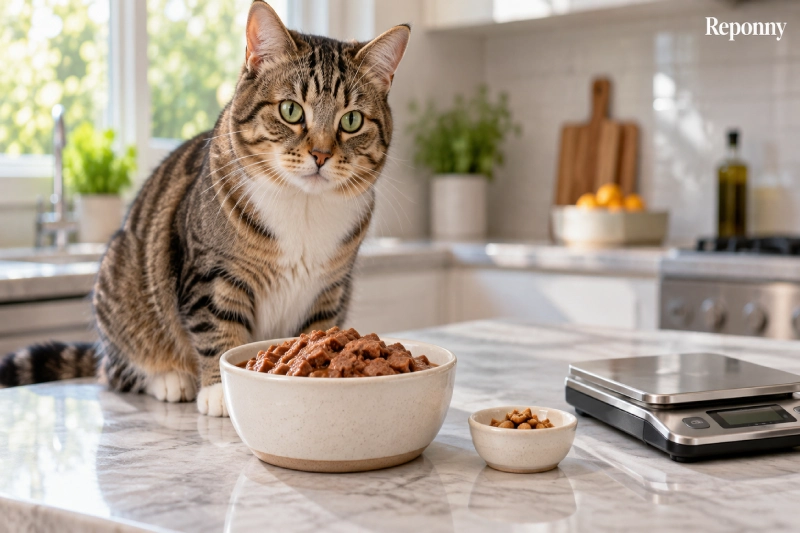
Wet food can sometimes help because its high moisture content can provide larger food volume for a given calorie amount, depending on the formulation.
But wet food is not automatically low-calorie.
Compare kcal per can or pouch and follow the complete weight-management plan.
Are Weight-Loss Cat Foods Worth It?
For cats requiring substantial calorie restriction, veterinary therapeutic weight-loss diets can be useful because they are designed to provide appropriate essential nutrients while reducing calorie intake.
Why Is My Cat Not Losing Weight?
Possible explanations include:
- portions are larger than estimated,
- treats are not being counted,
- food is being stolen from another cat,
- activity remains low,
- calorie needs are lower than calculated,
- or the plan simply needs adjustment.
Veterinary monitoring can help identify the problem.
Final Thoughts
A healthy cat weight is not one magic number.
The best target is the weight at which your individual cat maintains ideal body condition, healthy muscle mass, good mobility, and overall health.
For many cats, approximately 5/9 on a Body Condition Score scale represents ideal condition: ribs are easy to feel beneath a slight fat covering, a waist is visible behind the ribs, and excessive abdominal fat is absent.
If your cat is already at a healthy weight, prevention is much easier than weight loss.
Measure food.
Limit treats.
Encourage daily activity.
Monitor weight.
And adjust portions when life stage, neuter status, or activity changes.
If your cat is overweight, avoid crash diets.
Veterinary weight-loss programs usually combine controlled calories, complete nutrition, adequate protein, activity, and regular monitoring. Weight should fall gradually—not dramatically.
Most importantly, never allow an overweight cat to stop eating in an attempt to accelerate weight loss. Cats are vulnerable to serious metabolic complications, including hepatic lipidosis, when calorie intake becomes dangerously inadequate.
The goal is not simply to make the number on the scale smaller.
It is to help your cat carry the right amount of fat and muscle for a healthier, more active life—and then maintain that condition for years to come.