Grain-free cat food has become one of the most recognizable trends in pet nutrition.
Walk through almost any pet-food aisle and you will see packages advertising:
grain-free, no corn, no wheat, no soy, ancestral diet, meat-first, high protein, or biologically appropriate.
Because cats are obligate carnivores, the idea sounds logical: if cats evolved eating prey rather than bowls of rice or corn, shouldn’t grain-free food be healthier?
Not necessarily.
A grain-free cat food is simply a food that does not contain grains such as wheat, corn, rice, barley, or oats. Removing those ingredients does not automatically increase protein, reduce carbohydrates, improve digestibility, prevent allergies, or make the finished diet more appropriate for cats.
Many grain-free products replace grains with ingredients such as peas, lentils, chickpeas, potatoes, sweet potatoes, or tapioca. A grain-free food can therefore still contain a significant amount of carbohydrate.
Veterinary nutrition guidance emphasizes that the most important questions are whether the food is complete and balanced, appropriate for the cat’s life stage, nutritionally well formulated, manufactured with good quality control, and suitable for the individual cat. VCA notes that grain and gluten allergies are uncommon in cats and that grains can supply nutrients including vitamins, minerals, fatty acids, and fiber.
Quick answer: Healthy cats generally do not need a grain-free diet simply because they are cats. Grain-free food can be nutritionally appropriate when it is complete and balanced, but there is no established evidence that removing grains automatically makes a diet healthier. Grain-free may be useful when a veterinarian has identified a specific dietary reason to avoid a particular ingredient.
What Does “Grain-Free” Actually Mean?
A grain-free cat food avoids cereal grains such as:
- wheat,
- corn,
- rice,
- barley,
- oats,
- rye.
It does not necessarily mean:
- carbohydrate-free,
- starch-free,
- high-protein,
- low-calorie,
- hypoallergenic,
- or nutritionally superior.
That distinction is extremely important.
Grain-free dry food still needs ingredients that contribute structure during kibble manufacturing. Manufacturers may use potatoes, peas, lentils, chickpeas, tapioca, or other carbohydrate-containing ingredients instead.
AAFCO notes that plant ingredients such as corn, barley, peas, and potatoes can provide calories and nutrients and can help kibble maintain its structure.
So replacing rice with potato does not automatically transform the food into a carnivore-style diet.
It simply changes the carbohydrate source.
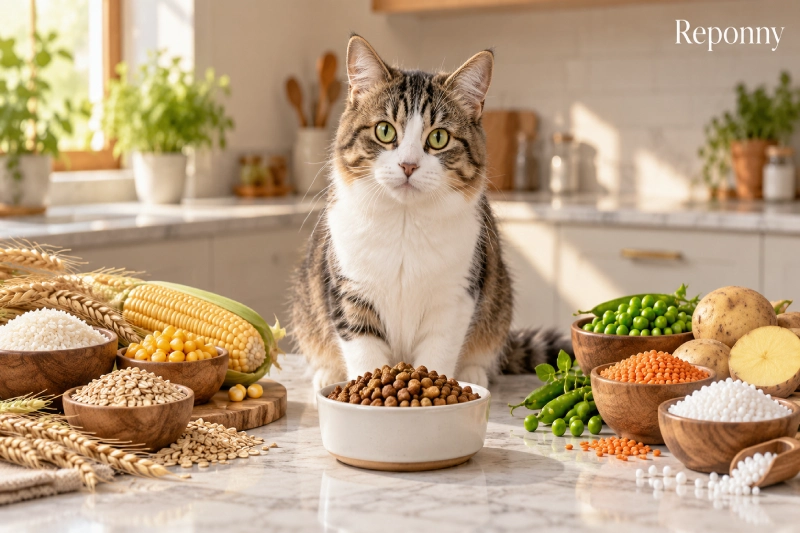
Grain-Free Is Not the Same as Gluten-Free
These two terms are often confused.
Gluten is a group of proteins found in certain grains, particularly:
wheat, barley, and rye.
But not every grain contains gluten.
Rice and corn, for example, do not contain gluten in the same way wheat does.
VCA explains that:
all grain-free diets are gluten-free, but not every gluten-free diet is grain-free.
For most cats, this distinction has little practical importance unless a specific adverse food reaction has been identified.
There is no general nutritional requirement for healthy cats to avoid gluten.
Cats Are Obligate Carnivores—So Why Are Grains Used?
Cats absolutely are obligate carnivores.
That means they have nutritional requirements shaped by an evolutionary dependence on animal tissues.
They require nutrients such as:
taurine, arginine, adequate protein, arachidonic acid, preformed vitamin A, essential fatty acids, vitamins, and minerals.
But “obligate carnivore” does not mean:
“Every plant ingredient is toxic or useless.”
A cat’s biology determines its nutrient requirements, not a mandatory ingredient list.
Properly processed plant ingredients can contribute:
- energy,
- fiber,
- fatty acids,
- vitamins,
- minerals,
- and functional properties within the diet.
VCA notes that grains such as wheat, oats, rice, corn, and barley can provide protein, fiber, essential fatty acids, vitamins, and minerals.
The complete formulation matters much more than whether one ingredient happens to be rice instead of peas.
Are Grains Just Cheap Fillers?
This is one of the most persistent pet-food myths.
The word filler sounds like an ingredient that contributes nothing except volume.
That is not an accurate description of properly formulated grains.
VCA specifically states that the idea that grains are nutritionally worthless fillers is incorrect. Grains can provide nutrients including iron, calcium, B vitamins, protein, fiber, and essential fatty acids.
AAFCO similarly notes that plant ingredients such as corn and barley contribute calories and nutrients to pet food.
That does not mean every grain-containing food is automatically excellent.
A poorly formulated food can contain grains.
A poorly formulated food can also be grain-free.
The presence or absence of grain tells you surprisingly little about the nutritional quality of the finished product.
Can Cats Digest Grains?
Yes, when they are properly processed.
The digestive physiology of cats differs from that of humans and dogs, but cats are capable of digesting appropriately cooked starches.
This does not mean cats have an essential dietary carbohydrate requirement. They do not.
But:
“cats do not require dietary carbohydrates”
is not equivalent to:
“cats cannot digest carbohydrates.”
This distinction matters when judging grain ingredients.
A small amount of cooked rice in a nutritionally complete cat food does not automatically make the diet inappropriate for a carnivore.
The overall amounts of protein, fat, essential amino acids, calories, minerals, vitamins, moisture, and other nutrients are more meaningful.
Is Grain-Free Cat Food Lower in Carbohydrates?
Not necessarily.
This is probably the most important misconception about grain-free diets.
Removing grain does not remove starch.
A grain-free product may contain:
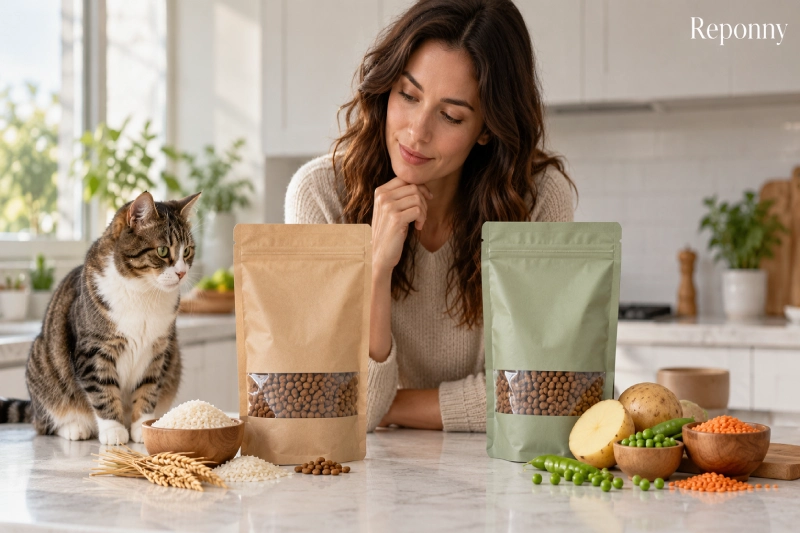
- peas,
- chickpeas,
- lentils,
- potato,
- sweet potato,
- tapioca,
- or other carbohydrate-rich ingredients.
So:
grain-free ≠ low-carb.
A food containing rice can theoretically contain less carbohydrate than a grain-free food containing large amounts of peas and potato.
You cannot reliably determine total carbohydrate merely by seeing the words grain-free on the package.
This connects directly to the larger issue discussed in our guide to Carbohydrates in Cat Food: evaluate the actual nutrient profile rather than relying on an ingredient-category marketing claim.
Is Grain-Free Cat Food Higher in Protein?
Again, not automatically.
Some grain-free foods are intentionally formulated to contain high protein.
Others are not.
Removing wheat or rice does not guarantee that the manufacturer replaced those ingredients with meat.
They may have been replaced partly by peas, lentils, potato, or another plant ingredient.
To determine whether a food is genuinely high in protein, look at:
- the guaranteed analysis,
- typical nutrient analysis when available,
- dry-matter protein if comparing wet and dry foods,
- calories,
- and the complete nutritional adequacy statement.
Do not assume a package with a wolf, mountain, forest, or large piece of meat on the front contains more protein than a conventional cat food.
Read the nutrition data.
Do Grain-Free Diets Prevent Food Allergies?
Usually not.
Many owners choose grain-free food because their cat is itchy, vomiting, experiencing diarrhea, or losing hair.
Food allergy is a legitimate medical condition in cats—but grain is rarely the main problem.
VCA states that grain and gluten allergies are very rare in cats.
More commonly reported feline food allergens include animal proteins such as:
beef, fish, chicken, and dairy.
This makes intuitive sense once you understand how food allergy works.
The immune system usually reacts to proteins.
That protein may come from an animal or, less commonly, a plant source.
Simply buying a grain-free diet does not remove chicken, beef, fish, dairy, or another protein that may actually be triggering the reaction.
What Should You Do If You Suspect a Food Allergy?
Do not randomly change among grain-free brands.
The most reliable way to diagnose a feline food allergy is a controlled elimination diet trial.
VCA describes veterinary elimination trials using a hydrolyzed protein diet or a novel protein diet, followed by a challenge with the previous diet to see whether symptoms return. A properly controlled trial generally lasts at least about eight weeks.
During the trial, the cat may need to consume only:
the prescribed diet, water, and approved medication.
Even small amounts of treats, table food, flavored medications, or another pet’s food can interfere with the results.
This is far more informative than choosing a supermarket food simply because the front says grain-free.
When Can Grain-Free Food Actually Be Helpful?
There are situations in which avoiding a particular grain may be reasonable.
For example, if a properly performed elimination trial demonstrates that an individual cat reacts to wheat or another grain ingredient, then avoiding that ingredient makes sense.
A veterinary nutrition plan might also use a grain-free formulation for another individual clinical reason.
But notice the distinction:
The cat benefits because a specific problematic ingredient is being avoided—not because grain-free diets are universally healthier.
For a healthy cat without a diagnosed dietary problem, there is no established nutritional requirement to avoid grains.
VCA concludes that a conventional diet is appropriate for many cats and emphasizes choosing food according to nutritional adequacy and the individual animal rather than diet trends
What About Grain-Free Cat Food and Heart Disease?
This subject requires careful explanation because much of the public discussion has centered on dogs, not cats.
Beginning in 2018, the FDA investigated reports of dilated cardiomyopathy (DCM) in pets eating certain diets. Many reported diets were labeled grain-free and contained high proportions of peas, lentils, other pulses, or potatoes.
However, the investigation was overwhelmingly canine.
From January 2014 through April 2019, the FDA received 515 canine DCM reports versus only 9 feline reports, involving 14 affected cats. The agency also emphasized that DCM is not the heart disease most commonly seen in cats; hypertrophic cardiomyopathy is much more typical.
This small number of feline reports does not establish that grain-free diets cause DCM in cats.
It is also important that FDA testing did not find simple, consistent deficiencies that explained the reported cases. Average protein, taurine, cystine, methionine, and several other measures were broadly similar between tested grain-free and grain-containing foods.
So the evidence does not support telling cat owners:
“Grain-free food causes heart disease in cats.”
That would go beyond the available evidence.
The more reasonable conclusion is that there is no demonstrated benefit to choosing grain-free food without a specific reason, and the overall formulation matters more than the grain-free label.
Taurine Matters More Than Grain Status
Cats have an essential dietary requirement for taurine.
Historically, taurine deficiency was recognized as an important cause of feline dilated cardiomyopathy. Modern complete commercial cat foods are formulated to provide sufficient taurine.
That is why the question:
“Does this food contain grain?”
is generally less nutritionally useful than:
“Is this food complete and balanced for cats and formulated to provide all essential nutrients?”
A grain-free food can provide adequate taurine.
A grain-containing food can provide adequate taurine.
Likewise, an improperly formulated diet of either type could potentially create nutritional problems.
The formulation wins over the marketing category.
Are Peas and Lentils Bad for Cats?
Not automatically.
Peas and lentils are permitted food ingredients and can contribute nutrients, starch, protein, and fiber.
The issue is not that a single pea is harmful.
The question is how ingredients interact within the whole diet.
During the FDA’s DCM investigation, peas and lentils received attention because they appeared frequently in many reported diets. More than 90% of products in the early case reports were grain-free, and 93% contained peas or lentils. But observational reports cannot prove that one ingredient caused the disease.
Ingredient concentration, formulation practices, nutrient digestibility, amino-acid metabolism, processing, and other factors may all matter.
This is one reason judging pet food from the ingredient list alone is unreliable.
Grain-Free Does Not Mean “More Natural”
The word natural is emotionally powerful.
But removing rice and adding potato does not automatically make a food closer to prey.
Neither rice nor potato is a major natural component of a wild cat’s diet.
The relevant question is whether the finished food recreates the nutritional requirements of a cat, not whether each ingredient resembles something a wildcat would personally hunt.
Commercial feline diets rely on food science to provide the proper combination of:
protein, taurine, fats, amino acids, vitamins, minerals, energy, and other essential nutrients.
A nutritionally balanced food can use ingredients that would never appear intact inside a mouse.
Grain-Free Wet Food vs. Grain-Free Dry Food
The words grain-free tell you less than the format and total formulation.
Wet grain-free foods often have high moisture and may contain relatively little starch.
But some contain carbohydrate-rich thickeners or gravy ingredients.
Dry grain-free foods generally still require enough starch or similar ingredients to create kibble structure.
Therefore, if your actual goal is:
more moisture, look at moisture.
If your goal is:
higher protein, look at protein.
If your goal is:
lower carbohydrate, look for carbohydrate data.
If your goal is:
fewer calories, look at calories.
Do not use grain-free as a shortcut for nutritional characteristics it does not necessarily represent.
Is Grain-Free Better for Overweight Cats?
Not inherently.
Weight gain occurs when calorie intake consistently exceeds energy expenditure.
A grain-free food can be:
low calorie, moderate calorie, or extremely calorie-dense.
The words on the front cannot tell you.
Some grain-free formulas are high in fat to increase palatability and energy density. A relatively small serving can therefore provide substantial calories.
If your cat needs weight management, focus on:
- total daily calories,
- measured portions,
- adequate protein,
- muscle preservation,
- activity,
- and body-condition monitoring.
The correct weight-management diet might contain grains.
Or it might not.
The grain status itself is not the treatment.
Is Grain-Free Better for Diabetic Cats?
Do not confuse grain-free with low-carbohydrate.
Cats with diabetes often benefit from a reduced-carbohydrate feeding strategy under veterinary supervision.
But a grain-free food containing large amounts of peas, potato, or tapioca may still contain substantial carbohydrate.
Therefore, for a diabetic cat, obtain actual carbohydrate information rather than relying on the grain-free label.
The 2026 AAHA diabetes guidance emphasizes carbohydrate level itself—not whether the carbohydrate came from grain. A diet change in a cat receiving insulin should be coordinated with the veterinarian because insulin requirements may change as diet changes.
What About Kittens?
Kittens need complete and balanced nutrition for growth.
Their diet must provide adequate:
protein, calories, calcium, phosphorus, essential fatty acids, taurine, vitamins, minerals, and other nutrients.
Whether a kitten food contains grain should be a secondary consideration unless a specific medical reason exists.
A grain-free adult food is not automatically appropriate for a kitten.
Check the nutritional adequacy statement.
Look for a food specifically formulated for growth or an appropriate all-life-stages diet.
The kitten’s rapid development matters far more than following a grain-free trend.
What About Senior Cats?
The same principle applies.
Age alone does not create a reason to eliminate grains.
A senior cat may need adjustments based on:
- muscle condition,
- body weight,
- appetite,
- hydration,
- kidney health,
- dental disease,
- digestion,
- and other medical issues.
An older cat losing muscle may need highly digestible protein and sufficient calories.
A cat with kidney disease may need a therapeutic diet with controlled phosphorus and other specific nutrient adjustments.
A grain-free label tells you almost nothing about those priorities.
How to Choose a Grain-Free Cat Food If You Still Prefer One
There is nothing inherently wrong with choosing grain-free food for a healthy cat if you prefer it—provided the product is nutritionally appropriate.
Evaluate it the same way you would evaluate any other diet:
| What to Check | Why It Matters |
|---|---|
| Complete and balanced statement | Confirms nutritional adequacy |
| Appropriate life stage | Kittens and adults have different needs |
| Protein and amino-acid nutrition | Essential for obligate carnivores |
| Calories | Important for body-weight control |
| Moisture | Important for total hydration |
| Carbohydrate level | Grain-free does not guarantee low carb |
| Manufacturer expertise | Formulation and quality control matter |
| Cat’s response | Weight, stool, appetite, coat and health matter |
VCA emphasizes that the most important consideration for conventional or alternative diets is whether the selected food is complete, balanced, and appropriate for the individual pet.
Red Flags to Avoid
A grain-free package deserves the same scrutiny as any other food.
Be cautious if marketing seems to rely primarily on claims such as:
“no fillers,” “ancestral,” “wild,” “human-grade ingredients,” or “grains are bad for cats”
without providing useful information about nutritional formulation.
Also be cautious when a manufacturer cannot clearly tell you:
who formulates its diets, where the product is made, how quality is controlled, or whether detailed nutrient information is available.
And remember that a long list of exotic ingredients does not necessarily equal better nutrition.
For most healthy cats, a reputable, well-formulated diet using ordinary ingredients is entirely reasonable.
Frequently Asked Questions
Is Grain-Free Food Better for Cats?
There is no established evidence that grain-free diets are inherently healthier for normal healthy cats.
The most important factors are complete and balanced nutrition, appropriate calories, suitable life stage, manufacturer quality, and the needs of the individual cat.
Do Cats Need Grains?
Cats do not have a specific biological requirement to eat wheat, rice, corn, or another grain.
But they also do not generally need those ingredients excluded.
The cat needs nutrients, not a particular marketing-style ingredient list.
Are Grains Bad for Cats?
Not inherently.
Properly formulated grains can provide energy, protein, fiber, vitamins, minerals, and essential fatty acids.
Can Cats Be Allergic to Grain?
Yes, individual cats can react to many different food proteins.
However, grain allergy is relatively uncommon. More commonly reported feline food allergens include proteins such as beef, fish, chicken, and dairy.
Is Grain-Free Cat Food Better for Allergies?
Not automatically.
A cat allergic to chicken will still react to a grain-free chicken food.
A properly controlled elimination diet is a more reliable method for identifying food allergy.
Is Grain-Free Cat Food Low in Carbohydrates?
Not necessarily.
Grain-free formulas can replace grain with carbohydrate-containing ingredients such as potato, peas, lentils, chickpeas, or tapioca.
Check actual nutrient data.
Is Grain-Free Food High in Protein?
Sometimes, but not always.
Protein content depends on the formulation, not on whether grains are included.
Check the guaranteed analysis and compare foods appropriately.
Does Grain-Free Cat Food Cause Heart Disease?
A direct cause-and-effect relationship between grain-free diets and DCM in cats has not been established.
The FDA investigation was overwhelmingly focused on dogs. Through April 2019, FDA had received nine feline DCM reports involving 14 cats, compared with hundreds of canine reports.
Should Kittens Eat Grain-Free Food?
Kittens can eat a grain-free food if it is complete and balanced for growth, but grain-free status itself provides no established advantage.
Prioritize the nutritional adequacy statement and healthy development.
Should Senior Cats Eat Grain-Free?
Not simply because they are older.
Senior nutrition should be based on body condition, muscle mass, hydration, appetite, and medical status.
Final Thoughts
Grain-free cat food is neither automatically good nor automatically bad.
It is simply one category of food.
Cats are obligate carnivores, but that does not mean every plant ingredient is harmful or that every food containing rice, corn, oats, or barley is biologically inappropriate.
Grains can contribute useful nutrients, while grain-free diets frequently replace them with other plant ingredients such as peas, lentils, potatoes, or tapioca.
For most healthy cats, there is no proven reason to avoid grains simply because marketing suggests that grain-free feeding is more natural.
Grain allergies can occur, but they are uncommon. When a real food allergy is suspected, a veterinarian-directed elimination diet is much more useful than randomly choosing a grain-free brand.
The concerns raised around grain-free diets and DCM also deserve perspective. FDA reports included a small number of cats, but the investigation was dominated by canine cases, and current evidence does not demonstrate that grain-free food itself directly causes DCM in cats.
So instead of asking only:
“Is this cat food grain-free?”
ask:
“Is it complete and balanced? Does it provide adequate protein and essential nutrients? How many calories does it contain? Is it appropriate for my cat’s life stage and health? And does the manufacturer have strong nutritional expertise and quality control?”
Those questions tell you far more about a cat food than the absence of grain ever will.