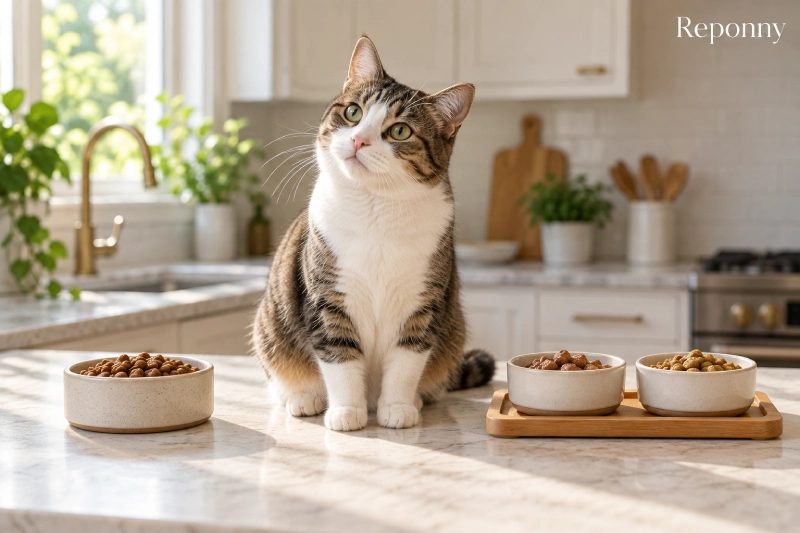
Some cats prefer to nibble throughout the day. Others finish every crumb the moment food reaches the bowl.
That creates a common question for cat owners:
Should you leave food available all day, or feed your cat at scheduled times?
Both approaches can work in the right situation, but they are not equally suitable for every cat.
Free feeding is convenient and can match a cat’s natural tendency to eat many small meals. However, unlimited access to food can make it harder to control calories, notice appetite changes, or determine how much each cat is eating in a multi-cat home.
Scheduled meals make portions easier to measure and create a predictable routine, but some cats may prefer more frequent opportunities to eat than two large meals per day.
For many indoor cats, the most practical solution is not simply “free feeding” or “two meals.” It is portion-controlled feeding divided into several small meals, sometimes with the help of an automatic feeder or food puzzle.
Quick answer: Free feeding may work for healthy cats that reliably maintain an ideal weight and self-regulate their intake. For cats prone to overeating, obesity, competition around food, or medical problems, measured scheduled meals are often easier to manage.
What Is Free Feeding?
Free feeding, sometimes called free-choice feeding or grazing, means food remains available so the cat can eat whenever it wants.
This often means filling a bowl with dry food in the morning and allowing the cat to take small meals throughout the day and night.
That pattern can resemble natural feline eating behavior. VCA notes that domestic cats often prefer many small meals and may eat around 12 to 20 times over a 24-hour period when given the opportunity.
However, there are two very different versions of free feeding.
One version is unlimited feeding, where the bowl is continually refilled whenever it becomes empty.
The other is portion-controlled grazing, where the owner measures the cat’s entire daily calorie allowance in the morning and allows the cat to consume that measured amount gradually.
The second approach provides much better control over calorie intake.
What Are Scheduled Meals?
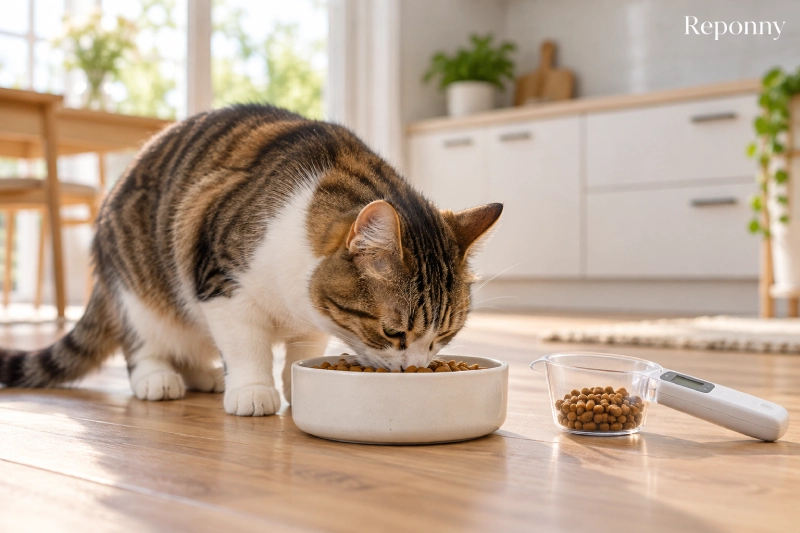
Scheduled feeding means food is offered at specific times rather than remaining constantly available.
For example, an adult cat might eat breakfast at 7 a.m. and dinner at 7 p.m.
Other cats may receive three, four, or more smaller meals spread through the day.
The most important feature is that the daily amount is measured, and feeding times are reasonably predictable.
Cornell states that most healthy adult cats can generally be fed once or twice daily, while VCA recommends at least two meals for many adult cats and notes that some cats do better with three or four smaller meals.
Scheduled feeding does not mean cats must eat only two large meals.
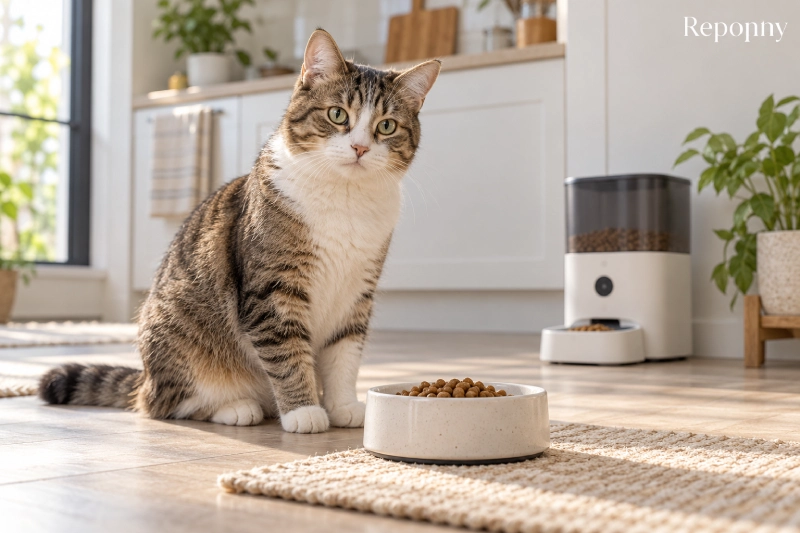
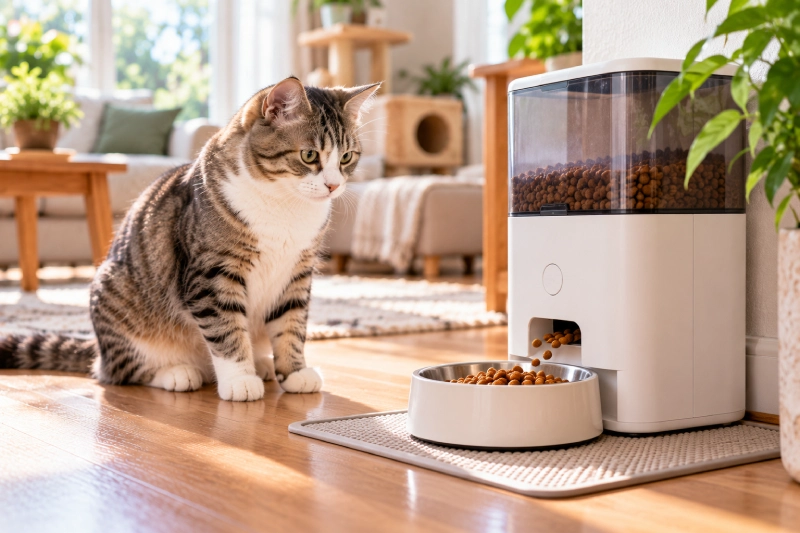
A timed automatic feeder can create a schedule of multiple small meals while preserving the portion-control benefits of meal feeding.
Free Feeding vs. Scheduled Meals at a Glance
| Factor | Free Feeding | Scheduled Meals |
|---|---|---|
| Cat can eat whenever desired | Yes | No |
| Portion control | Harder if unlimited | Easier |
| Monitoring appetite | Harder | Easier |
| Useful for weight management | Often less ideal | Often easier |
| Works with wet food | Limited | Yes |
| Fits natural small-meal behavior | Yes | Yes, if several meals are offered |
| Multi-cat monitoring | Difficult | Easier |
| Convenience for owner | High | Moderate |
| Automatic feeder compatible | Yes | Yes |
| Best for every cat? | No | No |
Neither method is automatically superior in every household.
The better choice depends on the individual cat.
The Biggest Risk of Free Feeding: Too Many Calories
The main concern with unrestricted free feeding is not the timing of food.
It is the quantity.
Cornell notes that leaving dry food available all day can work for some cats, but in others it can lead to overeating and inappropriate weight gain. Cornell’s obesity guidance also identifies free feeding as an important contributor to excessive calorie intake in some cats.
WSAVA takes a similar approach: free feeding may be acceptable when an animal can regulate its own intake and maintain an ideal body weight, but it is not recommended for cats prone to overweight or obesity.
The problem is easy to understand.
Suppose your cat needs 230 calories per day.
You pour food into the bowl in the morning.
Later, the bowl looks almost empty, so you add another handful.
A family member sees the bowl in the afternoon and tops it up again.
By the end of the day, nobody knows whether the cat ate 230 calories, 300 calories, or 450 calories.
A few extra pieces of kibble do not look like much, but dry food can be calorie-dense.
Over weeks and months, small excesses can result in significant weight gain.
Scheduled Meals Make Portion Control Easier
Scheduled feeding does not automatically prevent obesity.
A cat can still gain weight if each scheduled meal contains too many calories.
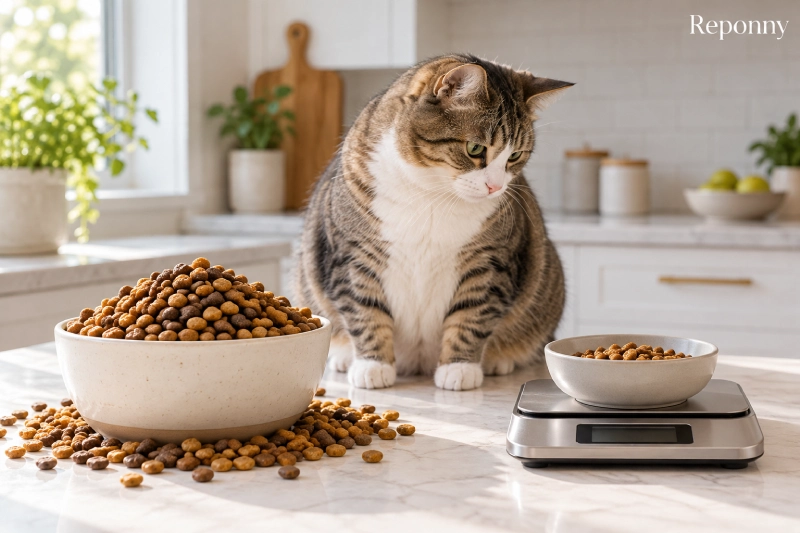
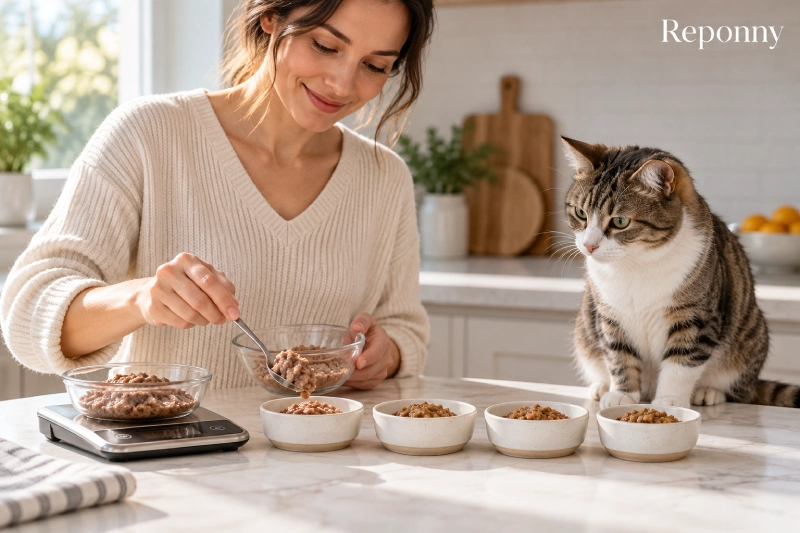
But meal feeding makes the amount easier to measure.
If your cat needs 240 calories per day and you feed twice daily, each meal can provide approximately 120 calories.
If you feed four times daily, each meal can provide approximately 60 calories.
The number of meals changes.
The daily calorie total does not.
That distinction is important.
Weight management is primarily about appropriate energy intake, body condition, and activity—not simply whether food is served at 7 a.m. or left out all day.
Cornell recommends monitoring body condition and working with a veterinarian to determine an appropriate target weight and feeding amount.
Scheduled Feeding Makes Appetite Changes Easier to Notice
One major advantage of meals is that you learn what normal eating behavior looks like for your cat.
If your cat normally runs into the kitchen at breakfast but suddenly refuses the meal, the change is obvious.
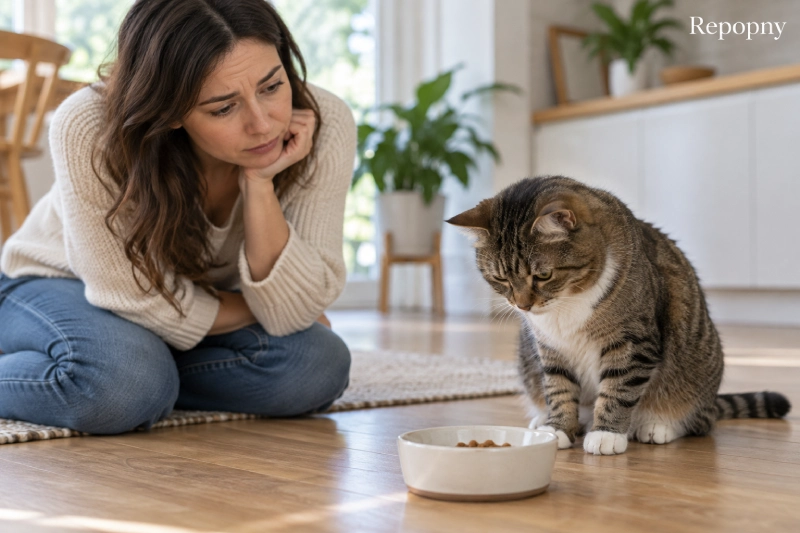
With free feeding, appetite changes can be harder to detect.
You may notice food remaining in the bowl but not know whether your cat ate less today, overnight, or several hours earlier.
This becomes particularly important because reduced appetite can be an early sign of illness.
Cornell emphasizes that cats refusing food can develop serious medical problems and recommends veterinary evaluation when a cat will not eat and is losing weight.
A predictable meal routine effectively gives you several daily opportunities to observe appetite.
That can be useful health information.
Is Free Feeding More Natural for Cats?
In one sense, yes.
Cats naturally tend to eat small amounts frequently rather than consume one enormous meal.
VCA describes domestic cats as grazers that may eat many small meals throughout the day and night.
But that does not mean a constantly overflowing bowl is required to meet that behavioral preference.
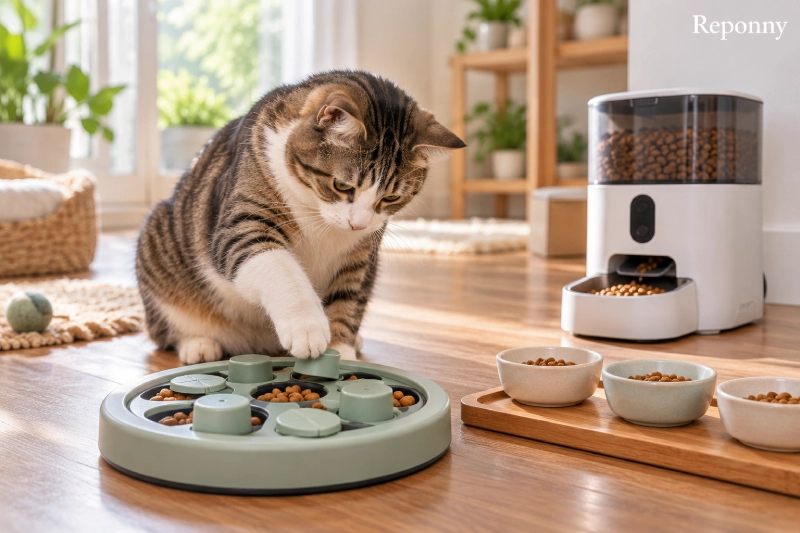
WSAVA recommends several alternatives that preserve small-meal feeding while still allowing portion control, including multiple meals, automated feeders, food-dispensing toys, and hiding portions of food around the home.
So a cat can have:
small frequent meals + controlled calories
at the same time.
For indoor cats, this can be an excellent compromise.
Instead of one large bowl, divide the daily ration among several feeding opportunities.
A Strong Middle Ground: Portion-Controlled Grazing
If your cat genuinely prefers grazing but does not need unlimited food, try a measured daily allowance.
For example, calculate that your cat should receive 55 grams of its current dry food per day.
Measure 55 grams once.
That is the entire daily allowance.
You can place some in the regular bowl, some in a puzzle feeder, and perhaps reserve some for an automatic feeder later.
Once the daily allowance is gone, do not automatically refill the bowl.
This method preserves flexibility for the cat while preventing the bowl from becoming an unlimited calorie source.
It also makes it easier to determine how much food your cat actually consumed during the day.
How Often Should Adult Cats Eat?
There is no single schedule that every adult cat must follow.
Cornell states that feeding once or twice daily can be appropriate for most healthy adult cats. VCA recommends at least two meals for many cats and notes that cats that beg between meals or eat only small amounts at once may benefit from three or four daily meals.
For many households, a practical schedule might be:
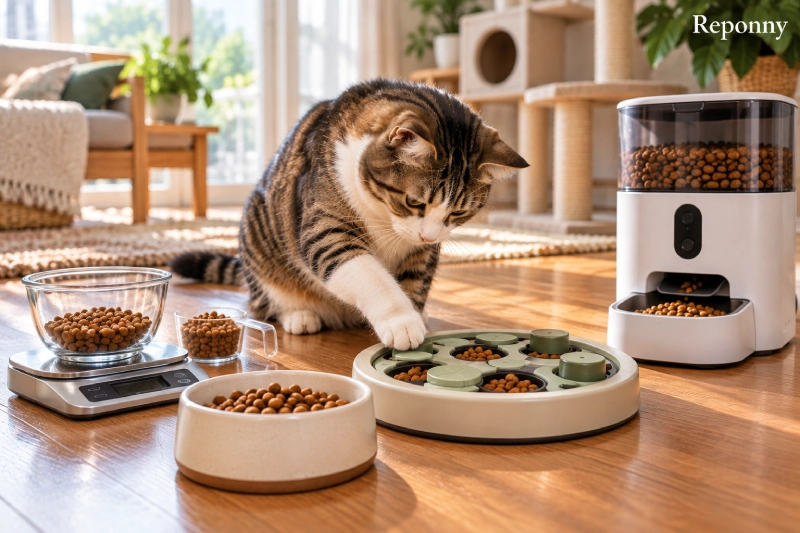
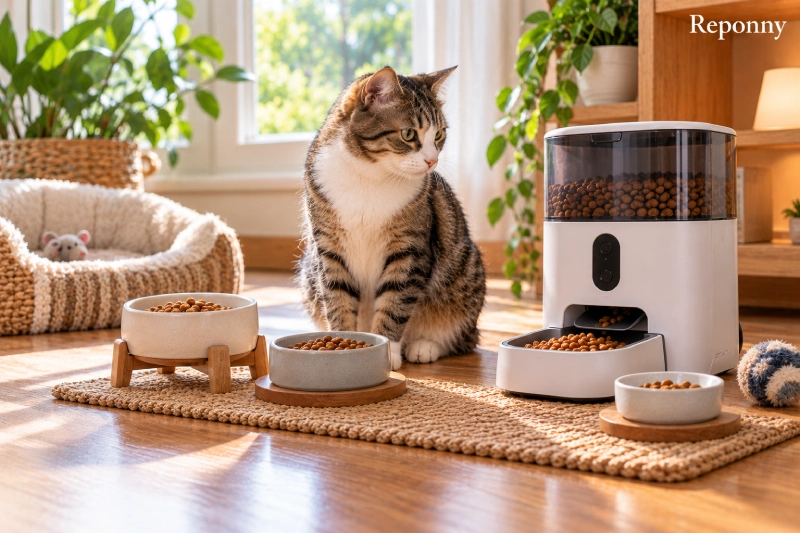
Morning meal → afternoon automatic feeder → evening meal → small late-night portion
That allows four small meals without requiring someone to stay home all day.
The most important thing is to keep total daily calories appropriate.
If you increase meal frequency from two meals to four, do not double the amount of food.
Divide the same daily allowance into smaller portions.
How Often Should Kittens Eat?
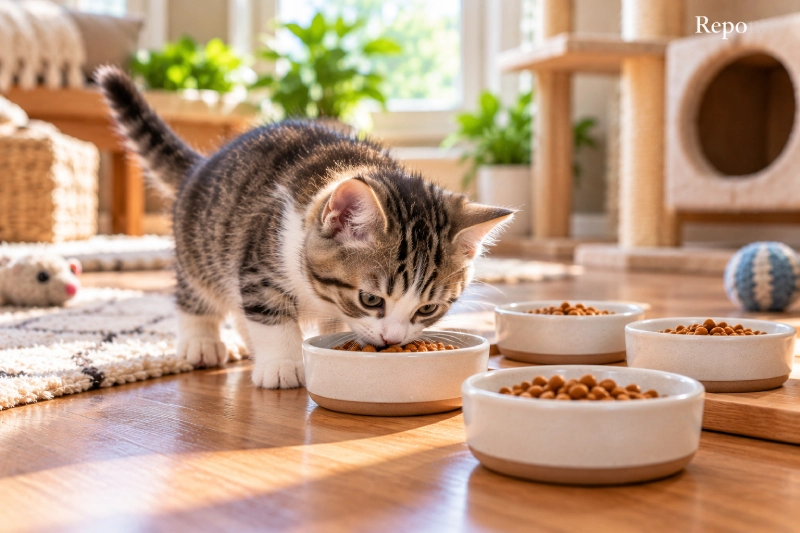
Kittens generally need more frequent meals than adults.
Cornell recommends around three meals per day until about six months of age, then generally about two meals daily from six months to one year.
Growing kittens require more calories relative to body size than adult cats.
However, unlimited free feeding is not automatically necessary.
VCA cautions that unrestricted ad-lib feeding of kittens can encourage excessive calorie intake and juvenile obesity.
A better approach is to provide age-appropriate kitten food in several measured meals.
Because growth rates change quickly, kitten portions should be reassessed regularly.
What About Senior Cats?
Healthy senior cats may continue their established meal schedule unless a veterinarian recommends a change.
Cornell notes that older cats can generally maintain the same feeding frequency as adults unless health circumstances require otherwise.
However, age can bring changes in:
appetite, dental health, mobility, digestion, muscle mass, and chronic disease.
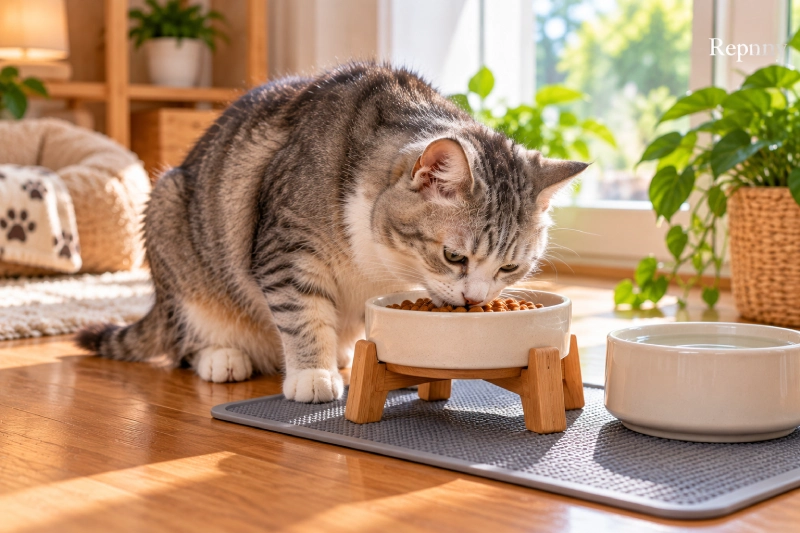
A senior cat that struggles to eat a large meal may do better with several smaller meals.
An older cat with mobility problems may benefit from food being placed in an easily accessible location.
And because appetite changes can be medically significant in older cats, measured scheduled meals make it easier to notice when intake decreases.
Free Feeding Wet Food Is More Difficult
Free feeding usually works best with dry food.
Wet food is perishable and should not remain at room temperature for long periods.
VCA specifically notes that moist food spoils more quickly when left out, making constant grazing less practical.
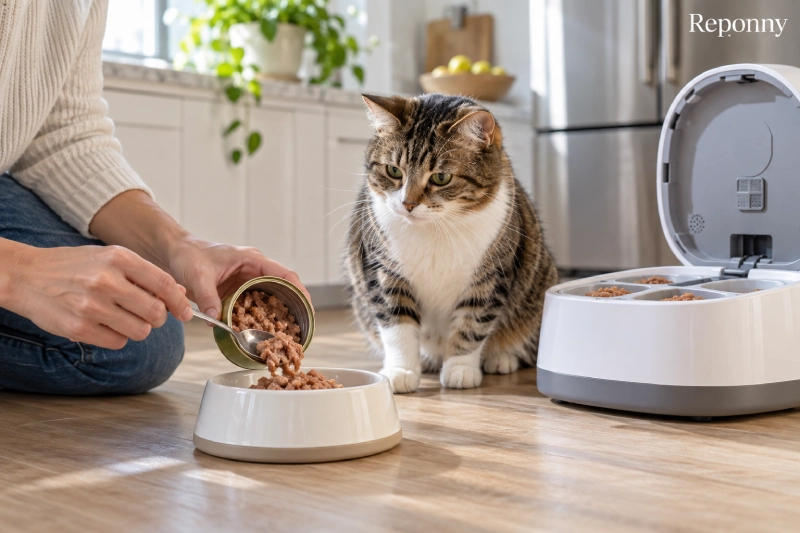
If your cat prefers wet food but likes frequent meals, consider:
a timed feeder designed to keep wet food cool, several fresh meals provided throughout the day, or a mixed feeding strategy using wet meals plus carefully measured dry food.
Do not leave a bowl of wet food sitting out from morning until evening.
Food safety matters too.
Which Method Is Better for Overweight Cats?
For a cat that is overweight or prone to overeating, measured feeding is usually much easier to manage than unlimited free feeding.
WSAVA specifically advises against free feeding in animals prone to overweight or obesity.
Cornell also identifies constant access to food as a factor that can contribute to feline obesity.
But do not drastically reduce food without veterinary guidance.
Cats should lose weight gradually.
A sudden severe calorie restriction can be dangerous, particularly in an overweight cat that stops eating adequately.
A veterinarian can help determine:
ideal body weight, appropriate daily calories, suitable food, safe rate of weight loss, and monitoring frequency.
For many overweight cats, dividing the daily ration into several measured meals can reduce the feeling that the food disappears immediately.
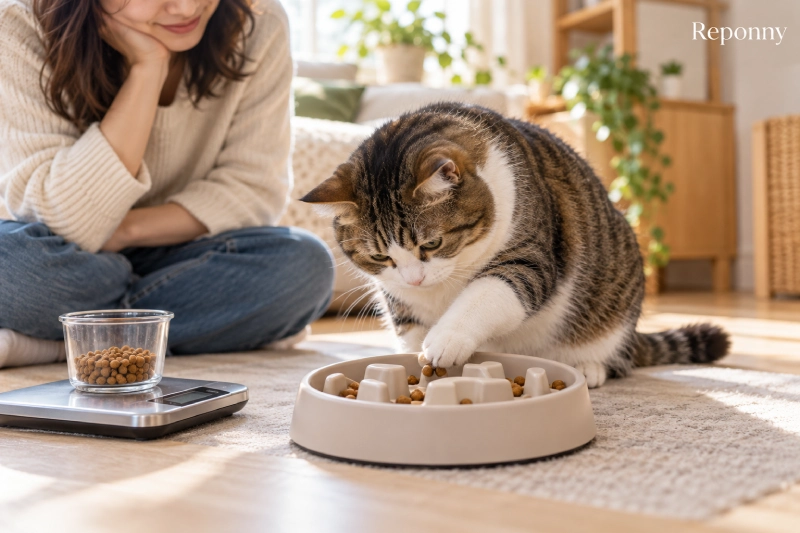
Puzzle feeders may also extend eating time and provide activity.
Feeding Multiple Cats in the Same Home
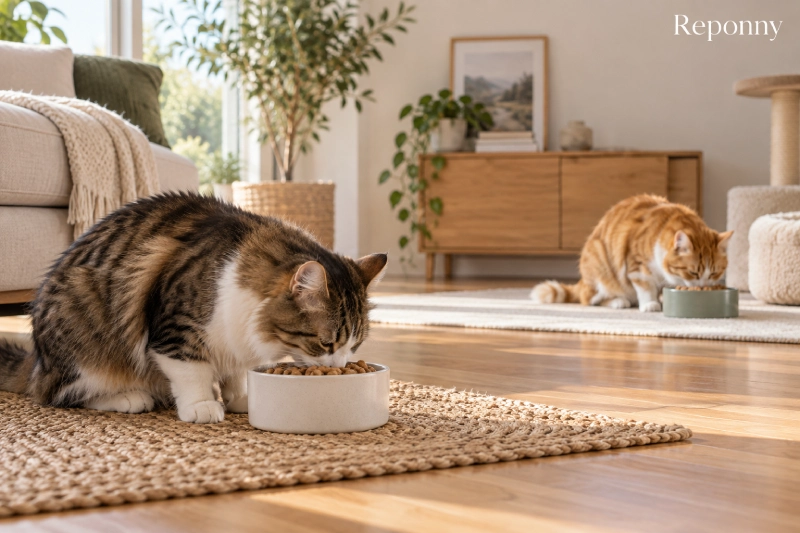
Free feeding becomes much harder to monitor when several cats share the same bowl.
You may know that one cup of food disappeared.
You do not know which cat ate it.
One confident cat may consume most of the calories while a shy cat eats too little.
Cornell specifically notes that multi-cat homes can make feeding difficult and suggests feeding cats separately or in different areas when necessary.
Scheduled individual meals allow you to observe each cat.
For households where cats need different diets, microchip-activated feeders can also help restrict access to specific food.
This becomes especially useful when one cat needs weight-control food while another needs higher calories or a veterinary diet.
Scheduled Meals Can Create a Useful Routine
Cats often respond well to predictable patterns.
VCA notes that regular meal times can provide routine and predictability, which may help cats cope with changes in the household.
Meals can also become useful anchors for:
play sessions, medication, grooming, training, and bedtime routines.
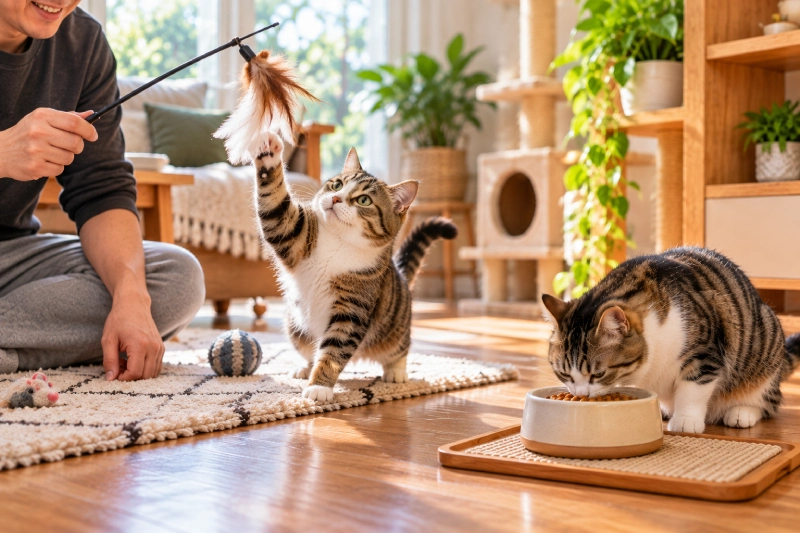
For example, you might play with your cat using a wand toy before the evening meal.
The sequence becomes:
play → eat → groom → rest
This provides enrichment while making meals part of a broader daily routine.
Scheduled feeding can also make future medical management easier because a cat is already accustomed to eating at predictable times.
What About Cats With Diabetes or Other Medical Conditions?
Medical conditions can change the feeding strategy.
Some cats may require diet composition, meal timing, medication, or monitoring plans tailored to their treatment.
VCA notes that a set meal schedule can be useful for medical conditions requiring food at particular times.
However, there is no universal rule that every diabetic cat must be fed exactly the same way. Cornell notes that feeding recommendations for diabetic cats can depend on diet, insulin type, and the individual cat, and that free-choice feeding may sometimes be acceptable under appropriate circumstances.
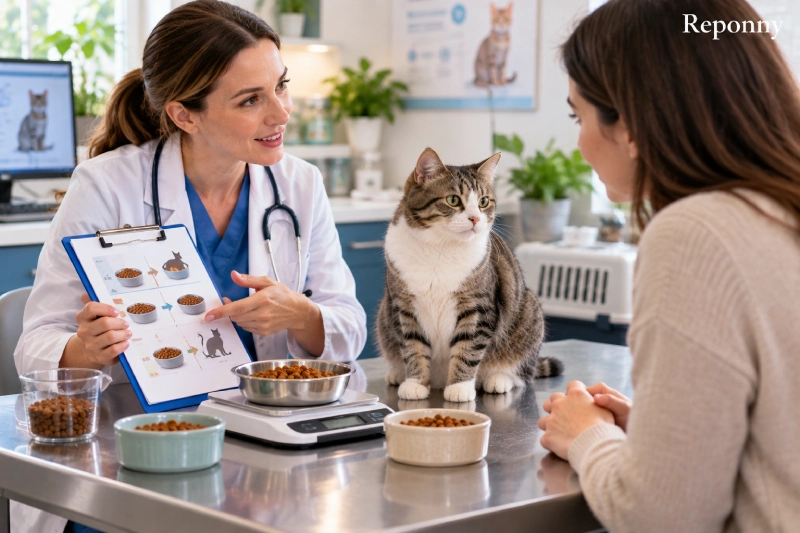
Therefore, if your cat has diabetes, kidney disease, urinary disease, gastrointestinal disease, or another diagnosed condition, follow the veterinarian’s feeding plan rather than applying a general schedule from the internet.
Can Automatic Feeders Replace Free Feeding?
For many households, automatic feeders offer an excellent compromise.
They allow owners to:
control the total daily amount, provide small meals during work hours, feed early-morning meals without getting out of bed, and create a predictable routine.
A cat that naturally prefers frequent feeding may do very well with four to six tiny scheduled portions.
Dry-food feeders are widely available.
Timed feeders designed for wet food can also work when they include appropriate cooling or insulated compartments.
The important point is still portion control.
An automatic feeder should dispense portions from a predetermined daily calorie allowance rather than function as an unlimited food source.
Puzzle Feeders Can Make Mealtime More Enriching
Cats evolved to search, stalk, capture, and manipulate food.
An indoor cat receiving its entire meal in a bowl completes none of those behaviors.
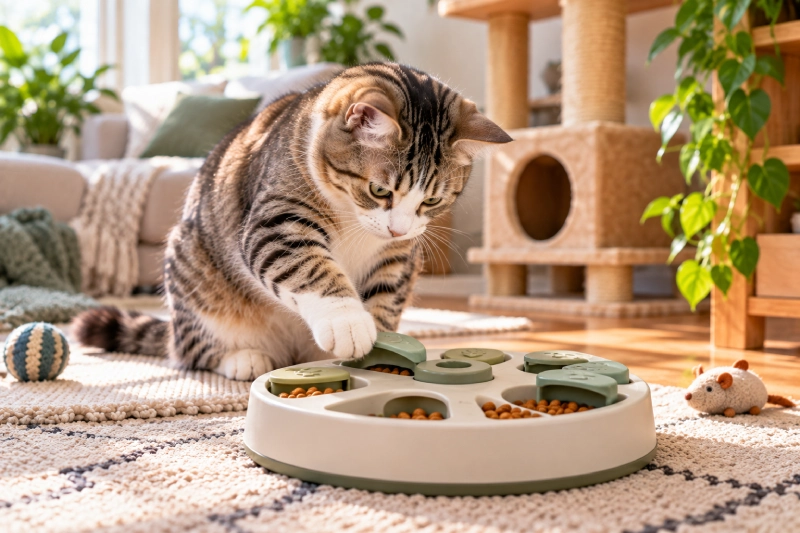
Food puzzles can make a portion of the daily ration take longer to eat and provide mental and physical activity.
WSAVA specifically suggests food-dispenser toys as one way to accommodate cats’ preference for small frequent meals without relying on unrestricted free feeding.
Start with an easy puzzle.
If food is too difficult to obtain, your cat may simply become frustrated and walk away.
As the cat learns how the toy works, difficulty can gradually increase.
Remember to subtract puzzle-feeder food from the daily ration.
It is part of the meal—not an extra snack.
How to Switch From Free Feeding to Scheduled Meals
A cat accustomed to seeing food available all day may protest when the bowl suddenly disappears.
Transition gradually.
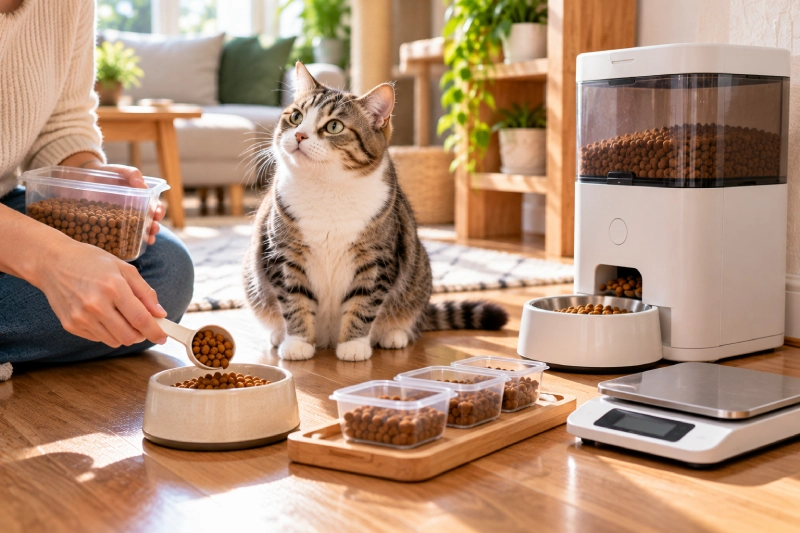
First, determine how much food your cat actually needs each day.
Measure that amount rather than continually refilling the bowl.
Then begin creating predictable meal opportunities while reducing constant access.
For example, move from unlimited food to a measured daily ration, then divide that ration into several feeding periods.
Multiple small meals are often easier for a lifelong grazer than immediately switching to only breakfast and dinner.
Consistency helps.
Do not respond to every meow by adding extra food, or the cat may quickly learn that vocalizing produces calories.
If your cat refuses to eat appropriately during the transition, do not simply wait indefinitely. Cats should not undergo prolonged food refusal, and meaningful appetite loss warrants veterinary advice. Cornell notes that a cat refusing food can develop serious health problems.
Which Feeding Method Is Right for Your Cat?
Rather than following one rule for every cat, consider your individual situation.
| Situation | Feeding Approach Often Worth Considering |
|---|---|
| Healthy cat that self-regulates well | Measured free feeding may work |
| Cat gaining weight | Scheduled portion-controlled meals |
| Cat that eats too quickly | More frequent small meals / puzzle feeder |
| Cat that begs constantly | Several small measured meals |
| Kitten | Multiple scheduled meals |
| Multi-cat household | Individual scheduled feeding |
| Cat on wet food | Scheduled fresh meals |
| Cat needing medication with food | Predictable meal schedule |
| Cat home alone during the day | Automatic timed feeder |
| Cat with medical condition | Veterinarian-directed plan |
The word measured matters throughout this table.
Whether food is offered twice, four times, or gradually through the day, knowing the total daily calories is one of the most useful steps you can take.
Frequently Asked Questions
Is It Better to Free Feed or Meal Feed a Cat?
For cats that maintain an ideal body condition and regulate their intake well, measured free feeding may be acceptable. Cats prone to overeating or obesity generally benefit from better portion control, which scheduled meals make easier.
Should Cats Have Food Available All Day?
Not necessarily.
Cats may prefer frequent small meals, but that can be achieved with measured portions, automatic feeders, or puzzle feeders rather than an unlimited bowl.
How Many Times a Day Should an Adult Cat Eat?
Most healthy adult cats can be fed once or twice daily, though some do better with three or four smaller meals.
Is Two Meals a Day Enough for a Cat?
For many healthy adult cats, yes.
However, a cat that becomes extremely hungry between meals or naturally eats only small amounts at once may be more comfortable with additional small meals.
Is Free Feeding Bad for Cats?
It is not automatically bad.
Cornell and WSAVA both recognize that it can work for some cats. The problem arises when the cat cannot regulate intake and begins gaining excess weight.
Can I Free Feed Wet Cat Food?
Wet food is less suitable for prolonged free feeding because it is perishable and should not remain at room temperature for long periods.
What If My Cat Wakes Me Up for Food?
A timed automatic feeder can move the feeding association away from you and provide a small early-morning meal without requiring you to get out of bed.
Make sure that meal comes from the cat’s normal daily calorie allowance.
Final Thoughts
So, free feeding vs. scheduled meals—which is better for cats?
There is no universal answer.
Free feeding can work for a healthy cat that naturally eats small amounts and reliably maintains an ideal body condition.
The problems begin when free feeding becomes unlimited feeding.
When nobody knows how many calories are being consumed, gradual weight gain can easily go unnoticed.
Scheduled meals make portions easier to control, appetite easier to monitor, and individual cats easier to manage in multi-cat households.
But scheduled feeding does not have to mean forcing a cat to eat two huge meals.
For many cats, an excellent compromise is:
a measured daily calorie allowance divided into several small meals using bowls, automatic feeders, and food puzzles.
That respects the feline tendency to eat frequently while keeping calorie intake under control.
Whatever method you choose, monitor your cat’s:
body weight, body condition, appetite, eating behavior, and general health.
The best feeding schedule is not the one that follows a rigid rule.
It is the one that provides appropriate nutrition, maintains a healthy weight, fits your household, and works consistently for the individual cat.