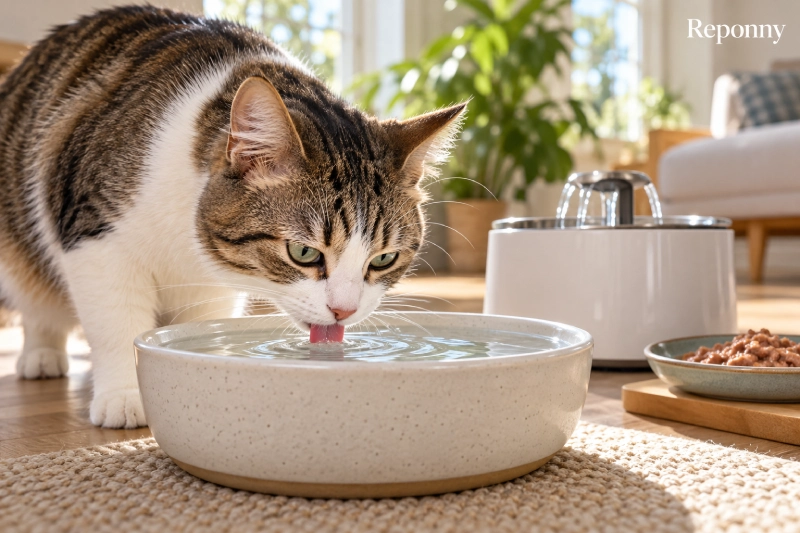
Cats are not famous for drinking large amounts of water.
Their ancestors evolved in dry environments and obtained much of their moisture from prey, so modern domestic cats can still have relatively low natural thirst compared with some other animals.
That does not mean hydration is unimportant.
Water is essential for temperature regulation, digestion, circulation, electrolyte balance, joint lubrication, and delivery of oxygen and nutrients throughout the body. Cornell Feline Health Center warns that dehydration can impair circulation, temperature control, neurologic function, and multiple organs when it becomes severe.
A cat can become dehydrated because it is drinking too little, losing too much fluid, or both.
Vomiting, diarrhea, kidney disease, diabetes, hyperthyroidism, poor appetite, dental pain, fever, and difficulty reaching water can all contribute.
Quick answer: Cats need roughly 4 ounces of total water per 5 pounds of lean body weight each day as a general starting point. A 10-pound cat therefore needs around 8 ounces, or approximately one cup, of water per day from drinking and food combined. Cats eating wet food may drink much less from the bowl because their food already supplies substantial moisture.
What Is Dehydration in Cats?
Dehydration occurs when a cat loses more body water than it takes in.
Water leaves the body continuously through:
- urine,
- feces,
- breathing,
- and other normal physiological processes.
Usually, drinking and food replace those losses.
Problems begin when losses increase or intake falls.
For example, a cat experiencing repeated vomiting may lose fluid rapidly while simultaneously feeling too nauseated to drink.
A cat with kidney disease may produce more urine and lose more water.
A painful dental problem may make a cat reluctant to approach food and water.
Cornell explains that dehydration can develop whenever water intake decreases, water loss increases, or both occur at the same time.
How Much Water Does a Cat Need?
There is no single exact amount suitable for every cat.
Cornell and VCA both use a practical estimate of approximately:
4 ounces of water per 5 pounds of body weight per day.
That gives a rough guide:
| Cat Weight | Approximate Total Daily Water |
|---|---|
| 5 lb / 2.3 kg | 4 oz / 120 mL |
| 7.5 lb / 3.4 kg | 6 oz / 180 mL |
| 10 lb / 4.5 kg | 8 oz / 240 mL |
| 12.5 lb / 5.7 kg | 10 oz / 300 mL |
| 15 lb / 6.8 kg | 12 oz / 355 mL |
Merck gives a broader general maintenance estimate of approximately 44–66 mL of water per kilogram of body weight per day, while emphasizing that requirements vary with diet, environment, health, and activity.
The most important word here is:
total.
A cat does not need to drink all of this from the water bowl.
Water also comes from food.
Wet Food Changes How Much a Cat Needs to Drink
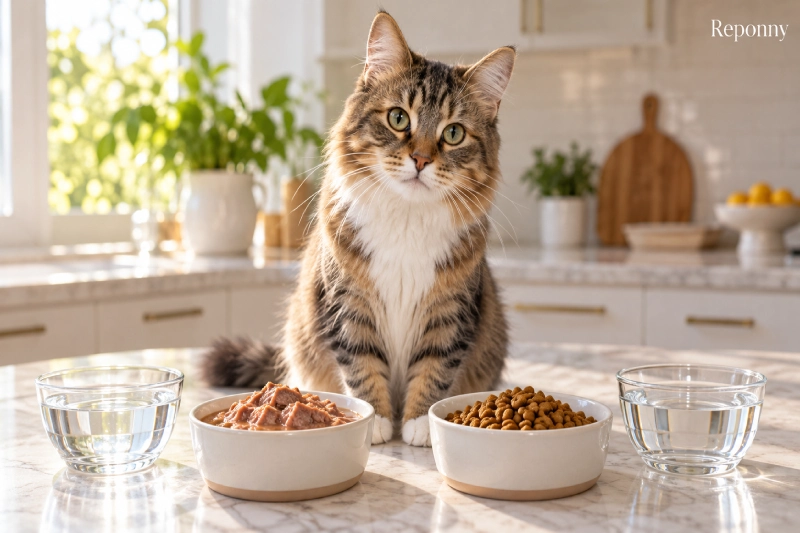
Wet food can contain a large amount of moisture.
Merck reports that canned pet foods may contain roughly 60% to more than 87% water, while dry foods typically contain only about 3–11% water.
That means a cat eating mostly wet food may obtain much of its water directly from meals.
A cat eating primarily dry kibble must usually obtain a greater proportion by drinking.
This explains why two healthy cats can visit the water bowl very differently.
Example
A cat eating moisture-rich canned food may rarely appear to drink.
That does not automatically mean the cat is dehydrated.
Another cat eating dry food may drink several times each day because its meals provide far less water.
Evaluate total hydration, not simply the number of trips to the bowl.
Signs of Dehydration in Cats
The signs vary depending on severity.
Cornell identifies common signs including:
- lethargy,
- weakness,
- poor appetite,
- dry or tacky gums,
- decreased skin elasticity,
- and sunken eyes in more severe cases.
You may also notice that your cat appears quieter than normal or spends more time resting.
More severe dehydration can interfere with circulation and normal organ function.
Merck describes worsening dehydration as being associated with progressively drier oral tissues, reduced skin elasticity, sunken eyes, weakness, changes in pulse quality, and eventually altered consciousness in severe cases.
Do not wait for the most dramatic signs.
By the time a cat looks obviously dehydrated, the underlying illness may already be significant.
Can You Check Dehydration With the Skin-Tent Test?
You may have heard of gently lifting the skin over a cat’s shoulders and watching how quickly it returns to normal.
Cornell explains that normally hydrated skin should return quickly, while dehydration can cause it to remain elevated or “tented” longer than expected.
However, this is not a perfect home diagnostic test.
Age matters.
Cornell specifically notes that older cats may have reduced skin elasticity even when normally hydrated.
Body condition and other factors can also influence what you see.
So if the skin test looks abnormal—or your cat has other concerning symptoms—use it as a reason to contact your veterinarian, not as a method to calculate an exact dehydration percentage yourself.
Veterinarians assess hydration using multiple findings rather than relying on one home test.
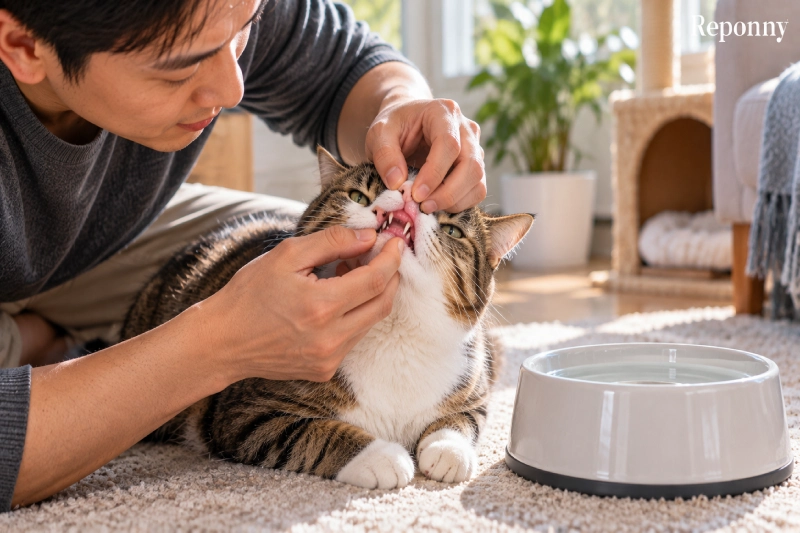
Check the Gums Too
Healthy gums are usually moist.
Dehydration may make the oral tissues feel:
dry or tacky instead of slick and moist.
Cornell and Merck both identify dry oral mucous membranes as a physical finding associated with dehydration.
Again, this is only one clue.
A cat that has dry gums plus vomiting, weakness, loss of appetite, or sunken eyes needs more attention than a cat with one uncertain home finding.
Common Causes of Dehydration in Cats
Dehydration is usually a consequence of another problem.
Some of the most common causes include:
Chronic Kidney Disease
Kidneys help regulate water balance.
Cats with chronic kidney disease can lose more water through urine because damaged kidneys become less able to concentrate it effectively.
Cornell lists chronic kidney disease as one of the common diseases associated with increased water loss and dehydration.
Diabetes Mellitus
Diabetes can cause excessive urination.
As glucose spills into the urine, additional water follows.
VCA notes that diabetic cats can become predisposed to dehydration because they urinate more frequently.
Vomiting and Diarrhea
Both can remove substantial fluid from the body.
If the cat simultaneously refuses food or water because it feels nauseated, dehydration can develop even faster.
Hyperthyroidism
Cornell includes hyperthyroidism among conditions that may increase water loss and contribute to dehydration.
Reduced Appetite
Food contributes water as well as calories.
A cat that stops eating—especially one that normally eats wet food—can suddenly lose an important source of daily moisture.
Dental Pain
Painful teeth or gums may discourage a cat from eating and sometimes from drinking.
Medication
Cornell notes that certain medications, including diuretics used in some heart patients, can increase fluid loss.
Environmental Access Problems
Sometimes the problem is surprisingly simple.
A cat may not drink adequately because:
- the bowl is empty,
- the water is dirty,
- another cat guards the bowl,
- the bowl is difficult to reach,
- or the water station is in an unpleasant location.
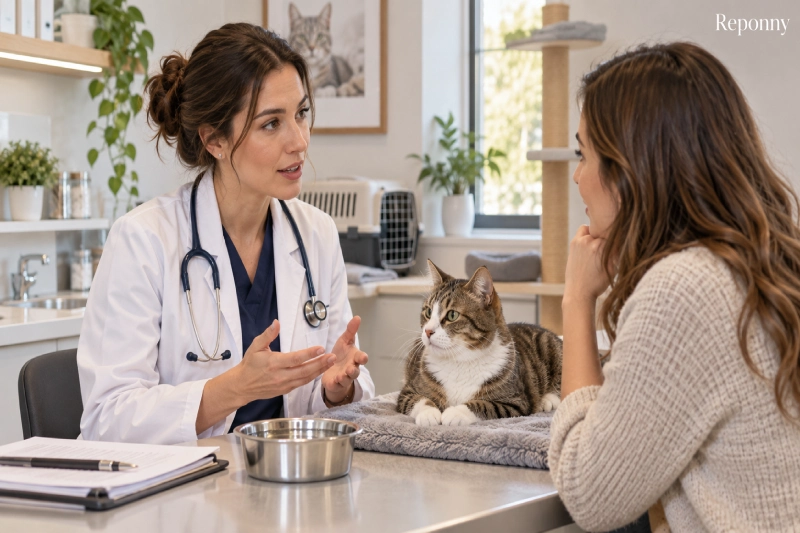
Multi-Cat Homes Can Create Hidden Water Problems
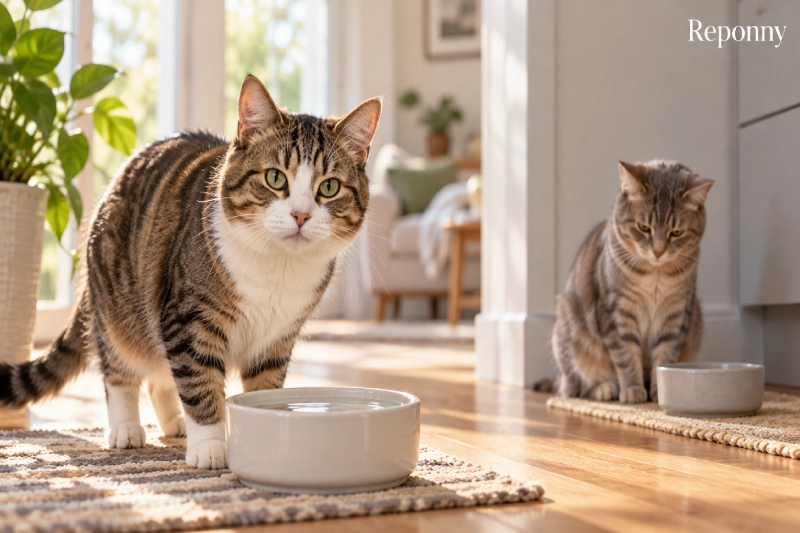
In a household with several cats, having one large water bowl does not necessarily mean every cat has comfortable access.
Cornell notes that territorial conflict can prevent a cat from reaching a water source.
A confident cat may sit near the bowl.
A timid cat may decide that drinking is not worth the confrontation.
This can happen even when there is no obvious fighting.
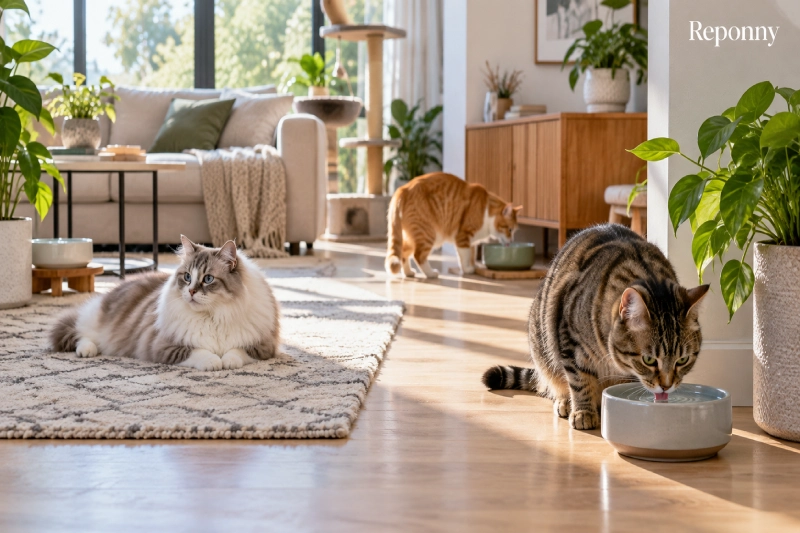
Provide multiple water stations in different locations so one cat cannot control every route to water.
If possible, position them so a shy cat does not need to pass another cat to drink.
How to Encourage a Cat to Drink More Water
If your veterinarian has not prescribed a special fluid plan, several simple changes may encourage healthier water intake.
1. Provide Multiple Water Bowls
Merck specifically recommends multiple fresh water sources because they can encourage cats to drink.
Place bowls in several areas of the home.
This is particularly useful for:
- multi-story homes,
- senior cats,
- multi-cat households,
- or cats with mobility problems.
A senior cat with arthritis should not need to climb stairs whenever it becomes thirsty.
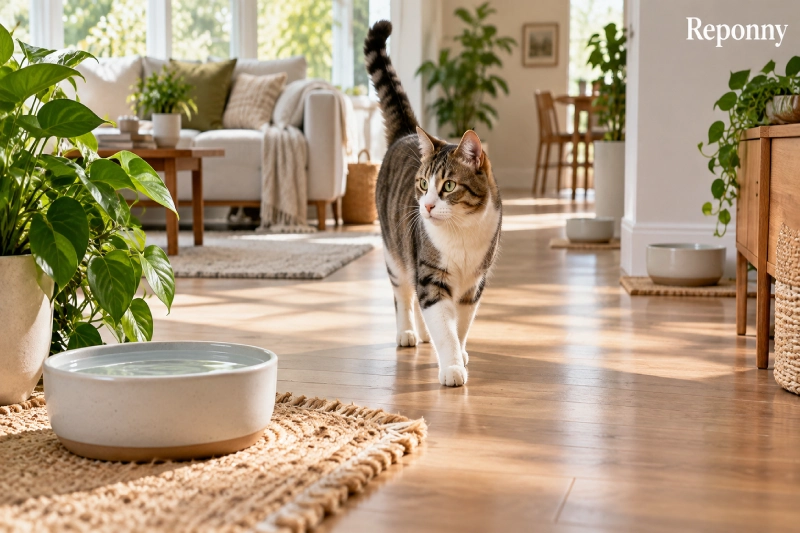
2. Keep the Water Fresh and the Bowl Clean
Cats can be sensitive to smell and taste.
VCA recommends changing water frequently and washing bowls daily to prevent odor and bacterial buildup.
Do not simply keep topping up yesterday’s water indefinitely.
Empty the bowl.
Wash it.
Rinse it thoroughly.
Refill it with fresh water.
Some cats appear dramatically more interested immediately after the bowl has been cleaned.
3. Experiment With Bowl Material
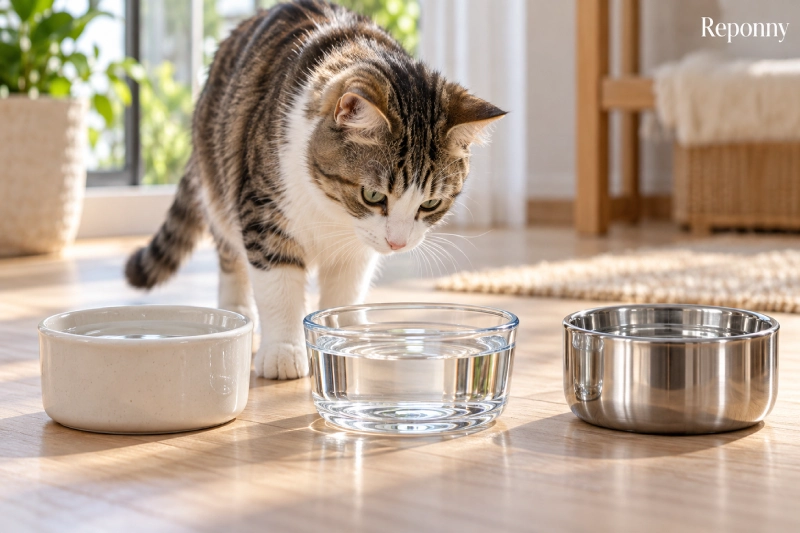
VCA suggests trying different bowl materials, including:
- ceramic,
- glass,
- and stainless steel.
Some cats appear less interested in plastic bowls.
Regardless of material, the bowl should be easy to clean and free of cracks or residue.
A broad, shallow bowl may also be more comfortable for some cats.
Do not assume that the most expensive bowl will automatically be your cat’s favorite.
Test a few safe options.
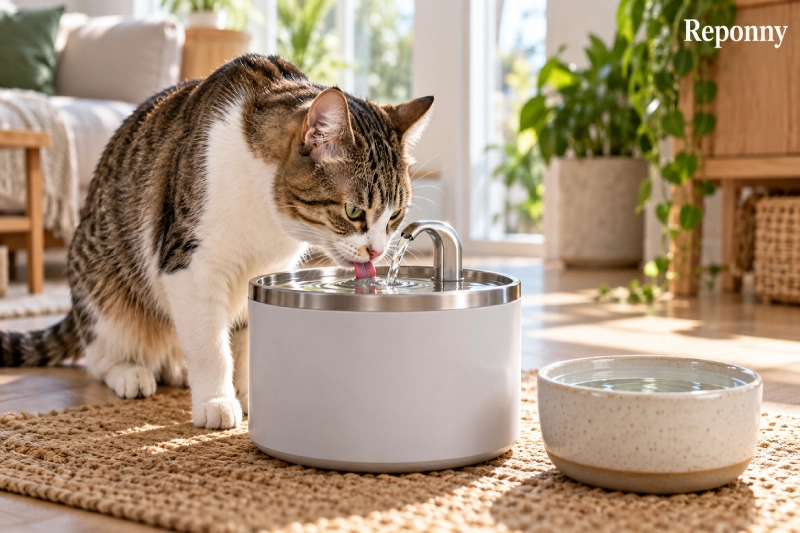
4. Try a Water Fountain
Some cats prefer moving water.
Cornell and VCA both suggest that a pet fountain can encourage drinking in certain cats.
A fountain is not guaranteed to work.
Some cats love it immediately.
Others ignore it completely.
If you use one:
- clean it regularly,
- maintain or replace the filter as instructed,
- make sure pumps remain clean,
- and keep another ordinary bowl available while your cat adjusts.
A dirty fountain is not better than a clean bowl.
5. Try Different Water Temperatures
Some cats prefer cold water.
Others prefer room-temperature water.
VCA recommends experimenting with temperature because individual preferences vary.
This is simple to test.
Offer fresh room-temperature water in one bowl and slightly cooler water in another.
See which receives more attention.
Avoid making water extremely cold or uncomfortable.
The goal is preference—not novelty for its own sake.
6. Change the Location of the Water Bowl
Where you place water may be just as important as what you put it in.
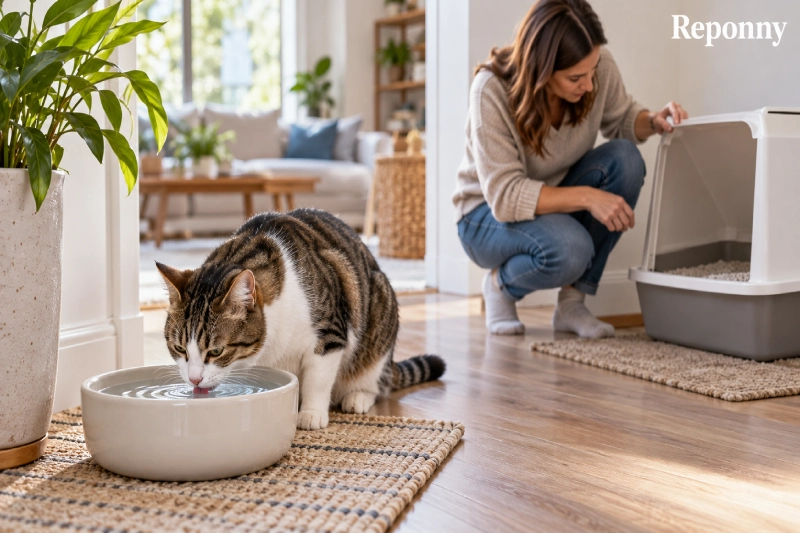
VCA recommends quiet locations and specifically advises keeping water away from the litter box.
Try water stations:
- near favorite resting areas,
- in quiet rooms,
- along common walking routes,
- or near places where your cat spends a lot of time.
Do not place every bowl next to noisy washing machines, busy hallways, or litter boxes.
The ideal drinking station should feel safe.
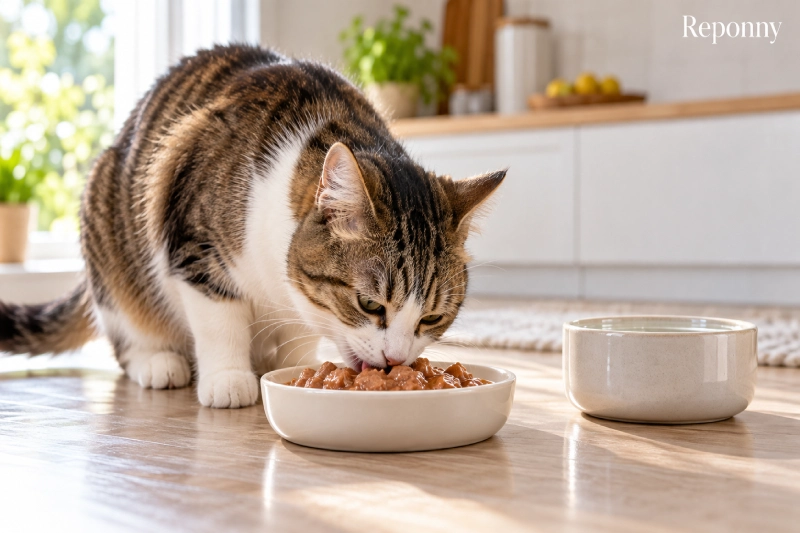
7. Feed More Wet Food
One of the simplest ways to increase water intake is to put more water inside the food.
Cornell specifically recommends wet food as a strategy for improving hydration.
Because canned foods can contain very high moisture levels, cats eating them often drink less but may still consume more total water.
You do not necessarily need to feed 100% wet food.
A mixed diet can also work.
For example:
wet breakfast + measured dry food later + wet dinner.
Keep total calories appropriate.
8. Add Water to Food
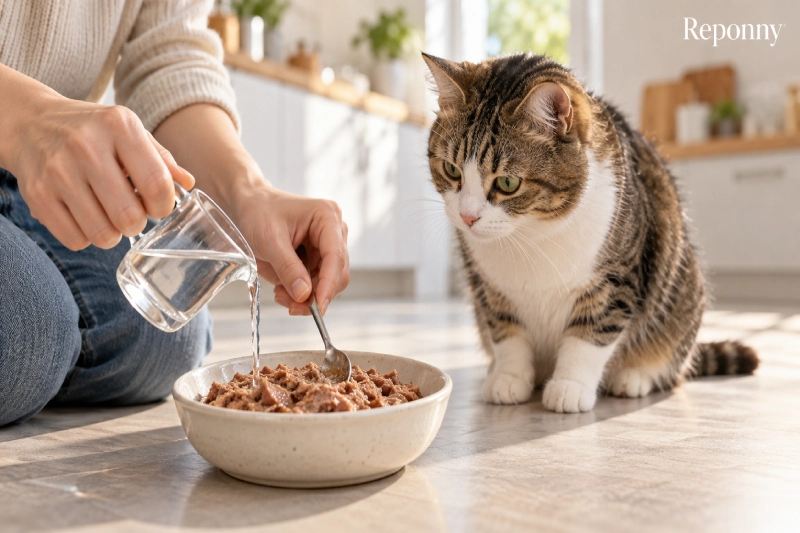
Cornell and VCA both suggest adding water to food as another way to increase fluid intake.
You can try:
- mixing a spoonful of water into wet food,
- or gradually moistening dry food if your cat accepts the texture.
Start with a small amount.
If you suddenly turn familiar kibble into a bowl of soup, some cats will simply walk away.
VCA specifically warns that if a cat refuses moistened food, provide its regular food rather than allowing prolonged food refusal.
For picky cats, gradual changes usually work better.
9. Flavor the Water Carefully
For a reluctant drinker, a small amount of flavor may help.
Cornell suggests that some cats may drink more when water is flavored with a small amount of tuna water or low-sodium chicken broth.
VCA similarly suggests about a teaspoon of low-sodium, unseasoned chicken broth as one possible strategy.
There are important cautions.
Avoid broths containing:
- onion,
- garlic,
- heavy salt,
- spices,
- or unsafe flavorings.
Change flavored water daily and clean the bowl thoroughly.
Also keep plain water available.
A flavoring technique should encourage hydration—not make the cat dependent on salty or highly flavored liquids.
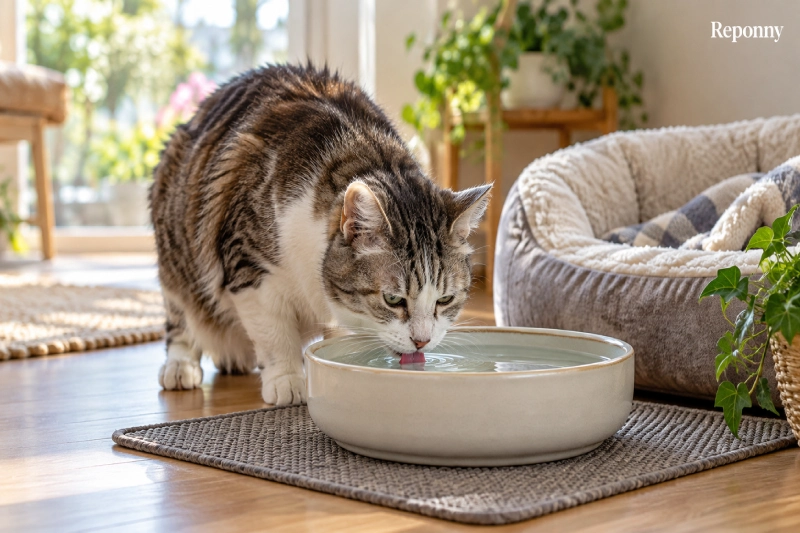
10. Make Water Easy for Senior Cats to Reach
Older cats may have arthritis or mobility limitations.
If the only water is downstairs, your senior cat may drink less simply because reaching it is uncomfortable.
Place water:
- near sleeping areas,
- on every frequently used floor,
- away from slippery surfaces,
- and somewhere the cat can reach without jumping.
A wide, stable bowl can also make drinking easier.
Hydration support often begins with making the environment easier to navigate
What If Your Cat Suddenly Starts Drinking Much More?
Drinking more water is not always a sign of improved hydration.
A sudden increase in thirst can be a medical clue.
Cornell lists several diseases associated with increased fluid loss, including:
- kidney disease,
- diabetes,
- and hyperthyroidism.
VCA also advises veterinary consultation when a cat’s drinking behavior changes significantly.
You may notice:
- the water bowl emptying faster,
- more visits to the fountain,
- drinking from sinks or toilets,
- larger urine clumps in the litter box,
- more frequent urination,
- or weight loss despite a good appetite.
Do not restrict water in response.
Merck states that healthy animals should generally have unrestricted access to water.
Instead, contact your veterinarian and mention both the increased drinking and any change in urination.
Can You Measure How Much Your Cat Drinks?
Yes, although it can be difficult in multi-cat households.
For a single cat, you can:
- Measure how much water you place in the bowl.
- Measure what remains after 24 hours.
- Account approximately for evaporation and spills.
- Repeat for several days.
Remember that this measures drinking water only.
It does not include moisture from food.
A cat eating canned food may drink very little and still have adequate total water intake.
For multiple cats, individual measurements are harder unless drinking access can be temporarily monitored or separated.
If your veterinarian needs accurate intake information, ask how they would like you to measure it.
Can You Give Water by Syringe?
Do not routinely force water into a cat’s mouth unless a veterinarian has specifically instructed you how.
Trying to syringe large amounts of water into an unwilling cat can create stress and may risk liquid entering the airway.
A genuinely dehydrated cat may need veterinary fluid therapy rather than repeated attempts to force drinking at home.
Cornell notes that clinical treatment can include subcutaneous or intravenous fluids, depending on the situation.
The underlying cause also needs treatment.
Giving water does not solve ongoing vomiting, kidney disease, diabetes, intestinal disease, or another condition that is continuously removing fluid.
When Is Dehydration an Emergency?
Contact a veterinarian promptly if you suspect dehydration.
Seek urgent care especially when dehydration occurs with:
- repeated vomiting,
- severe or persistent diarrhea,
- inability to keep water down,
- profound weakness,
- collapse,
- markedly sunken eyes,
- very dry gums,
- severe lethargy,
- confusion or altered consciousness,
- difficulty breathing,
- significant heat exposure,
- or complete refusal of food and water.
Merck describes severe dehydration as potentially involving poor circulation, weak pulses, pronounced skin-tenting, sunken eyes, and altered consciousness.
Cornell advises contacting a veterinarian promptly when dehydration is suspected because the cause must be identified as well as the fluid deficit corrected.
Kittens and Dehydration
Kittens deserve extra attention because their small bodies can deteriorate quickly when illness causes vomiting, diarrhea, or poor intake.
VCA lists dehydration signs in kittens including:
- lethargy,
- reduced appetite,
- dry gums,
- reduced skin elasticity,
- and sunken eyes.
A kitten with repeated vomiting or diarrhea should not simply be observed for several days.
Young kittens can lose both fluid and energy reserves quickly.
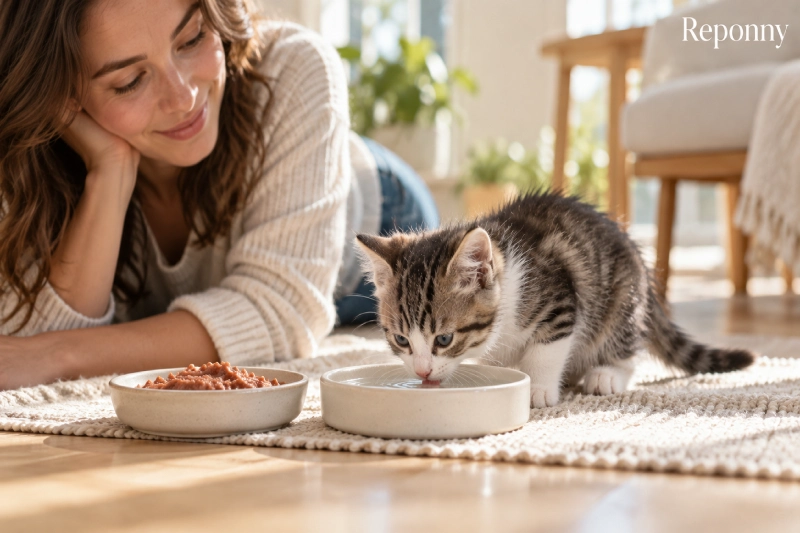
Keep fresh water available to weaned kittens and provide appropriate moisture-rich kitten food if suitable.
Very young unweaned kittens have different fluid and nutritional needs and should receive appropriate veterinary or neonatal-care guidance.
Hot Weather and Dehydration
Warm weather can increase hydration needs.
Cornell recommends ensuring continuous access to fresh water during hot weather and notes that fountains may encourage drinking in some cats.
For outdoor-access cats:
- provide clean water both indoors and outdoors,
- make sure bowls stay shaded,
- replace warm or dirty water,
- and ensure the cat can return indoors to a cooler environment.
Never rely on puddles or unknown outdoor water sources.
Heat exposure combined with inadequate water can become dangerous.
A cat that appears overheated, weak, confused, or unable to cool itself needs prompt veterinary attention.
Dehydration and Urinary Health
Good water intake supports normal urinary function.
VCA notes that increasing water intake is especially important for some cats with conditions such as bladder crystals, stones, kidney disease, or urinary problems.
More water generally produces more dilute urine.
However, hydration is only one part of urinary health.
A cat straining to urinate, repeatedly visiting the litter box without producing urine, crying while urinating, or passing only tiny drops may have a urinary obstruction or other urgent problem.
In particular, urinary obstruction in male cats can be life-threatening.
Do not try to manage those signs simply by encouraging more drinking.
Seek immediate veterinary care.
A Practical Hydration Setup for Your Home
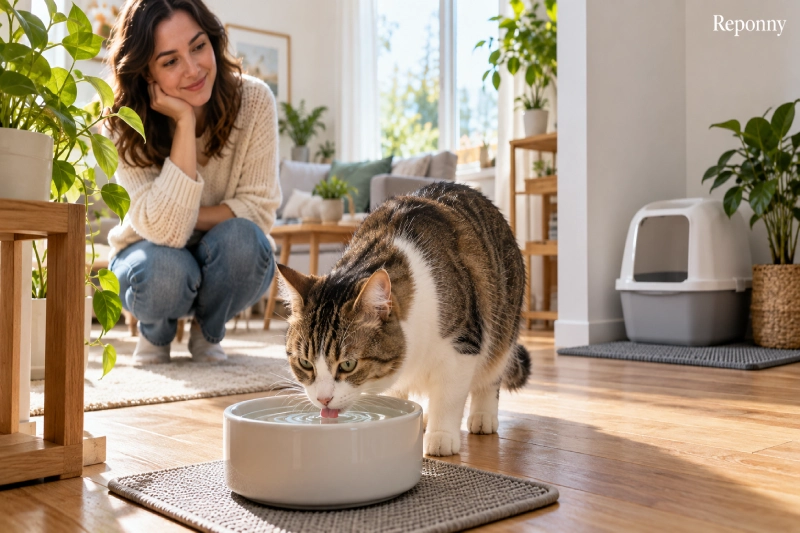
For many cats, a good hydration environment can be simple.
Try:
| Hydration Strategy | Practical Approach |
|---|---|
| Fresh water | Replace regularly |
| Multiple bowls | Place in different quiet locations |
| Bowl choice | Test ceramic, glass, or stainless steel |
| Wide bowl | Useful for cats that dislike touching edges |
| Water fountain | Try if your cat prefers moving water |
| Wet food | Adds substantial dietary moisture |
| Added water | Mix small amounts into food gradually |
| Flavor | Tiny amount of safe low-sodium broth if needed |
| Senior access | Put water close to favorite resting places |
| Multi-cat homes | Provide separate water stations |
The goal is to give your cat multiple easy opportunities to consume water without creating stress.
Frequently Asked Questions
How Much Water Should a Cat Drink Each Day?
As a general guide, cats need approximately 4 ounces of total water per 5 pounds of lean body weight per day.
A 10-pound cat therefore needs about 8 ounces, or one cup, from drinking and food combined.
How Can I Tell if My Cat Is Dehydrated?
Possible signs include:
- lethargy,
- weakness,
- reduced appetite,
- dry or tacky gums,
- reduced skin elasticity,
- and sunken eyes in more severe cases.
Veterinary assessment is more reliable than home testing alone.
Is the Skin-Tent Test Accurate for Cats?
It can provide a clue, but it is not perfect.
Cornell notes that geriatric cats may naturally have reduced skin elasticity even when hydrated.
Use the test together with other signs and veterinary advice.
Why Doesn’t My Cat Drink Much Water?
Cats eating wet food may obtain much of their daily water directly from food and therefore drink less.
Cats also vary individually in drinking behavior.
Is Wet Food Better for Hydration?
Wet food generally provides substantially more moisture than dry food and can increase total water intake.
That does not mean every cat must eat exclusively wet food.
Are Cat Water Fountains Better Than Bowls?
Some cats drink more from moving water, while others prefer ordinary bowls.
Cornell and VCA both recommend fountains as something worth trying rather than as a universal requirement.
Can I Add Water to My Cat’s Food?
Yes, for many cats.
Start with a small amount and increase gradually if your cat accepts it. If your cat refuses the altered food, return to a familiar meal rather than allowing food refusal.
Why Is My Cat Suddenly Drinking a Lot of Water?
A major increase in thirst can be associated with conditions including:
- kidney disease,
- diabetes,
- hyperthyroidism,
- and other illnesses.
Contact your veterinarian if drinking or urination changes noticeably.
Should I Restrict Water if My Cat Drinks Too Much?
No, not unless a veterinarian gives a very specific medical instruction.
Merck advises that animals generally should have unrestricted access to fresh water.
Excessive drinking should trigger investigation of the cause—not water restriction.
Can I Give My Cat Milk Instead of Water?
No.
Fresh water should remain the primary drink.
Many adult cats have difficulty digesting lactose, so milk can cause gastrointestinal upset and does not need to be part of a normal feline diet.
Final Thoughts
Hydration is easy to overlook because many cats do not spend much time visibly drinking.
But water is one of the most important nutrients in the feline diet.
A healthy cat needs enough total water to support:
circulation, digestion, temperature regulation, electrolyte balance, organ function, and normal urinary health.
As a general guide, a cat needs approximately 4 ounces of total water per 5 pounds of body weight each day, although individual needs vary.
Remember that wet food counts.
A cat eating moisture-rich canned food may rarely visit the bowl but still consume an appropriate amount of water.
A dry-food cat will usually need to drink more.
To encourage hydration, keep fresh water available at all times, provide multiple bowls, experiment with bowl material and location, try a fountain, add moisture to meals when accepted, and make water especially easy to reach for senior and multi-cat households.
At the same time, do not focus only on making your cat drink.
A cat that becomes dehydrated despite having access to water may have an underlying illness.
Vomiting, diarrhea, kidney disease, diabetes, hyperthyroidism, reduced appetite, medication effects, and other conditions can all disturb normal fluid balance.
And excessive drinking deserves attention too.
The goal is not to force your cat to drink the largest amount possible.
It is to maintain normal hydration while noticing meaningful changes in drinking, urination, appetite, weight, and behavior early.
When dehydration is suspected—especially alongside weakness, vomiting, diarrhea, food refusal, or other signs of illness—contact your veterinarian promptly.