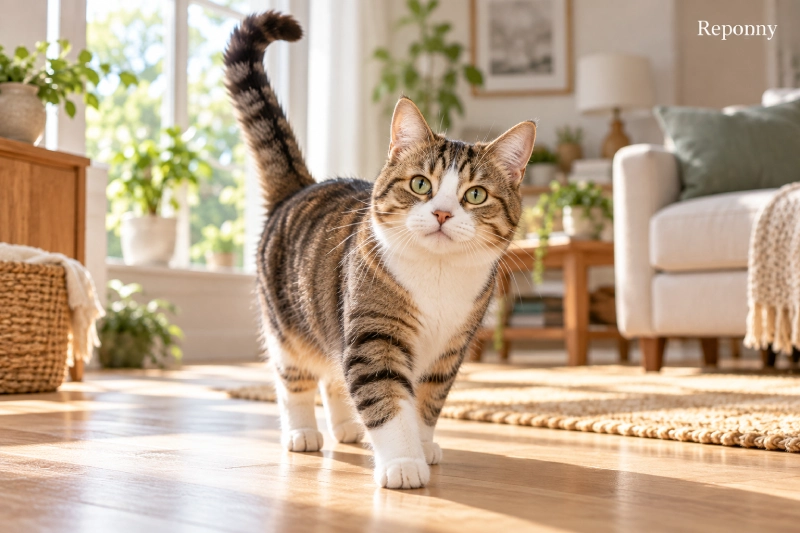
A cat’s tail can change from a relaxed curve to a rigid vertical line, a fast-moving whip, or a bottle-brush puff in only a few seconds.
Those changes are not random.
Cats use the position and movement of the tail as part of a larger system of visual communication involving the eyes, ears, whiskers, facial muscles, posture, and movement of the entire body.
One of the clearest examples is the upright tail. Research on domestic cats has found that the tail-up posture functions as an affiliative social signal. Cats use it when approaching other cats in friendly interactions, and kittens also display it when greeting their mothers.
But even the tail cannot be interpreted like a simple dictionary.
A rapidly moving tail may signal irritation during petting, while movement near the tip may occur when a cat is intensely watching prey. A low tail can accompany anxiety or pain, but some cats naturally carry their tails lower than others.
Context matters.
Quick answer: A relaxed upright tail usually indicates a friendly, confident cat. A gently curved tip often accompanies a relaxed greeting. A tucked or very low tail can indicate fear, anxiety, or pain. A puffed tail signals intense arousal or feeling threatened. Rapid swishing or thrashing often means irritation or overstimulation, while a twitching tip may occur during hunting or focused play.
Why Cat Tail Language Matters
Cats often communicate discomfort long before they scratch or bite.
Imagine you are petting your cat.
At first, the body is relaxed.
Then the tail tip begins moving.
A few moments later, the entire tail starts whipping from side to side. The ears rotate backward and the shoulders become tense.
If petting continues, the cat may eventually swat or bite.
Cornell specifically identifies tail lashing together with dilated pupils and ears moving backward as warning signals that can occur before petting-induced aggression.
Recognizing the earlier signal allows you to stop before the interaction escalates.
Tail language can also help you recognize:
- friendly greetings,
- fear,
- play,
- hunting focus,
- social tension,
- overstimulation,
- urine marking,
- and possibly pain or injury.
It is one of the easiest parts of feline body language to observe from across a room.
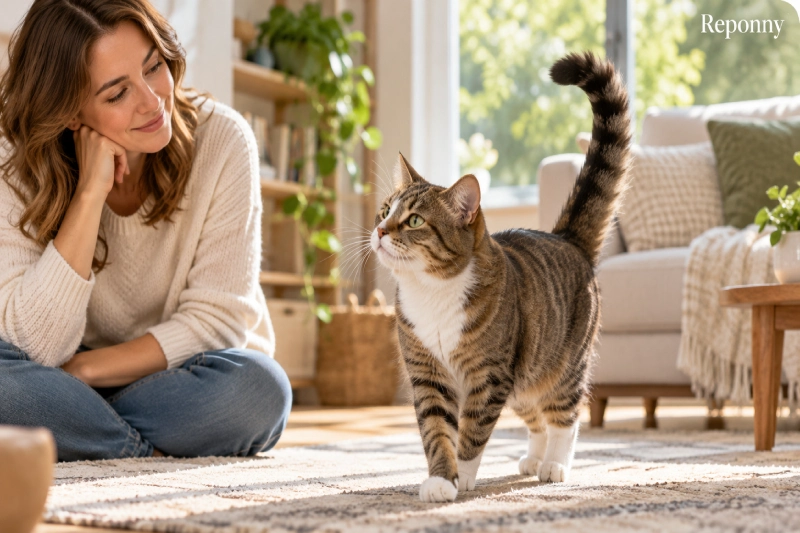
1. Tail Straight Up: Usually a Friendly Greeting
One of the most positive tail positions is a tail held vertically upward.
If your cat walks toward you with:
- tail upright,
- body loose,
- ears neutral or forward,
- relaxed facial expression,
the cat is generally feeling confident and socially comfortable.
VCA describes the straight-up tail in a relaxed cat as a signal of friendliness and confidence.
This interpretation is supported by behavioral research.
A study of domestic cats found that the tail-up signal was strongly associated with affiliative social interaction. It occurred when cats approached one another peacefully and appears to help communicate non-hostile intent.
Research examining cat-cat and cat-human visual signals has also found tail-up behavior particularly important when cats approached people. Those approaches were frequently followed by friendly rubbing against the person’s legs.
So when your cat comes running toward you with its tail held high, it is generally a very good sign.
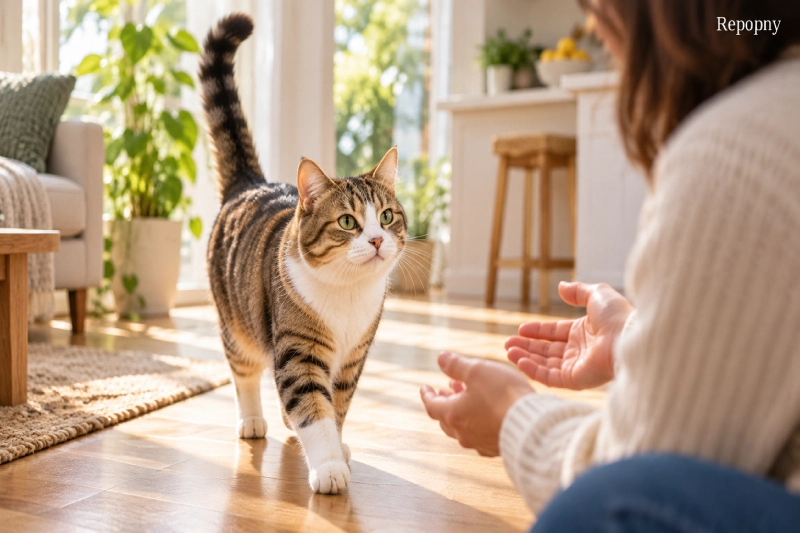
2. Tail Up With a Curved Tip: The “Question Mark” Tail
Sometimes the tail is upright but the final few inches curve gently forward.
Owners often describe this as a:
question-mark tail.
VCA describes an upright tail with a softly curved end as a posture commonly seen when a cat feels friendly and relaxed.
You may see this when your cat:
- approaches you,
- walks around the house confidently,
- greets a familiar person,
- or prepares for positive interaction.
The curve itself should not be overanalyzed.
Look at the whole cat.
If the eyes are soft, muscles loose, ears neutral, and movement calm, the message is generally positive.
Can you pet a cat with a question-mark tail?
Often yes—but allow the cat to make the final decision.
Offer your hand at a respectful distance and allow the cat to approach, sniff, rub, or walk away.
Friendly body language is an invitation to social interaction, not unlimited permission to handle the cat however you want.
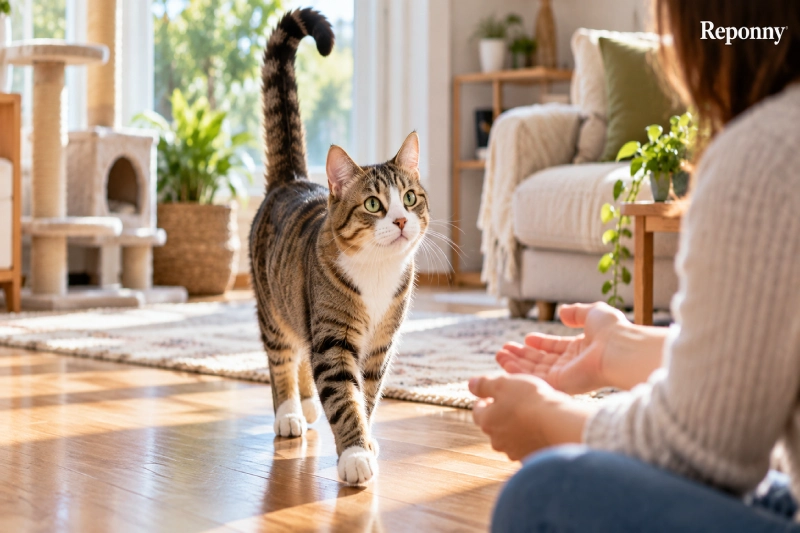
3. Tail Wrapping Around Your Leg or Arm
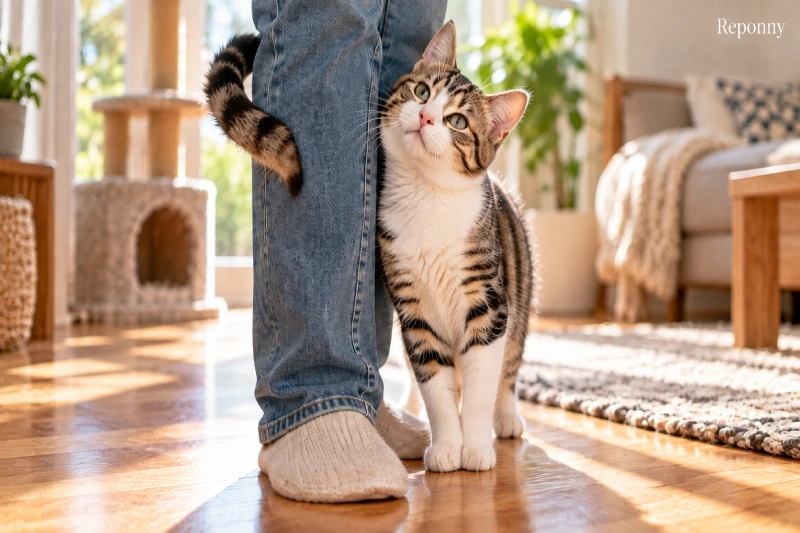
Some cats greet familiar people by rubbing against them and briefly curling the tail around a leg or arm.
VCA identifies this tail-wrapping greeting as an affiliative or affectionate interaction.
The movement can resemble a person briefly placing an arm around someone during a greeting.
You may see a sequence such as:
tail up → approach → cheek or body rub → tail wraps around leg → cat walks past.
The cat may also be depositing scent while rubbing against you.
The complete interaction usually indicates social familiarity and comfort.
Do not grab the tail when it wraps around you.
The cat is communicating voluntarily; allowing it to control the interaction helps preserve that trust.
4. Tail Quivering While Greeting You
This movement can confuse owners because tail quivering has at least two very different contexts.
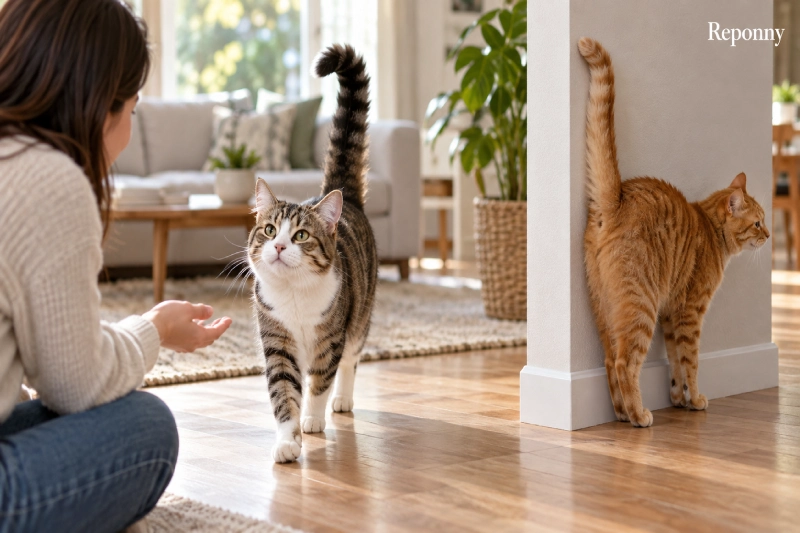
A cat may approach a familiar person with the tail upright and make a small rapid quivering movement.
VCA notes that a cat quivering its tail when seeing a person may simply be excited.
The rest of the cat is typically friendly:
- relaxed body,
- upright tail,
- approaching voluntarily,
- rubbing,
- or seeking attention.
That is different from urine spraying.
5. Quivering Tail Against a Wall: Watch for Urine Marking
If the cat:
- backs toward a vertical object,
- holds the tail upright,
- quivers the tail,
- and releases a small amount of urine backward,
that is characteristic of urine spraying or marking.
VCA describes this classic marking posture as the cat backing toward a vertical surface and usually quivering the tail while depositing urine.
So the same-looking tail vibration can mean something very different depending on what the rest of the body is doing.
Quivering while approaching you
Often excitement or greeting.
Quivering while backing toward a wall
May indicate urine marking.
New spraying behavior deserves attention because stress and medical problems can contribute to abnormal elimination behavior.
6. Tail Low to the Ground
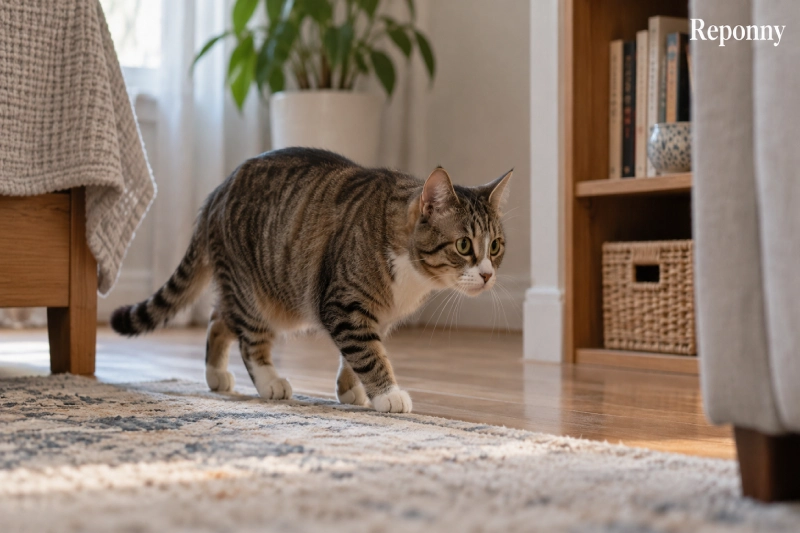
A tail held unusually low can indicate that the cat feels uncomfortable.
VCA notes that a tail carried close to the ground may accompany:
- fear,
- anxiety,
- or pain.
The rest of the body helps clarify the situation.
For example:
Low tail + crouched body + ears back
Fear or anxiety becomes more likely.
Low tail + reluctance to jump + unusual walking
Pain or injury becomes a greater concern.
Low tail while stalking a toy
The cat may simply be using a low hunting posture.
This illustrates why you should compare behavior with your individual cat’s normal baseline.
A cat that naturally carries its tail relatively low is different from a cat whose normally upright tail suddenly hangs down all day.
7. Tail Tucked Under the Body
A strongly tucked tail is more concerning than a casually low tail.
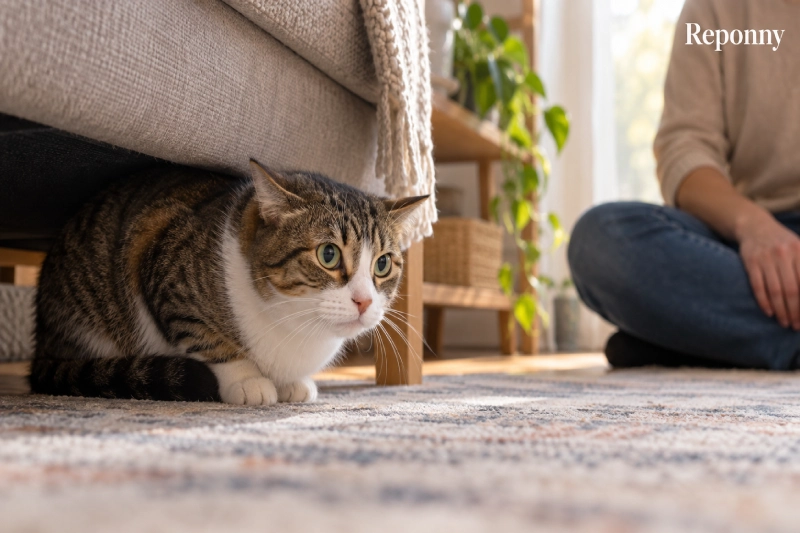
Cornell identifies a tail held closely wrapped or tucked beneath the body as part of the typical posture of a fearful cat.
VCA likewise notes that a tail tucked between the legs can indicate:
- fear,
- anxiety,
- or pain.
You may also see:
- flattened ears,
- dilated pupils,
- crouching,
- hiding,
- reduced movement,
- or tense muscles.
If the cat is frightened, do not pull it out of hiding or force physical contact.
Provide space and a safe exit.
If a normally confident cat suddenly begins keeping its tail tucked without an obvious behavioral reason, consider whether illness or pain could be involved.
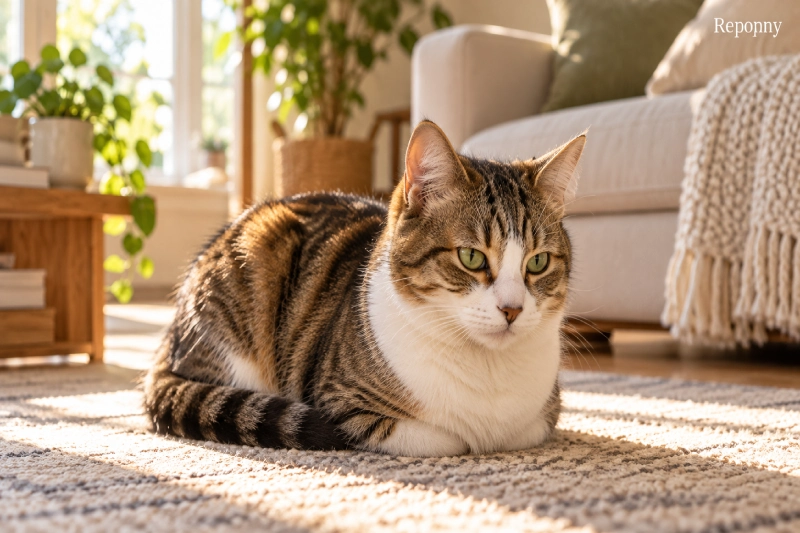
8. Tail Wrapped Around the Cat’s Own Body
This posture needs context.
A comfortable cat resting in a compact loaf position may casually wrap its tail around the body.
That can be completely normal.
However, VCA notes that persistent tail wrapping, especially with other abnormal body-language signals, can accompany defensiveness, pain, or illness.
Compare these situations:
Relaxed
Cat is resting comfortably, eyes soft, ears neutral, muscles loose.
Possibly uncomfortable
Cat remains tightly compressed, tail firmly wrapped, ears rotated backward, head lowered, appetite changed, or interaction reduced.
The tail alone does not tell you which situation is occurring.
The entire posture does.
9. Puffed-Up Tail: “Make Me Look Bigger”
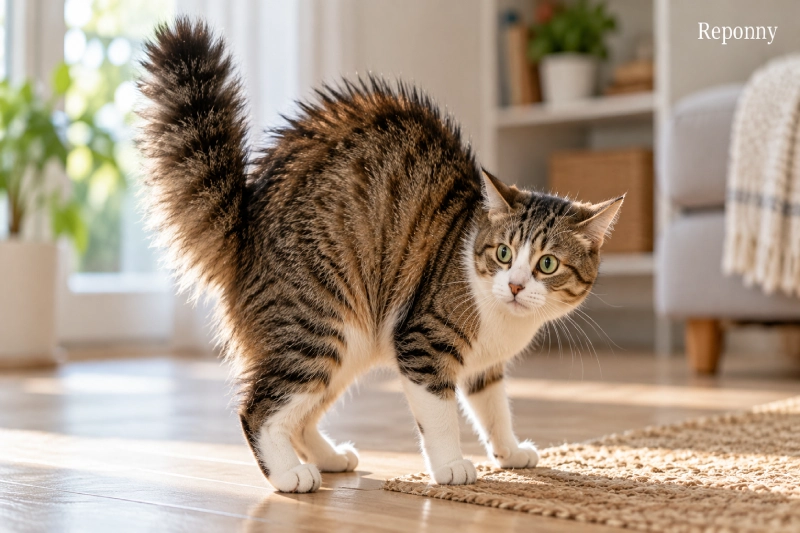
Few cat signals are as dramatic as a suddenly puffed tail.
The individual hairs stand outward, making the tail look several times larger than usual.
This is called piloerection.
A puffed tail typically reflects intense arousal, often because the cat feels frightened or threatened.
VCA states that a cat with the tail fur puffed outward may feel threatened and should be given space.
Cornell also describes raised hair on the tail and body as part of aggressive or defensive posturing.
You may simultaneously see:
- arched back,
- sideways posture,
- flattened ears,
- very large pupils,
- raised fur along the back,
- hissing,
- or growling.
The goal of this posture is partly to make the cat appear larger and more difficult to challenge.
Does a puffed tail always mean aggression?
No.
A startled cat can puff its tail instantly.
Kittens sometimes puff up during excited play.
Again, look at what happened immediately beforehand.
10. Tail Swishing Side to Side
Dog owners sometimes misinterpret this signal.
A wagging dog may be socially excited or friendly.
A rapidly swishing cat is often communicating something very different.
VCA states that wagging, swishing, thumping, or thrashing of the tail commonly occurs when a cat is irritated or angry, including when it has had enough petting or play.
Cornell similarly identifies tail lashing as a warning sign that may appear before petting-induced aggression.
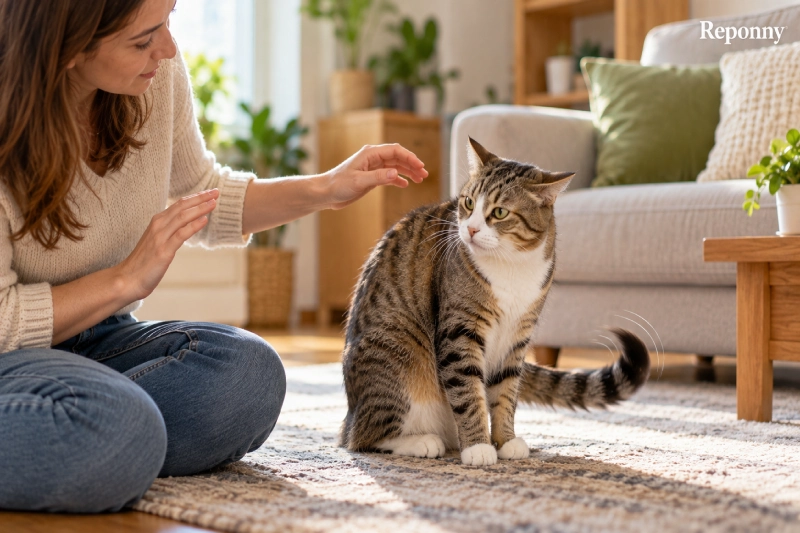
If your cat begins vigorously whipping the tail during petting:
stop touching the cat.
You do not need to wait for a hiss, swat, or bite.
The tail may already be communicating:
“I have had enough.”
Is Every Moving Tail an Angry Tail?
No.
Tail movement reflects arousal, and arousal can occur in several situations.
For example, the cat may be:
- hunting,
- playing,
- irritated,
- uncertain,
- intensely focused,
- or overstimulated.
A recent pilot study of human-cat communication found differences in tail-wagging behavior depending on how unfamiliar humans interacted with cats, supporting the idea that tail movement can relate to the cat’s comfort and social state.
So do not interpret movement without asking:
What is the cat doing?
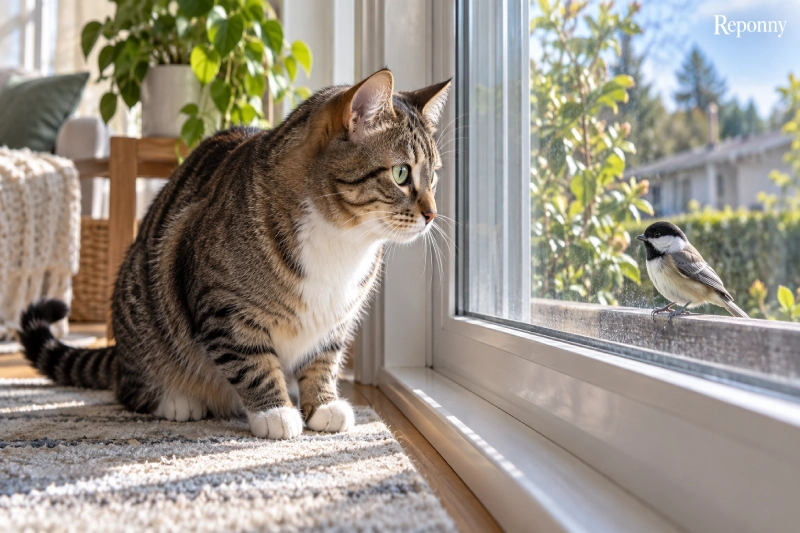
A cat watching a bird through the window is different from a cat whose tail is thrashing while someone rubs its belly.
11. Twitching Tail Tip
Sometimes only the last few centimeters of the tail move.
VCA notes that tail-tip twitching commonly occurs when a cat is engaging its hunting behavior, such as while watching a bird or preparing to pounce on a toy.
You may see:
- intensely focused eyes,
- low body position,
- ears pointed toward the target,
- whiskers forward,
- tail largely still,
- but the tip twitching.
This is very different from a full-force angry tail thrash.
However, VCA also notes that mild tail-tip twitching may indicate irritation in some contexts—for example, if you disturb a resting cat.
So:
bird outside window + twitching tip = likely focused hunting arousal
while
sleeping cat being repeatedly touched + twitching tip = possibly “please stop.”
12. Tail Thumping While Resting
A cat may remain lying down while repeatedly hitting the tail against the floor, sofa, or bed.
Do not assume the cat is relaxed simply because it has not stood up.
VCA groups thumping and thrashing with tail movements that commonly accompany irritation or anger.
Watch for additional signs:
- ears rotating backward,
- skin twitching,
- tense paws,
- pupils changing,
- head turning toward your hand,
- or sudden stillness.
If those signs appear during petting, give the cat a break.
Respecting low-level warnings reduces the need for stronger warnings later.
13. Tail Position During Play
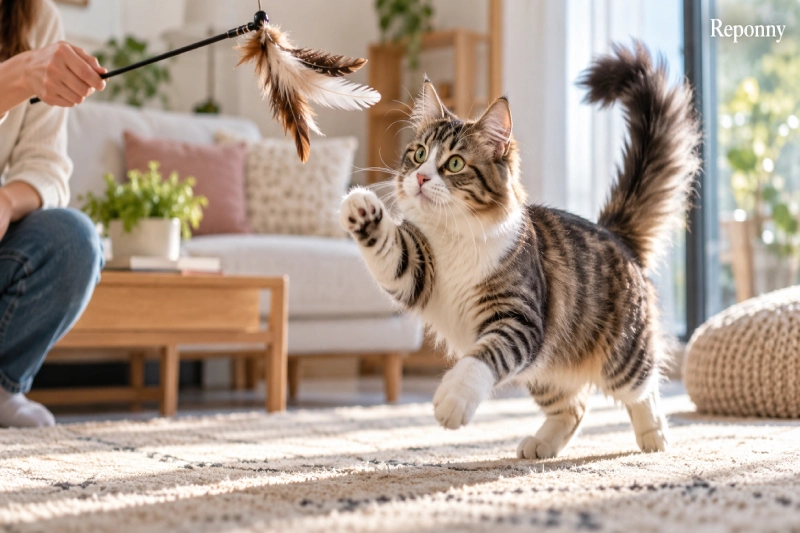
Cat play can look surprisingly dramatic.
A kitten chasing a toy may have:
- large pupils,
- fast tail movement,
- twitching tail tip,
- crouched posture,
- sudden pounces,
- and rapid changes of direction.
Those same individual signals might look concerning in another situation.
The difference is the behavioral sequence.
A playful cat voluntarily returns to the game, chases the toy, disengages normally, and does not appear trapped.
Use wand toys and other appropriate objects for hunting-style games instead of encouraging the cat to attack hands.
This gives predatory behavior an appropriate outlet.
14. Tail Signals Between Cats
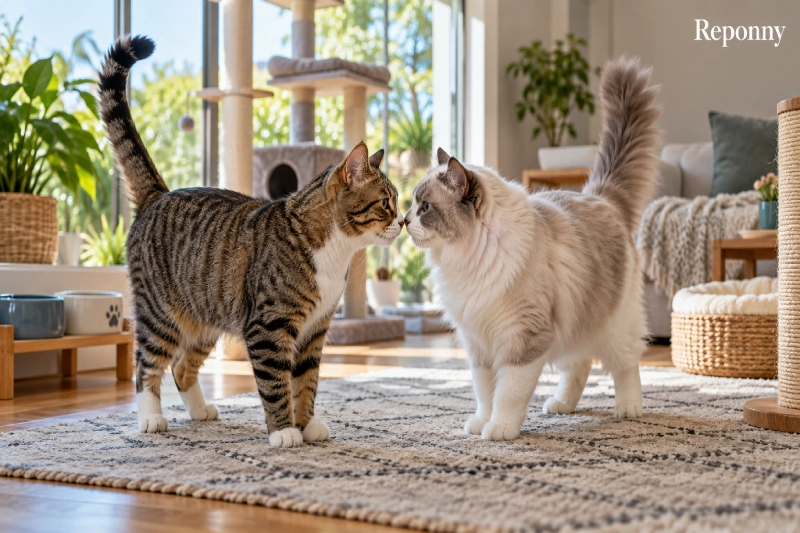
Tail posture also plays an important role in cat-to-cat communication.
The strongest scientific evidence exists for the upright-tail greeting signal.
Researchers studying social groups of domestic cats found that tail-up behavior accompanied friendly interaction and appeared to signal willingness to approach peacefully.
However, another study examining hundreds of cat-cat interactions found that tail position by itself was not always the best predictor of the interaction’s outcome. Ear positions and combinations of signals were also important.
This reinforces a central rule:
Even between cats, the tail is only one part of the conversation.
When observing two cats, look at:
- distance between them,
- ears,
- staring,
- body orientation,
- muscle tension,
- vocalizations,
- blocking of pathways,
- chasing,
- and whether either cat is trying to leave.
A quiet interaction can still contain social tension.
15. Can Tail Position Reveal Pain?
Sometimes.
A normally social cat that suddenly keeps its tail:
- low,
- tucked,
- unusually still,
- or tightly wrapped
may be experiencing discomfort, particularly if other behavior also changes.
VCA specifically lists anxiety and pain among possible reasons a cat may hold the tail low or tucked.
Possible accompanying signs include:
- reduced jumping,
- hiding,
- decreased appetite,
- reluctance to be touched,
- unusual walking,
- difficulty using the litter box,
- or vocalization.
Do not diagnose pain solely from tail posture.
But a sudden persistent change from your cat’s normal tail behavior deserves attention.
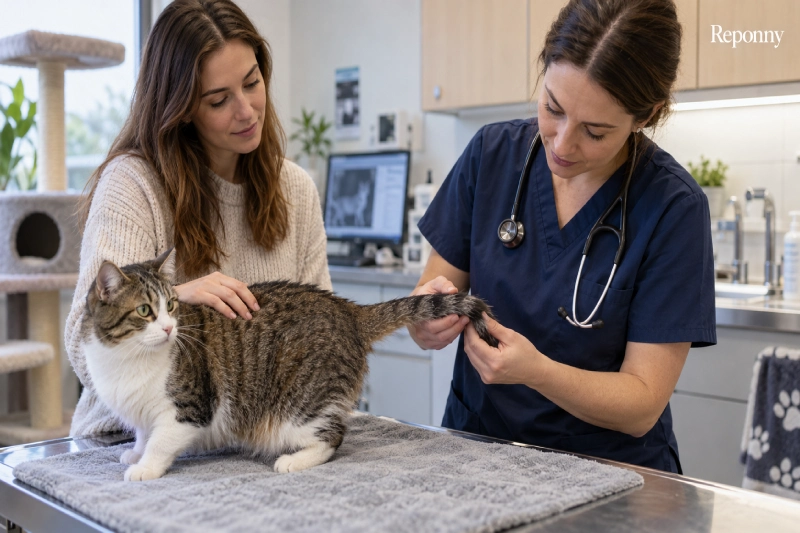
16. What If Your Cat Suddenly Cannot Lift Its Tail?
That is different from ordinary body language.
The feline tail contains vertebrae, muscles, nerves, and blood vessels and is effectively an extension of the spinal column.
VCA explains that injury to tail nerves—particularly near the base—can cause the tail to hang limply. Serious pull injuries can also affect nerves involved in urination and defecation.
Seek veterinary care if your cat suddenly:
- cannot lift or move the tail,
- has a new limp tail after trauma,
- cries when the tail is touched,
- has swelling or bleeding,
- develops urinary or fecal problems,
- or begins dragging the tail.
A limp tail is not merely an emotional message.
It can be a medical problem.
17. Why Is My Cat Biting or Chasing Its Own Tail?
Kittens may occasionally chase their tails during play.
VCA notes that this is less common in adult cats. Persistent tail chasing or biting can sometimes be associated with:
- itching,
- fleas,
- allergies,
- wounds,
- pain,
- anxiety,
- or inadequate enrichment.
Cornell also notes that cats with feline hyperesthesia may show unusual sensitivity near the back and tail base and may chase or bite their tails.
Occasional kitten play is one thing.
Repeated aggressive biting of the tail—especially if the cat damages the skin—is another.
Have persistent behavior evaluated rather than assuming the cat is simply entertaining itself.
A Simple Cat Tail Language Chart
| Tail Position or Movement | Common Interpretation |
|---|---|
| Straight upright tail | Friendly, confident greeting |
| Upright with curved tip | Friendly, relaxed |
| Tail wrapped around your leg | Affiliative social greeting |
| Upright tail quivering near you | Excitement may be involved |
| Quivering while backing to wall | Possible urine spraying |
| Low tail | Fear, anxiety, pain, or context-dependent focus |
| Tail tucked under body | Fear, anxiety, possible discomfort |
| Tail loosely wrapped while resting | Can be normal relaxation |
| Puffed tail | Intense arousal, fear, feeling threatened |
| Rapid swishing/thrashing | Irritation, anger, overstimulation |
| Twitching tip | Hunting focus, play, or mild irritation |
| Suddenly limp tail | Possible injury or nerve problem |
Think of this as a guide, not a translation dictionary.
The ears, eyes, whiskers, posture, environment, and your cat’s normal behavior always matter.
How to Respond to Your Cat’s Tail Signals
When the tail indicates comfort, you can allow the cat to continue interacting voluntarily.
When the tail begins showing uncertainty or irritation:
reduce pressure.
Stop petting.
Slow your movements.
Give the cat more space.
If the tail is puffed, tucked tightly, or thrashing together with flattened ears or defensive vocalization, do not corner the cat.
Allow an escape route.
Never punish a frightened cat for defensive behavior.
Cornell warns that physical punishment can increase fear and anxiety and worsen aggression.
The goal of understanding body language is not to control the cat.
It is to notice what the cat is already trying to communicate.
Frequently Asked Questions
What Does It Mean When a Cat’s Tail Is Straight Up?
A relaxed upright tail usually indicates friendliness and confidence.
Behavioral research supports tail-up as an affiliative greeting signal in domestic cats.
What Does a Question-Mark Cat Tail Mean?
An upright tail with a gently curved tip commonly accompanies a friendly, relaxed cat.
Why Does My Cat Wrap Its Tail Around My Leg?
This often occurs as part of an affectionate or affiliative greeting, usually together with rubbing against you.
Why Does My Cat’s Tail Quiver When It Sees Me?
If your cat approaches you with relaxed body language and an upright quivering tail, excitement may be involved.
If it backs toward a vertical surface while the tail quivers, the behavior may instead be urine marking.
Why Does My Cat Wag Its Tail While I Pet It?
Rapid swishing, thumping, or tail lashing during petting can indicate irritation or overstimulation.
Cornell identifies tail lashing as one signal that may precede petting-induced aggression.
Stop petting and give the cat a break.
Why Does My Cat Twitch the Tip of Its Tail?
Tail-tip twitching may occur when a cat is intensely focused on hunting or play.
In other contexts, particularly when a resting cat is disturbed, it can signal mild irritation.
Why Is My Cat’s Tail Puffed Up?
A puffed tail typically reflects intense arousal and often appears when a cat feels frightened or threatened.
Give the cat space.
Why Does My Cat Keep Its Tail Between Its Legs?
A tucked tail can accompany fear, anxiety, or pain.
Check the rest of the body and consider veterinary evaluation if the behavior is new or persistent.
Does a Moving Tail Mean My Cat Is Angry?
Not always.
Movement may occur with irritation, hunting focus, play, excitement, or social arousal.
The speed and type of movement plus the surrounding situation determine the likely meaning.
Why Is My Cat’s Tail Suddenly Limp?
A suddenly limp or immobile tail can result from fracture, nerve damage, or another injury.
VCA advises veterinary examination, especially when the cat cannot move the tail normally or has problems urinating or defecating.
Should I Touch a Cat With a Thrashing Tail?
Usually it is better to stop and give the cat space.
A thrashing tail can be an early warning of irritation, especially when accompanied by tense muscles or backward ears.
Final Thoughts
A cat’s tail can tell you an extraordinary amount—but only when you read it as part of the entire cat.
An upright relaxed tail is one of the clearest friendly feline signals, and scientific research supports its role in peaceful social greeting.
A gently curved tip often accompanies that same relaxed confidence.
A tail wrapped briefly around your leg can be part of an affectionate greeting.
At the other end of the emotional spectrum, a tucked tail may reflect fear or discomfort, while a dramatically puffed tail commonly signals intense arousal or feeling threatened.
Movement matters too.
A rapidly thrashing tail during petting is a good reason to stop.
A tiny twitch at the tip while your cat watches a bird may simply show hunting concentration.
A quivering upright tail can occur during an excited greeting—but a quivering tail combined with backing toward a wall can signal urine marking.
The most important lesson is not to memorize dozens of isolated tail positions.
Instead, learn to ask:
What is the tail doing?
What are the ears, eyes and whiskers doing?
Is the body loose or tense?
What happened immediately before this?
Is this normal for my cat?
That last question is especially important.
A sudden change in how your cat carries or moves its tail can sometimes indicate pain or injury rather than emotion. If the tail unexpectedly becomes limp or immobile, veterinary evaluation is appropriate. Vca
When you learn your cat’s normal tail language, you can respond earlier to fear, stop petting before overstimulation becomes a bite, recognize friendly invitations more confidently, and understand your cat with far fewer misunderstandings.