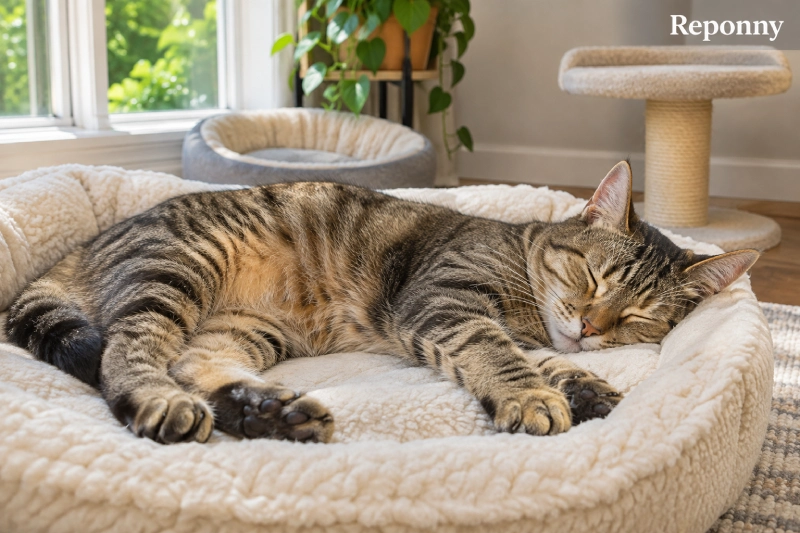
Cats can turn sleeping into an art form.
One moment your cat is curled into a perfect circle.
The next, it is stretched across the couch with all four legs pointing in different directions.
Some cats sleep belly-up.
Others tuck all four paws underneath themselves like a loaf of bread.
And some somehow twist their bodies into positions that look anatomically impossible.
It is tempting to treat every sleeping position as a secret message.
But cat sleeping positions are not a precise emotional dictionary.
A position can be influenced by:
- temperature,
- comfort,
- sleep depth,
- personality,
- age,
- the surface underneath the cat,
- whether the cat wants to conserve heat,
- and whether it feels safe in the environment.
VCA notes that common feline sleeping positions may offer clues about comfort and relaxation, but even veterinary behavior resources acknowledge that many interpretations are best viewed as reasonable observations rather than proven translations.
What matters most is not one unusual nap pose.
It is whether the position is normal for your individual cat.
A cat that has slept curled into a ball every winter for years is probably behaving normally.
A cat that has always slept comfortably on its side but suddenly begins sleeping upright, appears unable to settle, breathes faster, or seems painful deserves much more attention.
Quick answer: Common cat sleeping positions can reflect warmth, comfort, sleep depth and a sense of security. Curled positions often help conserve heat, side sleeping usually accompanies deeper relaxation, belly-up sleeping can indicate that a cat feels secure, and the loaf position may allow a cat to rest while remaining ready to move. However, a sudden change in sleeping posture—especially with rapid breathing, pain, hiding, reduced appetite or difficulty settling—can indicate a medical problem.
How Much Do Cats Sleep?
Cats sleep a lot.
Cats Protection reports that domestic cats generally sleep around 12 to 18 hours a day, usually in multiple naps rather than one continuous overnight sleep.
Other feline-care resources often use an average of roughly 16 hours per day, although individual cats vary considerably.
Kittens and senior cats often sleep more than healthy young adults.
Kittens are growing rapidly and require substantial rest.
Older cats may tire more easily and may also have physical limitations that make long periods of activity more difficult.
Sleep also reflects feline biology.
Cats evolved as predators that rely on relatively short periods of intense activity.
Resting between those periods helps conserve energy.
Your indoor cat may not need to chase a mouse for dinner, but the underlying behavioral pattern remains.
So a cat sleeping much of the afternoon is not necessarily lazy.
For cats, long periods of rest are normal.
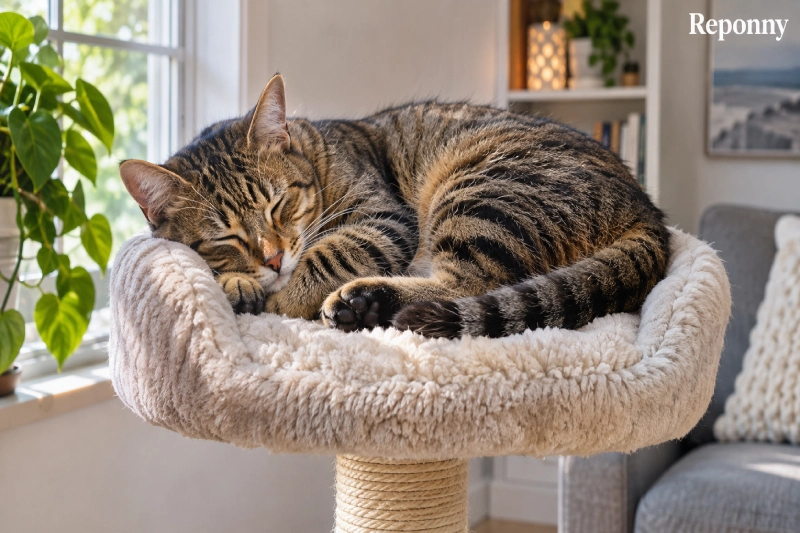
1. The Curled-Up Cat
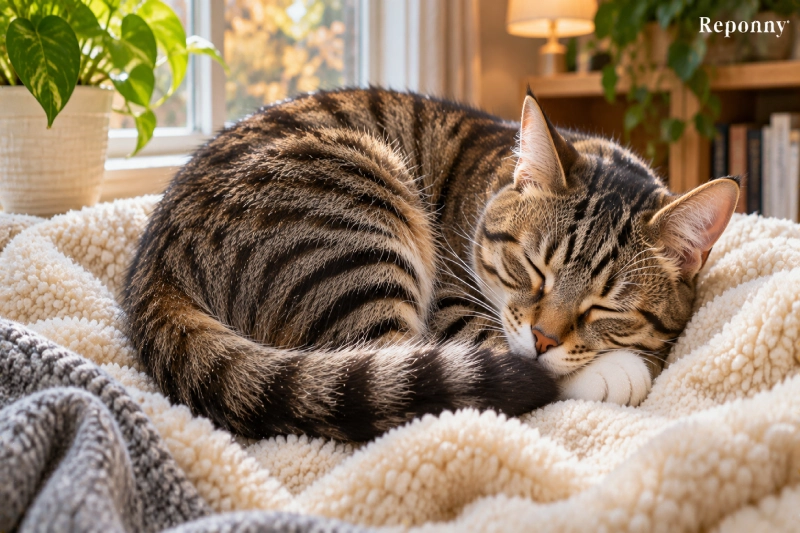
One of the most familiar feline sleeping positions is the curl.
Your cat may:
- tuck its paws underneath itself,
- curve its spine,
- bring its tail close to the body,
- and sometimes cover part of its face.
The result looks like a donut or furry ball.
What might it mean?
One important function of curling is heat conservation.
A compact posture reduces exposed body surface and keeps the limbs close to the torso.
VCA describes the curled position as one commonly associated with keeping warm and comfortable.
This is why you may see tighter curls:
- during colder weather,
- near a radiator,
- on a soft blanket,
- or in a draft-free corner.
Cats Protection also notes that cats naturally prefer warm, comfortable sleeping areas.
Curling may also physically protect the abdomen, although that does not necessarily mean the cat feels frightened.
A relaxed cat can sleep deeply while curled up.
Look at the face.
Soft facial muscles, closed eyes and relaxed ears suggest comfort.
When could curling mean something else?
A cat in pain can also adopt a compact posture.
The difference is usually the whole behavioral picture.
If your cat is tightly hunched rather than peacefully curled and also appears withdrawn, stops eating, resists moving or looks uncomfortable, contact your veterinarian.
VCA identifies hunched posture and unusual resting positions as possible indicators of pain.
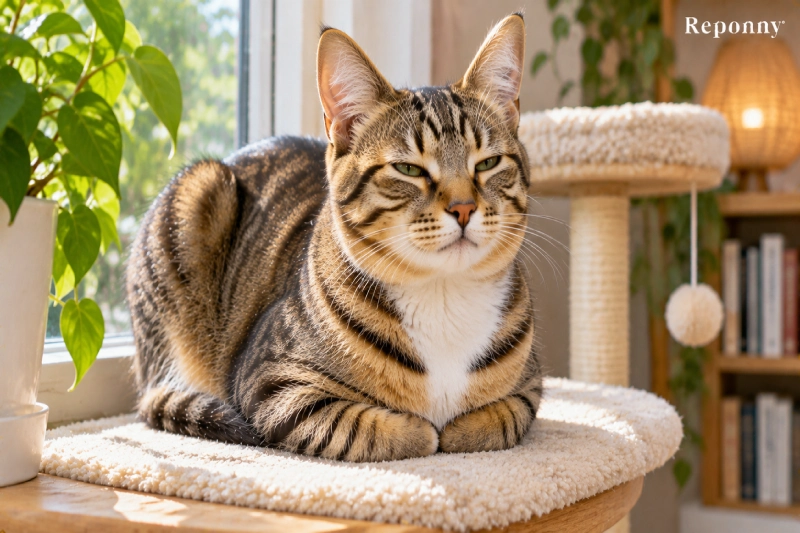
2. The Cat Loaf
Few cat positions are more recognizable than the loaf.
The cat sits upright or semi-upright with:
- front paws tucked underneath the chest,
- back legs folded beneath the body,
- tail close to the body,
- and head remaining upright.
The paws almost disappear completely.
What does the loaf position mean?
Often, a loafing cat is resting but not completely disengaged from its surroundings.
VCA describes the loaf as a posture in which the cat can rest while still remaining ready to move relatively quickly.
That makes sense.
A cat lying flat on its side must reposition the whole body before standing.
A cat in a loaf can rise much faster.
So the loaf may function as a comfortable middle ground between:
resting and remaining ready for action.
You may see it when your cat is:
- watching the room,
- sitting near you,
- resting between play sessions,
- or napping lightly.
A relaxed loaf
The head is comfortably upright.
Eyes may be partially closed.
Ears remain neutral.
Body muscles appear loose.
A painful hunch can look different
This distinction is important.
A cat in abdominal, spinal or other pain may sit with the back rounded, shoulders hunched and head held unusually low.
VCA specifically lists a hunched posture as a possible sign of pain or illness.
So:
loaf ≠ automatically pain.
But a cat that suddenly sits hunched and looks uncomfortable is different from a cat peacefully loafing on the windowsill.
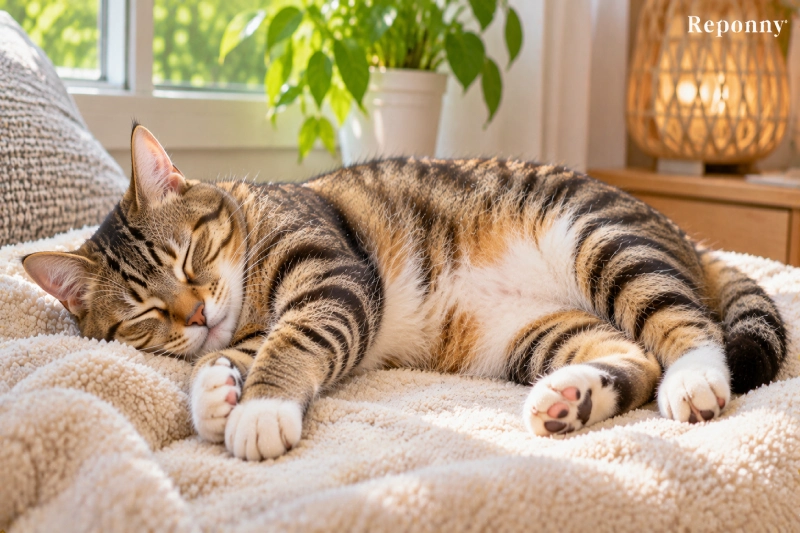
3. Sleeping on the Side
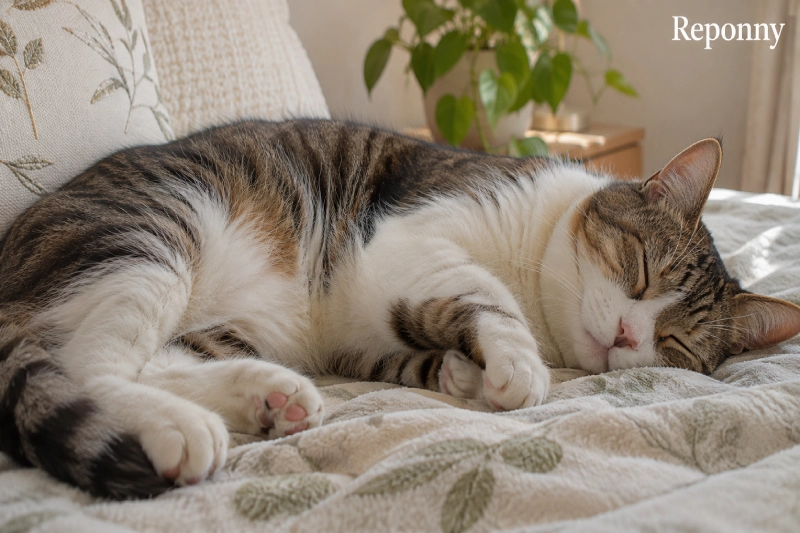
A cat sleeping fully on its side often looks completely relaxed.
The legs may be:
- slightly bent,
- loosely extended,
- or sprawled comfortably.
The belly and flank are more exposed than when the cat is tightly curled.
VCA describes side sleeping as a posture commonly associated with a deeper, more relaxed sleep state.
Your cat may spend a long nap in this position when:
- the room is comfortable,
- the sleeping surface feels safe,
- and there is no immediate need to remain ready to move.
It is especially common on:
beds, sofas, rugs and sunny floors.
Why side sleeping is useful to monitor
Because side sleeping may be normal for your cat, a change away from it can sometimes be meaningful.
VCA’s heart-health guidance specifically notes that pets with breathing or heart problems may change their usual sleeping posture and may stop sleeping on the side or back, instead remaining more upright because they are having difficulty getting comfortable.
So the important question is not:
“Is side sleeping healthy?”
It usually is.
The better question is:
“Has my cat suddenly stopped sleeping normally?”
4. Belly-Up Sleeping
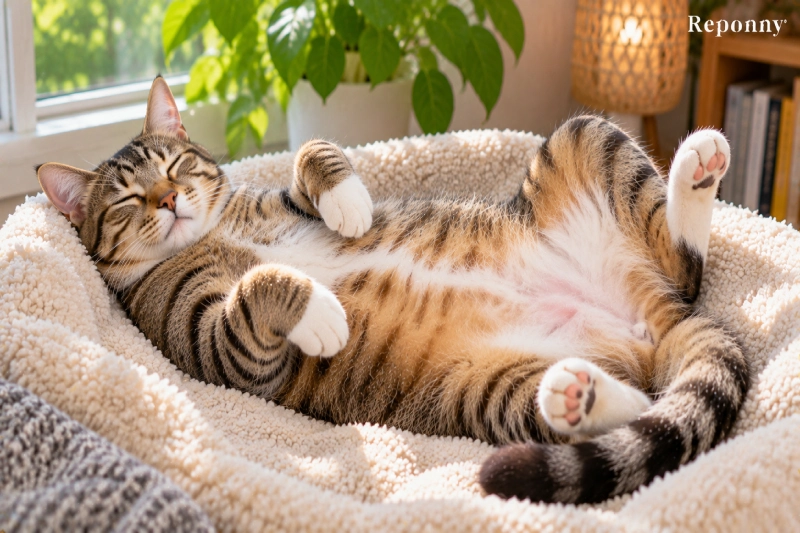
Few sleeping positions make a cat look more vulnerable than lying on its back with the belly exposed.
The legs may be:
- open,
- loosely bent,
- stretched upward,
- or hanging casually to the sides.
VCA describes belly-up sleeping as a position generally associated with relaxation and a sense of security.
The abdomen contains vulnerable organs.
A cat deeply sleeping with the belly exposed is therefore unlikely to feel that it must protect itself continuously.
That makes this posture a reasonable sign that the environment feels comfortable.
But does belly-up mean “rub my stomach”?
No.
This distinction is very important.
A cat can feel completely secure while lying on its back and still dislike having its abdomen touched.
The position may communicate:
“I feel safe here.”
It does not necessarily communicate:
“Please touch the most vulnerable part of my body.”
Many owners discover this difference when a sleeping belly-up cat suddenly grabs their hand with all four paws.
Allow your cat to rest unless you already know it enjoys belly contact.
5. Stretched Out on the Belly
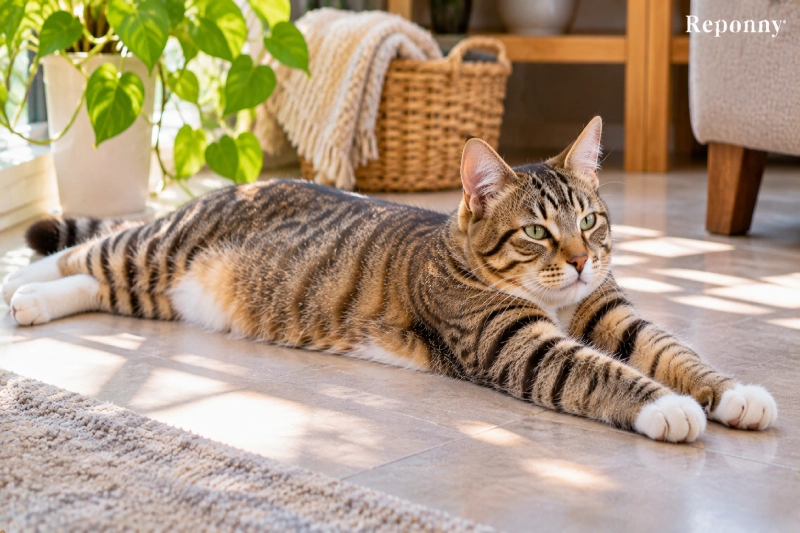
Some cats sleep or rest with the chest and abdomen on the surface while the legs stretch forward, backward or both.
Sometimes the cat looks almost like it has melted across the floor.
This position can occur when a cat is:
- comfortably resting,
- stretching,
- cooling down,
- or taking a lighter nap.
The surrounding environment matters.
A cat stretched across a cool tile floor on a warm day may simply be trying to increase contact with a cooler surface.
A cat stretched comfortably across a bed may simply enjoy taking up as much space as physically possible.
But do not assign one fixed emotional meaning to this pose.
There is less direct scientific evidence linking specific stretched positions with specific emotional states.
The best clues are still:
- facial tension,
- breathing,
- muscle relaxation,
- willingness to move,
- and whether the behavior is normal for that cat.
6. Sleeping With Paws Over the Face
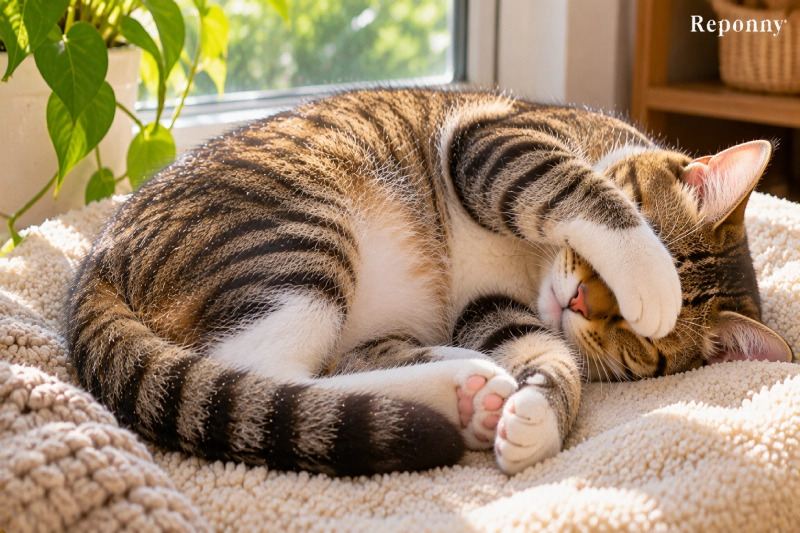
Cats sometimes sleep with one or both front paws covering their eyes or nose.
It looks extremely cute.
But the safest interpretation is usually practical rather than emotional.
The paw may:
- block bright light,
- help retain warmth around the face,
- or simply be where the leg happened to settle.
A cat curled up in a sunny room may place a paw over its eyes much like a person shielding their face from light.
You do not need to assume that the cat is embarrassed, hiding from you or having a dramatic emotional moment.
If the rest of the body is loose and comfortable, it is most likely simply a sleeping position.
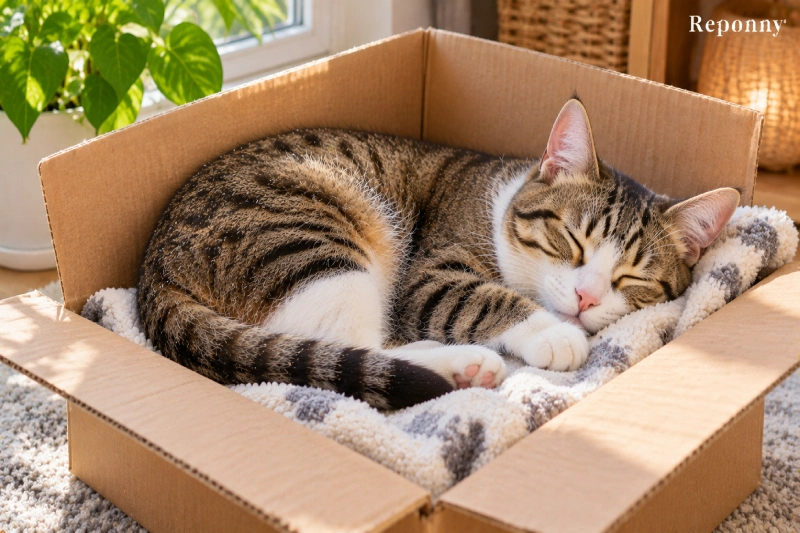
7. Sleeping in a Box or Other Enclosed Space
Put an expensive cat bed next to an empty cardboard box.
Many cats will choose the box.
Enclosed spaces can provide:
- physical boundaries,
- warmth,
- visual cover,
- and a sense of security.
VCA notes that cats naturally seek protected resting and hiding locations and that elevated or enclosed resting spaces can help cats feel safe within their environment.
Cats Protection similarly recommends beds and boxes that provide warm, comfortable, safe sleeping locations.
So a cat sleeping inside a box is not necessarily afraid.
It may simply like the enclosed design.
When hiding becomes concerning
There is a difference between:
choosing a favorite box for naps
and
suddenly hiding under furniture all day while refusing food.
Cats Protection recommends contacting a veterinarian when a cat begins sleeping significantly more than usual or hiding more than normal because an underlying medical problem may be present.
Again, the change matters more than the location itself.
8. Sleeping in a High Place
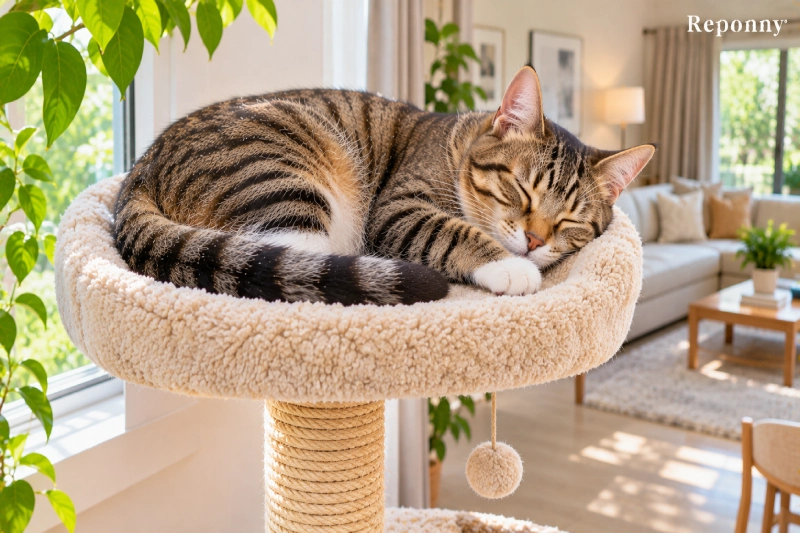
Cats often sleep:
- on shelves,
- cat trees,
- wardrobes,
- windowsills,
- or the top of furniture.
Height can provide an excellent combination of:
safety + visibility.
VCA notes that many cats seek elevated resting locations because they can relax while still monitoring their environment. Elevated spots may be particularly useful when cats want distance from other pets, children or household activity.
That makes high sleeping places an important part of environmental enrichment.
Provide:
- stable cat trees,
- secure shelves,
- non-slip surfaces,
- and comfortable bedding.
When high sleeping becomes avoidance
VCA makes an important distinction.
It is normal for a cat to choose an elevated sleeping place.
It is more concerning if the cat spends all of its time high up because it is too frightened to move freely around the house.
In a multi-cat household, this may indicate:
- social tension,
- resource guarding,
- or fear.
Observe whether your cat moves confidently through the rest of the home.
9. Sleeping Beside You or on You
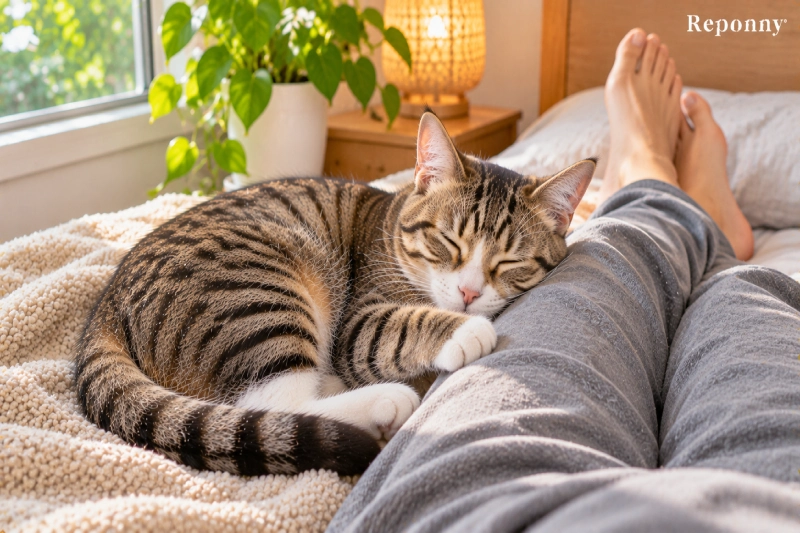
Many cats choose to sleep:
- on a person’s lap,
- beside their legs,
- on the chest,
- near the head,
- or directly on the bed.
Several practical factors may explain this.
Humans are:
- warm,
- familiar,
- soft,
- and associated with predictable safety.
Cats Protection notes that human bedding and pillows can also carry familiar scent and warmth, making them appealing sleeping locations.
Sleeping near you can therefore be consistent with social comfort.
But do not turn it into an exact measurement of affection.
A cat that sleeps across the room may be equally secure.
Some cats simply prefer more personal space.
And your cat sleeping on you does not mean you must continue touching it.
Cats Protection advises not disturbing sleeping cats because a suddenly awakened cat can become disoriented and react defensively.
If your cat is asleep on your lap, letting it sleep may be the kindest form of affection.
10. Sleeping With Another Cat
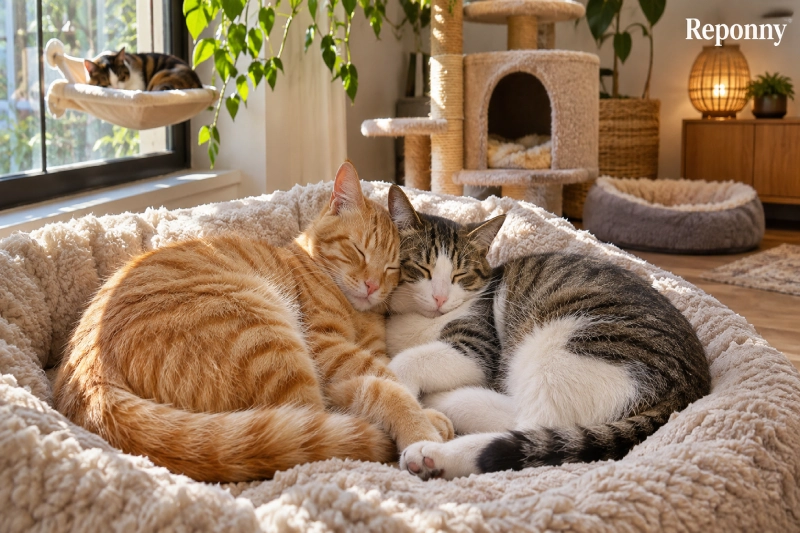
Bonded cats may sleep:
- touching,
- curled together,
- back-to-back,
- or partially on top of one another.
This can provide:
- warmth,
- physical comfort,
- and social contact.
A pair of cats that voluntarily sleeps closely together, grooms one another and seeks each other out generally has a very different relationship from cats that merely tolerate sharing the same room.
However, physical closeness during sleep should still be voluntary.
In multi-cat homes, provide several sleeping options so no cat is forced to share a bed because every other safe location is occupied.
Why Does My Cat Keep Changing Sleeping Spots?
This is usually normal.
Cats Protection notes that cats often rotate their preferred sleeping locations.
Several factors may influence the choice:
- temperature,
- sunlight,
- noise,
- household activity,
- available privacy,
- bedding texture,
- and time of day.
A sunny windowsill may be perfect in winter.
The cool bathroom floor may become more attractive in summer.
A bedroom may be quiet during the day but too busy at night.
Cats are excellent at finding the most comfortable location available.
Provide multiple options rather than expecting your cat to use one expensive bed exclusively.
Why Does My Cat Sleep With Its Back Toward Me?
Owners sometimes assume this is rude.
It usually is not.
A relaxed cat does not need to maintain constant eye contact with you.
Turning away can simply be part of finding a comfortable position.
If your cat voluntarily sleeps close to you with a loose body and relaxed posture, the direction its head faces is unlikely to indicate rejection.
Do not apply human social etiquette to feline sleeping positions.
Your cat is trying to sleep, not conduct a formal conversation.
Why Does My Cat Sleep With One Eye Partly Open?
Cats frequently move between light and deeper sleep.
During lighter rest, they may remain responsive to:
- sound,
- movement,
- smell,
- or changes in the environment.
Cats Protection notes that cats can remain surprisingly alert during naps, with ears or tails responding to surrounding activity.
An eye that occasionally appears partially open during sleep may therefore occur normally.
However, persistent squinting or inability to close an eye normally when awake is different and may require veterinary assessment.
Context matters.
Why Does My Cat Twitch While Sleeping?
Small twitches are common.
You may see:
- whiskers moving,
- ears flicking,
- paws jerking,
- toes moving,
- or the mouth making tiny movements.
Cats experience REM sleep, a sleep stage strongly associated with dreaming in humans.
Cats Protection’s 2026 review notes that cats undergo both REM and non-REM sleep and that movements such as whisker, ear and paw twitching commonly occur during REM sleep. Scientists consider dreaming likely, although we cannot know exactly what cats experience mentally while sleeping.
So a gently twitching paw is usually not a cause for concern.
When sleep movements deserve veterinary attention
Cats Protection advises veterinary consultation if movements become:
- intense,
- prolonged,
- repetitive,
- associated with loss of bladder or bowel control,
- or accompanied by other behavioral changes.
VCA similarly warns that violent movements during sleep can sometimes resemble neurological disorders or seizures and should be evaluated.
Recording a video can be very helpful for your veterinarian.
Is Snoring Normal in Cats?
Sometimes.
Sleeping position can influence airflow.
VCA notes that a pet may snore in certain sleeping positions even when it is otherwise healthy.
A cat that occasionally produces a soft snore while deeply asleep may not have a problem.
However, new or worsening respiratory noise deserves more attention.
Contact your veterinarian if snoring or noisy breathing occurs with:
- increased breathing effort,
- open-mouth breathing,
- coughing,
- exercise intolerance,
- nasal discharge,
- or other respiratory changes.
Open-mouth breathing in a resting cat is particularly concerning and should not be dismissed as normal sleep behavior.
When a Sleeping Position Can Signal Pain
The most useful clue is a change from normal.
VCA identifies several pain-related resting changes, including:
- unusual sleeping positions,
- sleeping in unusual places,
- pacing or restlessness,
- inability to get comfortable,
- hunched posture,
- and reduced willingness to move.
Cats with musculoskeletal pain may also:
- avoid jumping,
- stop using elevated beds,
- sleep on easier-to-access surfaces,
- or change position frequently.
Cornell notes that cats with joint pain may increasingly seek comfortable resting locations and may appear less active or more reclusive.
Senior cats deserve particular attention.
Cats Protection notes that older cats often prefer soft, well-padded sleeping surfaces, especially when muscle loss or arthritis makes hard surfaces less comfortable.
So if your older cat suddenly stops using its favorite high windowsill and starts sleeping on the floor, consider whether getting there has become difficult.
A Cat That Cannot Get Comfortable Deserves Attention
Normal cats change positions occasionally.
But repeatedly:
lying down → standing up → circling → lying down → standing again
may indicate discomfort.
VCA warns that excessive circling and repeated attempts to settle can occur when arthritis, spinal pain or other orthopedic problems make it difficult for a cat to find a comfortable position.
If this behavior is new or persistent, schedule a veterinary examination.
Do not assume the cat is simply being picky about its bed.
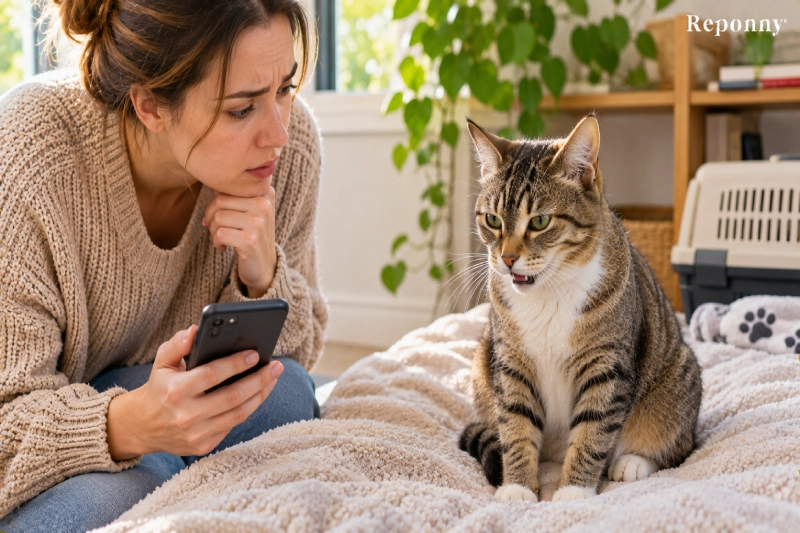
Sleeping Upright and Breathing Changes Can Be Serious
This is one of the most important sections of this article.
A cat with difficulty breathing may avoid lying in its normal position.
VCA’s home breathing guidance lists several warning signs associated with heart or respiratory disease, including:
- breathing faster than normal while resting or sleeping,
- increased breathing effort,
- restlessness,
- difficulty finding a comfortable sleeping position,
- and changing from normal side/back sleeping to a more upright or sphinx-like posture.
VCA advises that a normal resting or sleeping respiratory rate is generally below 30 breaths per minute, although an individual cat’s normal baseline matters. Persistent rates above that level, especially with increased effort, warrant veterinary attention.
Seek urgent veterinary care if your cat has:
- obvious breathing difficulty,
- open-mouth breathing,
- blue or very pale gums,
- collapse,
- or severe respiratory distress.
A change in sleeping posture can sometimes be an early sign that lying down has become uncomfortable.
Is My Cat Sleeping Too Much?
Cats naturally sleep for many hours.
That makes “too much” difficult to define by hours alone.
The better question is:
Has your cat’s normal pattern changed?
Cats Protection recommends speaking with a veterinarian when a cat begins sleeping substantially more than usual, especially when increased sleep is accompanied by hiding or other behavioral changes.
Warning signs can include:
- reduced appetite,
- weight loss,
- reduced play,
- reluctance to jump,
- hiding,
- poor grooming,
- vomiting,
- diarrhea,
- litter-box changes,
- or unusual breathing.
A kitten sleeping extensively may be completely normal.
A senior cat may also sleep more than it did when younger.
But sudden lethargy is different from normal sleep.
Should You Wake a Sleeping Cat?
Usually, no.
Cats need substantial rest.
Cats Protection recommends allowing cats to sleep without unnecessary disturbance. A cat that is suddenly touched while deeply asleep may wake disoriented and react defensively.
This is especially relevant for children.
Teach children to:
- leave sleeping cats alone,
- avoid pulling them from hiding places,
- and wait until the cat is awake before initiating interaction.
Letting a cat control when it rests helps make the home feel predictable and safe.
How to Create Better Sleeping Areas for Your Cat
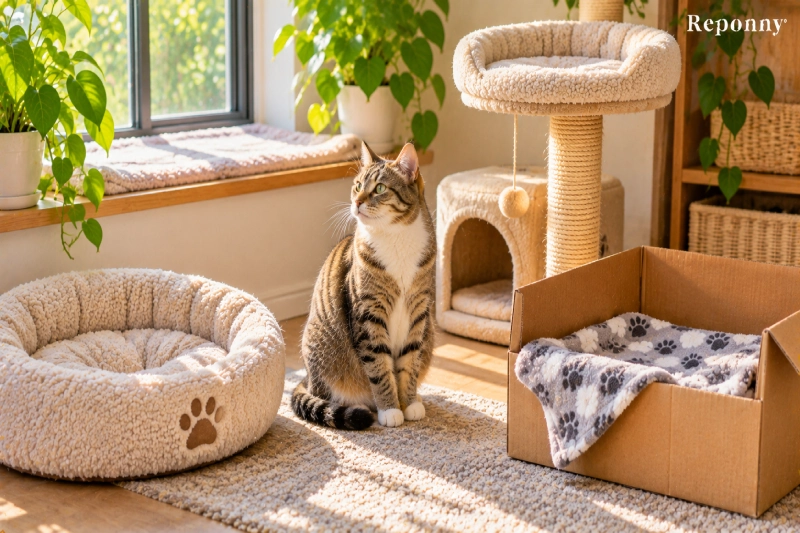
Instead of trying to make your cat use one bed, provide several choices.
A good feline sleeping environment may include:
- a warm soft bed,
- an elevated resting place,
- an enclosed box,
- a quiet room,
- a sunny location,
- and a cooler surface for warm weather.
VCA recommends stable elevated spaces where cats can rest while observing their surroundings.
Cats Protection recommends warm, comfortable and safe resting locations and notes that cats often rotate between sleeping spots.
For senior cats, make favorite beds easier to access.
Consider:
- ramps,
- low steps,
- thicker padding,
- non-slip flooring,
- and beds located near essential resources.
The goal is not to choose the sleeping position for your cat.
It is to give your cat enough safe options to choose for itself.
Cat Sleeping Positions at a Glance
| Sleeping Position | What It May Suggest |
|---|---|
| Curled into a ball | Warmth, comfort, heat conservation |
| Classic loaf | Light rest while remaining ready to move |
| Lying fully on side | Deeper relaxation |
| Belly exposed | Strong relaxation / feeling secure |
| Stretched out | Comfort, stretching or cooling depending on context |
| Paw over face | Light blocking, warmth or simple comfort |
| Inside a box | Enclosed safe resting place |
| High perch | Security, visibility and environmental control |
| Sleeping on owner | Warmth, familiarity and social comfort |
| Sleeping beside another cat | Social contact and warmth |
| Suddenly upright instead of normal side sleep | Medical concern if accompanied by breathing changes |
| Hunched and unable to settle | Pain or illness should be considered |
Remember:
these are clues—not guaranteed translations.
Frequently Asked Questions
What Do Cat Sleeping Positions Mean?
Cat sleeping positions can provide clues about warmth, relaxation, sleep depth and environmental comfort.
However, no position has one universal emotional meaning.
The cat’s normal habits and surrounding body language matter more than a single pose.
Why Does My Cat Sleep Curled Up?
Curling conserves body heat and creates a compact, comfortable sleeping posture.
VCA identifies warmth as one likely reason cats sleep curled into a ball.
What Does the Cat Loaf Position Mean?
A relaxed loaf often represents resting while remaining relatively ready to move.
However, a painful hunched posture can superficially resemble a loaf, so pay attention to facial expression, head position and overall behavior.
Why Does My Cat Sleep on Its Side?
Side sleeping commonly occurs during deeper relaxation because more of the body is exposed and the cat is not positioned for immediate movement.
Why Does My Cat Sleep on Its Back With Its Belly Up?
A belly-up sleeping cat generally feels very relaxed and secure.
But exposing the belly does not necessarily mean the cat wants the abdomen touched.
Why Does My Cat Cover Its Face While Sleeping?
The paw may help block light, retain warmth or simply be resting comfortably in that position.
It does not necessarily carry a specific emotional meaning.
Why Does My Cat Sleep in Boxes?
Enclosed spaces can provide warmth, physical protection and a sense of security.
Cats naturally seek comfortable, protected sleeping areas.
Why Does My Cat Sleep on Me?
You provide warmth, familiar scent and a comfortable surface.
Sleeping on or beside a person can also occur during positive social relationships.
Why Does My Cat Twitch in Its Sleep?
Small whisker, ear, eyelid or paw movements commonly occur during REM sleep and are usually normal.
Cats experience REM sleep and probably dream, although researchers cannot know exactly what cats experience mentally.
Is It Normal for Cats to Sleep 16 Hours a Day?
Yes.
Many adult cats sleep roughly 12–18 hours within a 24-hour period, often in numerous separate naps. Kittens and senior cats may sleep even more.
When Should I Worry About My Cat’s Sleeping Position?
Contact your veterinarian when there is a sudden persistent change, particularly if your cat:
cannot get comfortable, sleeps hunched, stops using normal resting places, becomes unusually inactive, or develops breathing changes.
VCA identifies unusual sleeping positions and difficulty settling as potential signs of pain or illness.
Final Thoughts
Cat sleeping positions are fascinating because they provide a small window into how comfortable your cat may feel.
A tightly curled cat may simply be conserving warmth.
A loafing cat may be resting while remaining ready to move.
A cat stretched fully on its side is often deeply relaxed.
And a cat sleeping belly-up with all four paws in the air probably feels very secure in its surroundings.
But avoid turning these observations into a rigid dictionary.
Not every curled cat is cold.
Not every loaf is anxious.
Not every belly-up cat wants a belly rub.
The most useful information comes from knowing what is normal for your individual cat.
Cats Protection reports that cats normally spend roughly 12–18 hours each day asleep and often rotate between several sleeping places.
That makes variation normal.
What deserves more attention is change.
If your cat suddenly starts hiding to sleep, cannot settle comfortably, adopts a persistent hunched posture, stops jumping onto favorite sleeping spots or begins sleeping upright instead of lying comfortably on its side, look at the whole picture.
Pain can alter sleeping posture.
Arthritis can make favorite elevated beds harder to reach.
And respiratory or heart problems can make a cat restless or cause it to adopt a more upright sleeping position.
Pay particular attention to breathing.
Persistent rapid breathing during sleep, obvious increased effort or open-mouth breathing should not be dismissed as a strange sleeping position.
And remember that sleep itself deserves respect.
Cats need substantial rest.
Allow them to choose warm, quiet, elevated and enclosed locations.
Give senior cats soft beds that are easy to reach.
Provide several sleeping options rather than forcing one particular bed.
And unless there is a good reason to do so:
let sleeping cats sleep.
Sometimes the best interpretation of a strange feline sleeping position is also the simplest:
your cat found it comfortable.