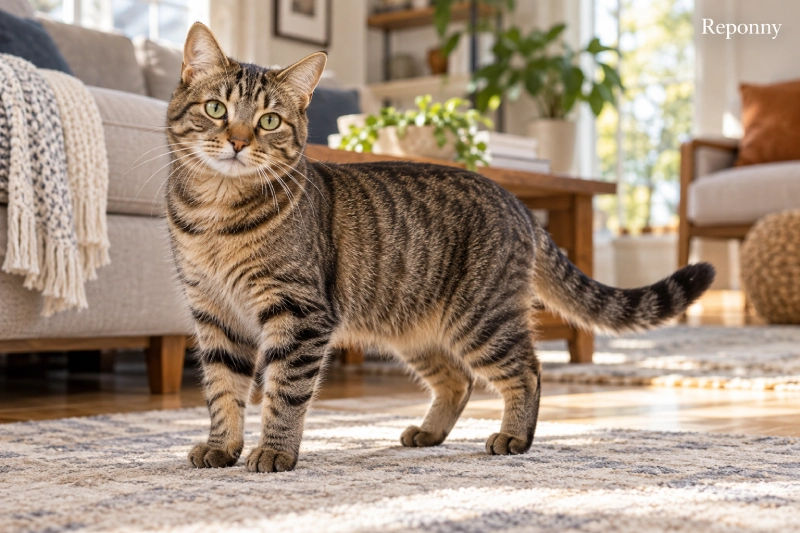
Your cat is communicating with you almost constantly—even when it makes no sound at all.
A slight turn of the ears, narrowing of the eyes, change in whisker position, lowered body, twitching tail, or sudden shift in posture can reveal whether a cat feels relaxed, curious, uncertain, frightened, overstimulated, or ready to defend itself.
The challenge is that cat body language should never be interpreted from one signal alone.
Dilated pupils, for example, can appear during fear—but also during play, excitement, or simply because the room is dark. A cat lying on its back may feel relaxed, but that does not automatically mean it wants its belly touched.
Cornell describes feline communication as a combination of facial signals and whole-body posture. A fearful cat may show dilated pupils, flattened ears, whiskers held against the face, and a tucked body, while a defensive or aggressive cat may arch its back, raise its fur, and turn its ears backward.
Understanding those combinations can help you avoid bites and scratches, recognize stress earlier, improve your relationship with your cat, and sometimes even notice signs of pain or illness.
Quick answer: Read your cat as a whole. Relaxed cats usually have soft eyes, upright neutral ears, relaxed whiskers, loose muscles, and comfortable posture. Fear or stress may produce wide pupils, ears turned sideways or backward, flattened whiskers, a low crouch, tucked tail, or attempts to hide. A threatened cat may arch its back, puff its fur, flatten its ears, or prepare to strike. Context always matters.
Why Learning Cat Body Language Matters
Cats rarely move directly from complete relaxation to biting without any change in behavior.
Often, the early signals are simply subtle.
A cat may first stop purring, turn its ears slightly sideways, tense its shoulders, flick the tip of its tail, or look toward your hand. If those signals are missed and petting continues, the cat may eventually swat or bite.
Learning to notice the earlier signs allows you to respond before the cat feels it must escalate.
VCA notes that recognizing signs of anxiety or stress can allow people to remove a cat from an uncomfortable situation before fear develops into more intense defensive behavior.
Body-language knowledge is especially valuable in homes with children, multiple cats, newly adopted cats, shy cats, and cats adjusting to unfamiliar visitors.
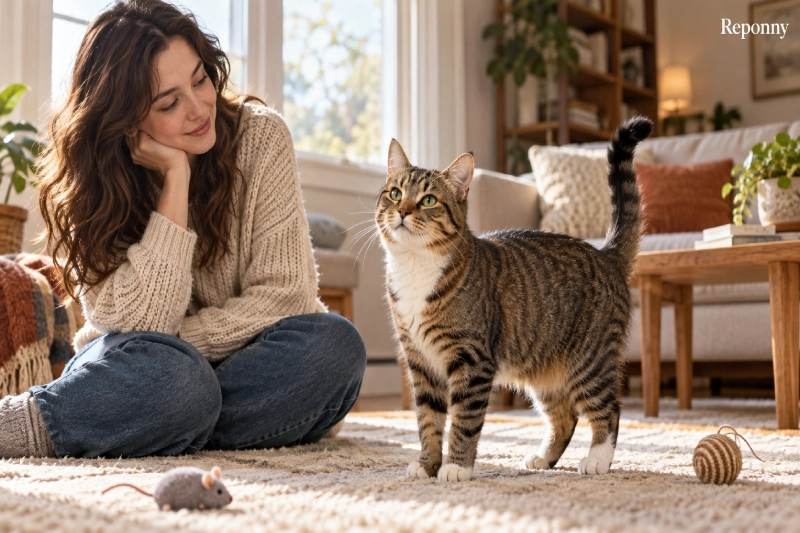
Never Read One Signal in Isolation
Imagine a cat with large pupils.
Does that mean the cat is afraid?
Possibly.
But the cat may also be sitting in a dark room.
It may be chasing a toy.
It may have just heard a sudden noise.
Or it may be intensely focused on something moving across the floor.
VCA specifically cautions that dilated pupils can occur with stress but also with low light, catnip, excitement, and other forms of stimulation.
Instead of asking:
“What do big pupils mean?”
ask:
“What are the pupils, ears, whiskers, tail, muscles, and body doing together—and what was happening immediately before this?”
That is the foundation of accurate feline body-language interpretation.
What Your Cat’s Eyes Can Tell You
Cats use their eyes in several important ways.
Eye shape, eyelid position, pupil size, blinking, and direction of gaze can all contribute information.
But the eyes are also strongly affected by lighting and physical arousal, so they must always be interpreted alongside the rest of the body.
Soft, Partially Closed Eyes
A relaxed cat often has soft-looking eyes rather than an intensely wide stare.
The eyelids may be partially closed.
The face appears loose rather than tense.
If the ears are also neutral, whiskers relaxed, and body comfortable, this usually indicates a calm emotional state.
VCA describes soft eyes with relatively narrow pupils as typical of a relaxed cat.
Wide Eyes
Wide-open eyes may indicate that the cat is highly alert.
The reason could be:
fear, surprise, excitement, hunting interest, or intense curiosity.
Look at the rest of the body.
Wide eyes combined with a crouched body and flattened ears suggest something very different from wide eyes combined with playful stalking of a toy.
Dilated Pupils
The black center of the eye becomes larger when the pupils dilate.
Dilated pupils are commonly associated with emotional arousal.
Cornell lists dilated pupils among signals seen in fearful and aggressive cats.
However, pupil dilation alone cannot diagnose fear.
Low light automatically enlarges the pupils.
Play and excitement can do the same.
Narrow Pupils
Narrow pupils may occur in bright light.
They can also occur during intense focus or arousal.
Therefore, narrow pupils are not automatically a sign that a cat is angry.
Lighting conditions should always be considered.
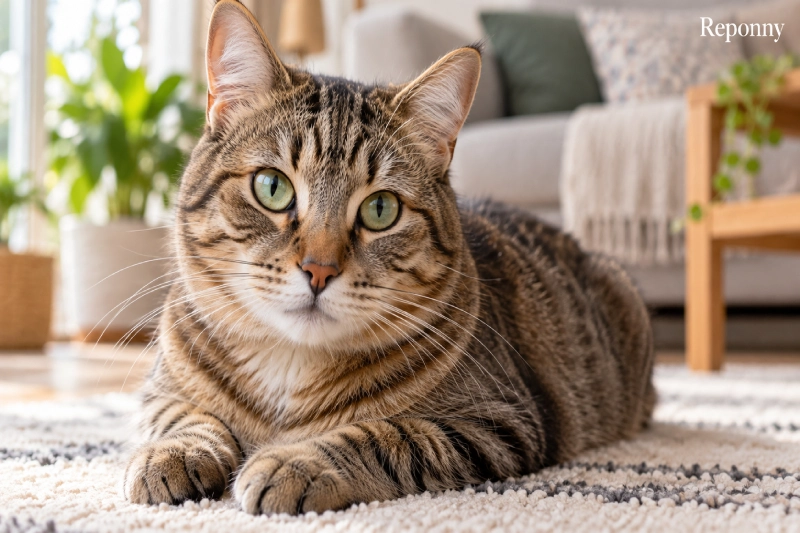
What Does a Cat’s Slow Blink Mean?
A slow blink usually consists of slowly narrowing or partially closing the eyes, sometimes followed by a full eye closure.
Owners often describe it as a cat “smiling” with its eyes.
Scientific research provides some support for the idea that slow blinking functions as positive communication between cats and humans.
In a 2020 study, cats produced more eye-narrowing movements when owners slow-blinked at them. Cats were also more likely to approach an unfamiliar experimenter after a slow-blink interaction than after the person maintained a neutral expression.
That does not mean every slow blink literally translates to:
“I love you.”
It is better understood as a relaxed, non-threatening social signal that can occur during positive interactions.
You can try it yourself.
Look toward your relaxed cat without staring intensely, slowly narrow your eyes, briefly close them, and then relax your gaze.
Do not force interaction afterward.
Let the cat decide whether to remain nearby or approach.
Is Staring at a Cat Bad?
Prolonged direct staring can feel socially intense to many cats.
A relaxed glance is very different from fixing your eyes on a nervous cat while moving directly toward it.
A worried cat may interpret sustained attention as threatening.
If a cat is fearful, use softer visual communication.
Turn your body slightly sideways, avoid looming over the cat, keep movements slow, and allow the cat to control distance.
This is particularly useful with newly adopted or shy cats.
What Your Cat’s Ears Mean
Cat ears are extraordinarily mobile.
They can rotate toward sounds independently, which means ear movement is partly about hearing rather than emotion.
Still, ear position is one of the most useful parts of feline body language.
Ears Upright and Forward
A comfortable cat commonly holds its ears upright and relatively forward.
The ears may swivel toward interesting sounds while the rest of the body remains relaxed.
VCA describes upright, forward ears as a common relaxed position.
Ears Turning Sideways
Ears angled outward—sometimes casually called “airplane ears”—can appear when a cat becomes uncertain, annoyed, overstimulated, or anxious.
This can be an early sign that interaction should slow down.
If you are petting your cat and the ears gradually rotate sideways while the body stiffens, consider stopping before the cat feels the need to escalate.
Ears Flattened Back
Flattened ears are a much stronger signal.
Cornell associates backward or outward flattened ears with fear and defensive aggression.
A cat with flattened ears, dilated pupils, tense muscles, and growling or hissing is clearly communicating:
“Give me space.”
Trying to pet or restrain the cat at that moment may lead to a defensive bite or scratch.
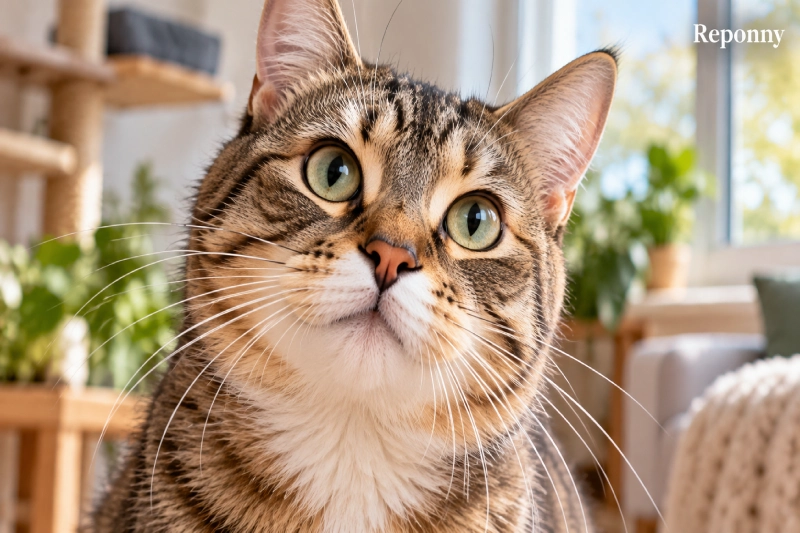
What Your Cat’s Whiskers Can Tell You
Whiskers are much more than decoration.
They are specialized sensory hairs called vibrissae.
VCA explains that whisker follicles contain abundant nerves and blood vessels, allowing whiskers to detect subtle air movement and nearby objects. They help cats navigate and gather information about their surroundings.
Whisker position can also contribute to emotional communication.
Relaxed Whiskers
A calm cat often holds the muzzle whiskers naturally out to the sides without obvious tension.
The face appears soft.
Whiskers Pulled Back Toward the Face
When frightened or trying to make itself less vulnerable, a cat may pull or flatten the whiskers back toward the cheeks.
Cornell specifically lists flattened or downward-pressed whiskers among fear signals.
If you see pulled-back whiskers together with flattened ears, wide pupils, and a crouched body, the cat likely needs more distance.
Whiskers Pointed Forward
Forward whiskers require context.
A hunting or highly curious cat may project its whiskers forward while concentrating on something.
A tense or threatened cat may also hold the whiskers far forward.
VCA notes that stressed cats may hold their whiskers either flattened toward the cheeks or far forward, illustrating why whiskers cannot be interpreted alone.
Never Cut Your Cat’s Whiskers
Whiskers are sensory structures.
VCA advises against cutting or pulling them because doing so can reduce spatial information and potentially confuse the cat.
Whiskers naturally shed and regrow.
Finding an occasional whisker around the house is normal.
But intentionally trimming them for appearance serves no benefit.
What Relaxed Cat Posture Looks Like
A relaxed cat generally looks physically loose.
The muscles are not visibly tense.
The body may be stretched out, sitting comfortably, lying on one side, or resting with the paws tucked underneath.
The head may remain upright.
The ears are usually neutral or forward.
The eyes appear soft.
The tail rests naturally rather than whipping rapidly.
Cornell describes a calm cat as standing with a relatively straight back, head held comfortably, ears erect, fur lying flat, and a relaxed tail posture.
A comfortable cat may also expose its side or roll onto its back.
But belly exposure needs special interpretation.
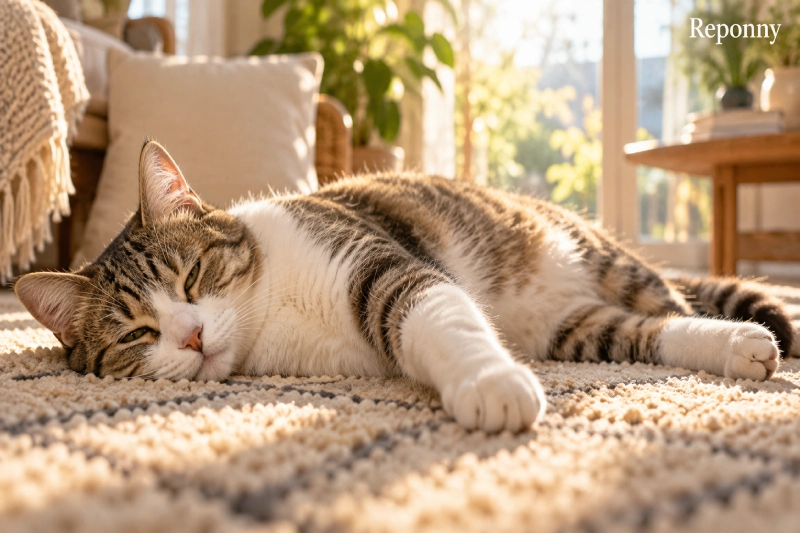
Does Showing the Belly Mean “Pet Me”?
Not necessarily.
A cat lying belly-up may feel safe enough to expose a vulnerable part of its body.
That can indicate relaxation and trust.
But it does not automatically mean the abdomen is being offered for touching.
Some cats enjoy belly contact.
Many do not.
A cat can also roll onto its back during defensive situations because that position gives it access to all four paws, claws, and teeth.
Always consider the complete posture.
A loose cat slowly rolling over while purring is different from a tense cat with flattened ears, wide pupils, and paws prepared to strike.
If you are unsure, pet safer areas such as the cheeks or head—or simply let the cat relax without touching it.
What Fearful Cat Posture Looks Like
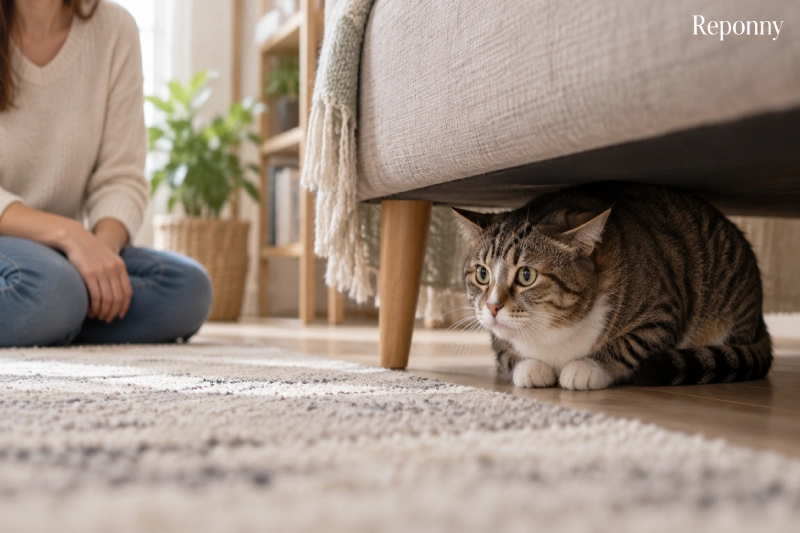
A frightened cat often tries to reduce its apparent size.
The body may become low and compact.
The cat may crouch close to the ground, pull its paws underneath itself, lower its head, tuck the tail close to the body, or try to hide.
VCA notes that frightened cats may crouch low, freeze, retreat, hide, lower the head, tuck the tail, and hold the ears backward.
Cornell similarly describes fear as involving a low or prone posture, outward-flattened ears, dilated pupils, whiskers close to the face, and a tail wrapped tightly or tucked underneath.
Do not drag a frightened cat out of hiding simply to “show it there is nothing to fear.”
Allow access to safe hiding spaces and let the cat regain confidence at its own pace.
What a Threatened or Defensive Cat Looks Like
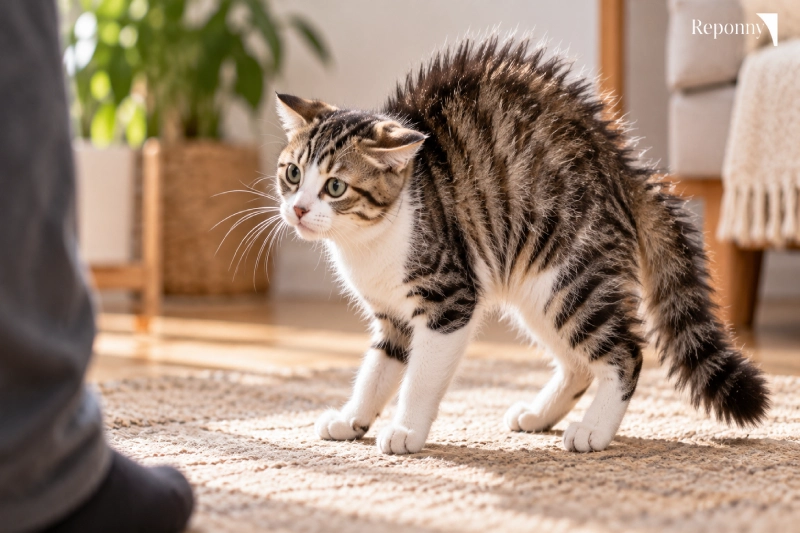
Sometimes a cat tries to make itself appear larger, not smaller.
This is the classic image many people associate with Halloween cats:
arched back, raised fur, large-looking tail, and sideways body orientation.
VCA explains that cats may turn sideways, arch the back, raise the fur, and position the tail prominently to increase apparent size when trying to drive a threat away.
Other signals may include:
dilated pupils, flattened ears, hissing, growling, tail movement, raised paw, or visible preparation to strike.
The correct human response is generally not to “prove who is boss.”
Increase distance.
Avoid punishment.
Cornell warns that physical punishment can increase fear and anxiety and may worsen aggression.
The Tail Completes the Picture
Cat tails communicate so much information that they deserve a dedicated guide of their own, but they are essential when reading whole-body language.
A relaxed, confident cat may approach with its tail upright and loose.
VCA notes that an upright but relaxed tail, sometimes with a softly curved tip, commonly accompanies confidence and comfort.
By contrast, a tightly tucked tail can occur with fear.
A puffed tail may accompany intense arousal or defensive behavior.
Rapid side-to-side tail movement can signal irritation or high arousal, although similar movement may occur immediately before a playful pounce.
Again:
context determines meaning.
A swishing tail attached to a kitten stalking a toy is not the same as a swishing tail attached to a tense cat whose ears have flattened while you continue petting it.
How to Recognize Overstimulation During Petting
One of the most useful applications of body-language knowledge is preventing petting-induced bites.
A cat may initially enjoy petting and then reach a point where continued touch becomes uncomfortable.
Early changes can include:
skin twitching, body tension, looking back toward your hand, ears rotating sideways, tail-tip movement, pupil changes, or suddenly becoming very still.
The cat may then move away, swat, or bite if contact continues.
Do not interpret this as betrayal.
The cat’s tolerance simply ended.
Pay attention to the earlier signals and stop while the interaction is still positive.
This allows the cat to learn that communicating discomfort works without needing stronger defensive behavior.
Play Body Language Can Look Surprisingly Intense
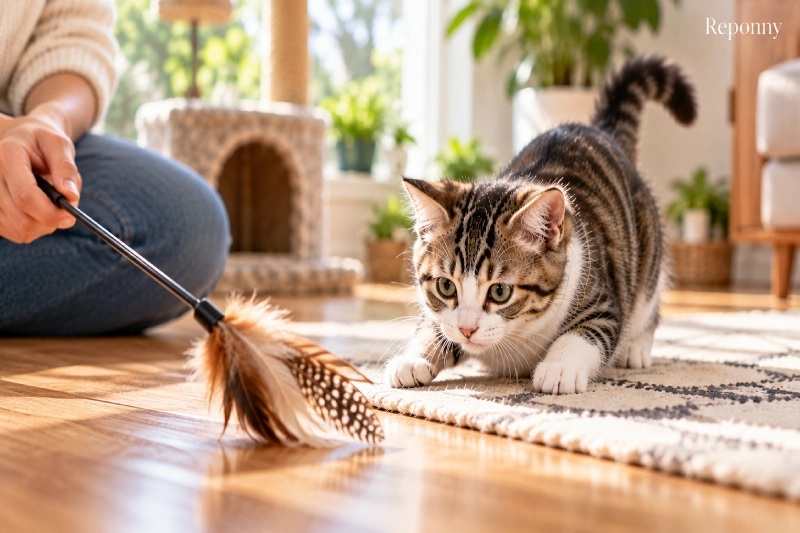
Play often imitates hunting.
A playful cat may:
stalk low to the ground, focus intensely, enlarge its pupils, wiggle its hindquarters, swish the tail, and suddenly pounce.
Cornell notes that play aggression may involve stalking, pouncing, dilated pupils, ear changes, and active tail movement.
The surrounding context helps distinguish play from true defensive aggression.
A kitten repeatedly pouncing on a feather wand and returning for more interaction is very different from a cornered cat hissing with flattened ears.
Use toys rather than hands for predatory play.
That gives the cat an appropriate target and reduces the chance that hands become objects to bite and scratch.
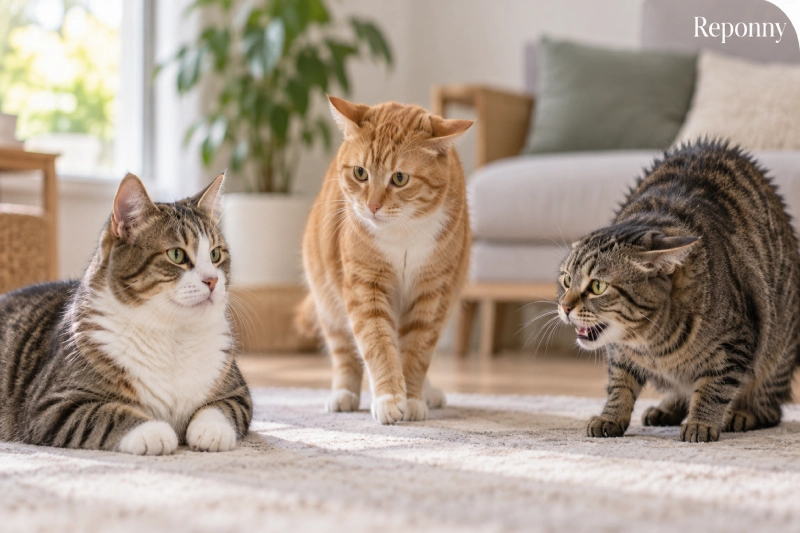
Body Language Between Cats
Cats communicate extensively without vocalizing.
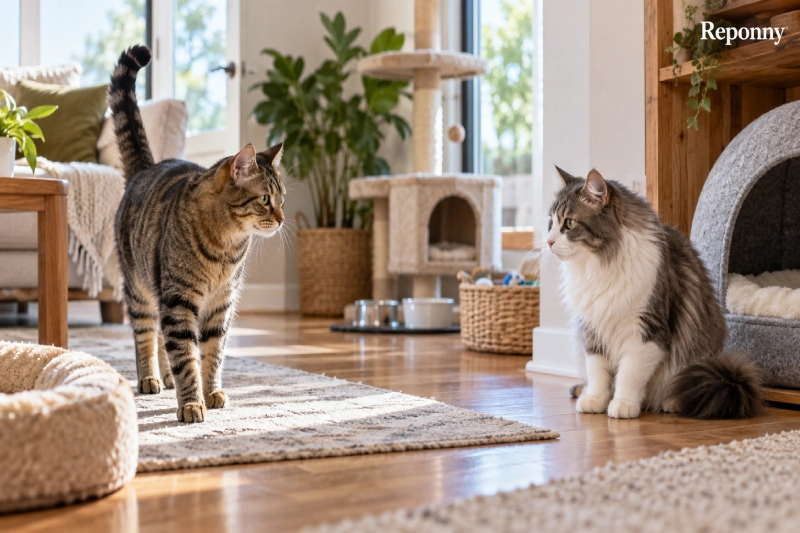
In multi-cat households, some conflict is so subtle that owners miss it.
VCA notes that one cat may simply stare at another, occupy a doorway, or position its body along a pathway to prevent the other cat from accessing food, water, litter boxes, or another area.
No dramatic fight is required.
One cat may quietly begin avoiding part of the home.
If you notice one cat consistently waiting until another leaves before approaching resources, consider whether social tension is occurring.
Multiple separated food stations, water sources, litter boxes, resting areas, and hiding opportunities can reduce competition.
Cat Body Language Can Also Reveal Pain
Behavior is not only about mood.
A sudden change in posture, facial expression, activity, or tolerance for touch can indicate discomfort.
VCA notes that cats in pain may squint, stare abnormally, adopt unusual sleeping or standing positions, become defensive when touched, and show changes in whisker position or facial tension.
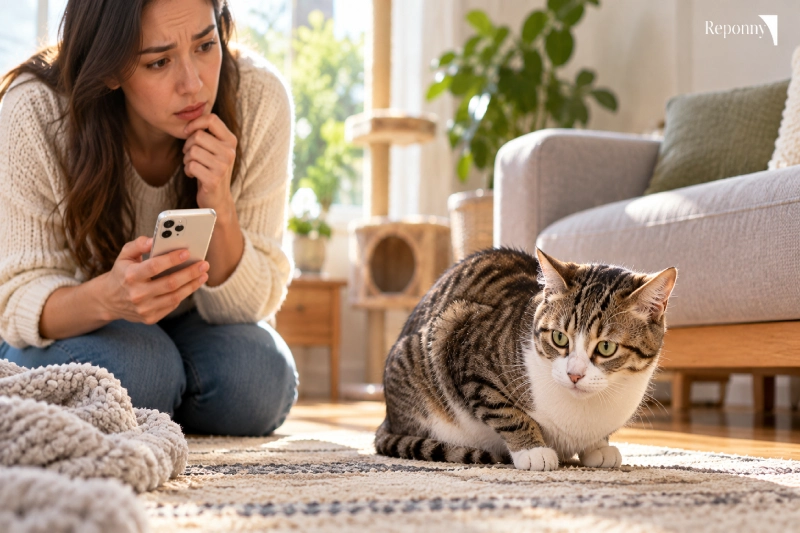
A normally social cat that suddenly crouches alone, stops jumping, resents being handled, or remains tense even while resting should not automatically be labeled “grumpy.”
Pain, illness, or injury may be involved.
Persistent behavioral changes deserve veterinary evaluation.
This is particularly important because cats often conceal obvious signs of illness.
A Simple Cat Body Language Reference
| Signal | Relaxed / Positive | Uncertain / Stressed | Fearful / Defensive |
|---|---|---|---|
| Eyes | Soft, partly closed | Wide, alert | Often wide with dilated pupils |
| Ears | Upright, neutral or forward | Turned sideways | Flattened backward/outward |
| Whiskers | Loose and neutral | May move forward or back | Often flattened toward face |
| Body | Loose, stretched or comfortably seated | Tense or hesitant | Crouched, frozen, arched or puffed |
| Tail | Loose, sometimes upright | Flicking or held lower | Tucked, puffed or tense |
| Movement | Smooth and voluntary | Pausing, scanning | Freezing, hiding, fleeing or defending |
These patterns are general guides—not a dictionary.
Individual cats have different personalities, experiences, anatomy, and preferred ways of communicating.
Your own cat’s normal baseline is especially valuable.
How to Respond to Your Cat’s Body Language
If your cat looks relaxed, continue interacting only while the cat remains comfortable.
If you see mild uncertainty, reduce intensity.
Pause petting.
Move more slowly.
Give the cat more space.
If the cat is clearly fearful or defensive, stop advancing and create a safe exit route.
Do not corner, chase, shout at, or physically punish the cat.
If concerning signals occur frequently without an obvious trigger, or the cat’s normal behavior changes suddenly, consider veterinary evaluation.
Body language is not only communication.
Sometimes it is the first visible sign that something is medically wrong.
Frequently Asked Questions
How Can I Tell if My Cat Is Happy?
A comfortable cat often has soft eyes, relaxed facial muscles, neutral or forward ears, relaxed whiskers, loose body posture, and smooth movements.
An upright relaxed tail may also accompany friendly approaches.
What Does It Mean When My Cat Slow Blinks at Me?
Research suggests slow eye narrowing can function as positive communication between cats and humans. Cats in experimental studies responded to human slow blinking and were more likely to approach after slow-blink interactions.
It is better described as friendly, relaxed communication than literally translating it as “I love you.”
Why Are My Cat’s Pupils Huge?
Possible reasons include darkness, excitement, play, fear, stress, or another form of arousal.
Pupil size should never be interpreted without context.
What Do Flattened Cat Ears Mean?
Flattened ears commonly occur during fear, anxiety, defensive behavior, or aggression.
Give the cat space, particularly when flattened ears occur with dilated pupils, crouching, hissing, or growling.
What Do Forward Whiskers Mean?
Forward whiskers can appear during curiosity, hunting, intense interest, or high arousal.
Stressed cats can also hold their whiskers strongly forward, so check the ears, eyes, tail, and posture at the same time.
Why Does My Cat Tuck Its Tail?
A tail held tightly against or beneath the body commonly accompanies fear or insecurity.
Look for additional signals such as a low crouch, flattened ears, and wide pupils.
Why Does My Cat Arch Its Back and Puff Up?
This posture can make the cat appear larger when it feels threatened.
VCA describes cats turning sideways, arching the back, and raising the fur as part of defensive threat behavior.
Does Showing the Belly Mean My Cat Trusts Me?
It can indicate relaxation and a sense of safety, but belly exposure is not necessarily permission to touch the abdomen.
Watch the rest of the body and respect the individual cat’s preferences.
Why Does My Cat Suddenly Bite During Petting?
Some cats become overstimulated after a period of physical contact.
Subtle warning signals may occur before the bite, including ear changes, body tension, tail movement, skin twitching, or looking toward the hand.
Stopping earlier can prevent escalation.
Can Body Language Tell Me My Cat Is Sick?
Sometimes.
Changes in posture, squinting, hiding, reluctance to move, unusual facial tension, aggression when touched, or persistent defensive behavior can occur with pain.
A significant or persistent change from your cat’s normal behavior deserves veterinary attention.
Final Thoughts
Cats may seem mysterious because much of their communication is quiet.
But once you begin watching the eyes, ears, whiskers, tail, muscle tension, and whole-body posture together, their behavior becomes much easier to understand.
A relaxed cat usually looks physically loose.
The eyes are soft.
The ears sit naturally.
The whiskers are relaxed.
Movement is smooth and unhurried.
A worried cat often begins to change subtly.
The pupils may widen.
The ears may rotate sideways.
The body becomes lower or more tense.
The whiskers may flatten.
The cat may freeze, retreat, or search for an escape route.
If the perceived threat continues, those signals can become much stronger: ears flatten, fur rises, the back arches, hissing begins, and defensive behavior becomes more likely. Cornell emphasizes that recognizing these signs and avoiding physical punishment can reduce fear and help prevent escalation.
The most important lesson is that no single movement has one guaranteed translation.
Large pupils do not always mean fear.
Forward whiskers do not always mean aggression.
A belly-up cat is not always requesting a belly rub.
A swishing tail does not always mean anger.
Context changes meaning.
Over time, you will also learn your individual cat’s baseline. That may be even more valuable than memorizing a body-language chart.
When you notice the small signals and respond before your cat needs to shout with claws or teeth, communication becomes easier for both of you.