Cats are obligate carnivores. Their wild ancestors evolved eating prey that supplied large amounts of protein, moderate amounts of fat, and relatively little carbohydrate.
That fact has led to one of the most debated questions in feline nutrition:
Should cats eat carbohydrates at all?
The answer is more nuanced than simply “carbs are bad.”
Adult cats do not have an established dietary requirement for carbohydrates, because their bodies can manufacture the glucose they need from amino acids and other compounds. At the same time, healthy cats are capable of digesting properly cooked starch efficiently and using the resulting glucose for energy. Merck Veterinary Manual reports that cats can digest properly cooked starches at greater than 90% efficiency.
So the presence of rice, corn, potato, peas, or another carbohydrate-containing ingredient does not automatically make a cat food unhealthy.
The more useful questions are how much digestible carbohydrate the diet contains, what else is in the formulation, how many calories your cat consumes, whether the food is complete and balanced, and whether your individual cat has a medical condition such as diabetes.
Quick answer: There is no scientifically established universal percentage at which carbohydrates suddenly become “too high” for every healthy cat. Cats do not require dietary carbohydrates, but they can digest appropriately processed starch. For healthy cats, overall nutritional balance, calories, protein, body condition, and individual health are more useful than choosing food according to one carbohydrate number alone.
What Are Carbohydrates in Cat Food?
The word carbohydrate describes a large group of compounds rather than one single ingredient.
In cat food, carbohydrates can include digestible starches and sugars as well as different forms of dietary fiber.
Common carbohydrate-containing ingredients include rice, corn, wheat, barley, oats, potatoes, sweet potatoes, peas, lentils, tapioca, and other plant ingredients.
These ingredients can serve different purposes.
Digestible starch can provide energy. Some starch is also useful in the manufacturing of dry kibble because it helps create the physical structure of the food.
Fiber behaves differently. Merck explains that dietary fiber resists digestion by the cat’s own digestive enzymes, although intestinal bacteria may break down some types of fiber.
This means that discussing “carbohydrates” as though every carbohydrate behaves identically can be misleading.
A gram of digestible starch and a gram of certain dietary fibers do not have exactly the same physiological effect.
Do Cats Actually Need Carbohydrates?
Adult, nonreproducing cats do not require dietary carbohydrate as an essential nutrient.
Their bodies can create glucose through a process known as gluconeogenesis.
Merck explains that cats continuously produce glucose using glucogenic amino acids and glycerol. Because glucose can be synthesized this way, dietary carbohydrate is not classified as an essential nutrient for adult, nonreproducing cats.
This is one of the major metabolic differences that reflects the cat’s evolutionary history as an obligate carnivore.
However, there is an important difference between:
“cats do not require carbohydrate”
and
“cats cannot digest carbohydrate.”
Those statements are not the same.
Cats can digest appropriately processed starch very efficiently. Merck reports digestibility greater than 90% for properly cooked starches from sources such as grains.
Therefore, the mere presence of digestible carbohydrate in a complete cat food does not prove that the food is inappropriate.
Cats Are Still Obligate Carnivores
The ability to digest cooked starch does not turn cats into omnivores.
Cornell Feline Health Center describes cats as obligate carnivores that evolved consuming prey rich in protein, moderate in fat, and containing relatively little carbohydrate. Cats also depend on nutrients associated with animal tissues, including specific amino acids and fatty acids.
A nutritionally appropriate cat diet therefore needs to provide adequate:
protein, essential amino acids such as taurine and arginine, fats and essential fatty acids, vitamins, minerals, and water.
Carbohydrate cannot substitute for those requirements.
This is why a food should never be judged solely by whether it is “low carb.”
A low-carbohydrate diet could still be nutritionally poor if it fails to provide adequate essential nutrients.
Likewise, a food containing some starch may still provide complete and balanced feline nutrition.

So, How Much Carbohydrate Is Too Much for a Healthy Cat?
This is where simple internet rules become unreliable.
There is currently no single universally accepted carbohydrate percentage that defines “too much” for every healthy cat.
Some online feeding guides suggest that cat food must remain below a specific number such as 10%, 15%, or 20% carbohydrate. Those numbers may be useful in certain medical contexts, particularly diabetes, but they should not automatically be applied to every healthy cat.
A 2025 meta-analysis examined 16 feline nutrition studies and evaluated diets spanning approximately 2.8% to 57% of metabolizable energy from nitrogen-free extract, a measure commonly used to estimate carbohydrate. Within the studies analyzed, higher dietary carbohydrate was not associated with greater body-fat mass, fasting insulin, or fasting glucose. The researchers emphasized that additional work is still needed, particularly on responses after meals.
This does not prove that unlimited carbohydrate is desirable.
It does show why claims such as “any cat food above X% carbohydrate causes obesity or diabetes” are too simplistic.
For a healthy cat, consider carbohydrate as part of the entire nutritional picture rather than treating one percentage as a universal cutoff.
Do High-Carbohydrate Diets Make Cats Obese?
Carbohydrates are often blamed for feline obesity.
The evidence is more complicated.
The 2025 meta-analysis mentioned above found no evidence that dietary carbohydrate concentration itself predicted greater body-fat mass across the studies analyzed.
Excess total calorie intake remains extremely important.
Cornell emphasizes maintaining an appropriate body weight and notes that overfeeding contributes to obesity. Free-choice feeding can result in excessive calorie consumption in some cats.
Fat also contains more calories per gram than either protein or carbohydrate.
AAFCO’s modified Atwater calculations assign approximately 3.5 kcal per gram to protein and carbohydrate and 8.5 kcal per gram to fat when estimating metabolizable energy in pet foods.
So replacing carbohydrate with large amounts of fat does not automatically make a diet better for weight control.
For an overweight cat, the most important practical factors include total daily calories, portion control, adequate protein, body condition, activity, and a safe weight-loss plan.

Carbohydrates and Feline Diabetes
This is where dietary carbohydrate becomes much more clinically important.
Cats with diagnosed diabetes mellitus are different from healthy cats.
Cornell states that diets low in carbohydrates have been shown to improve blood-glucose regulation in diabetic cats.
The updated 2026 AAHA Diabetes Management Guidelines for Cats recommend reduced carbohydrate intake for most diabetic cats. AAHA describes an ideal diet for many diabetic cats as providing roughly less than 12–15% of metabolizable energy from carbohydrate, together with high protein. The guidelines also acknowledge variation between individual patients and expert recommendations.
For some obese diabetic cats, AAHA notes that a lower-calorie therapeutic diet containing a moderate carbohydrate level of around 15–25% of metabolizable energy may be considered when weight management is a major priority.
Those numbers are important—but they apply to medical nutrition for diabetes, not to the definition of a healthy diet for every cat.
Do not place a diabetic cat on a dramatically different diet without coordinating the change with the veterinarian, particularly if the cat receives insulin or another glucose-lowering medication.
Does Eating Carbohydrates Cause Diabetes in Healthy Cats?
The evidence does not support such a simple conclusion.
Obesity is an important risk factor for feline diabetes. Cornell reports that overweight cats have a substantially increased risk of developing diabetes compared with cats at optimal body weight.
The 2025 meta-analysis did not find dietary carbohydrate concentration itself associated with increased fasting glucose, fasting insulin, or body-fat mass across the available studies.
So it is more accurate to say:
Carbohydrate restriction is useful in managing many cats that already have diabetes, while the development of diabetes in healthy cats is influenced by multiple factors, particularly body condition and insulin resistance.
This distinction matters.
Preventing obesity through appropriate calories and activity may be more useful than obsessing over one carbohydrate percentage while allowing a cat to become overweight.
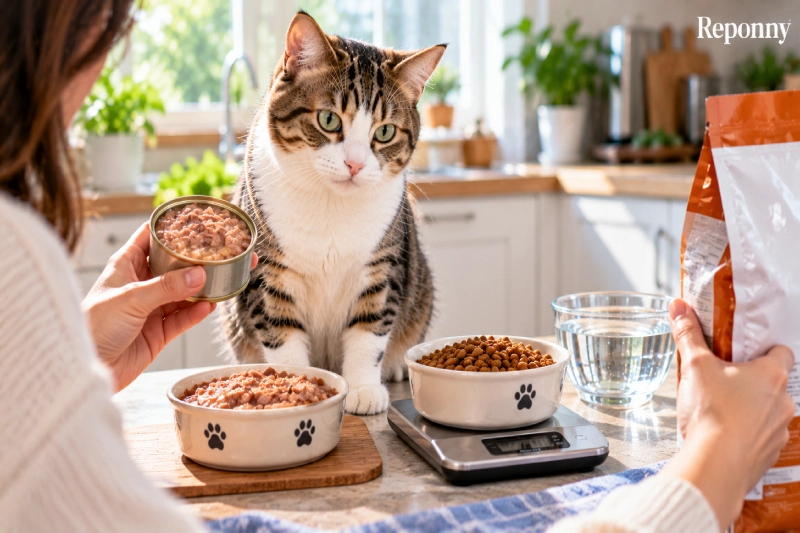
Wet Food vs. Dry Food: Which Has Fewer Carbohydrates?
Wet foods often contain less digestible carbohydrate than dry kibble, but this is not guaranteed.
Cornell notes that canned food contains substantial moisture, typically at least around 75%, while dry foods contain much less water.
The 2026 AAHA feline diabetes guidelines also note that canned foods generally offer lower carbohydrate levels and higher water intake than dry foods, which is one reason canned diets are commonly preferred for diabetic cats.
However, some wet foods contain starch-rich gravies or sauces, while some dry foods are specifically formulated with reduced carbohydrate.
You therefore cannot reliably determine carbohydrate content simply from:
wet vs. dry
or from the appearance of the food.
You need the nutritional information for the individual product.
Why Dry Cat Food Usually Contains Starch
Dry kibble requires structure.
During extrusion and cooking, starch helps the ingredients form stable pieces that hold together after processing.
This is one reason dry foods often contain ingredients such as:
rice, corn, wheat, potato, peas, tapioca, or other starch sources.
That fact alone does not establish whether the finished food is nutritionally good or bad.
Remember that cats can digest properly processed starch efficiently.
The more useful questions are whether the diet is complete and balanced, provides adequate protein and essential nutrients, contains an appropriate calorie density, and suits your individual cat.
Grain-Free Does Not Mean Carbohydrate-Free
One of the easiest mistakes when shopping for cat food is assuming:
grain-free = low carbohydrate.
It does not.
A grain-free food may replace corn, wheat, or rice with other carbohydrate-containing ingredients such as:
potatoes, peas, lentils, chickpeas, or tapioca.
The absence of grain tells you which ingredient category is missing.
It does not tell you the total amount of digestible carbohydrate in the finished food.
Likewise, a food containing a modest amount of rice is not automatically higher in carbohydrate than every grain-free food.
If carbohydrate level matters medically, obtain actual nutrient information instead of relying on front-of-package marketing.

How to Estimate Carbohydrates in Cat Food
Carbohydrate content has traditionally been more difficult for consumers to find because it is not consistently included in the standard guaranteed analysis.
AAFCO explains that carbohydrates are often estimated rather than directly measured using what is called nitrogen-free extract, or NFE.
The basic calculation is:
100 − protein − fat − fiber − moisture − ash = estimated carbohydrate/NFE
For example, imagine a food with:
| Component | Percentage |
|---|---|
| Protein | 40% |
| Fat | 18% |
| Fiber | 3% |
| Moisture | 10% |
| Ash | 8% |
| Estimated carbohydrate | 21% as fed |
The calculation would be:
100 − 40 − 18 − 3 − 10 − 8 = 21%
But there is an important limitation.
Guaranteed-analysis numbers are commonly listed as minimums or maximums rather than exact typical nutrient values. Ash may also be absent from the consumer label.
That means a calculation from the package can only provide an estimate.
For a more accurate number—especially for a diabetic cat—ask the manufacturer for a typical nutrient analysis and carbohydrate content expressed on a metabolizable-energy basis or discuss the product with your veterinarian.
AAHA notes that pet-food labels still do not consistently provide carbohydrate information, although newer AAFCO pet-food labeling modernization rules are moving toward carbohydrate disclosure.

As-Fed, Dry Matter and Calories Are Different Measurements
Carbohydrate percentages can become confusing because they may be expressed in different ways.
You may encounter:
as-fed percentage,
dry-matter percentage, or
percentage of metabolizable energy.
These numbers are not interchangeable.
A wet food containing 5% carbohydrate as-fed could appear extremely low, but much of that food is water. Once moisture is removed mathematically, its carbohydrate percentage on a dry-matter basis becomes higher.
Similarly, veterinary diabetes recommendations often describe carbohydrate as a percentage of metabolizable energy, which is different again.
Therefore, do not directly compare:
“10% carbohydrate dry matter”
with
“10% of calories from carbohydrate.”
They represent different calculations.
When a specific carbohydrate target is medically important, use the same measurement method recommended by the veterinarian.
What About Fiber?
Fiber belongs to the broad carbohydrate family but behaves differently from digestible starch and sugar.
Merck explains that fiber is resistant to digestion by the cat’s digestive enzymes, although intestinal bacteria can ferment some fibers.
Different types of fiber may influence:
stool consistency, intestinal bacteria, digestive transit, satiety, and hairball passage.
That is why some weight-management and gastrointestinal diets deliberately adjust their fiber content.
A food containing useful dietary fiber should not automatically be labeled “high carb” in the same nutritional sense as a food containing large amounts of digestible starch.
When discussing carbohydrate percentages, always ask whether the number refers to:
total carbohydrate, digestible carbohydrate, starch and sugars, or estimated NFE.
The terms are related but not identical.

Are Carbohydrates Bad for Kittens?
A kitten does not need a fashionable “zero-carb” diet.
It needs complete and balanced nutrition formulated for growth.
Growing kittens require adequate protein, calories, essential fatty acids, calcium, phosphorus, taurine, vitamins, minerals, and other nutrients in appropriate proportions.
The fact that carbohydrate is not classified as an essential nutrient does not mean the best kitten diet is simply meat with all carbohydrate-containing ingredients removed.
AAFCO emphasizes that complete and balanced foods must meet nutrient standards appropriate to the animal’s life stage.
For a kitten, the nutritional adequacy statement and healthy growth are more useful priorities than trying to achieve the lowest carbohydrate number possible.
What About Overweight Cats?
If your cat is overweight, carbohydrate is only one part of the problem.
The first priority is controlling total energy intake safely.
Cornell emphasizes calorie control and gradual weight loss for obese cats rather than uncontrolled food restriction.
A weight-management food may modify several nutritional characteristics at the same time, including:
protein, fat, fiber, energy density, and sometimes carbohydrate.
Higher protein can help support lean body mass, while certain fibers can help with satiety.
What matters is whether the diet allows your cat to consume appropriate nutrition while gradually moving toward a healthier body condition.
Do not switch an overweight cat to an extremely calorie-dense, high-fat diet merely because it has fewer carbohydrates.
And never use starvation or severe food restriction to force rapid feline weight loss.
How to Choose a Cat Food When You Are Concerned About Carbohydrates
Instead of buying according to a single front-of-package claim, compare the entire diet.
| What to Check | Why It Matters |
|---|---|
| Complete and balanced statement | Confirms nutritional adequacy for the intended life stage |
| Protein | Cats have substantial protein and amino-acid requirements |
| Calories | Excess calories contribute to weight gain regardless of source |
| Body condition | Determines whether current intake is appropriate |
| Moisture | Wet diets can support hydration |
| Carbohydrate information | Especially useful for diabetic cats |
| Medical condition | Diabetes and other diseases may change the ideal macronutrient profile |
| Manufacturer data | Typical nutrient analysis can be more useful than package estimates |
AAFCO identifies the nutritional adequacy statement as one of the most important pieces of information when selecting pet food.
For a healthy cat, that should generally come before chasing a specific carbohydrate percentage.

Frequently Asked Questions
Do Cats Need Carbohydrates?
Adult, nonreproducing cats do not have an essential dietary carbohydrate requirement because they can manufacture glucose through gluconeogenesis.
That does not mean they cannot digest carbohydrates.
Can Cats Digest Carbohydrates?
Yes.
Merck reports that dogs and cats can digest properly cooked starch at greater than 90% efficiency.
Raw or poorly digestible starch and excessive simple sugars may be handled differently.
What Percentage of Carbohydrates Should Cat Food Have?
There is no single scientifically established carbohydrate percentage that is ideal for every healthy cat.
A 2025 meta-analysis found no relationship between dietary carbohydrate content and greater body-fat mass, fasting insulin, or fasting glucose across the studies analyzed, which included a broad range of carbohydrate concentrations.
Medical conditions can change the target.
Is 20% Carbohydrate Too High for Cats?
Not necessarily for a healthy cat.
You first need to know whether the number represents as-fed percentage, dry matter, or percentage of metabolizable energy.
The overall formulation, protein, calories, body condition, and health status also matter.
What Carbohydrate Level Is Recommended for Diabetic Cats?
The 2026 AAHA Diabetes Management Guidelines suggest reduced carbohydrate intake for diabetic cats and describe an ideal target for many patients as roughly below 12–15% of metabolizable energy, while emphasizing individualized management.
This target should not be automatically applied to healthy cats.
Is Grain-Free Cat Food Lower in Carbs?
Not necessarily.
Grain-free foods may use potatoes, peas, lentils, tapioca, or other starch-containing ingredients instead of grain.
Look at actual nutrient data rather than the grain-free label.
Is Wet Cat Food Low in Carbohydrates?
Wet foods often contain less carbohydrate than dry foods, and AAHA notes this advantage when discussing diabetic-cat diets.
However, individual formulations vary, so check the specific product.
Do Carbohydrates Cause Obesity in Cats?
Current evidence does not support carbohydrate concentration alone as a universal cause of feline obesity. A recent meta-analysis found no association between higher carbohydrate content and increased body-fat mass across the studies included. Total calorie intake and body condition remain highly important.
Should I Put My Healthy Cat on a Zero-Carb Diet?
There is no established requirement for every healthy cat to eat a zero-carbohydrate diet.
Prioritize complete and balanced nutrition, adequate protein, appropriate calories, hydration, and healthy body condition.
Final Thoughts
Carbohydrates in cat food are a much more nuanced topic than the internet often suggests.
Cats are obligate carnivores.
They do not have an essential dietary requirement for carbohydrates, and their metabolism is strongly adapted to using protein and fat.
But that does not mean every carbohydrate-containing cat food is unhealthy.
Healthy cats can digest properly cooked starch efficiently, and current evidence does not establish one universal carbohydrate percentage above which food automatically becomes harmful.
For healthy cats, focus on the whole diet:
complete and balanced nutrition, adequate high-quality protein, appropriate calories, essential fats, vitamins and minerals, hydration, and healthy body condition.
Carbohydrate becomes more clinically important when diabetes enters the picture. For diabetic cats, the 2026 AAHA guidelines generally favor a high-protein, reduced-carbohydrate approach, often targeting less than roughly 12–15% of metabolizable energy from carbohydrate.
So instead of asking only:
“How low are the carbs?”
ask:
“Is this food nutritionally complete, appropriate for my cat’s health and life stage, and helping my cat maintain an ideal body and muscle condition?”
That is a much more useful way to evaluate a cat’s diet.