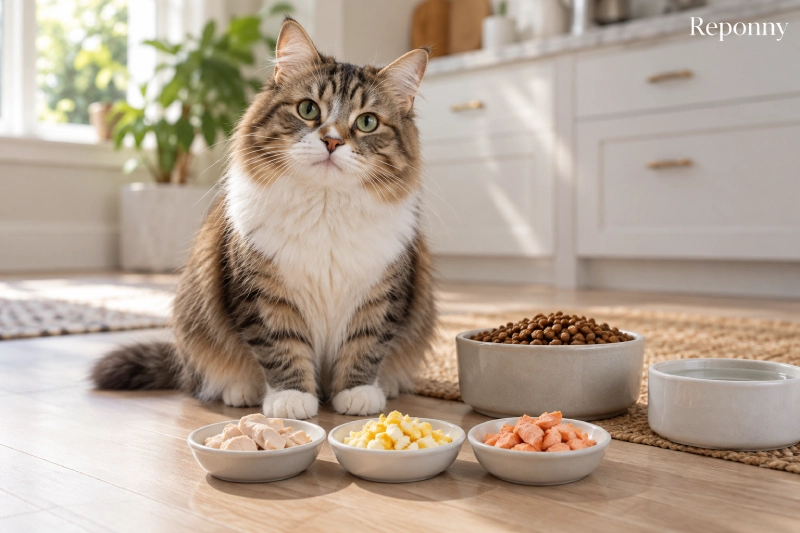
Chicken, fish, and eggs are three foods that many cats find almost impossible to ignore.
The smell of freshly cooked chicken can bring a sleeping cat into the kitchen within seconds. Open a can of tuna and your cat may appear before you have even reached for a plate. Crack an egg into a frying pan and you may suddenly have an audience.
Fortunately, plain, properly cooked chicken, fish, and eggs can all be offered to many healthy cats in small amounts.
VCA Animal Hospitals includes cooked meats, cooked seafood, and cooked eggs among human foods that can be used as occasional cat treats when they are prepared without unsafe seasonings.
But there is an important distinction:
A food being safe as a treat does not mean it is nutritionally complete enough to become your cat’s regular diet.
Cats require carefully balanced amounts of protein, taurine, arginine, essential fatty acids, vitamins, minerals, and other nutrients. Cornell emphasizes that a nutritionally complete and balanced cat food should provide the overwhelming majority of the diet.
Quick answer: Cats can eat small amounts of plain, fully cooked, boneless chicken, eggs, and fish. Avoid raw animal products, cooked bones, heavily seasoned foods, onion, garlic, sauces, and excessive portions. Treats and human foods should generally stay within about 10% of daily calories.
Can Cats Eat Chicken?
Yes.
For many healthy cats, plain cooked chicken is one of the simplest human-food treats you can offer.
VCA lists cooked meat among human foods that are generally suitable for cats when served without seasoning.
Chicken provides animal protein and is highly appealing to many cats.
The safest version is:
fully cooked, boneless, plain chicken with no seasoning or sauce.
Good preparation methods include:
- boiling,
- baking,
- steaming,
- or cooking in a pan without seasoning or rich oils.
Remove bones before serving.
For an occasional treat, choosing lean meat and removing excessive skin or fat can also help limit unnecessary calories.
Avoid chicken prepared with:
- onion,
- garlic,
- onion powder,
- garlic powder,
- salty seasoning,
- spicy sauces,
- gravy,
- barbecue sauce,
- or heavy amounts of butter and oil.
ASPCA warns that onion, garlic, and chives can damage red blood cells, with cats being particularly susceptible to Allium toxicity.
So the chicken on your dinner plate may be very different from the chicken you should offer your cat.
How Much Chicken Can a Cat Eat?
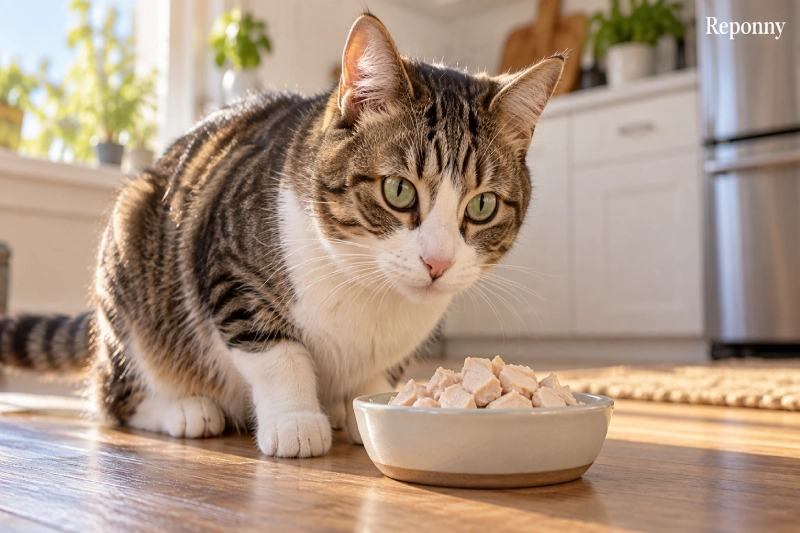
Think in terms of treat-sized portions, not human meal portions.
VCA recommends that treats and snacks provide no more than about 10% of a cat’s daily calorie intake, with roughly 90% coming from complete and balanced food.
Suppose a cat needs approximately 220 calories each day.
A 10% treat budget would be only:
22 calories.
That can be reached surprisingly quickly.
You do not need to fill a second bowl with chicken.
A few tiny pieces can provide the smell and taste your cat enjoys without replacing too much nutritionally complete food.
Can Cats Eat Chicken Every Day?
A small amount of plain cooked chicken can sometimes be used regularly as a treat, provided it fits into the cat’s calorie allowance and does not interfere with an appropriately balanced diet.
But chicken alone should not become the entire diet.
Cornell explains that cats need more than protein. They require vitamins, minerals, fatty acids, amino acids, and other nutrients in the correct proportions. Cornell also warns that homemade diets can easily become nutritionally incomplete.
A bowl of chicken breast is therefore not nutritionally equivalent to a complete cat food.
This is especially important for:
- kittens,
- pregnant or nursing cats,
- senior cats,
- and cats with medical conditions.
These animals may have more specific nutritional requirements.
Can Cats Eat Raw Chicken?
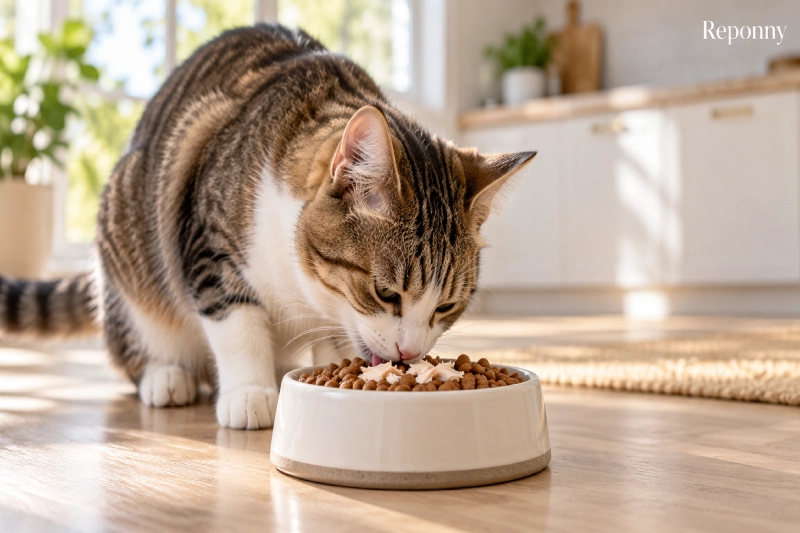
Raw chicken is not the safer choice.
Raw animal products can contain disease-causing microorganisms.
FDA states that raw pet foods have a higher risk of contamination with harmful bacteria such as Salmonella and Listeria monocytogenes than processed pet foods and advises that avoiding raw food is the most reliable way to prevent exposure from raw diets.
Cornell also does not recommend raw meat as food or treats because of infectious-disease risks to cats and people.
The risk is not limited to the cat.
Pathogens can potentially spread through:
- food-preparation surfaces,
- bowls,
- the cat’s mouth,
- saliva,
- and feces.
Households containing very young, elderly, pregnant, or immunocompromised people may have additional reasons to avoid unnecessary exposure.
If you want to share chicken, plain cooked chicken is the simpler choice.
Can Cats Eat Chicken Bones?
No.
Remove bones before giving chicken to your cat.
FDA warns that bones can become stuck in the esophagus, stomach, or intestines and cause gastrointestinal obstruction.
Cooked bones are particularly concerning because heating makes them brittle and more likely to splinter. VCA notes that cooked bones can cause intestinal obstruction or perforation.
Bones can also:
- become lodged in the mouth,
- damage teeth,
- cause choking,
- or create internal injuries.
Do not give your cat leftover chicken wings, drumsticks, carcasses, or fish bones.

Can Cats Eat Eggs?
Yes.
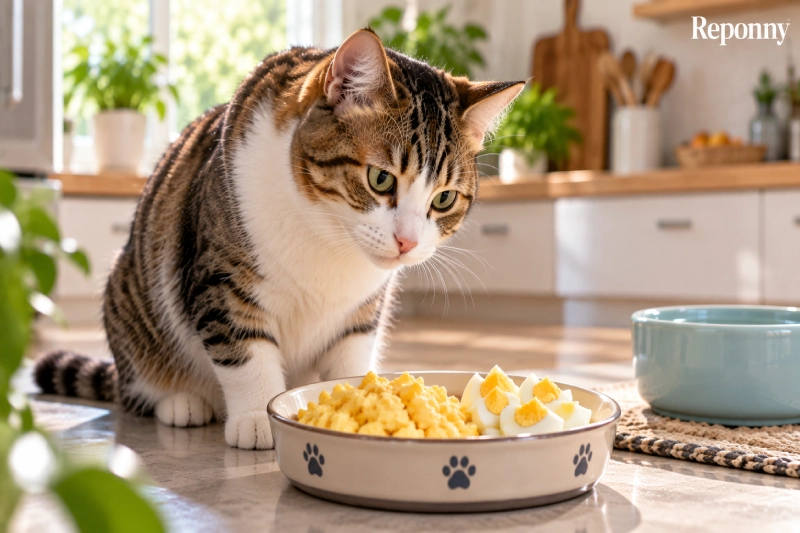
Fully cooked plain eggs can be offered as an occasional treat to many healthy cats.
VCA specifically lists cooked eggs among human foods that can be used for cats.
Eggs contain:
- protein,
- fat,
- amino acids,
- and several vitamins and minerals.
However, an egg is not a complete feline diet.
Even though eggs are nutrient-rich, they do not provide every nutrient your cat needs in the correct amounts and ratios.
Treat them as an extra—not as a replacement for cat food.
What Is the Best Way to Cook Eggs for Cats?
Keep preparation simple.
Suitable options include:
hard-boiled egg or plain fully cooked scrambled egg.
Avoid adding:
- salt,
- garlic,
- onion,
- cheese,
- cream,
- butter-heavy sauces,
- sausage,
- bacon,
- or seasoning mixtures.
A tiny portion is enough.
Remember that one whole chicken egg can represent a meaningful number of calories for a small cat.
Your cat does not need an entire breakfast-sized serving.
Can Cats Eat Raw Eggs?
Cooked is safer.
VCA cautions that raw eggs and other raw animal products may be contaminated with potentially harmful bacteria.
Food safety is one reason to cook eggs thoroughly before sharing them with your cat.
You may see raw-feeding advocates claim that cats naturally consume raw animal foods.
But the question is not whether cats historically encountered raw prey.
The question is whether exposing a household cat and the people living with it to avoidable foodborne pathogens provides a proven benefit.
FDA and Cornell both identify raw animal foods as a source of infectious-disease risk.
For a treat, there is little practical reason to take that additional risk.
Can Cats Eat Fish?
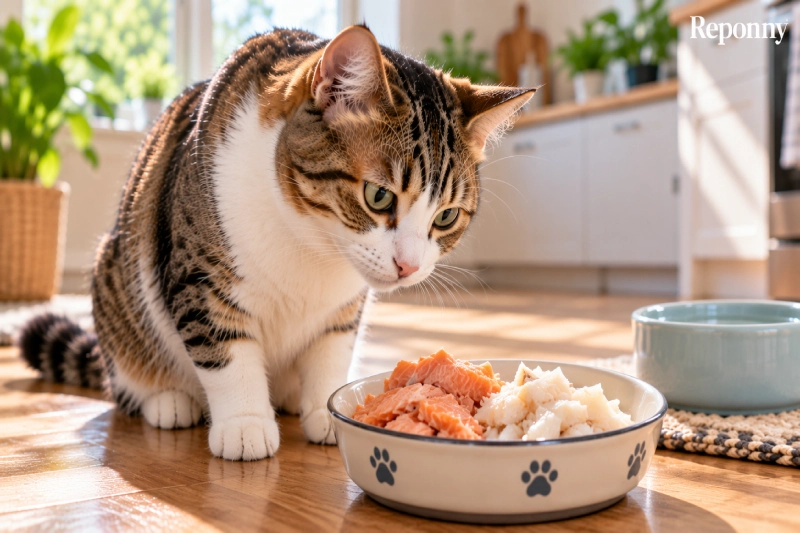
Yes—plain, cooked, boneless fish can be an occasional treat.
VCA lists cooked seafood among foods that may safely be used as treats for many cats.
Cats are often strongly attracted to fish because of its aroma.
Possible choices can include small portions of:
- salmon,
- white fish,
- cod,
- or other fully cooked boneless fish.
The fish should be prepared without:
- salt-heavy seasoning,
- onion,
- garlic,
- sauces,
- breading,
- or deep frying.
Remove all bones before serving.
Should Cats Eat Fish Every Day?
Fish can be part of a properly formulated commercial cat food.
That is different from feeding your cat human fish products every day.
Cornell warns that some cats fed canned fish products intended for humans have developed potentially serious neurological problems and advises that human foods should remain occasional treats rather than replacements for complete cat food.
A diet based largely on plain tuna or another single fish also will not provide every nutrient in the proportions your cat requires.
For example, a can of tuna designed for humans is not formulated to meet feline requirements for:
- calcium,
- vitamins,
- trace minerals,
- fatty-acid balance,
- and other essential nutrients.
So there is an important difference between:
a complete cat food formulated with salmon or tuna
and
feeding a bowl of human tuna as the cat’s normal meal.
The first can provide balanced nutrition.
The second should be an occasional food at most.
Can Cats Eat Canned Tuna?
A small amount of plain tuna may occasionally be used as a treat for a healthy cat, but human canned tuna should not become a regular replacement for cat food.
If you offer a tiny amount, choose a simple product without dangerous seasonings.
Avoid products prepared with:
- onion,
- garlic,
- spicy flavorings,
- or rich sauces.
Cornell’s feeding guidance specifically cautions against relying on canned fish products manufactured for humans.
If your cat loves tuna flavor, a complete and balanced commercial tuna-flavored cat food is a better way to provide that taste as part of the regular diet.

Can Cats Eat Raw Fish?
Raw fish carries food-safety concerns similar to other raw animal products.
Cornell recommends against raw diets because potentially viable bacteria, viruses, and parasites can infect cats and people.
Some raw fish also contains enzymes called thiaminases that can destroy thiamine, or vitamin B1. Long-term feeding of nutritionally unbalanced raw fish is therefore very different from occasionally giving a small piece of fully cooked fish.
Cooking makes fish a safer choice from a microbial perspective.
For an ordinary treat:
cook it, remove the bones, and keep it plain.
What About Fish Bones?
Fish bones may be small, but that does not make them safe.
Bones can become lodged in the digestive tract or create injuries. FDA identifies bones as items that can cause gastrointestinal obstruction.
Sharp cooked fish bones may also injure:
- the mouth,
- throat,
- esophagus,
- stomach,
- or intestines.
Carefully inspect cooked fish before giving any portion to your cat.
Boneless fillets are easier to manage than serving leftovers from a whole fish.
Chicken vs. Fish vs. Eggs: Which Is Best?
There is no need to identify one universal winner.
All three can be appropriate occasional foods when prepared correctly.
| Food | Can Cats Eat It? | Best Preparation | Main Caution |
|---|---|---|---|
| Chicken | Yes | Fully cooked, plain, boneless | No seasoning or bones |
| Eggs | Yes | Fully cooked, plain | Keep portions small |
| Fish | Yes | Fully cooked, boneless, unseasoned | Do not make human fish the regular diet |
| Raw chicken | Best avoided | — | Pathogen risk |
| Raw eggs | Best avoided | — | Pathogen risk |
| Raw fish | Best avoided | — | Pathogens and nutritional concerns |
The best choice may simply depend on what your cat tolerates and enjoys.
The more important requirement is that none of them displace too much of the complete and balanced diet.
Are Chicken, Fish and Eggs Good Sources of Protein?
Yes.
All three provide animal-source protein.
Cats are obligate carnivores and require substantial dietary protein as well as specific amino acids. Cornell notes that cats evolved consuming animal tissues and depend on animal-derived nutrients.
However, high protein content alone does not make a meal complete.
For example:
chicken breast + egg + fish
may sound like an ideal carnivore meal.
But unless the recipe has been properly formulated, it can still be deficient or imbalanced in important nutrients such as:
- calcium,
- certain vitamins,
- trace minerals,
- fatty acids,
- and other nutrients.
That is why feeding a variety of meats does not automatically create a complete homemade diet.

How Much Egg, Chicken or Fish Can You Give a Cat?
There is no single gram amount suitable for every cat.
A 7-pound indoor cat and a 15-pound active cat have very different calorie requirements.
A simple rule is more useful:
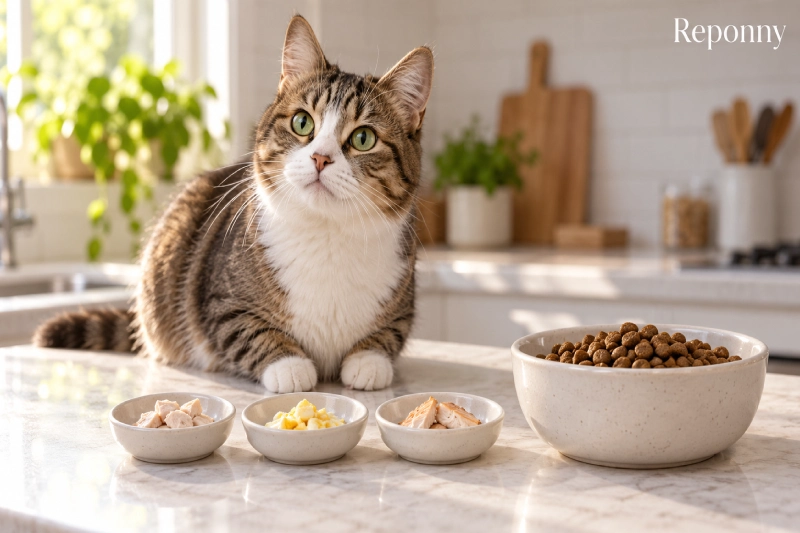
Keep all treats and extras to about 10% or less of daily calories.
VCA recommends approximately 90% of daily calories from complete and balanced food and no more than 10% from treats and snacks.
That 10% includes everything outside the main diet:
- chicken,
- fish,
- eggs,
- commercial treats,
- food toppers,
- and table scraps.
Do not give 10% chicken plus 10% fish plus 10% treats.
The total of all extras should remain within the treat allowance.
For many cats, a few tiny morsels are enough.
What Seasonings Should Cats Avoid?
The safest preparation is completely plain.
Do not assume a seasoning is harmless because humans use it every day.
Onions, garlic, and chives are particularly important to avoid.
ASPCA reports that Allium foods can cause gastrointestinal irritation and red-blood-cell damage, potentially leading to anemia, with cats particularly susceptible.
Be especially careful with:
- garlic powder,
- onion powder,
- seasoning packets,
- marinades,
- stocks,
- sauces,
- gravies,
- and prepared deli meats.
Powders can be easy to overlook because there may be no visible pieces of onion or garlic.
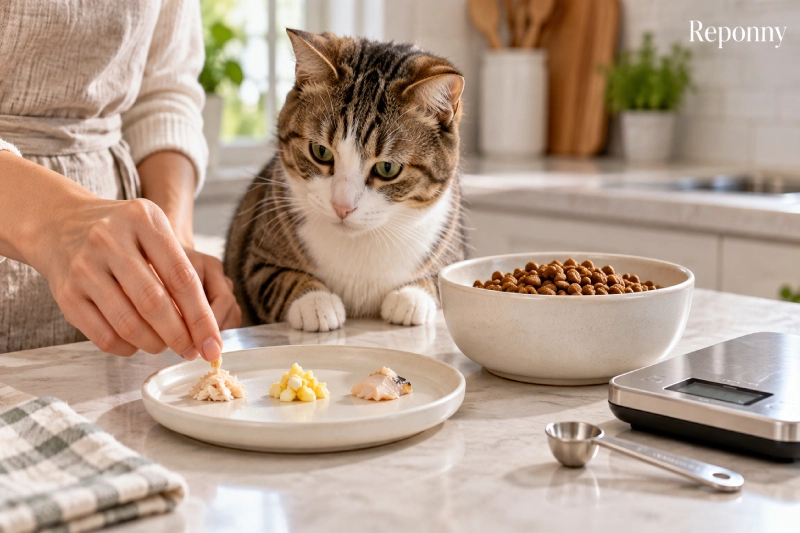
If you plan to share a little chicken or fish, set aside a plain piece before seasoning the human meal.
Can Kittens Eat Chicken, Eggs and Fish?
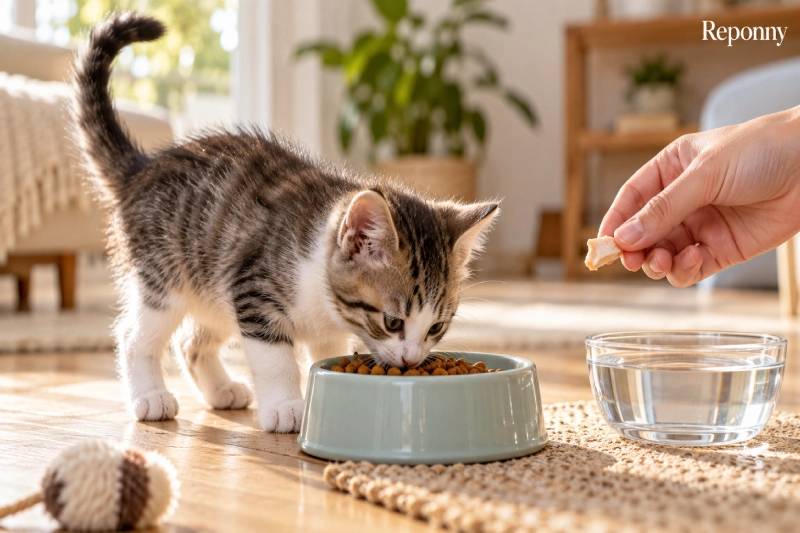
A healthy, fully weaned kitten can occasionally have a tiny amount of properly cooked, plain, cat-safe food.
But kittens have very little nutritional room for mistakes because they are growing rapidly.
Their primary food should be complete and balanced for growth.
A kitten needs carefully controlled amounts of:
- protein,
- calories,
- calcium,
- phosphorus,
- fatty acids,
- vitamins,
- minerals,
- taurine,
- and many other nutrients.
Do not replace kitten food with bowls of chicken, tuna, or eggs simply because the kitten loves them.
Growth nutrition is more complicated than providing lots of protein.
What About Cats With Food Allergies or Medical Conditions?
A food that is safe for most cats may not be appropriate for every individual.
VCA advises owners of cats with medical conditions or therapeutic diets to check with their veterinary team before introducing treats, because extras can interfere with some prescription diets or expose a cat to an ingredient being avoided.
This can matter for cats with:
- diagnosed food allergies,
- gastrointestinal disease,
- kidney disease,
- urinary disease,
- obesity,
- diabetes,
- or veterinary elimination diets.
Chicken, for example, may be an ordinary safe treat for one cat but completely inappropriate during a carefully controlled elimination diet testing for food reactions.
If your cat eats prescription food, do not automatically assume plain meat is harmless.
Ask whether treats are compatible with the treatment plan.
What If Your Cat Steals Raw Chicken or Fish?
Do not panic, but take the exposure seriously.
Determine:
- what the cat ate,
- how much,
- whether bones were involved,
- how long ago it occurred,
- and whether the food contained seasonings or other ingredients.
Monitor for problems such as:
- repeated vomiting,
- diarrhea,
- lethargy,
- abdominal discomfort,
- loss of appetite,
- difficulty passing stool,
- choking,
- or trouble swallowing.
If bones were swallowed or the cat develops symptoms, contact a veterinarian promptly.
FDA notes that bones can cause obstruction, and raw animal products carry bacterial contamination risks.
Frequently Asked Questions
Can Cats Eat Cooked Chicken?
Yes. Plain, fully cooked, boneless chicken can be offered in small amounts to many healthy cats. VCA includes cooked meats among acceptable human-food treats for cats.
Can Cats Eat Chicken Breast?
Yes.
Plain cooked chicken breast is a simple option because it can be prepared without bones, sauces, or seasoning.
Keep the portion small and use it as a treat rather than a complete meal.
Can Cats Eat Eggs?
Yes.
Cats can have a small amount of fully cooked plain egg. Avoid salt, butter-heavy preparations, cheese, onions, garlic, and other seasonings.
Can Cats Eat Scrambled Eggs?
Yes, provided the egg is fully cooked and plain.
A small amount is enough.
Can Cats Eat Raw Eggs?
Raw eggs are best avoided because raw animal products can carry pathogenic bacteria.
Can Cats Eat Salmon?
A small amount of plain, fully cooked, boneless salmon can be used as an occasional treat.
Do not serve salmon prepared with sauces, heavy seasoning, onion, garlic, or bones.
Can Cats Eat Tuna?
A tiny amount of plain tuna may occasionally be offered to a healthy cat, but human canned tuna should not replace complete cat food. Cornell cautions against relying on canned fish made for human consumption.
Can Cats Eat Fish Every Day?
It is better not to use human fish as the cat’s everyday diet.
A commercial complete and balanced cat food containing fish can be suitable for regular feeding, but plain fish by itself does not provide all required nutrients.
Can Cats Eat Chicken Bones?
No.
Bones can cause choking, obstruction, tooth damage, or gastrointestinal injury. Cooked bones may splinter.
Is Chicken Better Than Fish for Cats?
Neither needs to be declared universally better.
Plain cooked chicken and fish can both be occasional treats.
The overall complete diet is far more important than choosing between the two.
Final Thoughts
So, can cats eat eggs, fish and chicken?
Yes—when they are prepared correctly.
For most healthy cats, the safest versions are:
plain cooked chicken, fully cooked eggs, and fully cooked boneless fish.
Keep portions small.
Avoid onion, garlic, rich sauces, excessive salt, seasoning mixes, and bones.
Cook animal foods rather than serving them raw. FDA and Cornell both identify raw animal foods as potential sources of infectious pathogens.
And remember the most important nutritional rule:
Chicken, fish and eggs are treats—not complete cat diets.
A cat may happily eat chicken every day, but enthusiasm does not make chicken nutritionally complete.
For most cats, at least about 90% of daily calories should continue to come from complete and balanced food, leaving no more than roughly 10% for treats and other extras.
If your cat has a medical condition, food allergy, or prescription diet, ask your veterinarian before adding human foods.
The safest approach is simple:
Cook it. Keep it plain. Remove the bones. Keep the portion small. And let complete cat food do the nutritional heavy lifting.