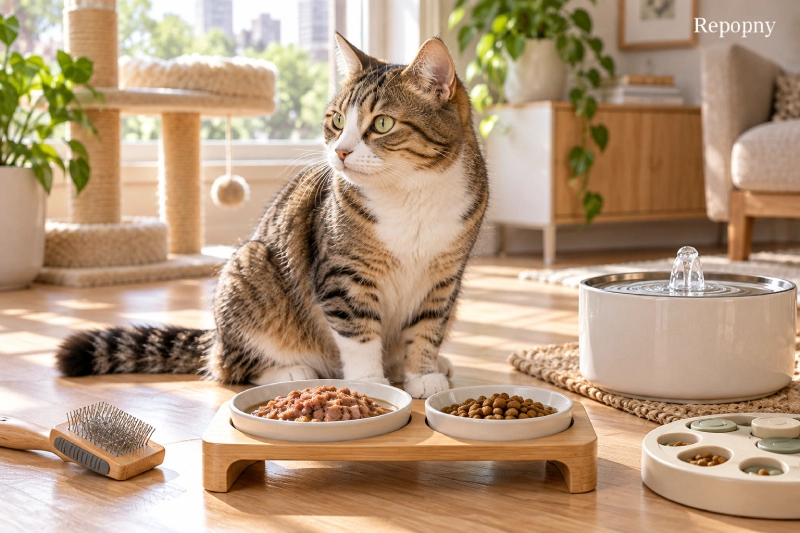
Indoor cats live safer, more controlled lives than cats that roam freely outdoors, but living indoors creates its own nutritional challenges.
Many indoor cats spend much of the day sleeping, have food delivered directly to a bowl, are spayed or neutered, and have fewer opportunities to hunt, climb, and travel long distances. This can make excess calorie intake and weight gain particularly important concerns.
Indoor cats may also groom frequently, leading owners to search for foods marketed for hairball control.
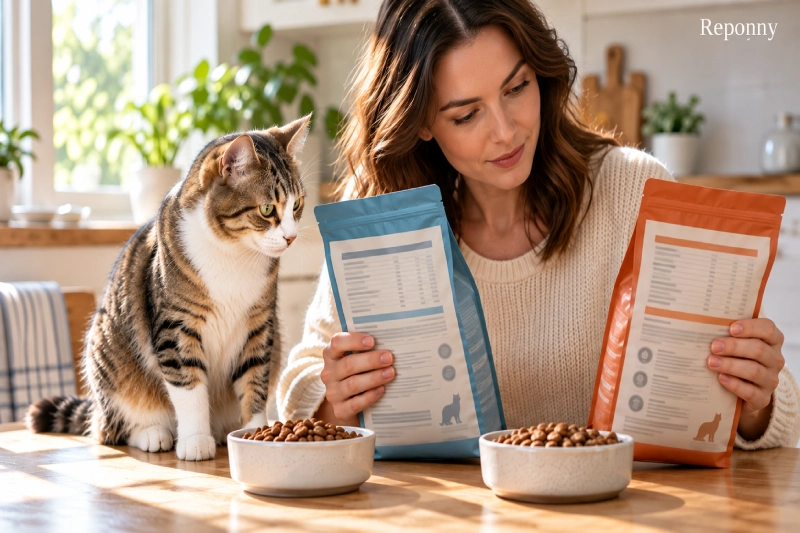
That explains why pet-food shelves are filled with bags labeled:
Indoor Formula. Indoor Weight Control. Indoor Hairball. Indoor Adult.
But the word “indoor” does not tell you whether a food is nutritionally ideal for your cat.
AAFCO recognizes nutritional life stages such as growth, adult maintenance, gestation/lactation, and all life stages—not a separate nutritional life stage called “indoor.” A food for an indoor cat should still first be complete and balanced for the appropriate life stage.
The best food for an indoor cat therefore depends less on the word printed on the front of the package and more on:
calories, protein, portion size, moisture, fiber, body condition, activity, age, and individual health.
Quick answer: For most healthy adult indoor cats, choose a complete and balanced adult-maintenance diet with adequate protein, appropriate calories, and a feeding amount that keeps the cat near an ideal body condition of about 5/9. Wet, dry, or mixed feeding can all work. If hairballs are frequent, increased dietary fiber may help some cats—but regular grooming and investigation of excessive hairball vomiting are also important.
Do Indoor Cats Need Special Cat Food?
Not necessarily.
A healthy indoor cat does not automatically need a food specifically labeled “indoor.”
The important question is whether the food matches the cat’s actual nutritional needs.
AAFCO recommends selecting a food that is:
- intended for cats,
- complete and balanced,
- appropriate for the animal’s life stage,
- and fed in an amount that maintains healthy body condition.
An indoor formula may be useful if its characteristics happen to match your cat.
For example, some indoor foods are formulated with:
- reduced calorie density,
- moderate fat,
- increased fiber,
- or ingredients intended to help manage hairballs.
But another adult cat food without the word indoor may provide an equally appropriate—or even better—nutritional profile for your individual cat.
Do not buy based on the name alone.
Why Indoor Cats Can Gain Weight Easily
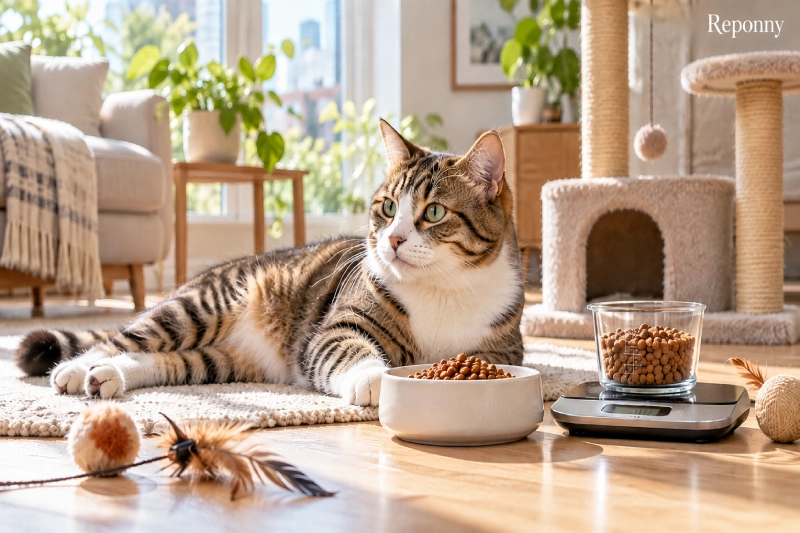
Indoor living often reduces energy expenditure.
Cornell notes that cats living exclusively indoors generally expend fewer calories than cats that go outdoors, while AAHA states that energy needs are influenced by activity, neuter status, body condition, age, and health.
Several factors can combine:
Less Physical Activity
An outdoor cat may walk, climb, patrol territory, stalk prey, and react continuously to its environment.
An indoor cat may spend many hours sleeping on a sofa.
Free-Choice Feeding
Keeping a bowl of dry food full all day can work for some cats, but Cornell notes that free feeding may lead to overeating and inappropriate weight gain in others.
Neutering
AAHA identifies neutering as an important risk factor for feline weight gain, especially when food intake is not adjusted afterward.
Too Many Treats
Treats, chicken, lickable snacks, toppers, and table food all add calories.
Calorie-Dense Food
A small-looking serving of kibble may contain far more calories than owners expect.
For indoor cats, the amount fed may matter more than whether the package says “indoor.”
Calories Are One of the Most Important Things to Check
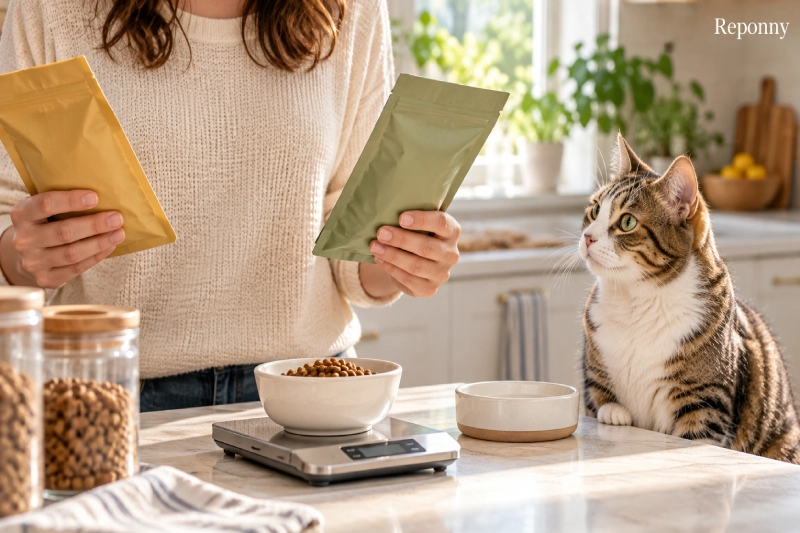
Do not compare indoor cat foods only by cups or grams.
Compare calories.
AAFCO requires calorie information on U.S. pet-food labels and it should be expressed both as kilocalories per kilogram and in a familiar household unit such as kcal per cup, can, or pouch.
Imagine two dry foods:
Food A: 320 kcal per cup
Food B: 450 kcal per cup
If you serve one cup of each, Food B provides about 41% more calories.
That can make a major difference for a small indoor animal.
AAHA specifically notes that sedentary and indoor pets may require less energy than general calorie estimates suggest, so calorie recommendations should always be adjusted according to body weight and Body Condition Score.
Feeding charts are only starting points
If your cat gains weight while eating the package recommendation, reduce intake with veterinary guidance.
If your cat loses unwanted weight, intake may need to increase.
The cat’s body condition ultimately tells you whether the calorie amount is appropriate.
What Is a Healthy Body Condition for an Indoor Cat?
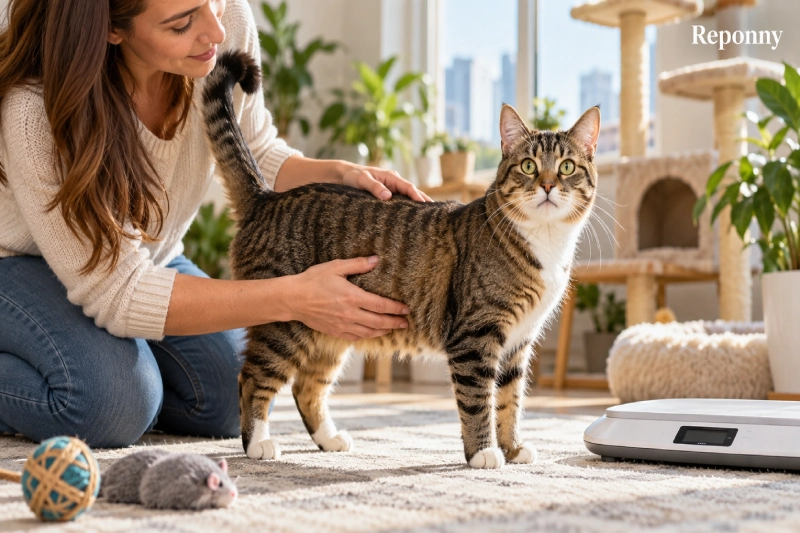
Cornell uses a nine-point Body Condition Score system and describes approximately 5/9 as ideal.
At ideal condition:
- the ribs are easy to feel beneath a slight fat covering,
- a waist is visible behind the ribs,
- and the abdominal fat pad is relatively small.
AAHA generally considers:
6–7/9 = overweight
and
8–9/9 = obese.
Do not wait until your cat looks dramatically overweight.
Even gradual weight gain matters.
Weigh your indoor cat periodically and learn how to feel the rib cage and waist.
Body condition is more useful than trying to force every cat toward an arbitrary number such as 10 pounds.
Protein Still Matters for Indoor Cats
An indoor lifestyle does not make a cat less carnivorous.
Cats remain obligate carnivores whether they sleep on a sofa or hunt outdoors.
A nutritionally appropriate food must supply essential nutrients including:
- adequate protein,
- taurine,
- arginine,
- essential fatty acids,
- vitamins,
- and minerals.
The mistake is assuming an inactive indoor cat needs an extremely low-protein diet simply because it requires fewer calories.
During weight management, maintaining sufficient protein can be particularly useful for helping preserve lean body mass.
Instead of looking only for low calorie, look for:
appropriate calories + adequate protein + complete and balanced nutrition.
An indoor cat should lose excess fat, not unnecessary amounts of muscle.
Wet vs. Dry Food for Indoor Cats
Neither format is automatically best for every indoor cat.
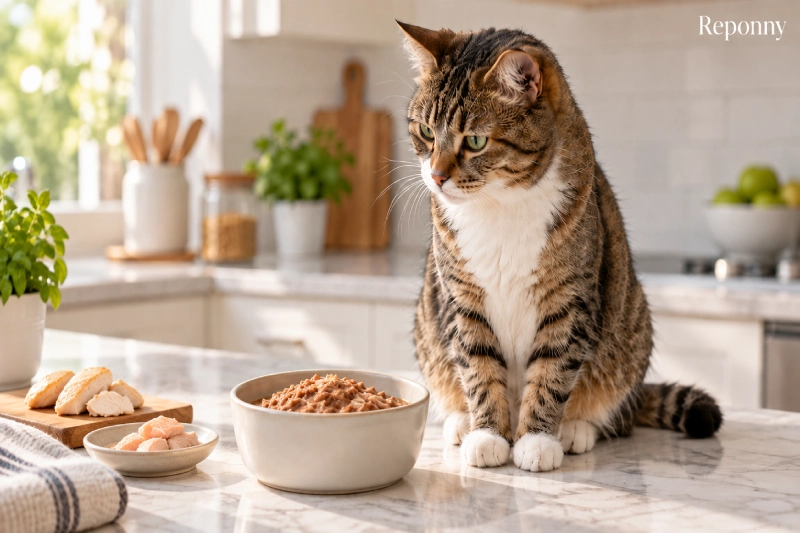
Cornell notes that high-quality wet and dry foods can both provide complete and balanced nutrition.
The differences matter, however.
Wet Food
Wet food typically contains around 70–80% water, according to Cornell.
Potential advantages include:
- greater dietary moisture,
- larger food volume for some calorie levels,
- strong aroma and palatability,
- and easier portion-based meal feeding.
Wet food may be particularly useful for cats that naturally drink little.
Dry Food
Dry food can offer:
- convenience,
- easy measuring,
- longer stability after serving,
- and compatibility with puzzle feeders and automatic feeders.
The main practical risk is that dry food can be easy to overfeed, particularly when the bowl is continually refilled.
Mixed Feeding
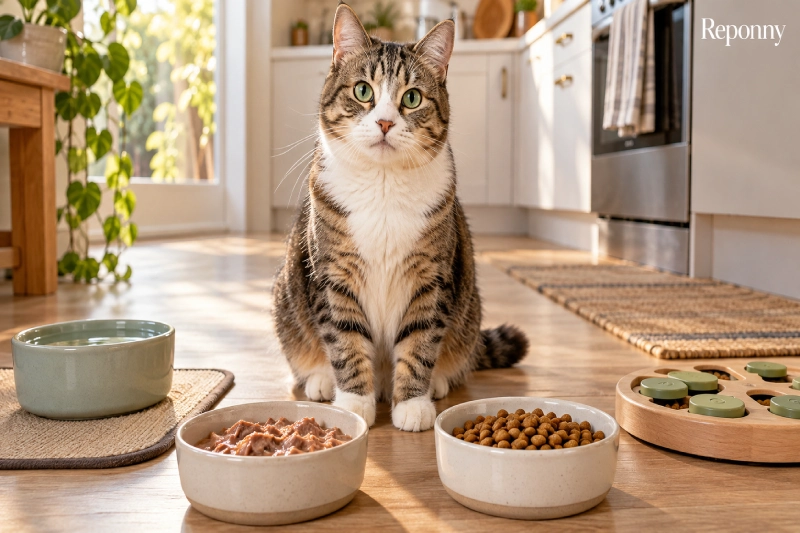
There is nothing wrong with feeding both formats when total calories remain controlled.
For example:
wet breakfast + measured dry food in a puzzle feeder + wet dinner
can provide moisture, enrichment, and portion control.
The best format is the one that allows your cat to maintain healthy body condition while receiving complete nutrition.
Hydration Matters Even for Indoor Cats
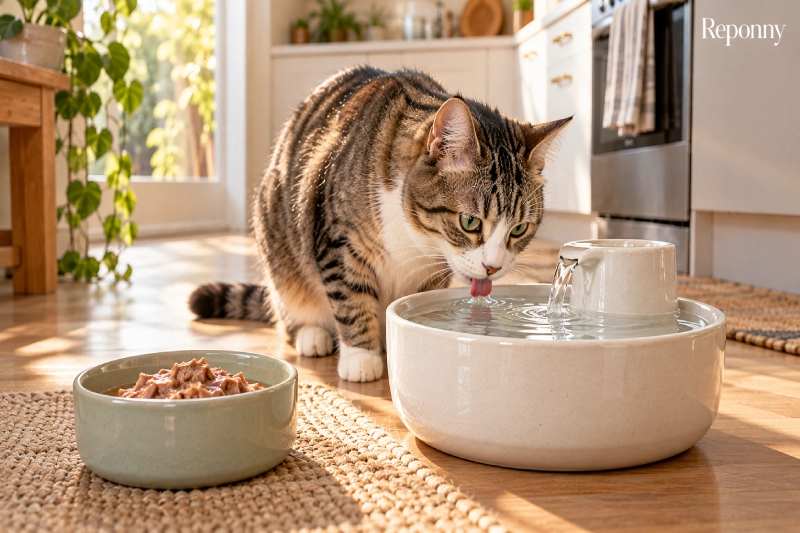
Indoor cats should always have unrestricted access to fresh water.
Cornell notes that this is particularly important for cats fed only dry food and for cats prone to lower urinary tract problems.
To encourage water intake:
- provide multiple clean water bowls,
- place water in quiet locations,
- try a cat fountain,
- wash bowls regularly,
- and consider incorporating moisture-rich food.
Do not assume a cat is well hydrated simply because it lives in a climate-controlled house.
Water intake still depends on diet, health, temperature, and individual preference.
What Is Hairball-Control Cat Food?
When cats groom themselves, they swallow loose hair.
Most swallowed hair travels through the gastrointestinal tract and leaves the body in feces.
Sometimes hair accumulates and forms a mass known medically as a trichobezoar, or hairball.
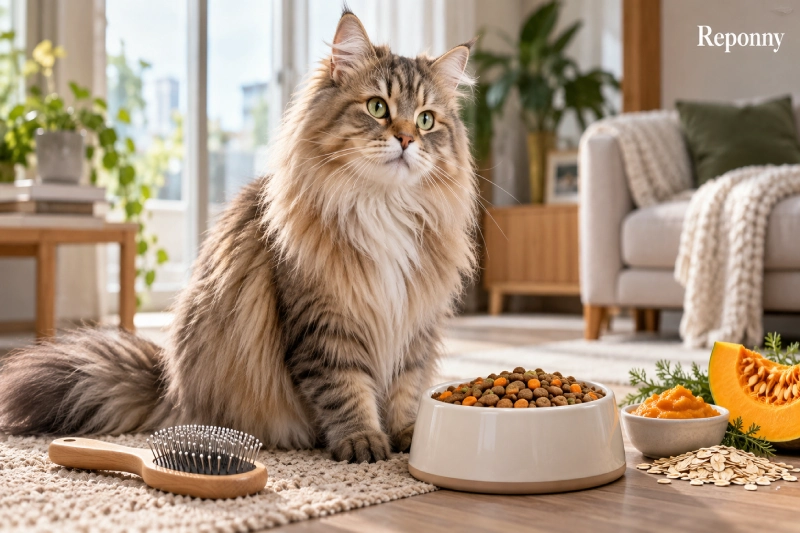
Hairball-control foods commonly contain higher or specially adjusted fiber levels intended to help move swallowed hair through the gastrointestinal tract instead of allowing it to accumulate in the stomach.
VCA notes that hairball-specific diets often use increased fiber for this purpose.
That can be useful for some cats.
But the words hairball control do not automatically mean every indoor cat needs that food.
Does Fiber Really Help With Hairballs?
It can.
Dietary fiber may help swallowed hair move through the digestive system.
VCA reports that hairball diets frequently contain increased fiber specifically to encourage gastrointestinal passage of hair.
But fiber is not the entire solution.
Hairballs develop because hair is swallowed during grooming.
Therefore, preventing excessive hair ingestion is equally important.
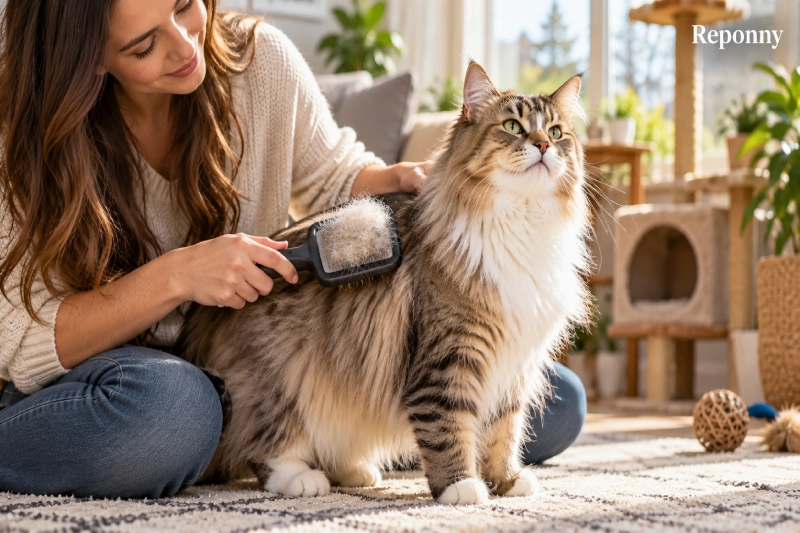
Cornell identifies daily brushing and combing as one of the most practical ways to reduce hairball formation, particularly in long-haired cats and during shedding seasons.
The best hairball strategy may therefore combine:
appropriate diet + adequate hydration + regular grooming.
Do not simply keep increasing dietary fiber on your own.
Different gastrointestinal problems require different dietary strategies, and too much fiber is not automatically better.
Which Indoor Cats Are More Likely to Get Hairballs?
Hairball risk can vary considerably.
Cornell notes that long-haired breeds, including Persians and Maine Coons, are more likely to develop hairballs than short-haired cats. Older cats may also groom more efficiently and ingest more hair than young kittens.
Risk may increase with:
- long or dense coats,
- seasonal shedding,
- frequent grooming,
- excessive grooming,
- skin allergies,
- flea problems,
- stress-related grooming,
- or gastrointestinal disease.
VCA also emphasizes that skin and intestinal disease can increase hairball problems and should be addressed rather than relying only on hairball food.
Frequent Hairballs Are Not Always “Normal”
An occasional hairball can occur in an otherwise healthy cat.
Repeated vomiting is different.
Merck advises veterinary evaluation when a cat has frequent hairballs or repeated vomiting, because another gastrointestinal or medical problem may be responsible.
Cornell also warns that large hairballs can occasionally create a gastrointestinal obstruction requiring medical—and sometimes surgical—treatment.
Contact your veterinarian if your cat has:
- frequent vomiting,
- repeated unproductive retching,
- reduced appetite,
- constipation,
- abdominal discomfort,
- lethargy,
- weight loss,
- or persistent hairball episodes.
Do not assume every episode of vomiting is “just hairballs.”
Should Every Indoor Cat Eat a High-Fiber Diet?
No.
Fiber can be helpful in certain situations, but more is not always better.
A healthy cat with:
- normal stools,
- healthy weight,
- no significant hairball problem,
- and no gastrointestinal disease
does not necessarily require a special high-fiber formula.
Fiber can influence:
- stool volume,
- calorie density,
- satiety,
- gastrointestinal transit,
- and nutrient digestibility.
The ideal amount depends on the entire formulation and the individual cat.
If your main reason for choosing a high-fiber food is repeated vomiting or constipation, talk with your veterinarian first.
Those signs can have causes unrelated to a simple fiber deficiency.
Hairball Gels and Lubricants: Use Carefully
Commercial hairball gels and digestive lubricants are also available.
VCA states that these products should be used under veterinary direction, while Merck advises that lubricant products used for hairballs should be given with veterinary approval and supervision.
Do not routinely give:
- mineral oil,
- petroleum-based products,
- human laxatives,
- or homemade lubricants
without veterinary guidance.
A cat with an intestinal obstruction needs diagnosis—not more lubricant at home.
Is “Indoor Weight Control” Food Better?
It can be useful when it helps you control calories while maintaining complete nutrition.
But do not assume every indoor formula is automatically low-calorie.
Check the label.
Look specifically at:
kcal per cup, can, or pouch.
A food labeled “indoor” could theoretically contain more calories per serving than another food labeled simply “adult maintenance.”
The number matters more than the marketing phrase.
For cats that genuinely need weight loss, AAHA notes that therapeutic weight-loss diets are formulated to provide adequate vitamins and minerals even when calories are restricted. Simply feeding very small amounts of ordinary maintenance food can potentially reduce essential nutrient intake too far.
How Much Should You Feed an Indoor Cat?
There is no single portion for every indoor cat.
Energy requirements depend on:
- ideal body weight,
- age,
- activity,
- neuter status,
- muscle mass,
- body condition,
- health,
- and calorie density of the food.
AAHA uses Resting Energy Requirement calculations as a starting point but explicitly notes that sedentary and indoor cats may need less than generalized estimates. Intake should be adjusted according to weight and BCS.
This is why:
“½ cup per day”
is meaningless unless you also know:
how many calories are in that ½ cup and how many calories your individual cat needs.
A better method is:
- Estimate your cat’s calorie requirement.
- Check kcal per cup/can/pouch.
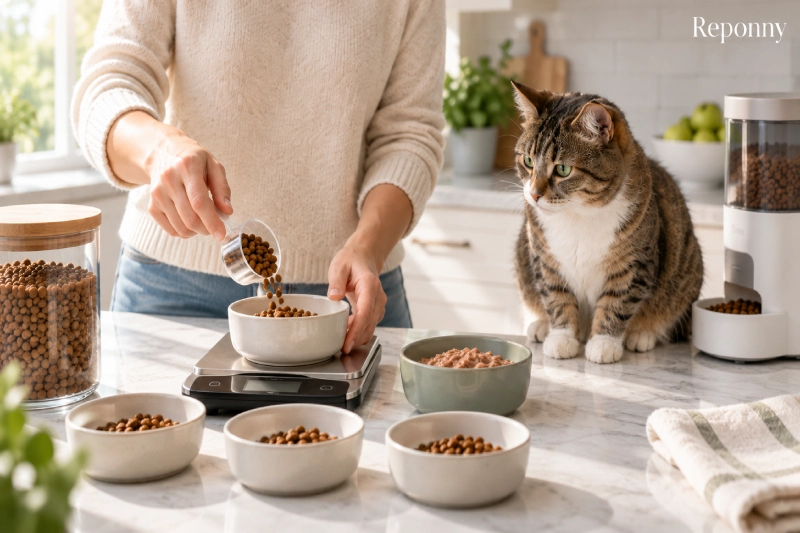
- Measure the correct daily portion.
- Monitor weight and BCS.
- Adjust as needed.
Meal Feeding vs. Free Feeding
For many indoor cats, scheduled portions make calorie control easier.
Cornell notes that free feeding dry food can contribute to overeating and inappropriate weight gain in some cats.
You might divide the daily food into:
breakfast + afternoon meal + dinner
or use an automatic feeder for additional small meals.
Cats naturally tend to prefer multiple small eating opportunities, so scheduled feeding does not have to mean only one giant meal.
The important point is that the daily total remains controlled.
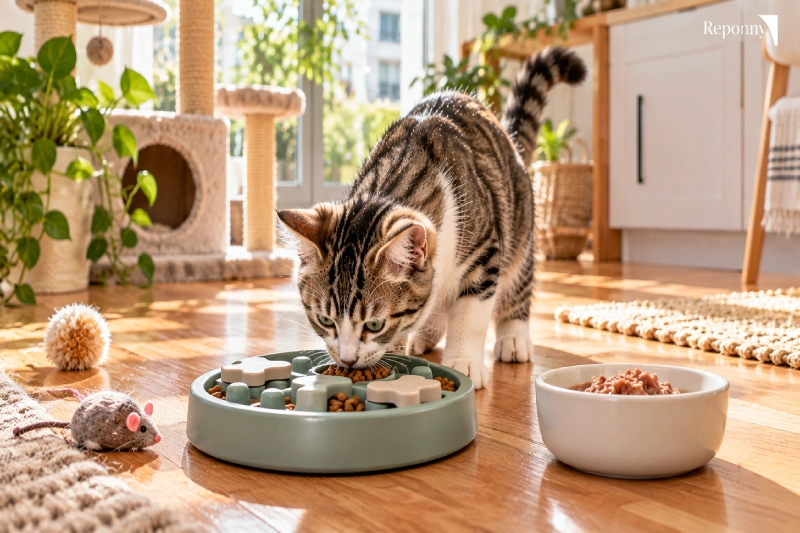
Puzzle feeders can also turn part of the food ration into activity.
Indoor Cats Need Environmental Enrichment Too
You cannot solve every weight problem with food alone.
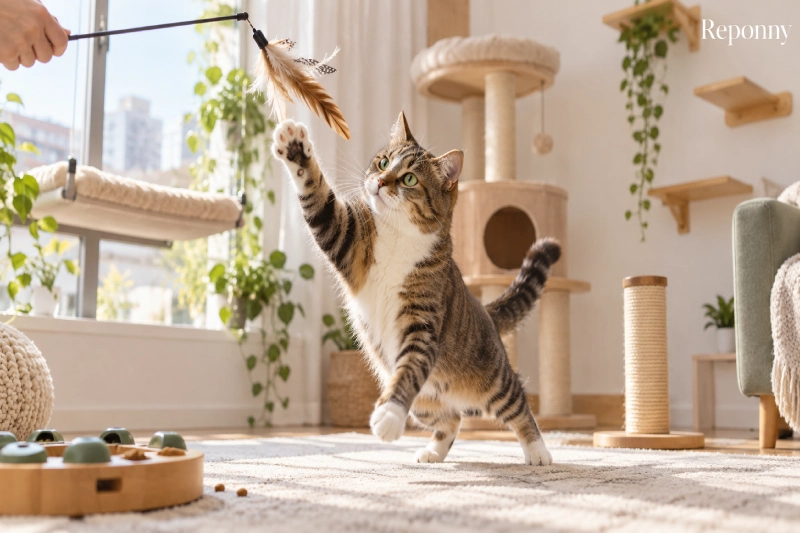
Indoor cats need opportunities to express normal feline behaviors.
Provide:
- climbing spaces,
- scratching surfaces,
- hiding places,
- window viewing areas,
- interactive toys,
- puzzle feeders,
- and short daily play sessions.
Moving more increases energy expenditure, supports muscle, and can reduce boredom.
It may also help prevent owners from using food as the cat’s main source of entertainment.
A treat is not the only way to make an indoor cat happy.
Sometimes a five-minute hunting-style play session is the better reward.
What About Treats?
For an indoor cat with relatively low calorie needs, treat calories can accumulate surprisingly quickly.
All extras should be counted:
- crunchy treats,
- lickable treats,
- cooked chicken,
- tuna,
- toppers,
- table food,
- pill pockets.
A common practical rule is to keep treats to about 10% or less of total daily calories, leaving the overwhelming majority of nutrition to complete and balanced food.
For an overweight indoor cat, using pieces of the normal food ration as rewards can work particularly well.
That provides the reward without adding extra calories.
What Ingredients Should You Look For?
Do not judge indoor cat food solely by whether chicken appears first.
WSAVA cautions that ingredient lists do not reveal the nutritional quality, digestibility, or overall adequacy of the finished diet. More meaningful information includes nutritional adequacy, calories, manufacturer expertise, quality control, and detailed nutrient data.
Instead, prioritize:
Complete and Balanced Nutrition
Look for an appropriate AAFCO nutritional adequacy statement.
Appropriate Protein
Cats require adequate protein and essential amino acids.
Controlled Calories
Especially important for sedentary, neutered, or weight-prone indoor cats.
Appropriate Moisture
Wet food can substantially increase dietary water intake.
Appropriate Fiber
Useful for some weight-control or hairball formulas, but not something to maximize blindly.
Manufacturer Quality
WSAVA recommends considering who formulates the diet, nutritional expertise, quality-control processes, and whether detailed nutrient information is available.
Foods and Claims You Do Not Automatically Need
Indoor cats do not inherently require:
Grain-Free Food
Grain-free does not automatically mean lower calorie, higher protein, or lower carbohydrate.
Organic Food
Organic describes agricultural production, not superior feline nutrition.
Raw Food
Cornell’s updated feeding guidance states that clear health benefits of raw diets have not been demonstrated and highlights infectious-disease risks from bacteria, viruses, and parasites.
Extremely High Protein
Adequate protein matters, but the highest percentage on the shelf is not automatically best.
“Premium” or “Holistic” Labels
WSAVA points out that some marketing terms provide little practical nutritional information.
A plain-looking, well-formulated complete diet may be a better choice than a fashionable product built around marketing claims.
Best Food for an Overweight Indoor Cat
If your indoor cat is already overweight, the goal changes from prevention to controlled weight loss.
Start with veterinary assessment.
Your veterinarian can estimate ideal weight and determine whether another medical problem needs consideration.
A weight-loss plan may include:
- controlled calorie intake,
- a therapeutic weight-management food,
- adequate protein,
- increased activity,
- measured portions,
- restricted treats,
- and regular weighing.
Do not suddenly cut food to an extreme level.
Cornell warns that abrupt starvation in overweight cats can increase the risk of hepatic lipidosis, a serious liver disorder.
Weight loss should be gradual.
Best Food for a Senior Indoor Cat
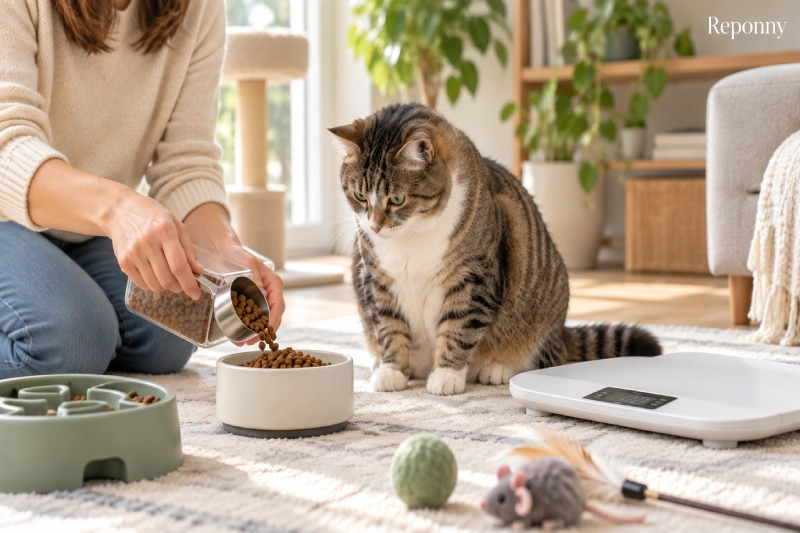
Do not assume every older indoor cat needs fewer calories.
AAHA notes that while mature cats may have lower energy needs, some senior cats over age 10 experience reduced digestive efficiency and may eventually require more calories to maintain healthy body condition.
Senior indoor cats should be monitored for:
- weight loss,
- muscle loss,
- reduced appetite,
- dental problems,
- kidney disease,
- mobility changes,
- and altered drinking.
The best diet may therefore change as the cat ages.
An overweight seven-year-old indoor cat and a thin fourteen-year-old indoor cat should not automatically eat the same “indoor senior” formula.
Individual body and muscle condition matter.
Best Food for a Long-Haired Indoor Cat
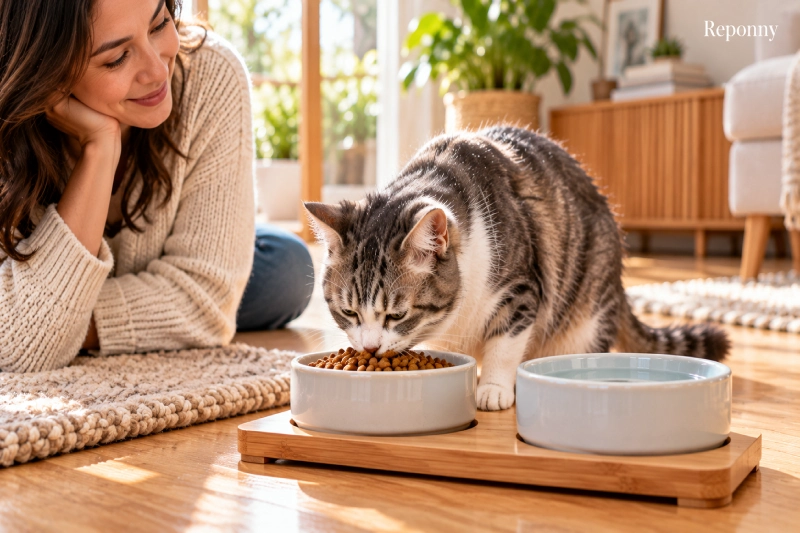
Long-haired indoor cats often raise the biggest hairball concerns.
Food can help, but start with grooming.
Cornell specifically recommends regular—often daily—brushing or combing to remove loose fur before the cat swallows it.
If hairballs remain frequent despite regular grooming, ask your veterinarian whether a complete hairball-control diet with adjusted fiber is appropriate.
Also investigate:
- excessive grooming,
- fleas,
- allergies,
- itchy skin,
- stress,
- and gastrointestinal disease.
A long coat may increase risk, but frequent vomiting still should not simply be dismissed.
How to Choose the Best Indoor Cat Food: 8-Step Checklist
When comparing products, use this order:
| Priority | What to Check |
|---|---|
| 1 | Complete and balanced for the correct life stage |
| 2 | Calories per cup, can, or pouch |
| 3 | Your cat’s current Body Condition Score |
| 4 | Adequate protein and overall nutrient balance |
| 5 | Moisture and drinking habits |
| 6 | Fiber level if hairballs or satiety are concerns |
| 7 | Manufacturer expertise and quality control |
| 8 | Whether your individual cat maintains healthy weight, stool, coat, muscle and appetite |
The word indoor should come after these considerations—not before them.
Frequently Asked Questions
What Is the Best Food for Indoor Cats?
There is no single best food for every indoor cat.
For most healthy adults, choose a complete and balanced adult-maintenance diet, feed an appropriate number of calories, and monitor body and muscle condition.
Do Indoor Cats Need Indoor Cat Food?
No.
“Indoor” is not one of AAFCO’s recognized nutritional life stages. A standard complete adult food may be perfectly appropriate if the calories and nutrient profile suit your cat.
Should Indoor Cat Food Be Lower in Calories?
Many indoor cats have lower activity levels, so calorie control can be important.
AAHA notes that sedentary and indoor cats may need less energy than generalized calorie calculations predict.
But an active indoor cat may require more.
Is Wet Food Better for Indoor Cats?
Wet food can be very useful because it contains substantial moisture—typically around 70–80% according to Cornell.
However, complete and balanced dry food can also be appropriate when portions and hydration are managed correctly.
Is Dry Food Bad for Indoor Cats?
No.
The primary issue is not that dry food is inherently bad.
Problems can occur when calorie-dense kibble is free-fed and the cat consumes more energy than it needs.
Measure portions rather than continually filling the bowl.
What Is Hairball-Control Cat Food?
Hairball diets commonly contain increased or adjusted fiber intended to move swallowed hair through the gastrointestinal tract.
They may help some cats but are not necessary for every indoor cat.
Does High-Fiber Food Stop Hairballs?
Fiber may help reduce hair accumulation, but it is not guaranteed to eliminate hairballs.
Regular grooming is also important, particularly in long-haired cats.
How Often Are Hairballs Normal?
An occasional hairball may occur.
Frequent hairballs, repeated vomiting, appetite changes, weight loss, constipation, or repeated retching warrant veterinary evaluation because another condition may be responsible.
Should Indoor Cats Be Free-Fed?
Some cats regulate free-choice feeding successfully.
Others overeat.
Cornell notes that unlimited access to dry food can contribute to inappropriate weight gain in some cats.
Measured meals make intake easier to monitor.
Should Indoor Cats Eat Grain-Free Food?
There is no general requirement.
Grain-free status does not tell you calories, protein quality, carbohydrate content, or overall nutritional adequacy.
How Do I Know if My Indoor Cat Is Overweight?
Feel the ribs and look for a waist behind them.
Cornell describes approximately 5/9 BCS as ideal. At this condition, ribs remain palpable under a slight fat covering and a waist is visible.
Final Thoughts
The best food for an indoor cat is not necessarily the bag with the largest INDOOR CAT label on the front.
Indoor cats have the same fundamental feline requirement for complete, balanced nutrition as other cats.
What often changes indoors is energy expenditure.
Because many indoor cats move less, receive regular treats, and have easy access to food, calorie control becomes particularly important. AAHA specifically notes that sedentary and indoor cats may require fewer calories than generalized recommendations suggest.
Start by choosing food that is complete and balanced for the correct life stage.
Then look at:
calories, protein, moisture, portion size, fiber, feeding method, and your cat’s body condition.
Wet food can help increase total water intake, while dry food can provide convenience and work well with puzzle feeders. Either can be appropriate when calories are controlled.
For cats with hairballs, fiber-containing hairball diets may help move swallowed hair through the gastrointestinal tract. But food should not be the only strategy. Regular brushing can substantially reduce the amount of loose hair swallowed, and frequent vomiting deserves veterinary attention.
And do not forget the part that no bag of food can provide:
movement and enrichment.
An indoor cat benefits from climbing, chasing, scratching, hunting-style play, puzzle feeding, and daily interaction.
The healthiest indoor feeding strategy therefore combines:
complete nutrition + controlled calories + adequate hydration + regular grooming + enrichment + body-condition monitoring.
That approach is far more useful than simply searching for the word “indoor” on a package.