For most of us, driving is a mundane ritual—a predictable sequence of stoplights, highway lanes, and
morning commutes. We take the asphalt beneath our wheels for granted, expecting guardrails to catch
our slips and paved shoulders to buffer our mistakes.
But in the remote, untamed corners of the globe, the act of driving transforms from a simple means of transit into a white-knuckle game of survival. There are paths on this planet where death doesn’t wait for a major pileup; it sits patiently just an inch away from your tires, separated only by a crumbling ledge or a sudden swell of the tide.
These are not your standard weekend scenic routes.
They are impossible pathways carved out of sheer vertical cliffs, swallowed by furious oceans, or cloaked in impenetrable fog. A single millisecond of distraction, a minor miscalculation of a cornering angle, or a momentary brake fade, and gravity will take care of the rest.
>>In this deep-dive exploration, we strip away the romance of extreme travel and examine the harrowing realities
of the world’s most perilous thoroughfares. Fasten your seatbelt and clear your head—these ten roads
demand absolute concentration.
1. Skippers Canyon Road, New Zealand: Where Insurers Call It Quits
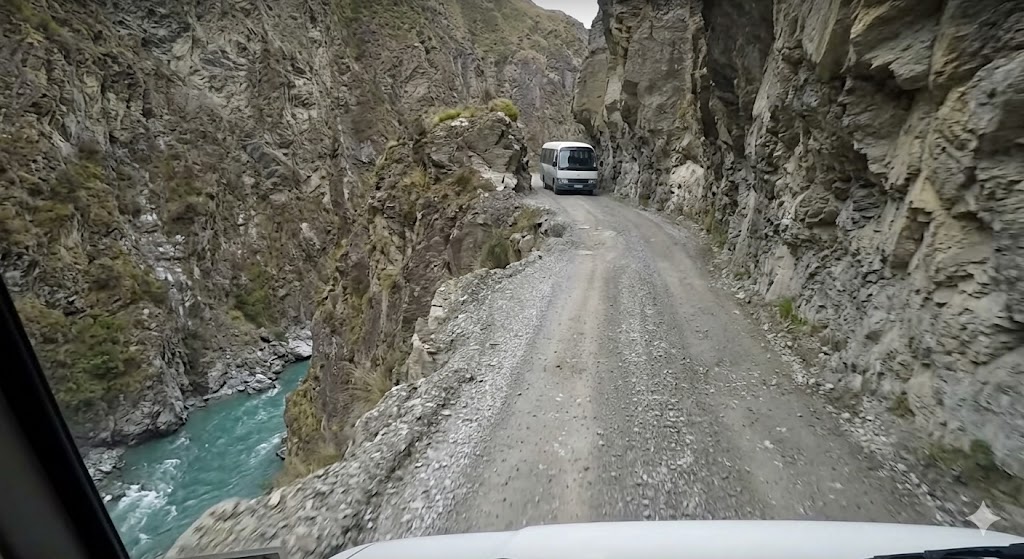
Tucked away in the rugged backcountry of New Zealand’s South Island, Skippers Canyon Road stands as a
terrifying monument to human desperation and greed. Hand-carved out of raw, vertical schist rock by gold
miners in the late 19th century, this bypass was never designed for modern vehicular traffic.
Today, it remains almost entirely unchanged from its treacherous origin: a narrow, unpaved shelf suspended over a dizzying void.
The Pure Terror of the Single-Lane Abyss
What makes Skippers Canyon a psychological meat grinder is its absolute lack of margin for error. The road is
so intensely narrow that passing another vehicle is physically impossible across most of its length.</p>
Should you encounter an oncoming local tour bus or an overconfident off-roader, one of you will be forced to back up for hundreds of meters along an unfenced, crumbling edge.
The Wet-Weather Trap:
The surface is entirely composed of loose shale, fine gravel, and silt. When a light rain hits the canyon,
this mixture instantly transforms into a slick, grease-like slurry, stripping vehicles of traction and
threatening to send them into a catastrophic plunge toward the Shotover River below.
The danger is so widely recognized that it has achieved a legendary status within the global insurance
industry. One hundred percent of standard rental car agreements in New Zealand explicitly state that all
insurance coverage is completely void the moment your tires touch Skippers Canyon Road. If you slide off,
you are entirely on your own.
2. Passage du Gois, France: The Atlantic’s Deceptive Disappearing Act
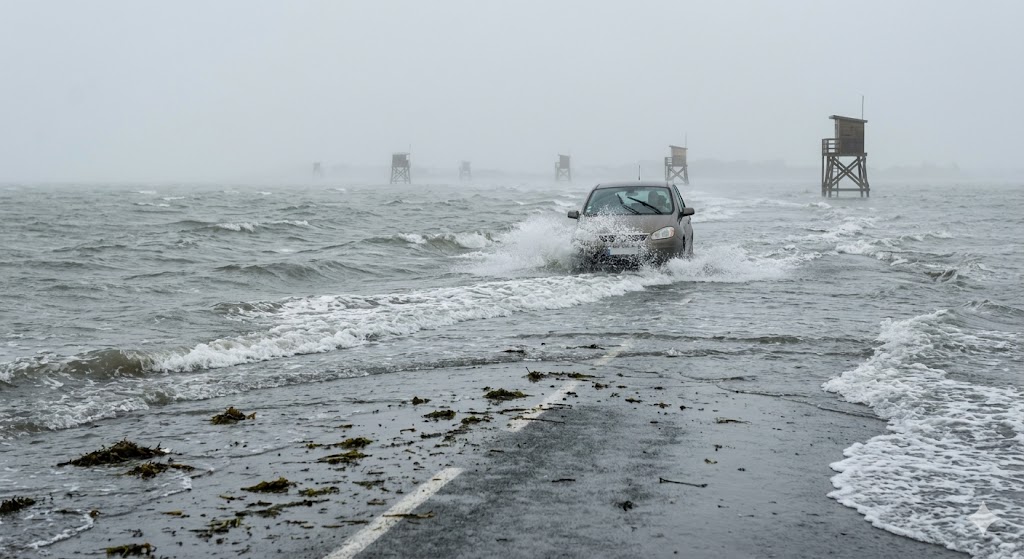
Danger does not always manifest as a sheer drop or a towering mountain peak. On the western Atlantic coast
of France, a 4.3-kilometer stretch of road known as the Passage du Gois connects the mainland to the island
of Noirmoutier. To the uninitiated, it looks like a beautiful, flat coastal causeway.
But beneath its tranquil exterior lies a lethal, fluid trap dictated by the relentless rhythms of the ocean.
A Timed Race Against Rising Swells
Twice every single day, without fail, the Atlantic tide dazes the region, rising rapidly to completely submerge
the entire roadway under several meters of water. Drivers must meticulously calculate their crossing windows
based on strict tidal schedules. Misjudging the schedule by even fifteen minutes can turn a routine coastal
drive into a desperate rescue scenario.
Even when crossed at the mathematically perfect moment, the road surface presents an extreme hazard. As
the water recedes, it leaves behind a thick coating of hyper-slippery marine silt and wet seaweed.</p>
Stepping on the gas or turning too sharply can send a car spinning out of control as if it were on smooth
ice. While the French government has erected elevated wooden rescue towers for stranded drivers to climb, their vehicles are invariably claimed by the sea, turning into expensive salt-water casualties.
3. Patiopoulo-Perdikaki Road, Greece: A High-Altitude Leap of Faith
 <
<
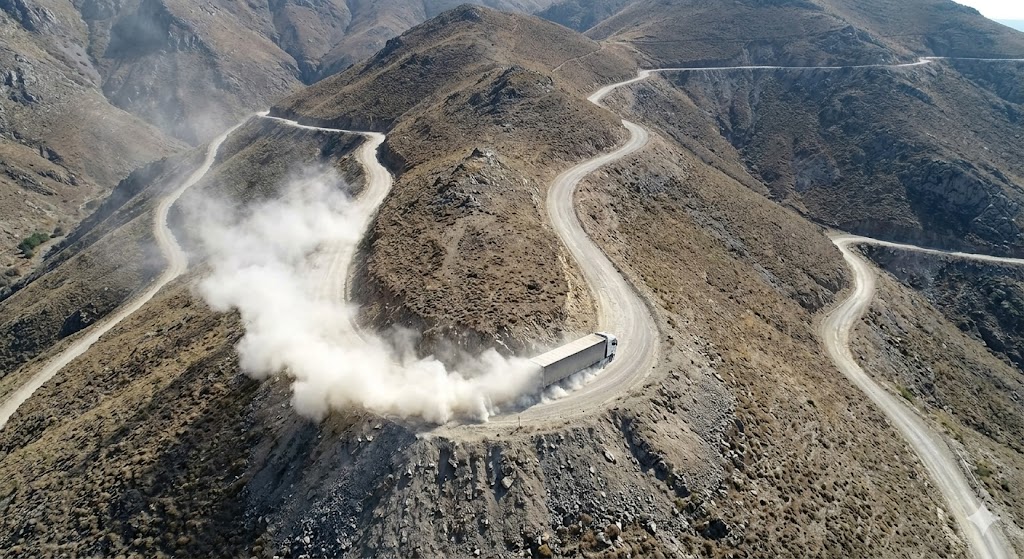
Meandering through the mountainous Agrafa region of Greece, the Patiopoulo-Perdikaki road looks from a
distance like a beautiful, delicate silk ribbon draped across the craggy peaks.
Up close, however, that poetic illusion vanishes, replaced by a 23.5-kilometer nightmare characterized by extreme elevation changes, missing infrastructure, and zero safety features.
Blind Corners and Choking Dust Clouds
This mountain pass climbs violently from an altitude of 700 meters to over 1,100 meters via a relentless
sequence of hairpins. The defining characteristic of this route is the total absence of guardrails or barrier
walls. A single instance of oversteering or a momentary lapse in steering control will result in an uninterrupted
tumble down a steep, rocky precipice.
Compounding the structural danger is the raw nature of the road itself. There is no asphalt here; the track
consists entirely of rough dirt, potholes, and unstable gravel.
During the dry summer months, passing heavy transport trucks kick up massive, blinding clouds of fine dust that hang in the stagnant mountain air, completely obliterating visibility.
Drivers are frequently forced to navigate sharp corners blindly, relying on sheer luck to avoid driving off the edge into the waiting void.
4. North Yungas Road, Bolivia: The Infamous “Death Road”
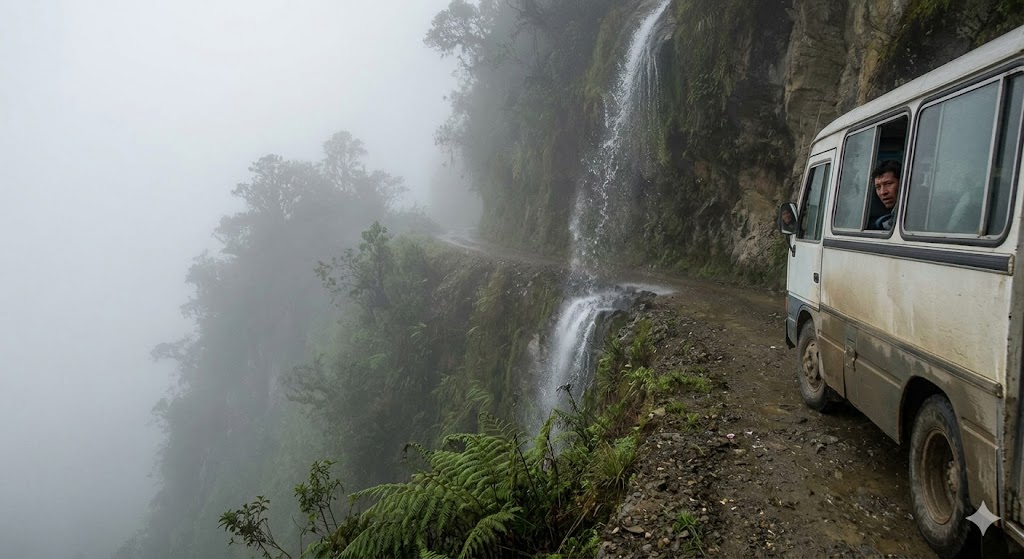
No international compilation of dangerous infrastructure can ever be complete without mentioning Bolivia’s notorious North Yungas Road.
Earning the grim title of the “World’s Most Dangerous Road” by the Inter-American Development Bank in the 1990s, this path serves as a stark reminder of how geography can weaponize against human transport.
The Chilling Psychological Pressure of Local Rules
Connecting the high-altitude capital of La Paz to the Amazonian rainforest region of the Yungas, this track
drops over 3,500 meters in a span of just 60 kilometers. As you descend from the frigid Altiplano into the
humid valleys, the paved road gives way to a single-lane dirt track carved directly out of the cliffside.
The drops are vertical, extending up to 600 meters down into an abyss covered by deceptively lush green ferns.
To survive, drivers must adhere to a highly unusual local traffic rule: the downhill driver must always stay on
the outer edge of the cliff to give uphill drivers the safer inside wall.
This means that if you are descending the pass, your left tires will be inches from a catastrophic drop, forcing you to look straight down into the chasm through your driver-side window. When the unpredictable Andean fog rolls in, reducing visibility to less than two meters, driving here feels like stepping directly into the afterlife.
5. Zoji La Pass, India: The Himalayan High-Wire Act
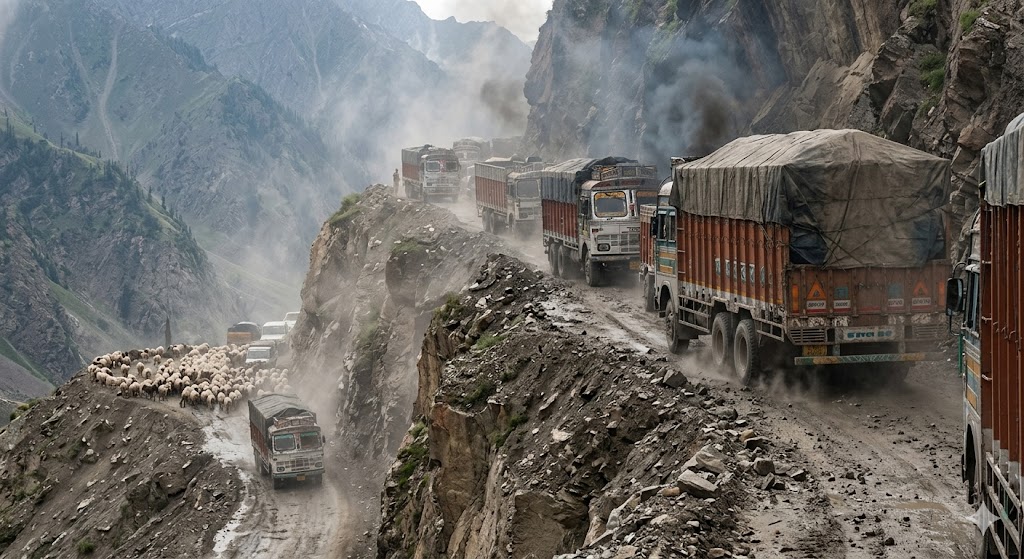
Situated at a staggering altitude of 3,528 meters (11,575 feet) above sea level, the Zoji La Pass is a critical yet
terrifying mountain lifeline in the Western Himalayas.
This unpaved 9.5-kilometer ledge cuts through brutal rock faces to link the valley of Kashmir with the high, arid plains of Ladakh.
Combating Thin Air and Heavy Convoys
The hazards of Zoji La are multi-layered. Before a driver even faces the physical geometry of the road, they
must contend with the physiological effects of acute altitude sickness.
The thin air reduces oxygen saturation, inducing headaches, dizziness, and dulled reflexes—a lethal state of mind when navigating a road with no guardrails and vertical drops of over a thousand meters.
The Connoisseur’s Nightmare:
This is a vital commercial and military corridor, meaning you are never alone. The narrow ledge is
constantly packed with massive, smoke-belching commercial trucks. When two heavy trucks meet on a
bend, one is forced to back up to the absolute edge of the precipice, their rear tires kicking loose stone
into the empty air below.
Furthermore, the pass is heavily prone to sudden, violent snowstorms and mudslides that can strand
hundreds of vehicles in freezing temperatures for days
on end. It is a place where human willpower is tested to
its absolute breaking point against the raw power of the Himalayas.
6. Fairy Meadows Track, Pakistan: A Deadly Gamble for Paradise\
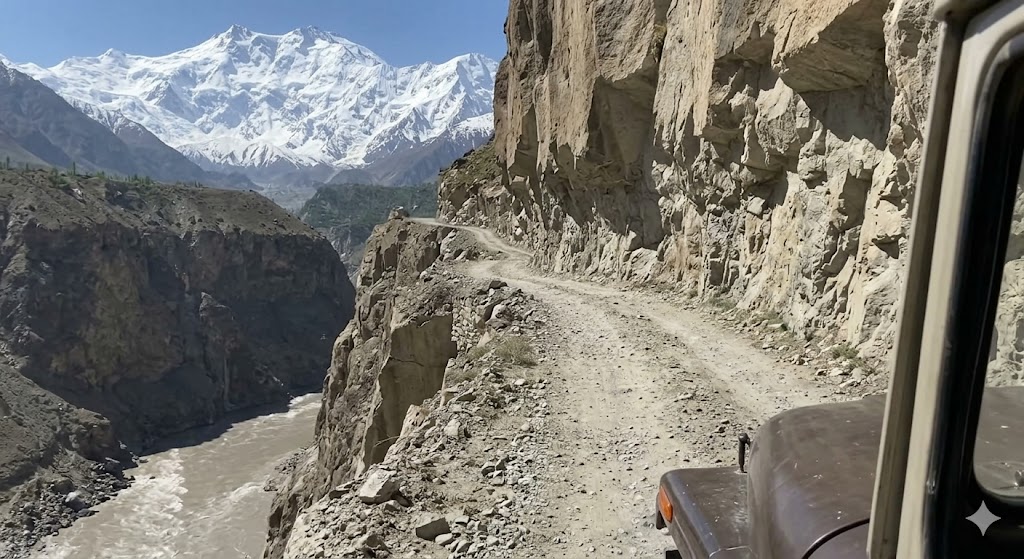
Don’t let the whimsical, fairy-tale name fool you; the road to Fairy Meadows in Pakistan is an absolute gauntlet
of terror. Located at the base of Nanga Parbat—the ninth highest mountain in the world, ominously dubbed
the “Killer Mountain”—this 16-kilometer mountain track is entirely unpaved, unstable, and unforgiving.
Hand-Carved Ledges Over the Roaring Indus
What makes the Fairy Meadows track uniquely terrifying is its primitive construction. It was hacked out of the
sheer limestone cliffs decades ago by the bare hands of local villagers using basic tools. No government
entity maintains this road, meaning there are no retaining walls, no asphalt, and absolutely zero safety
barriers.
The path is so narrow that it is strictly restricted to small local four-wheel-drive Jeeps driven by locals who
possess a near-supernatural familiarity with the terrain.
As the ancient Jeep rattles along the loose gravel, passengers look directly down out of the uncurtained windows at a vertical drop leading down to the turbulent,muddy waters of the Indus River. The constant vibration of the engine echoes off the canyon walls, creating a suffocating atmosphere of pure suspense where a single blown tire means instant death.
7. Tianmen Mountain Road, China: The 99-Bend Dragon
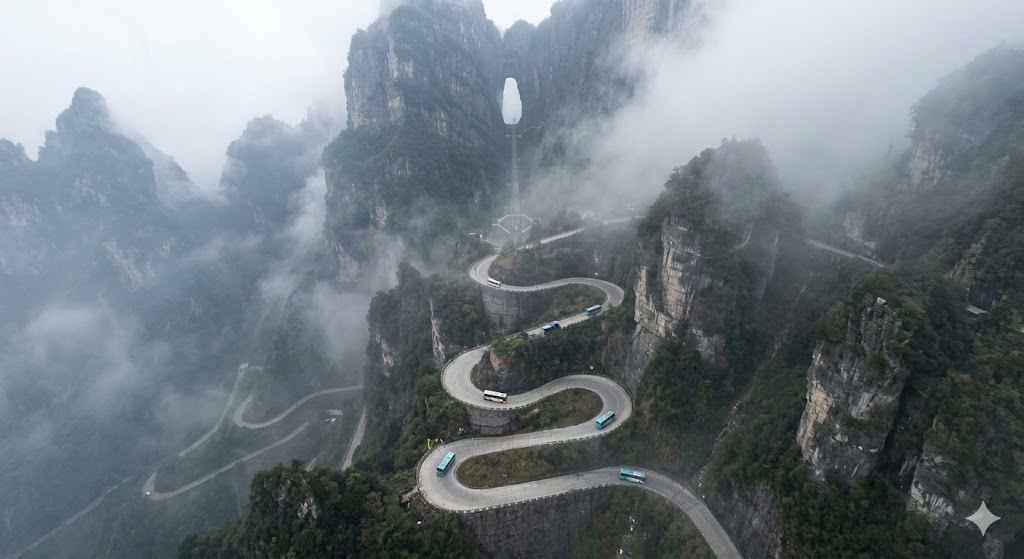
Located inside the world-famous Tianmen Mountain National Park in Hunan Province, China, this architectural
marvel is a dizzying assault on a driver’s vestibular system. Spanning a brief 11 kilometers, the Tianmen
Mountain Road contains exactly 99 sharp, continuous hairpin turns as it snakes its way up to the legendary
“Heaven’s Gate” cave.
The War on Brakes and Equilibrium
From an aerial perspective, the road resembles a giant, twisting dragon draped across the vertical limestone
karst landscape. The danger here does not stem from a lack of infrastructure—the road is perfectly paved and
features solid concrete barriers—but rather from the relentless, intense physical demands placed on both
vehicle and driver.
The elevation rockets upwards from 200 meters to 1,300 meters over an incredibly short distance. Drivers
must transition instantly from a hard U-shaped left turn directly into a blinding right turn, over and over again.
This constant, aggressive cornering puts immense thermal stress on a vehicle’s braking system and tires. If a
driver experiences brake fade due to overheated pads, the concrete barriers will do little to prevent the vehicle
from ricocheting or flipping over on the steep slopes
Navigating these curves while dodging aggressive local tourist buses requires surgical precision and flawless stamina.
8. Eyre Highway, Australia: The Hypnotic Desert Trap
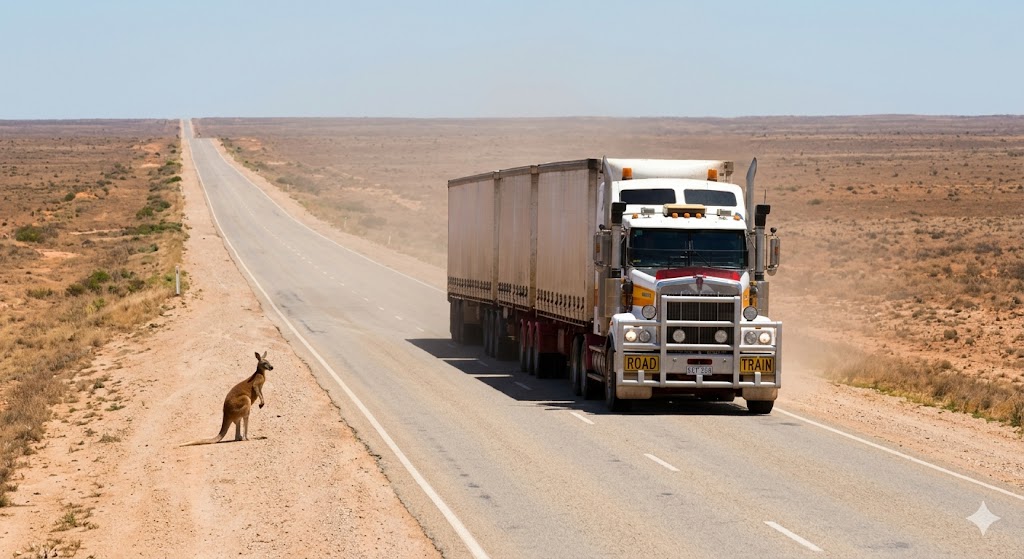
To the untrained eye, Australia’s Eyre Highway looks like the safest road on earth. Cutting through the vast,
featureless Nullarbor Plain—a name derived from the Latin terms meaning “no trees”—this highway is
completely flat, flawlessly paved, and contains the famous “90-Mile Straight,” a 146.6-kilometer stretch of
asphalt without a single bend. Yet, it ranks among the country’s deadliest stretches of tarmac.
The Silent Killer of Absolute Monotony
The hazard here is entirely psychological. The utter lack of visual stimuli, combined with the shimmering,
oppressive desert heat rising off the road surface, acts as a powerful hypnotic agent. Drivers quickly succumb
to “highway hypnosis” or sudden microsleeps without even realizing their cognitive functions are shutting
down.
The silence is shattered only by the arrival of the true beasts of the Australian outback: “Road Trains.” These
are massive prime movers pulling up to four heavy freight trailers, measuring over 50 meters in length and
weighing hundreds of tons. When a road train blasts past a car at 100 km/h, the resulting displacement of air
creates a violent vortex that can instantly suck a vehicle off the road or flip a caravan.
Combined with the constant hazard of giant red kangaroos leaping blindly across the tarmac at dusk, the Eyre Highway proves that straight roads can be just as lethal as mountain passes.
9. Halsema Highway, Philippines: Crystalline Views and Blinding Fog
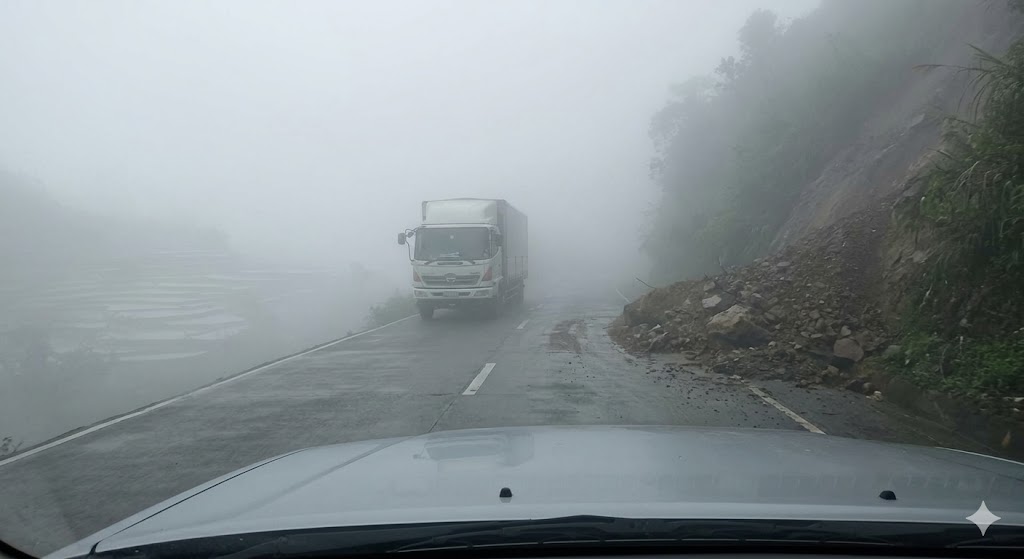
Stretching through the Central Cordillera mountain range of Luzon island, the Halsema Highway peaks at an
altitude of over 2,200 meters above sea level, making it the highest highway system in the Philippines. While it
serves as a critical agricultural artery for transporting fresh vegetables to the lowlands, it is a treacherous
route that has claimed countless lives.
Pea-Soup Fog and Sudden Landslides
The primary weapon of the Halsema Highway is its unpredictable, hyper-dense mountain fog. At a moment’s
notice, the clear tropical air can vanish, replaced by a thick, pea-soup mist that reduces visibility to less than a<br />meter. Drivers are suddenly forced to operate completely blind, unable to see oncoming traffic or the
unbarricaded drops flanking the outer lane.
Furthermore, the region is highly geologically unstable and experiences intense typhoons. Heavy rainfall
routinely triggers massive, catastrophic landslides.
Entire sections of the mountain can give way without warning, sending boulders crashing down onto the roofs of passing vehicles or washing the road itself down into the valleys below. It is a route where you must constantly look both down at the cliff and up at the
tumbling rocks above.
10. Karakoram Highway, China & Pakistan: The Volatile Eighth Wonder
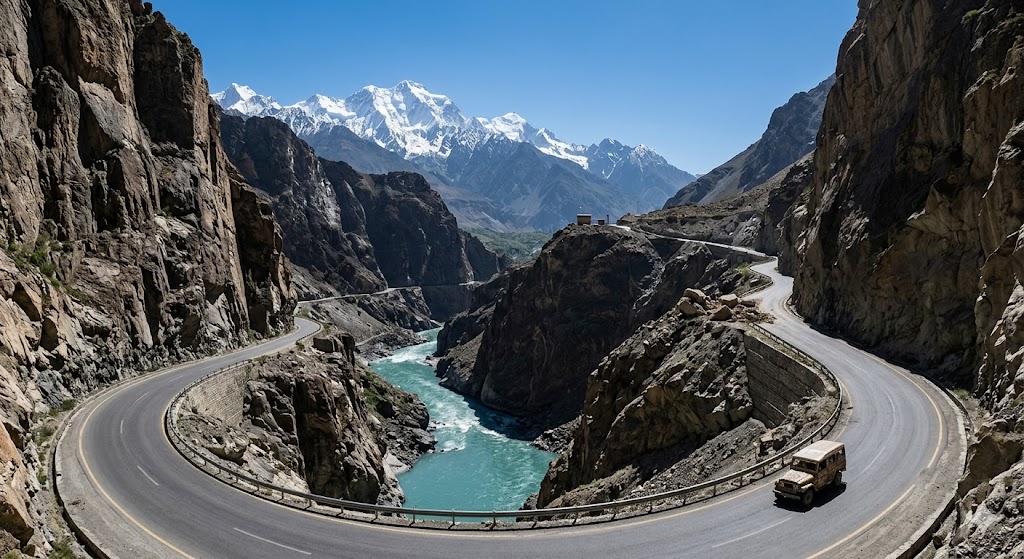
Connecting Pakistan with China across the spectacular Karakoram mountain range through the Khunjerab
Pass, the Karakoram Highway (KKH) is the highest paved international road on the planet, topping out at
4,693 meters (15,397 feet).
It is an engineering marvel that cost the lives of over a thousand workers during its decades-long construction.
A Multi-Threat Gauntlet of Nature and Humanity
Driving the KKH is an exercise in extreme resilience. The road forces drivers to navigate through deep, dark
gorges where the sun rarely penetrates, flanked by unstable shale cliffs that drop rocks onto the pavement
with alarming frequency.
Drivers face severe risks of acute hypoxia due to the extreme altitude, making clear
decision-making difficult.
Beyond the formidable environmental hazards of avalanches, flash floods, and glacier movements, the
highway presents human security risks.
Because it passes through highly remote and geopolitically sensitive
border territories, certain desolate stretches have historically been plagued by banditry and localized militant activity.
Traveling the Karakoram Highway requires not just a highly capable four-wheel-drive vehicle and a
mountain-tested nervous system, but a deep respect for the sheer scale and unpredictability of the Karakoram
mountains.
The Ultimate Extreme Driving Survival Protocol
If fate or an insatiable thirst for adventure ever forces you to log miles on these hazardous routes,
survival boils down to a few non-negotiable principles:
- Mechanical Perfection is Mandatory: A minor fluid leak or a slightly worn brake pad that goes
unnoticed in a city will fail catastrophically under the intense thermal and mechanical stresses of a
mo
- untain pass. Your brakes, tires, and cooling systems must be flawless.
- Ego is a Lethal Liability: These roads do not care about your driving skills or your confidence. Defer
to local rules completely. If local custom demands that you stop and hug a cliff face to let an old truck
pass, you do it without hesitation.
- Hire a Local Expert: There is zero shame in relinquishing the steering wheel. Local drivers possess
an intuitive, battle-tested understanding of the specific potholes, weather patterns, and blind spots
unique to their home terrain. Let them handle the survival, while you focus on making it back alive.